Exercise 1: Influential books

Consider the importance of books to you both personally and within a broader global sense.

First of all, think back to the earliest books you came across as a child, through your teenage years and early adulthood to where you are now. There may be half a dozen books which stick in your memory or are important to you in some way. There may be many more than that. It may be an early reading book, a particular image or short rhyme which helped you recognise letterforms. It may be the distressed metallic silver cover of a Salinger novel you read as a teenager, or the book you bought on impulse after work one day, seduced by the tactile quality of the cover.

Identify these books in your learning log, use photographs and annotation to create an illustrated list documenting the books that are important to you, for whatever reason.

Now, connect your influential books to those with a more global reach. Identify seminal works that have informed or challenged some of the areas you have identified. These may be scientific, artistic, historical, political, geographic, fictional, poetic or religious texts. For example, a book from your childhood could connect to other seminal children’s books by association, such as Heinrich Hoffmann’s Der Struwwelpeter / Shockheaded Peter (1845) or Charles Perrault or the Brothers Grimm. Likewise a book featuring dinosaurs might connect to Charles Darwin’s Origin of the Species.

When we appreciate the breadth and influence of books, we begin to appreciate the extent of a book’s potential impact. Books carry and communicate ideas; powerful messages can be contained within seemingly innocuous bound paper pages. In your learning log, create another list of books, with accompanying images and annotations, which you believe to be more globally important, but connect to your first list in some way.

This activity will feed into your first assignment, so document your ideas in your sketchbooks and learning log to refer back to later.

Researches

Books have always played an essential role in my life. Once I even thought to connect my profession with literature, to engage in a more detailed study of classics and contemporaries that to analyse their works. But later my main interest was in drawing and design, reading become just a hobby. During my school years at the summer holidays, according to the program, we were asked to read at least 60 books on foreign and Ukrainian literature. After all, we had to analyse and write an essay or review for all these works, so it was important to get acquainted with each work personally. I found all the necessary materials in the local and school libraries, at neighbours, friends, or in-home archives, and I did not mind spending another hour reading the book. I enjoyed the tactile connection with the book, turning the pages, always paying attention to what kind of binding was in the book, hard or soft, the quality and colour of the paper, and the smell of book sheets. I read some of the books because I should have known them according to the program, but some books are etched into my memory to this day.

Over time, e-books began to replace printed publications, more and more services began to appear for listening to audiobooks or loading books into an electronic version, which is more economical and ergonomic. In the modern world, a home library is a rarer phenomenon than, compared to 20 years ago when each house had a separate chest of drawers for books. Many book lovers still prefer a printed book to an e-book, but even for myself, I noticed that my last literature purchases were books on design, psychology or recipes, which should always be at hand. New books I read in e- option, faster ordering and no need to store printed copies on shelves in the house.

It was interesting for me to go over the books that impressed me since childhood. Since the age of 6, I have enjoyed immersing myself in fairy tales and children’s stories by such authors as The Brothers Grimm, Hans Christian Andersen, Korney Chukovsky, Charles Perrault, Lewis Carroll. Over time, when I began to grow up, I switched myself to more serious novels, such as “Angelica” by Ann and Serge Gollon, “Robinson Crusoe” by Daniel Defoe, “Anna Karenina” by Leo Tolstoy, “Children of Captain Grant” by Jules Verne, “Notre Dame Cathedral” Victor Hugo, “Crime and Punishment” Fyodor Dostoevsky, etc.

Oddly enough, the modern editions, the books I read as an adult were not that significant or influential for me. The book was already perceived more as a source of information than an authority. Still, I found authors who caught my attention, “Sapiens. A Brief History of Humanity” Yuval Noah Harari, “Eat, Pray, Love” by Elizabeth Gilbert, “Shantaram” by Gregory David Roberts and many others.

Walt Disney Big Dictionary

This was my first book on English, published back in 1993. It mainly consisted of vivid illustrations of cartoon characters with numerous words in Russian and their translation. The book was hardcover, large and very pleasant to study, and I always wanted to return to it. As a child, I considered this book quite difficult, despite the easy-to-learn English words, in my understanding it was a separate science, and the first window into the world of a foreign language, which I did not know at that time. But still, I liked to scroll through it, study the illustrations, the emotions that it conveyed.

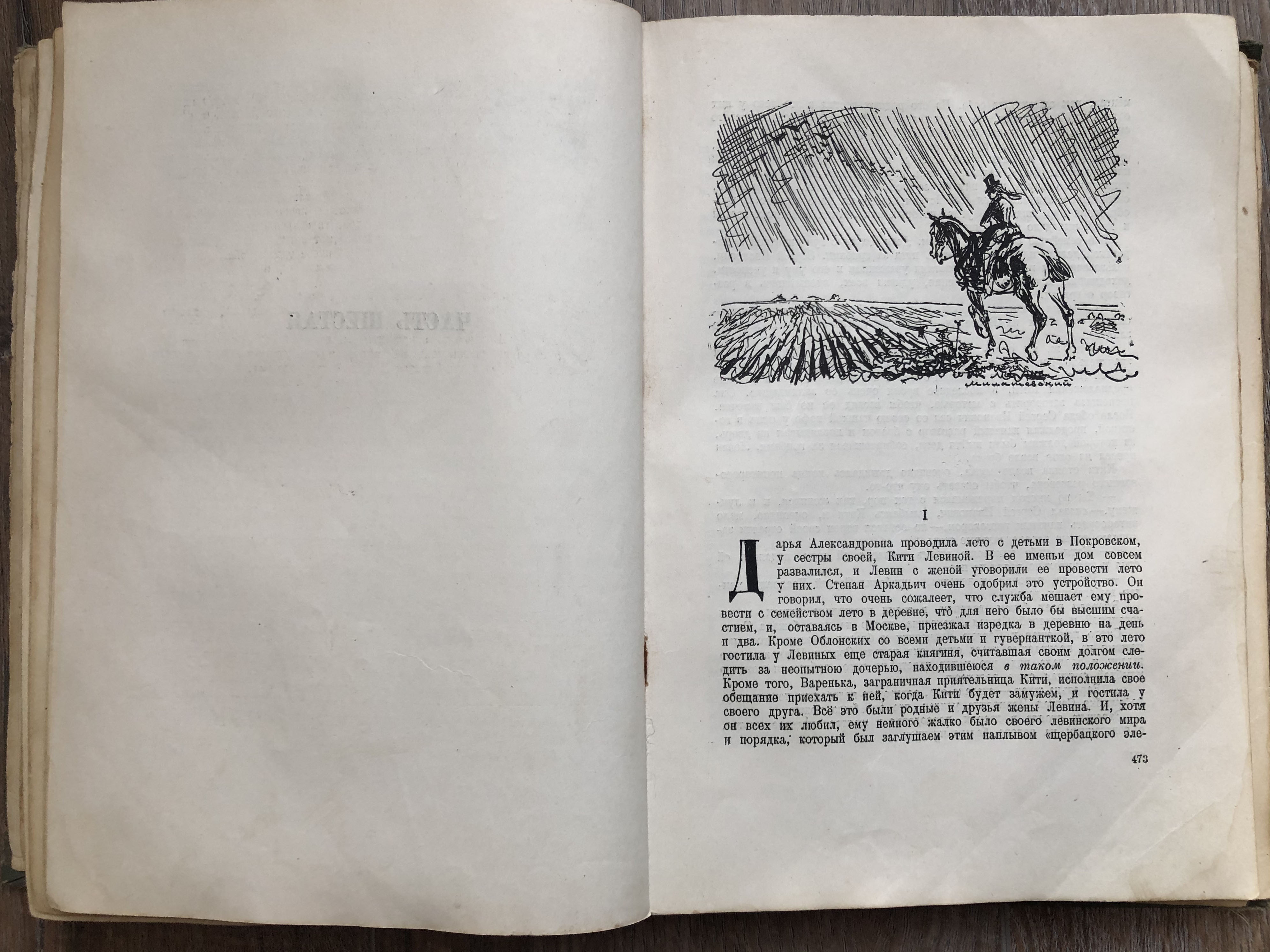
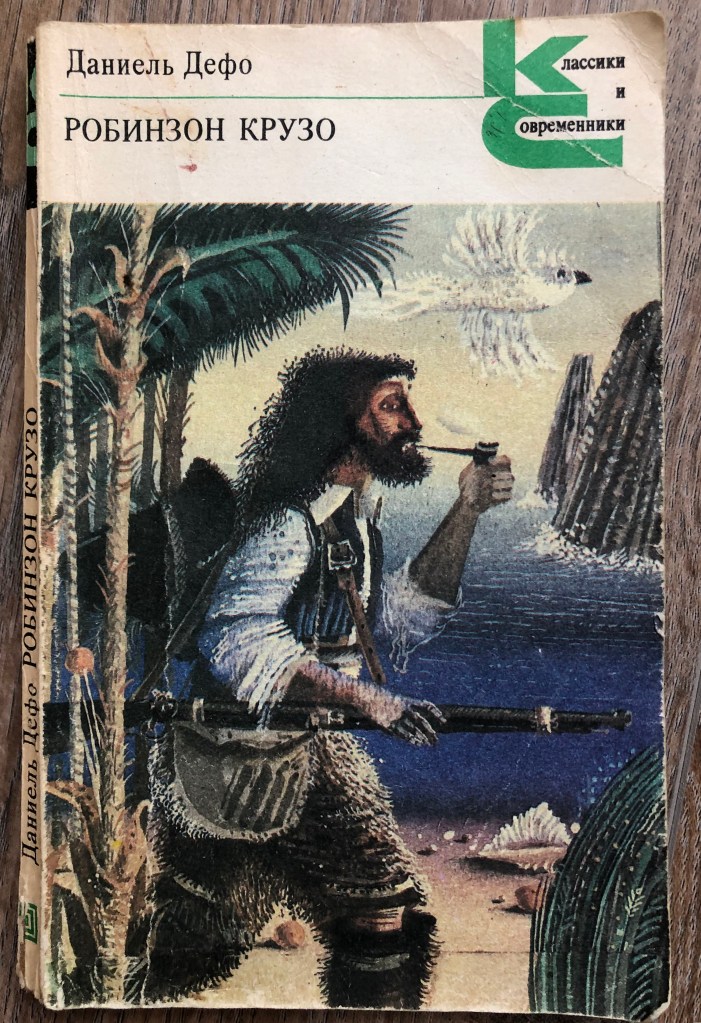
Robinson Crusoe. Daniel Defoe

Why is this book important to me? Probably because it was the first discovery of the world of travel and distant islands. Many in childhood would dream of getting to a distant green island, overgrown with palm trees and the singing of wild birds. In my understanding, this book is a visual narration of how fortitude and a thirst for adventure can change a person’s life, the ability to find a way out of a situation. I think this story served as the beginning of my perception of the territory of the Earth, full of mysterious and exotic places, perhaps that is why I dreamed of getting to a distant island from an early age. At the first opportunity, I made a trip to the Maldives and Seychelles. Of course, this was all filled with comfort, compared to the tests that fell to the lot of Robinson, but I was still able to experience the very fact of being on a distant island in the middle of the ocean.

The cover of this book was soft and inside contained some black and white sketches of the work. Another example is that a book can be discreet in design, but the content carries some meaning that makes it memorable.
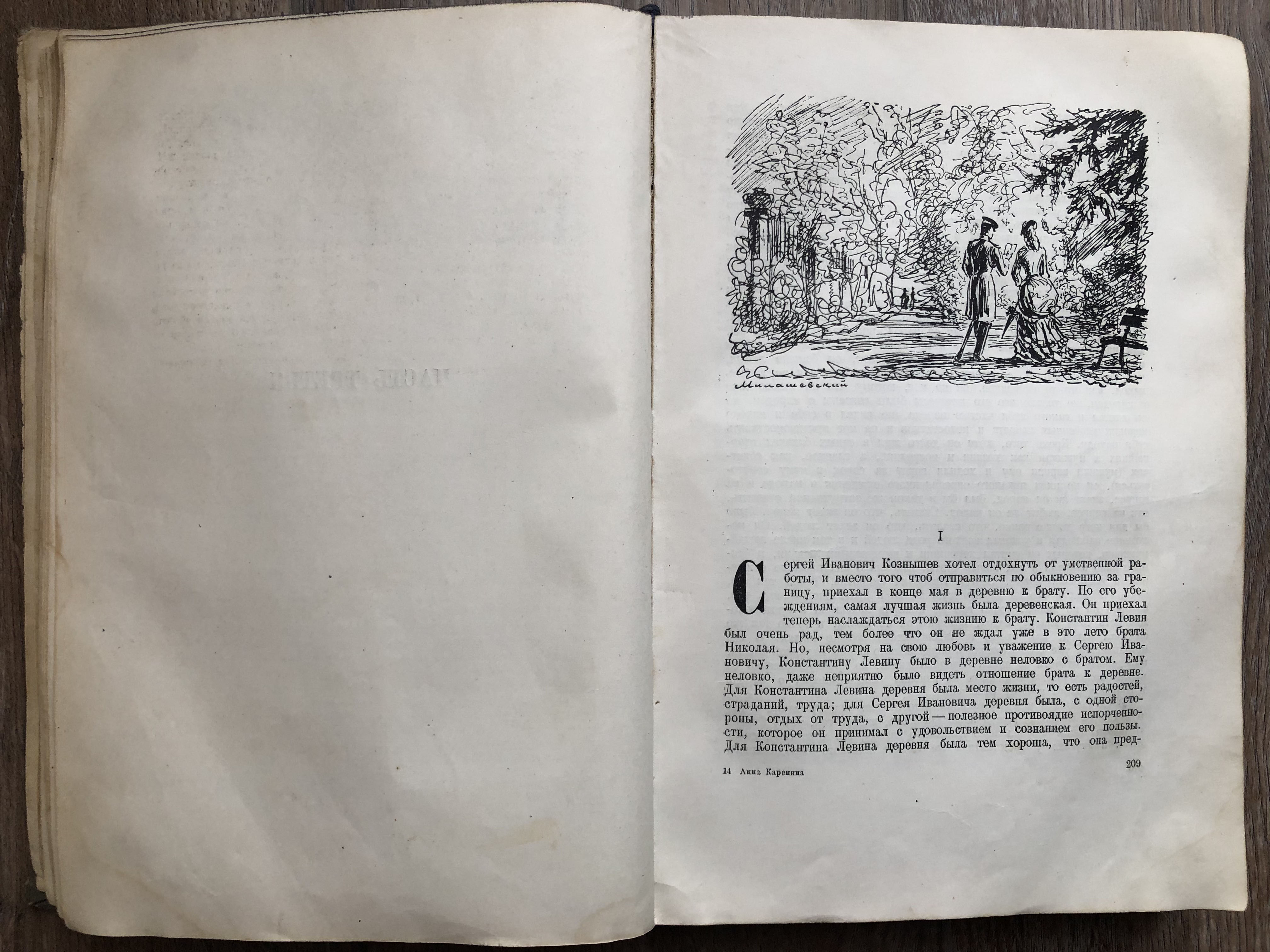
Anna Karenina. Leo Tolstoy

The peculiarity of this book is that I read it at a more mature age, and the publication itself dates back to 1939. The book is voluminous, similar to those that were previously stored in libraries, printed with some of the old printing technologies. The cover in it is hard and a little dull, but that is why this book seemed to be the most tempting to read, it seemed to me that this novel contains a part of history and culture, inside there were pictures in black and white, and in general, it tells a spiritual and tragic story, which will not leave anyone indifferent.
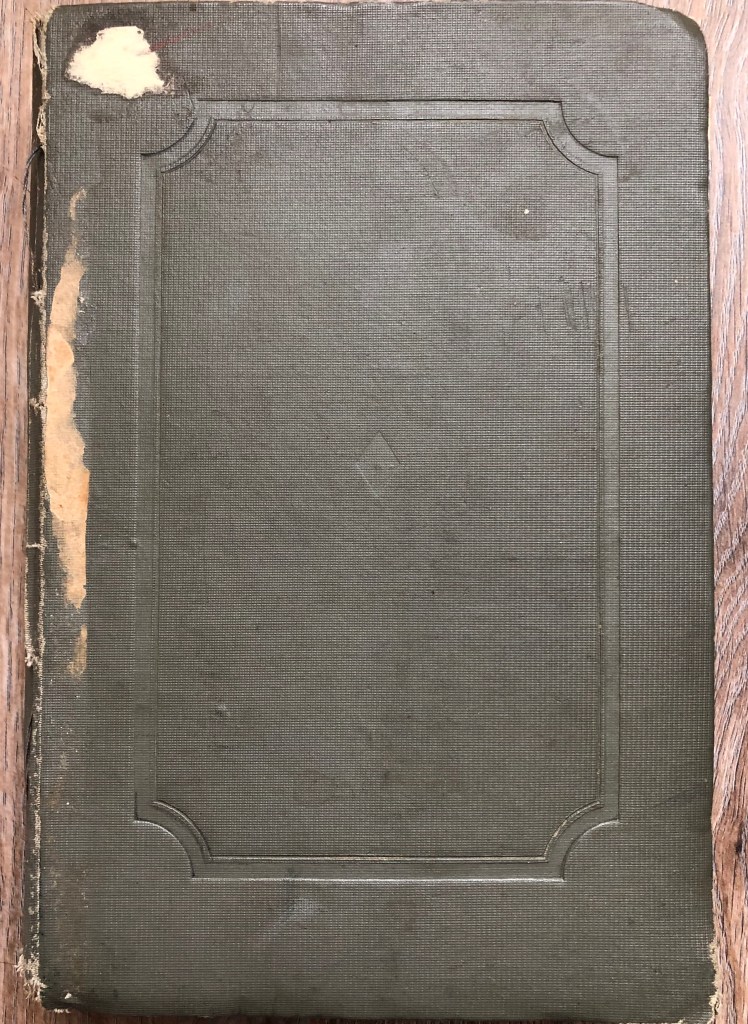
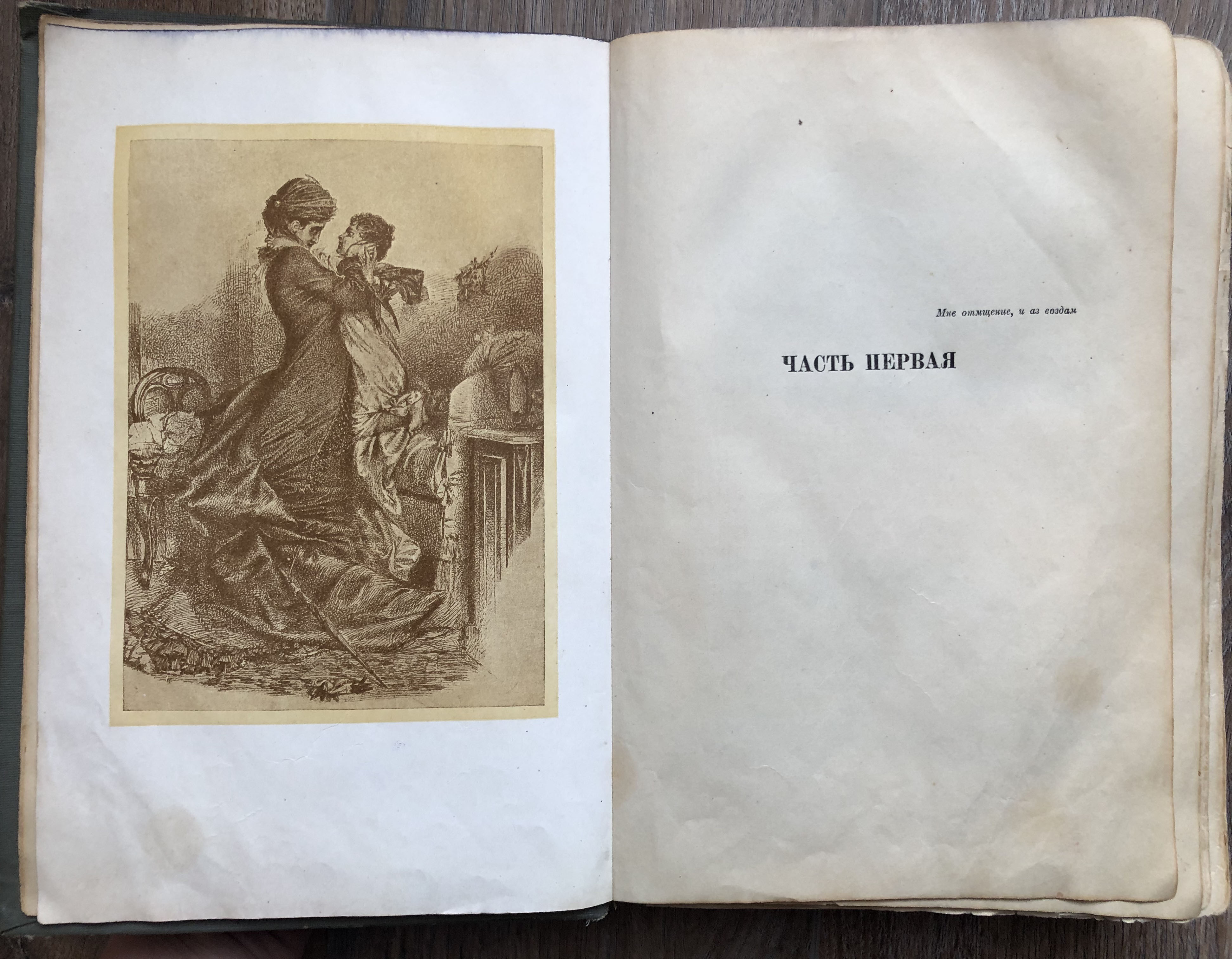
Fig. 3 Anna Karenina. Leo Tolstoy (1936) Home Library

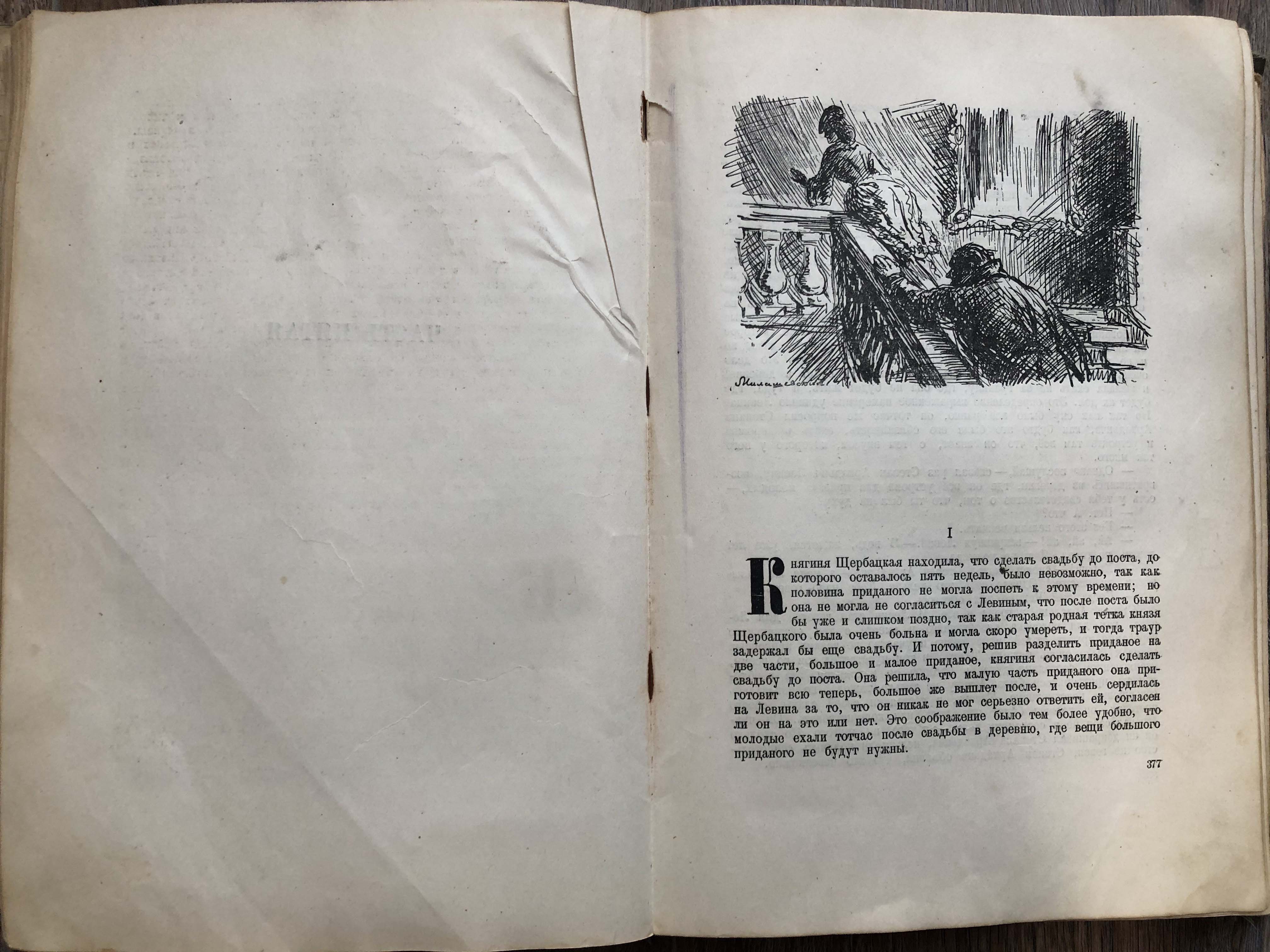
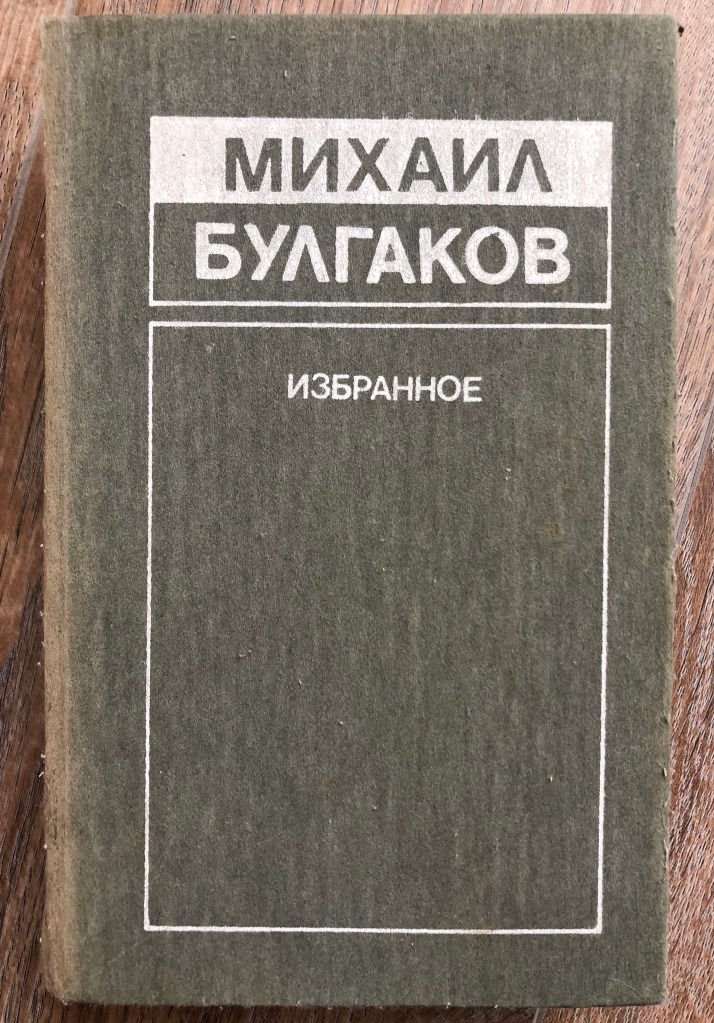
Master and Margarita. Mikhail Bulgakov

I read this copy of the Soviet Union Edition, when it was important to make the cover necessarily hardcover, with minimal decorative filling, and the colours of the covers also varied from dark green, burgundy, grey, the book was supposed to make a solid impression, without any tempting illustrations and registration. I confess I understood this novel only from the third run, the story is very deep and multifaceted, also thick, about 500 pages.
Sapiens. A Brief History of Humankind. Noah Harari

This is one of the modern books that I read about 3 years ago. I was attracted by the title of the book, it describes the theory of the origin of man on Earth, how evolution developed, it touches on parts of psychology, history and geography, and human knowledge. If you look at the design and design of the book, then the cover already has a more modern look, a paperback with a small illustration of a fingerprint on a light background. Inside, the author has placed several pages of B history museums and sketches, and the paper itself for reading the pages is whiter and smoother than the books I read at an earlier age.

Shantaram. Gregory David Roberts.

Although in fact, the novel itself takes place in more remote corners of Bombay, in the slums, the book tells the details of the gangster part of India.

Also an example of contemporary literature, a soft, catchy cover with a contrasting print. In general, I noticed that modern authors prefer to place some kind of image or photo, collage on the cover of a book. Restrained and monochromatic thick bindings are no longer as popular as they used to be. It is interesting for me to analyse this book in the sense that when you look at the cover and the beautiful title, the cover exudes a calm and cultural part of India, the Taj Mahal.

Fig. 5 Sapiens. A Brief History of Humankind. Noah Harari At: https://www.amazon.com (Accessed 24/11/2020) Fig.6 Shantaram. Gregory David Roberts. At: https://www.livelib.ru/book/1000329470-shantaram-gregori-devid-roberts (Accessed 24/11/2020)

Connection with global reach
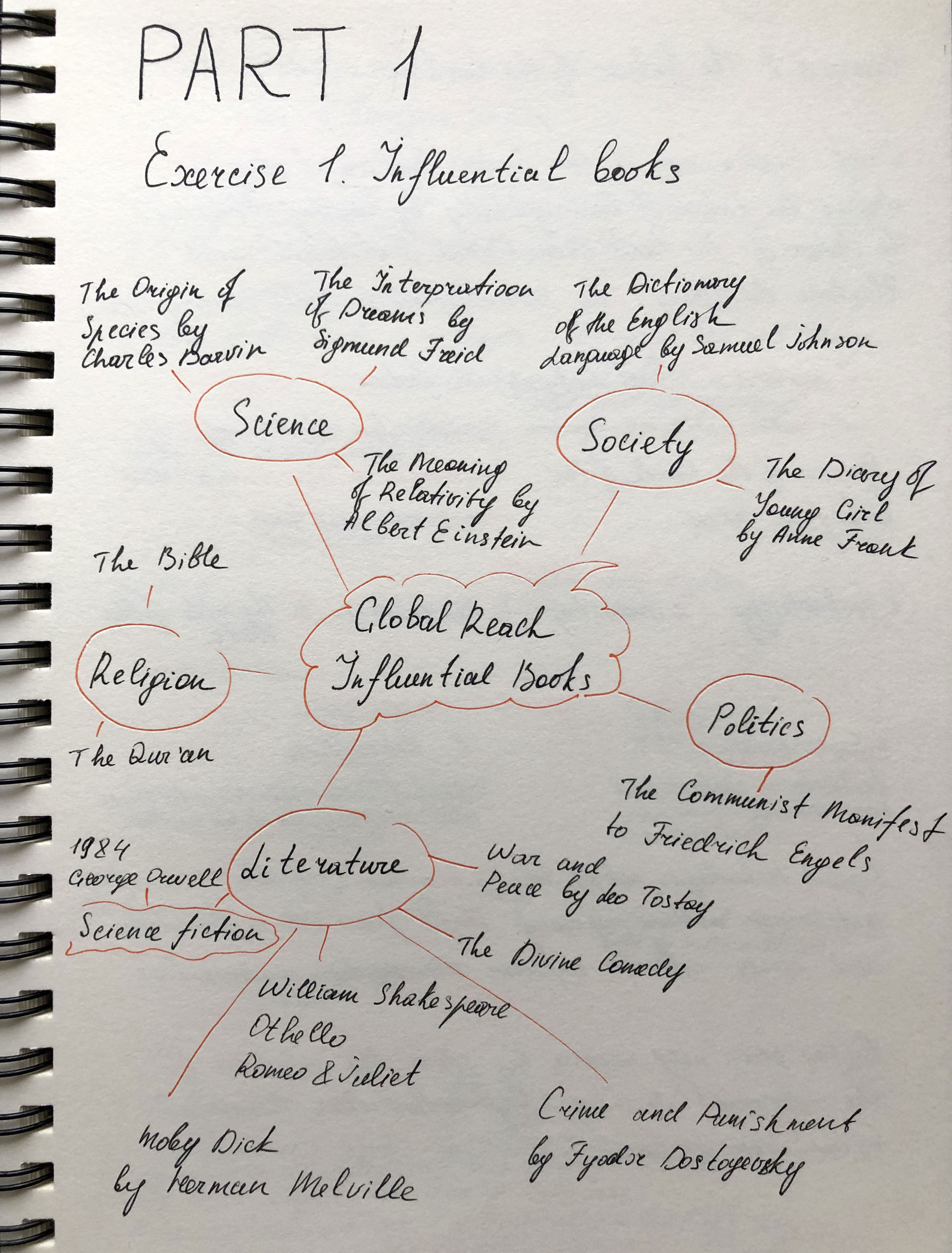
To understand how the above books are related to books on a world scale, I first decided to look through the list of those very famous books. They turned out to be at least 100 works from the field of science, psychology, history, sociology and also classical literature. In the Mind Map, I introduced books that I was familiar with personally, with which I crossed paths in one way or another, according to the same school curriculum.

Walt Disney Big Dictionary translation of the famous American edition of Walt Disney Productions, 1971. One of the best picture dictionaries of the English language for children, based on the famous cartoons Disney characters speak English and Russian. The dictionary is compiled on a thematic basis and allows children to learn the words that their American peers master in the first years of their lives. I see the connection of this book with A Dictionary of the English Language by Samuel Johnson, considered the most influential dictionary of the English language. Credited as the foundational text for the study of the English language and lexicography, Johnson’s dictionary was not the first of its kind, but it was the most comprehensive and well-researched.

Robinson Crusoe. Daniel Defoe’s novel became a literary sensation and spawned many imitations. He demonstrated the inexhaustible possibilities of man in the development of nature and in the struggle against a hostile world. This message was very consonant with the ideology of early capitalism and the Enlightenment.
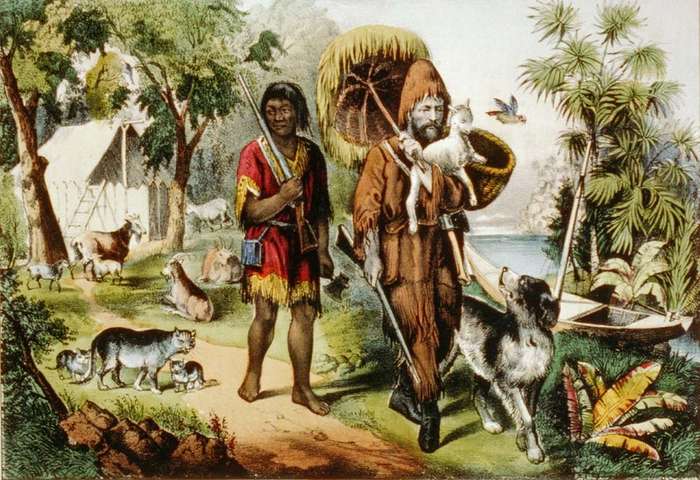
The name of the protagonist Robinson Crusoe has become a household name, a kind of “survivor symbol.” But was Robinson the first survivor of world culture? I can see the connection of this book with many films that were produced in modern times. But the origins of Robinsonade coming from the ancient story “Tale of Haye, the son of Yakzan”, which was written in the Middle Ages, in the XII century. Its author is the Arab poet Ibn Tufal. The book tells the story of a boy who has been living in the wild on the island since his birth. A lama helps him to survive, which feeds him with her milk. From the plot of this Arab story, we can conclude that the motives of “Robinson Crusoe” and “Mowgli” intersect in it. Many motives of “Robinson Crusoe” are intertwined with the story of Ibn Tufal.

Anna Karenina, novel by Leo Tolstoy, published in instalments between 1875 and 1877 and considered one of the pinnacles of world literature. Indeed, too many readers, including Tolstoy himself, it signalled a radical shift in the already impressive history of the novel as a literary form. With its sweeping and complex plot lines, subtle characterisations, and blend of romance and social commentary, Anna Karenina is often mentioned in the same breath as Cervantes’s Don Quixote (1605) and Laurence Sterne’s The Life and Opinions of Tristram Shandy (1759-1767), both of which have permanently altered and defined the novel. Indeed, these books reset the standard for novel writing. In the final and tragic act of Anna’s suicide, readers recognise the theme that Tolstoy has been building towards: Anna’s love, like that of Shakespeare’s Desdemona or Thomas.

The Master and Margarita is now recognised as one of the finest achievements in 20th-century Russian literature. Witty and ribald, the novel is at the same time a penetrating philosophical work that wrestles with profound and eternal problems of good and evil. By turns a searing satire of Soviet life, a religious allegory to rival Johann Wolfgang von Goethe’s Faust, and an untamed burlesque fantasy, this is a novel of laughter and terror, of freedom and bondage.

Sapiens: A Brief History of Humankind. The book surveys the history of humankind from the evolution of archaic human species in the Stone Age up to the twenty-first century, focusing on Homo sapiens. Harari’s concept of a “cognitive revolution” reminded me of he Origin of Species by Means of Natural Selection, Charles Darwin. This work by Darwin laid out the foundation for the theory of evolution. Since its publication, the book’s theories and observations have helped make life sciences what they are today. Darwin’s adaptation and evolutionary model still aid modern scientists as they build a better understanding of all Earth’s species, including our own.

Shantaram is a novel by Gregory David Roberts, in which a convicted Australian bank robber and heroin addict escapes from Pentridge Prison and flees to India. The novel is commended by many for its vivid portrayal of tumultuous life in Bombay.

Stepping away from stories about life in prison and instead focusing on books that have similar writing styles to Shantaram, The Alchemist by Paulo Coelho is undoubtedly a great book to read for lovers of Shantaram. The main plot is taken from European folklore: according to the classification of folklore plots by Aarne-Thompson-Uther – plot 1645 “Treasure of the House“. A typical representative is the English fairy tale “The Pedlar of Swaffham” (“The dream of a peddler”), as well as one of the episodes of “A Thousand and One Nights“.

Conclusion

The task in my understanding turned out to be very interesting and informative, I have always paid special attention to books and world literature, here you could find out the opinions of other authors, plunge into the research or fictional world of writers. So, thanks to a little research, I was able to draw a parallel of some of my favourite works with stories written in ancient times. So for myself, I was able to connect such works as Robinson Crusoe and Mowgli, or Anna Karenina with the works of Shakespeare, and in the bark of the book The Master and Margarita, there is a similar story of Faust. Hope my introductory research will help me with my first assignment.

Materials:

https://en.wikipedia.org/wiki/Robinson_Crusoe

https://en.wikipedia.org/wiki/Anna_Karenina

https://www.encyclopedia.com/arts/educational-magazines/anna-karenina#:~:text=FURTHER%20READING-,INTRODUCTION,novel%20as%20a%20literary%20form.

https://en.wikipedia.org/wiki/The_Alchemist_(novel)

http://sonic.net/~rteeter/grtinfluential.html
Exercise: Lorum Ipsum

Lorem Ipsum is dummy text with more-or-less normal distribution of letters that makes it look like readable English. It has been used for many years and some desktop publishing packages now use it as their default model text. If you don’t have it already, go to http://www.lipsum.com and generate as much as you need. Now select one of the designs from your research that you like and think works. Using the dummy text, try and copy the layout and design as closely as possible. You will need to measure the margins and column widths. If you don’t have the exact typeface get as near as you can. If you are copying a page that includes photographs just leave 10% tinted boxes to indicate their position. Is the type serif or sans serif? Is the text set ragged or justified? Are there spaces after paragraphs or are new paragraphs indented? How many columns are there to a page? What happens when you alter the fonts, change the alignment, adjust the leading or tracking? Now try another, a different publication from your collection.
OCA. Core Concepts

Start

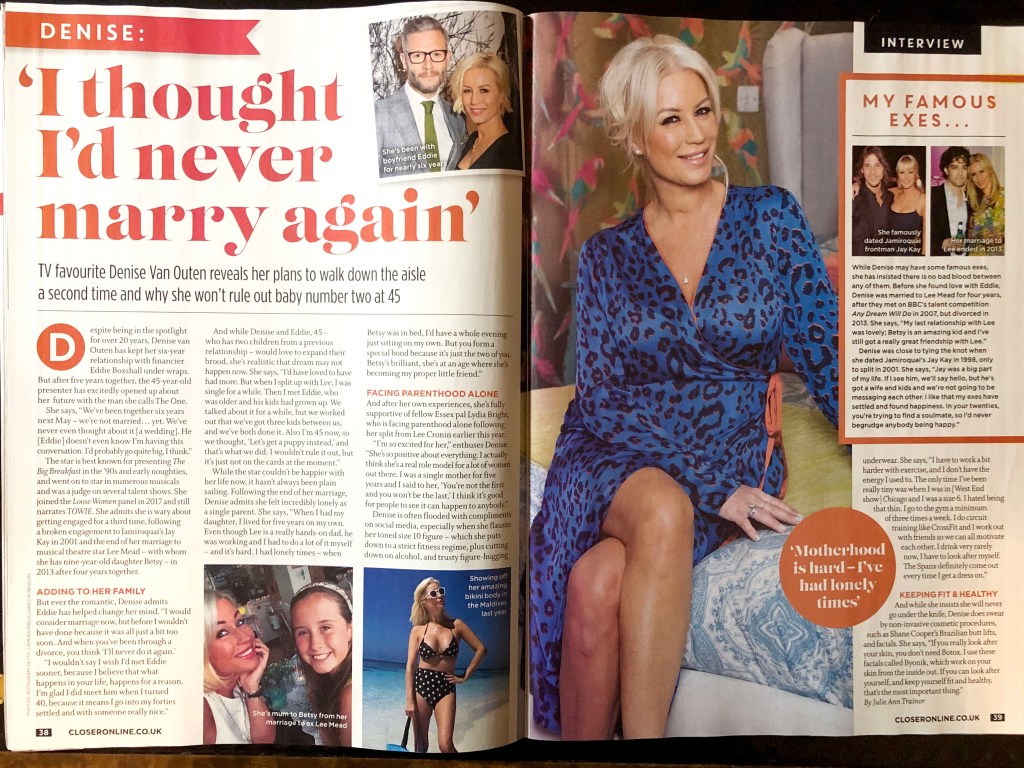
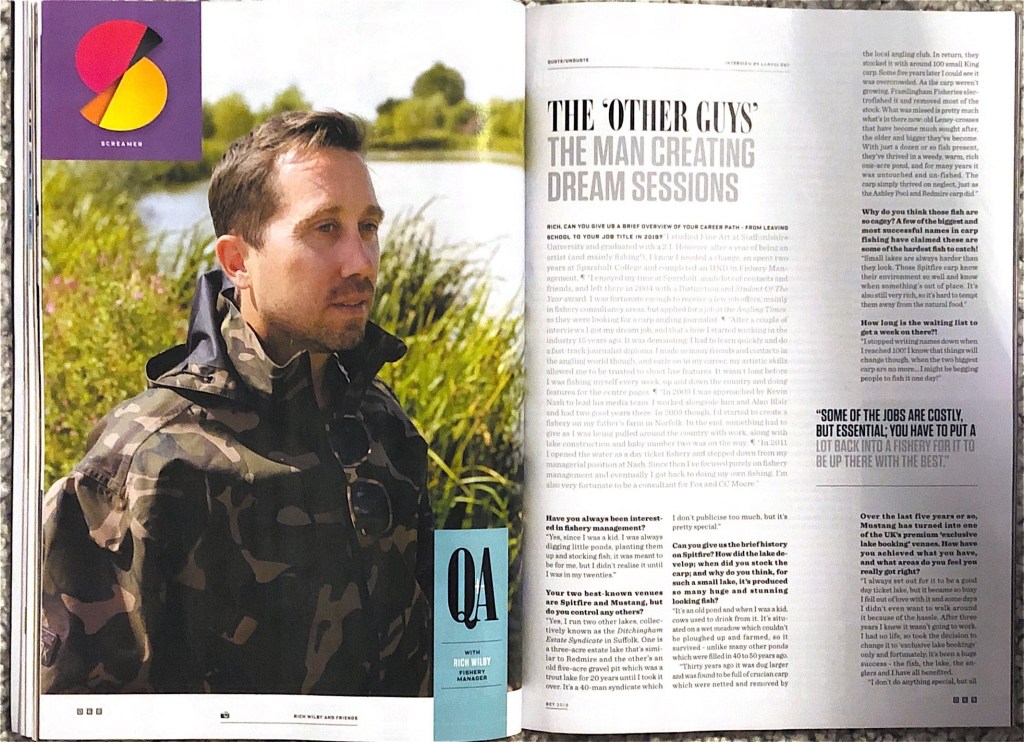
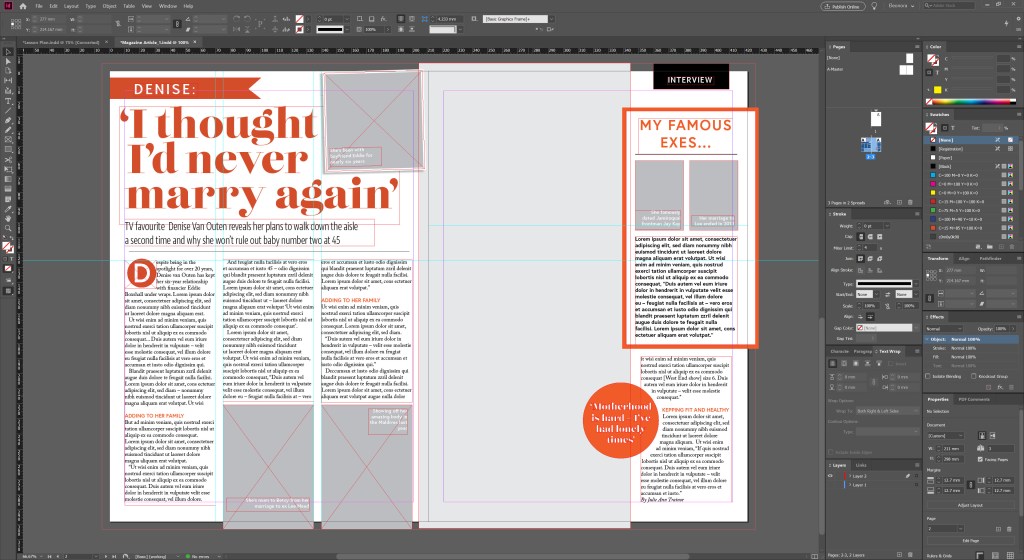
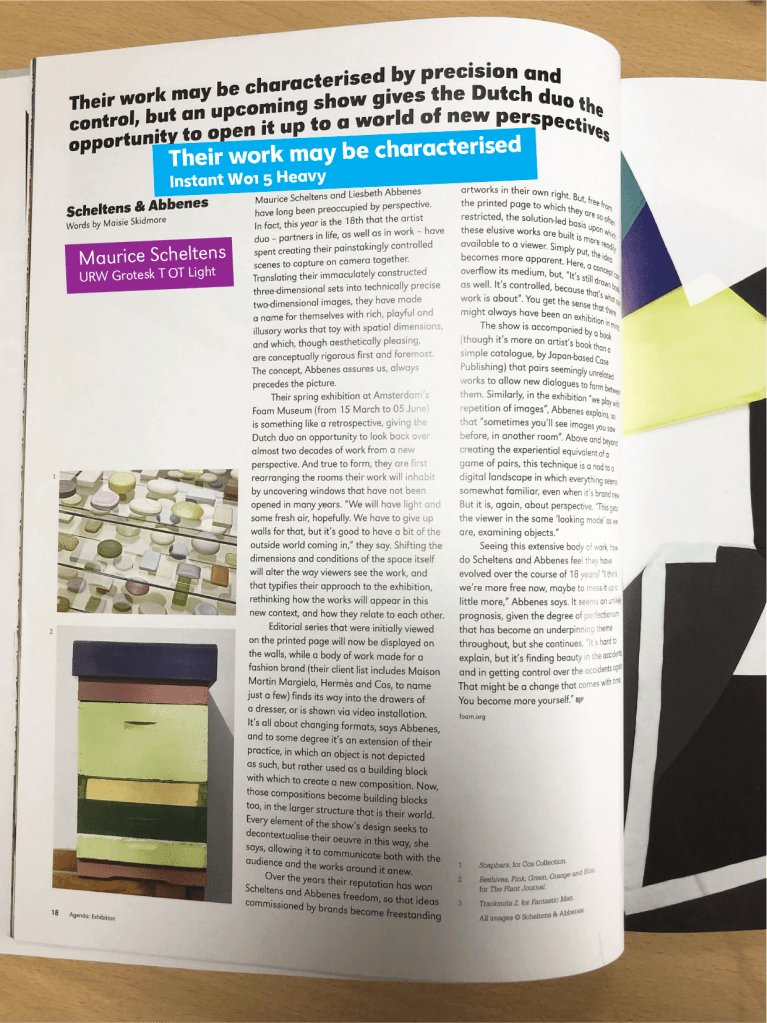
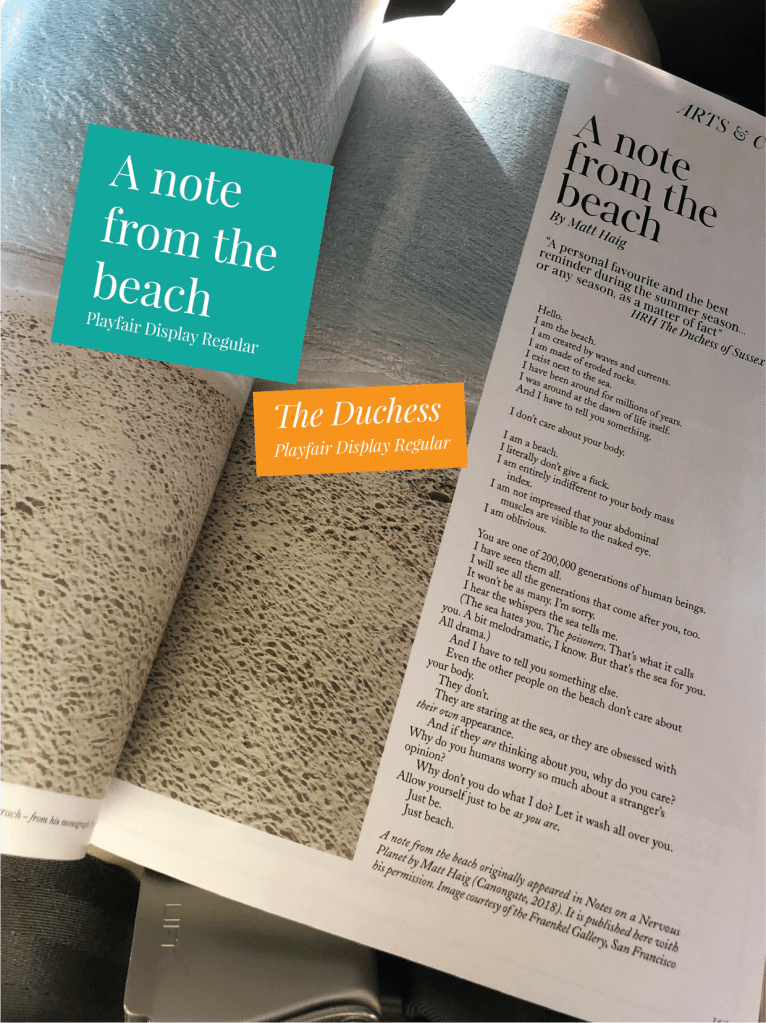
After analysing this exercise, I understood that it was a continuation of the previous task, where I tried to collect different examples and samples of layouts from newspapers and magazines. Once again I went through all the samples that would have brought my attention to a more detailed analysis. So, in my archive, there were two designs that I would like to display in this part. The first one from the magazine Closer, and the second, oddly enough, the magazine about fishing Carpology, which in my opinion turned out to be quite creative and interesting in the combination of fonts and composition.

Sketches
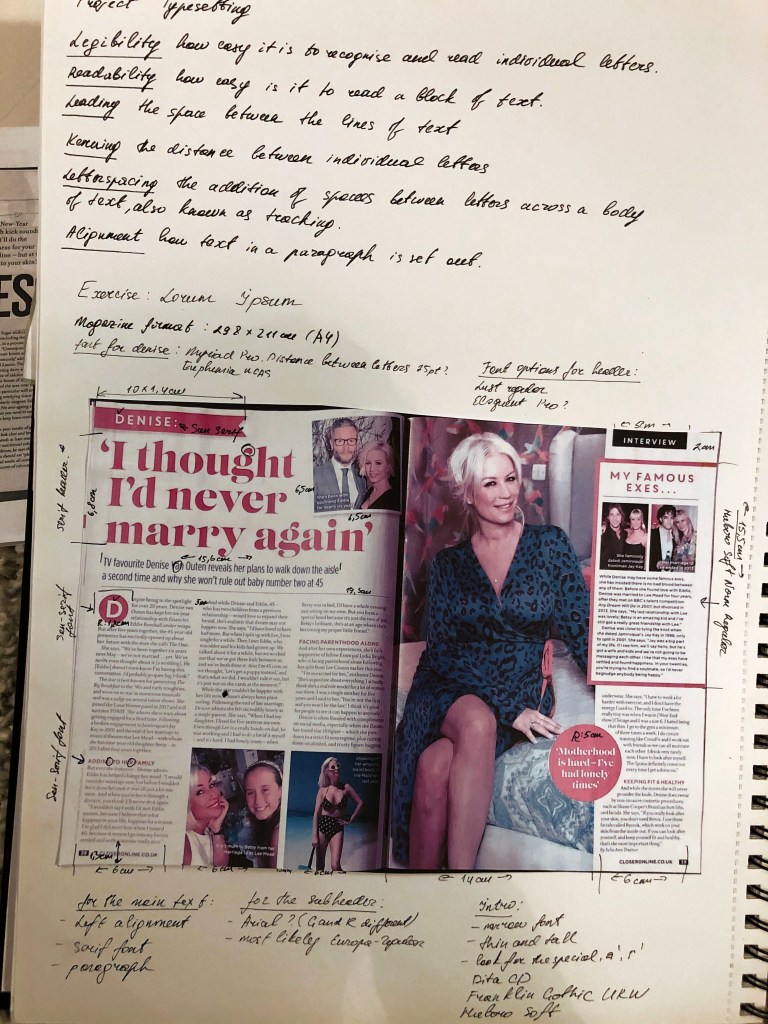
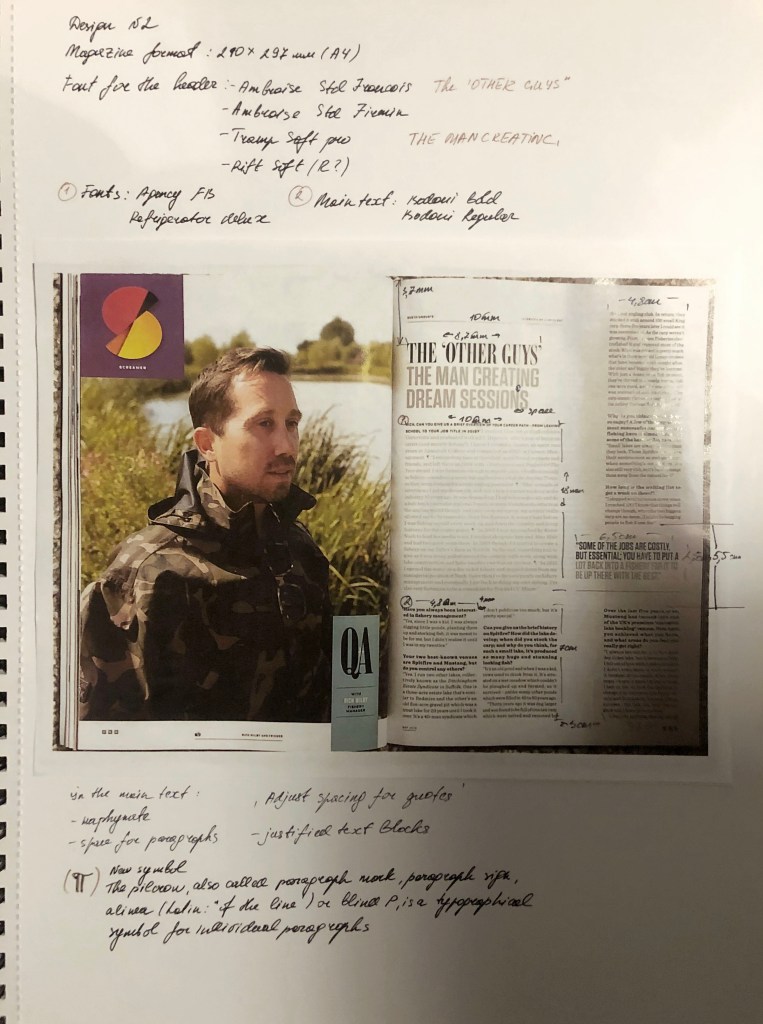
I liked the large unusual headline and the presence of photos and inserts of different colours in a women’s magazine. This design, in my understanding, was quite attractive and interesting. So, I transferred all measurements of text blocks, font sizes and options in a small sketch. Since I didn’t have a special ruler that would help me determine the font points, I found a simple way to measure the font size manually. The most interesting part was to determine the font itself. In my sketches, could be seen that I have identified the dominant features of each font, such as “g” “t” in the title, and the letters “R” and “G” in the subtitle. Explanations of font choices and measurements from my sketchbook are bellow.

In the case of defining fonts, the font selection function in Adobe Indesign turned out to be very useful, in which you can select fonts depending on their type, such as serifs, sans serifs, fixed-width, script, and so on. After several attempts I was able to find the desired font, uploaded it to my computer, and accordingly expanded my collection of fonts.

Design 1

After measurements of all text blocks, paragraph spacing, and possible font options, I started designing in Adobe Indesign. So, in the main heading, the serif font is used, which I defined as the Lust Didone font, 75 pt. The introductory word uses the sans-serif font Dita Cd Light, which I had to transform, namely, squeeze up to 87%, and the letter space by -25%. The subtitle, photo caption, Initial letter uses the Europe-Bold sans-serif font. The sidebar also uses the font from the main header of Lust Didone. In the main text, I’ve noticed the peculiar letter “w” which helped me to define the font as Adobe Caslon Pro (10pt). The paragraphs were aligned to the left, in the left spread only three columns, but in the right because of the dominant photo, only one column was selected for the text. There are no indents between paragraphs, but there are spaces in front of a paragraph, which makes text readability easier. This layout is saturated with photos, 4 types of fonts, which makes it dynamic and easy to read.

Design 2

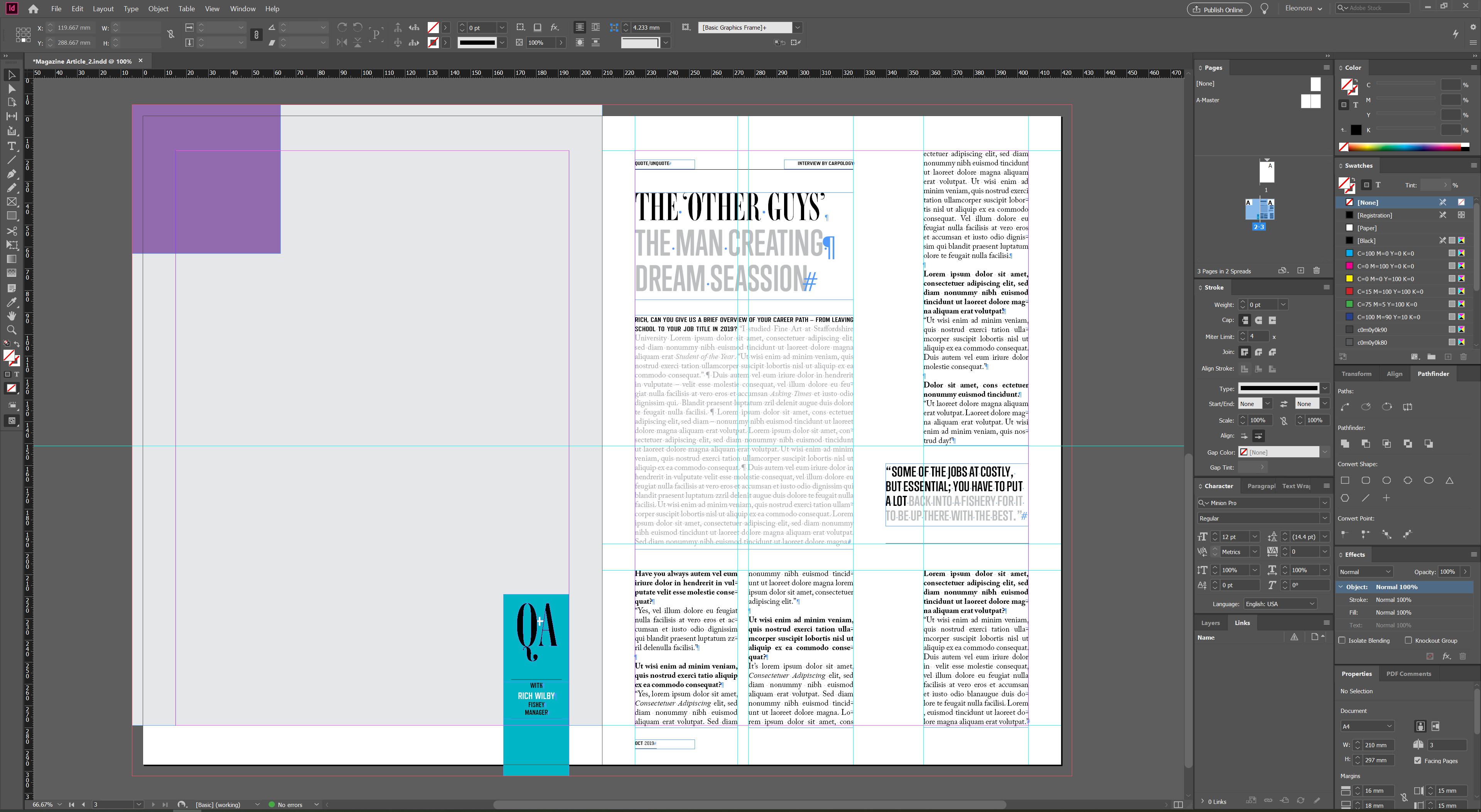
And finally, an analysis of the fishing magazine, which attracted me with its simplicity and originality. The use of a serif font combined with a modern sans serif font for the title is also noticeable in this magazine. In order to determine the font, I used the same method in Adobe InDesign, as in the previous layout. There are two interesting combinations in the title, font Ambroise Std Francois (50pt) and Trump Soft Pro Bold (44pt). Columns of paragraphs are divided into one wide, as the main, and three columns for the main text. Here the text is aligned on both edges, hyphenation is present. The design is neat and discreet, pleasant to read.
In the main text there is also a combination of sans-serif and serif fonts Refrigerator Deluxe (10pt), Adobe Caslon Pro Regular/Bold (10pt). There is some extra spacing between each paragraph, and lots of air around the text blocks, which makes wording easy to read and follow.

Conclusion

In conclusion, I would like to say that I truly enjoyed this exercise. I was able to find the necessary font among thousands of fonts. Once again, I realised for myself how important attention to detail is, and that small differences in layout, such as hyphenation, text alignment to the left or adjusted, visually change the perception of information. I have discovered the importance of kerning and leading. I am sure that I will be able to supplement my knowledge with new skills which will be useful for future designs.

Exercise: A typographic jigsaw puzzle

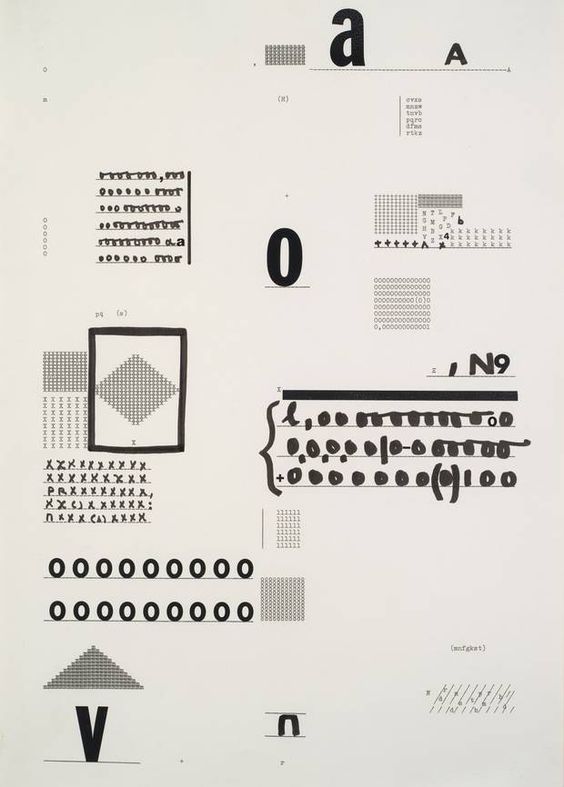
Untitled (Disks) 1972 Mira Schendel 1919-1988 Presented by the American Fund for the Tate Gallery 2012 http://www.tate.org.uk/art/work/T13708

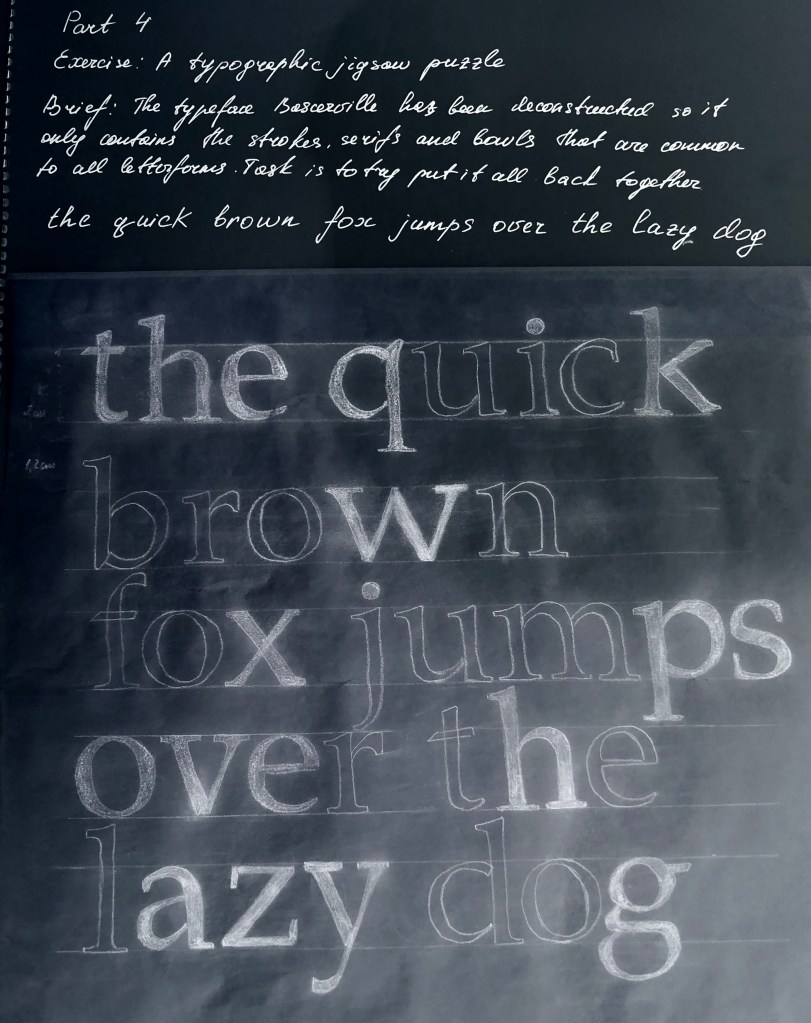
This exercise is designed to help you to look at typefaces more closely. You will need a sharp pencil, some tracing or thin paper and a ruler. On the facing page the typeface Baskerville has been deconstructed so it only contains the strokes, serifs and bowls that are common to all the letterforms. Your task is to try and put it all back together again to read

the quick brown fox jumps over the lazy dog

This is a pangram containing all the letters of the alphabet. It is all in lowercase. Start by drawing your baseline, determine the x height by identifying a whole letter such as x, e or n and draw your median line. This should provide a good starting point to try and piece together all the other elements. Remember that some parts will be used more than once, for example the same stem will be used in several letters. Try and account for all the parts without leaving any stray serifs behind.

Researches

So, continuing to research the theory of type, the new task brought a new experience. For me, a font has always been an all-encompassing component in the design, when you have a task to create a layout, in my understanding, a font has always been an addition to the message. But in the new chapter, the theory of typography opens as a separate part, which is also important for graphic designer attention, because it has the origins of the development of design theory, and writing takes its origins from ancient times, as well as paintings and drawings. Before starting the practical task, I decided to create for myself a small auxiliary layout of the anatomy of the text, in which I painted all the components of the font.

I’ve noted some of the names of letterform parts: aperture, ascender, baseline, cap height, descender, leading, letter-spacing, sans serif, serif, stem, stroke, x-height. Ascenders are an upward vertical stroke found in certain lowercase letters that extend beyond either the cap height or baseline. Descenders are the downward vertical stroke in these letters. In some cases, a collision between these strokes can occur when the line height (the vertical distance between baselines) is too tight. A serif is a small shape or projection that appears at the beginning or end of a stroke on a letter. Typeface with that have serifs are called a serif typeface. 

In a detailed analysis of the font, I noticed that all composing letters have a logical explanation. If you look at the font as a live object, then each element can be compared with the nature that surrounds us.

For example, the tail at the letter Q, the shoulder at the letters n, m, h, the small ear at the letter g, the straight stem as the basis for the characters h, k, l, bowl resembles a cup handle with tea for symbols such as p, d, b, p.

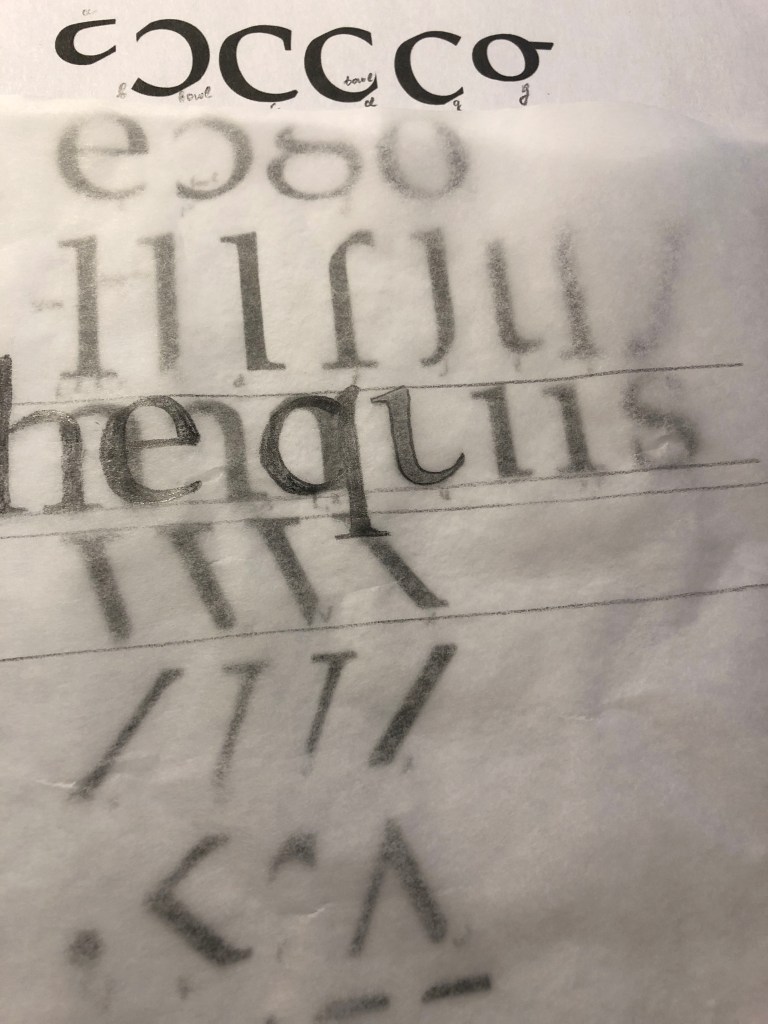
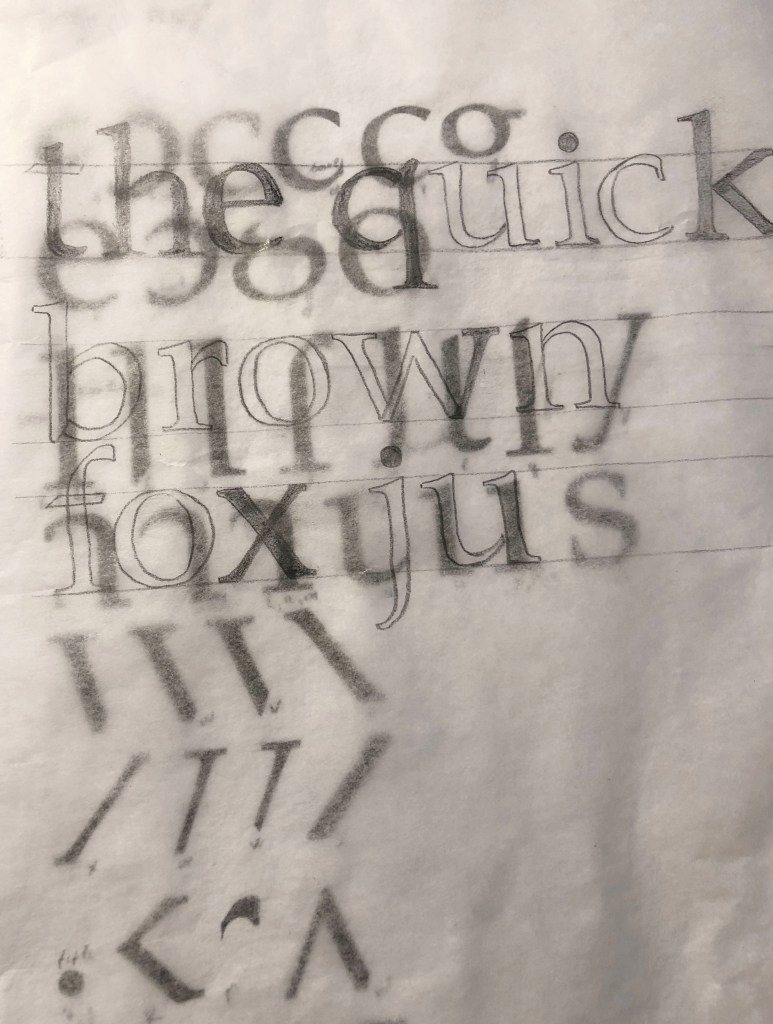
When it came to analysing the individual elements of the font in the task, I realised that it is not so easy to recognise all the letters when they are fragmented into small particles. I had to spend some time analysing all the elements of the font. To make my task a little easier, I decided to start by designating for myself on a piece of paper to which symbol this or that element can be attributed.

I decided on the size of the letters 2 cm and the distance between the lines of 1.5 cm.
Letters such as l, s, g, o, e were obvious. When I determined the letters h, n, I gradually began to see the boundary between the characters, literally a slight difference mattered. Suppose a serif on one side that would be suitable for the characters m, n, h, did not find its application, in my opinion, the serif should be on both sides. But over symbols b, p, d, m, v, w, p, q I had to sweat. Also, I never paid attention to the connection between the letters u & a, for me it could be said a discovery, until the last day I thought that I would have to finish the letter a by myself!

In conclusion, I would like to say that I had to spend a little more time on the task than I expected. In fact, it was important for me not only to draw letters and forget about this exercise, for me it was important to delve deeper into the analysis of the font and its components. Suppose now I can now determine for myself some differences in the font, and that one small serif, gives the font stability or dynamics. Earlier for me the theoretical font was an unknown Planet. Now I understand that after doing a little research, I understood the basic components of the font, and I began to think about creating my own font in the future.

Research Point

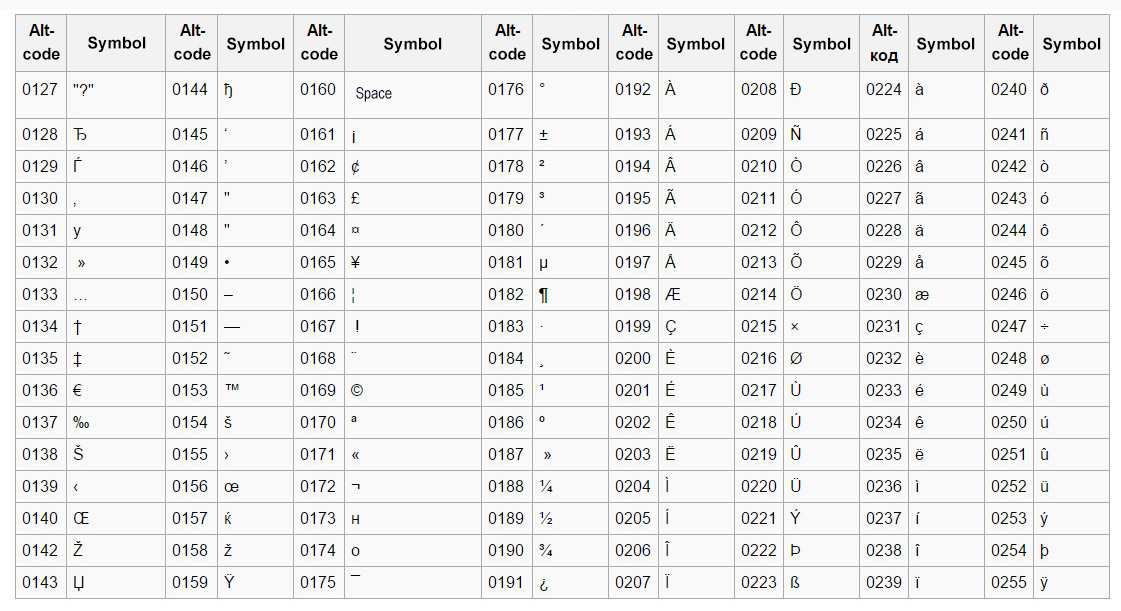
The alphabet is only part of a typeface that contains lots of different characters such as numbers, punctuation, mathematical and monetary symbols and ligatures. Ligatures are where two letters are combined together to make printing easier. Explore your computer keyboard to find some of the other characters. You will need to use your shift, alt and ctrl keys.

This was just random pressing of Alt+numcode, lots of funny and foreigh symbols came up. — ˜ ‘ Šٷ ، ኖ ʷ ᇢ،ٰٮ ƽ 뇫 Ӫ. When I work at my work computer, I sometimes use a list of characters from the code in the alt + numpad combination. My main symbols are • ° ²» etc.

I was interested in trying to practice with the keyboard on my Mac, it was more out of curiosity, because we are surrounded by many characters, the meaning of which we do not even suspect, but in the modern world we use a limited set of standard characters that are familiar to business correspondence.

Choose a magazine, for example the Big Issue or Heat, and look at the main typefaces theyuse for the body text and headlines. Go to http://www.identifont.com and use the programme toidentify the fonts. Look at the ranges of typefaces all around you and try to identify theirdistinguishing characteristics. Make notes in your learning log.

I wanted to try experimenting with this site, to find out what its essence is. At hand I had several issues of magazines, one of them was the British Journal of Photography. At first glance, the most common search engine, but when I disassembled this site in more detail, I discovered for myself you can say a new font selection system for professional work. As I often found it difficult to find the right font, when you come across something unusual in an article or poster, I sometimes had to look through all the fonts in my Adobe Illustrator program to find the right one. But here the search for the desired character resembled an exciting game. Frankly, at first I incorrectly selected the fonts, a small error could lead me to a completely different font, but the more precision in the selection of characters, the higher the likelihood that you will find a suitable font.
I also had the release of the September Vogue magazine, I was interested in what elegant font was used in it. It’s easiest to use the Times New Roman Serif font or Baskerville, but why not discover something new.

Conclusion

I found the first part of the task quite interesting for myself, it was interesting to find out where a symbol is hiding. For convenience, I would print myself a cheat sheet of the main signs and symbols that may be useful in design. The second part of the assignment turned out to be even more interesting, because thanks to her, I can now replenish an even more collection of fonts for my subsequent work. I will be happy to use this system in my future works for inspiration.

Introducing yourself

Exercise one: Picture Charades

For this exercise, I had a task to play a game of charades in which I had a try to communicate through sketches of popular book, film, or program. In my first trial, I painted a clear image of Breakfast at Tiffany, which is presented below.

Eleonora Davydovska 518265 Exercise 1_Charade

But further down I’ve diced to try to communicate through the actual drawings. Here are my trials.

Charades
Charades

Books & Exhibitions

Here are links of artists I was inspired that to complete for my first Assignment.
Loved Illustration works of Matthew Richardson, as they are an example of new vision.
Another artist which I like most is John Stezaker. I was enjoying looking through his re-examines the various relationships to the photographic image. In his collages, Stezaker appropriates images found in books, magazines, and postcards and uses them as ‘readymades’. Through his elegant style, Stezaker adopts the content and contexts of the original images to convey his own witty and original meanings.

Robert Rauschenberg art is one of the examples of Abstract Expressionism. https://www.rauschenbergfoundation.org/artist

Helvetica film analysing:

Cult-ure. Book Research

This book is helping to understand the connection between the symbol and the object.
There were examples of the history of art is the archaeology of culture which I’ve attached below.
I like an idea from the book, that everyone’s handwriting is unique, and everyone who can write has designed one typeface: their own handwriting, ‘tone of voice’.
A painting is never finished, – Pablo Picasso
Also what I discovered for myself We are at the very beginning of recorded history, how far we can go into the history following photographs? Probably only grandparents have some, or grand-grandparents, but not further than that. Everything that is happening now, is captured on a camera.
Are you a good idea? The idea is in charge.
  • An idea multiplied through conversation can travel further than you can shout.
  • An idea multiplied through the written word can go further than a conversation.
  • An idea multiplied through the printed book can than the written word.

Red Square

The meaning of Red colour by reference to Nature:
Red=Blood
Red=Heat
Red=Fire
Red=Anger

Reference to Culture:
Red=Stop
Red=Danger
Red=Off

The art of traditional sculpture consists of removing everything that is not the sculpture.

This is a frame.
A frame defines a boundary, a limit.
Inside the frame is the area the artist exercised control over – this is the extent of the work. Outside the area, we have less control – the culture, the rest of the world. The edges of the book, for example, are a frame – they contain the book. Beyond is your room. Outside this frame, there also exist other copies of this book, identical in form, but not location.

Culture is a map.

Culture is a map that makes experience intelligible. It’s a map of who, a whole, we think we are; our values, our art, ur intellectual effort.
How many times can you solve a problem?
As style changes over time, it becomes fashion. Fashion, like the style, can only exist after the practical need, the function has been fulfilled.
Apophenia is the experience of seeing patterns or connections in random or meaningless data.


Introducing yourself

First Impression. Memories

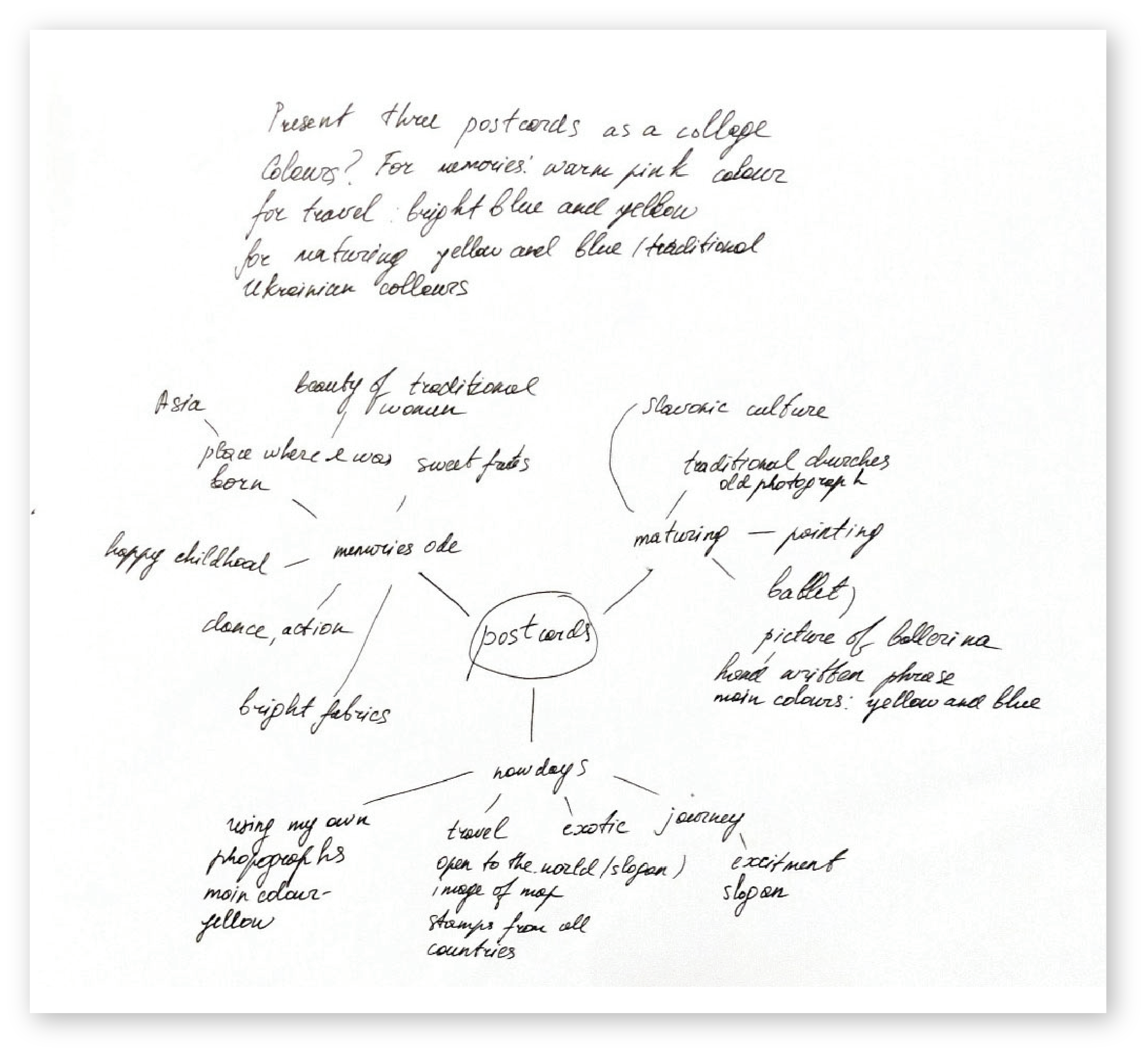
For my first Assignment, I have a task to introduce myself. Below the example of the mind map I produced, some generic ideas that came into my mind, how I would describe myself.  For me is quite important to reflect graphic design ideas through the colours, so each card was associated with the specific colour that I imagined. In the result I had three main ideas:

  • card for the childhood memories and influences of the Eastern Culture
  • card for the maturing, hobbies as ballet and painting
  • card for the travel, like travelling which always is my passion

After some brainstorming, I started to design them straight away.

mind map.png

For my first postcard, I’ve decided to design it through the cultural influences from the countries that I have lived in. Firstly I would like to picture my native country where I was born and where I lived until I was 6 years old. That country is Uzbekistan — a faraway place in Middle Asia, a country with hot summers and cold winters. Where towns were surrounded by desert, 🐫🌵 where fruits were the sweetest in the world, where fabrics were full with bright and juicy colours, and girls wearing long braids were spinning in dance with a smile on their faces.

3768172
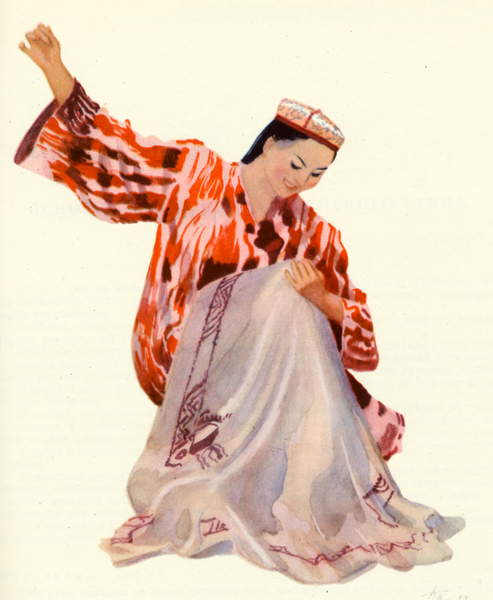
Folk Dancer From Uzbekistan/ Bridgeman Images

From pictures of Uzbekistan I wanted to show a traditional Uzbekistan Dancer, which is always smiling, she has long dark hair, and she loves spinning in dancing. Uzbek dance is characterized by intricate arm and hand movements, a variety of spins and turns, backbends, shoulder isolations and animated facial expressions.

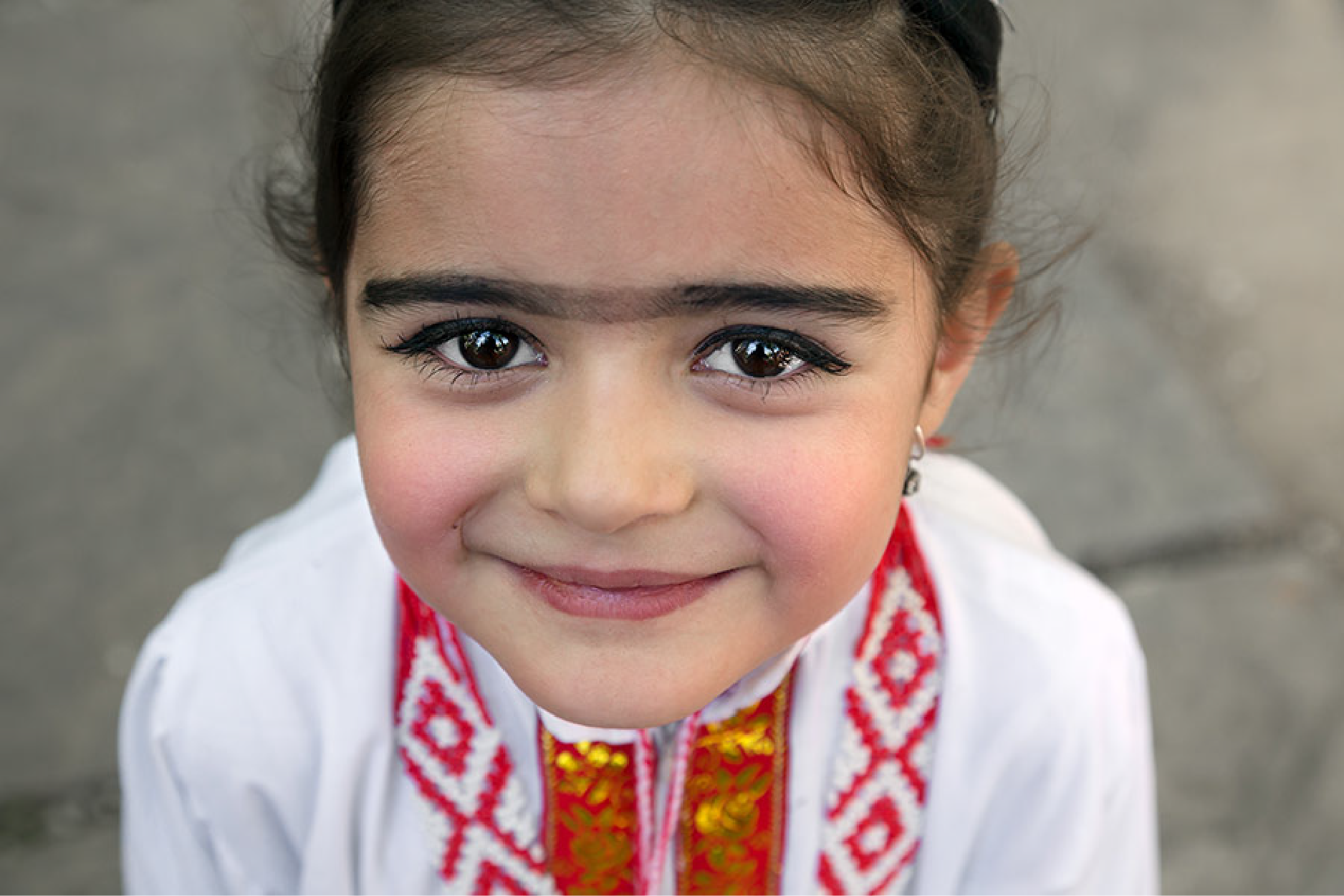
Girls loved wearing wide dark eyebrows, which were joined in the nose bridge. The unibrow is considered a symbol of beauty and purity for women, this little girl reminds me of myself at an early age when I thought I was gorgeous as I imitated adults.

Pascal Mannaerts - Photographer | Pamirs
Pascal Mannaerts Photos

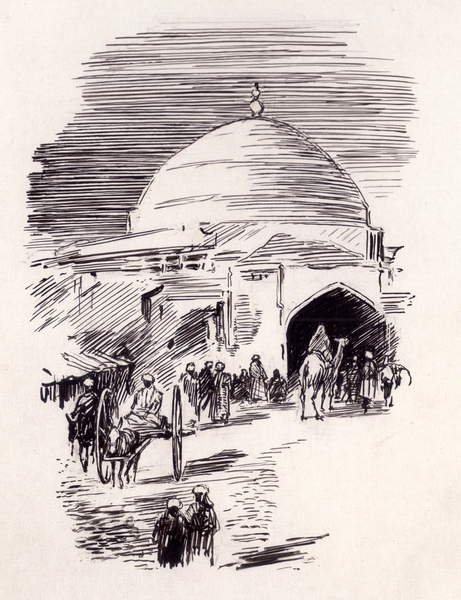
On another image below, is the soul of Uzbekistan — a place called Bukhara, an old traditional city which is one of the older cities in Central Asia.

When I close my eyes, I see spacious Uzbek streets, with no trees, just dry open space with an old mosque, where in the early mornings and evenings we could hear prayer songs. The sketch painting reminds me of my favourite Eastern Fairytale about Princess Budur “Aladdin’s Magic Lamp” from the collection “A Thousand and One Nights.” On the side of the road, you could always find a stream with cold clean water, which you could drink if you felt thirsty under the hot Asian sun.

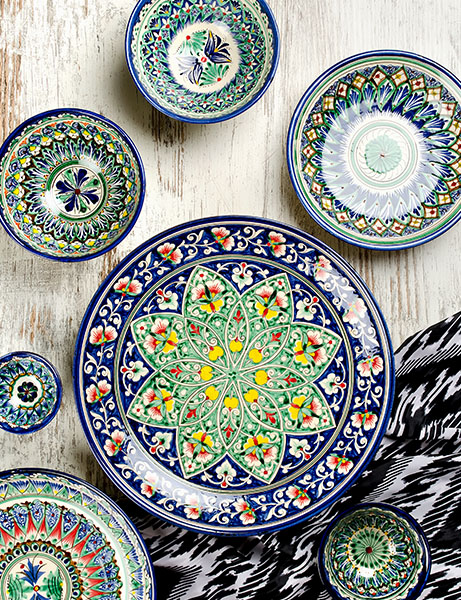
Also, I’ve pictured traditional pattern Uzbek plates, as we used them to serve traditional fruits and hot naan pieces of bread for family and friend dinners.

“Motherland cradle me
close my eyes
lullaby me to sleep
keep me safe
lie with me
stay beside me
don’t go, don’t you go”―Natalie Merchant

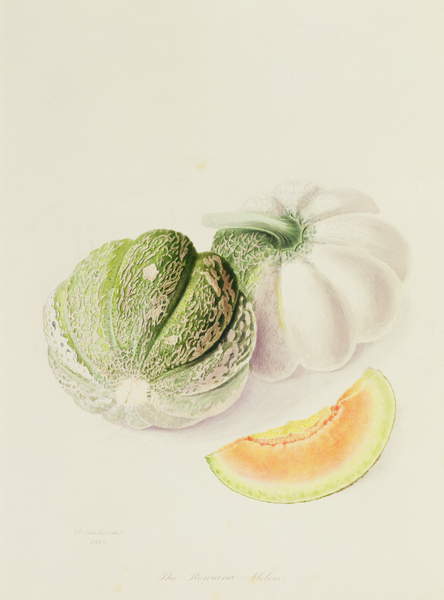
51538
The Romana Melon, 1818 (w/c on paper), Hooker, William (1779-1832) / Lindley Library,  London, UK / Bridgeman Images

639899
The Samanid mausoleum, built by the first local Muslim dynasty in Bukhara/ Bridgeman Images


3245902
Uzbekistan (Indian ink on paper)/ Bridgeman Images

shutterstock_700069756
Ethnic Uzbek ceramic tableware / Shutterstock Image


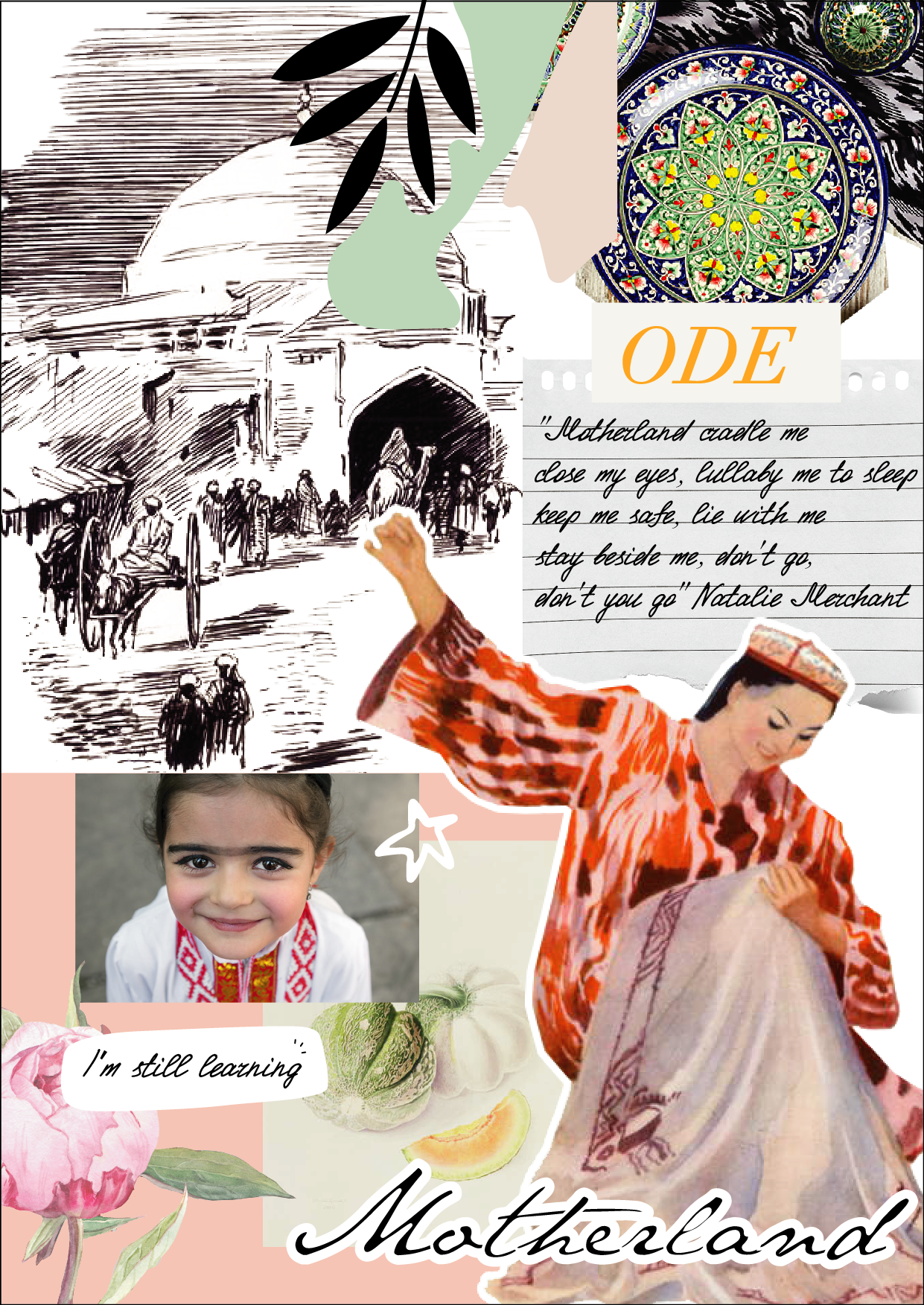
I was pretty happy with the card design, as to me it was a tender and soft card, filled with Eastern elements and personal memories. The font that was used for Ode is handwritten font Katherina, I like it as it is similar to my writing.

Cards A6-01
Postcard Ode

In conclusion for the first impression, I would like to say, that the main influence from the country where I was born was:

  • appreciation of Eastern Culture
  • understanding that each part of ethnic features affect the personality formation
  • memories from childhood are given the strongest influence on personality

Second Impression. Maturing

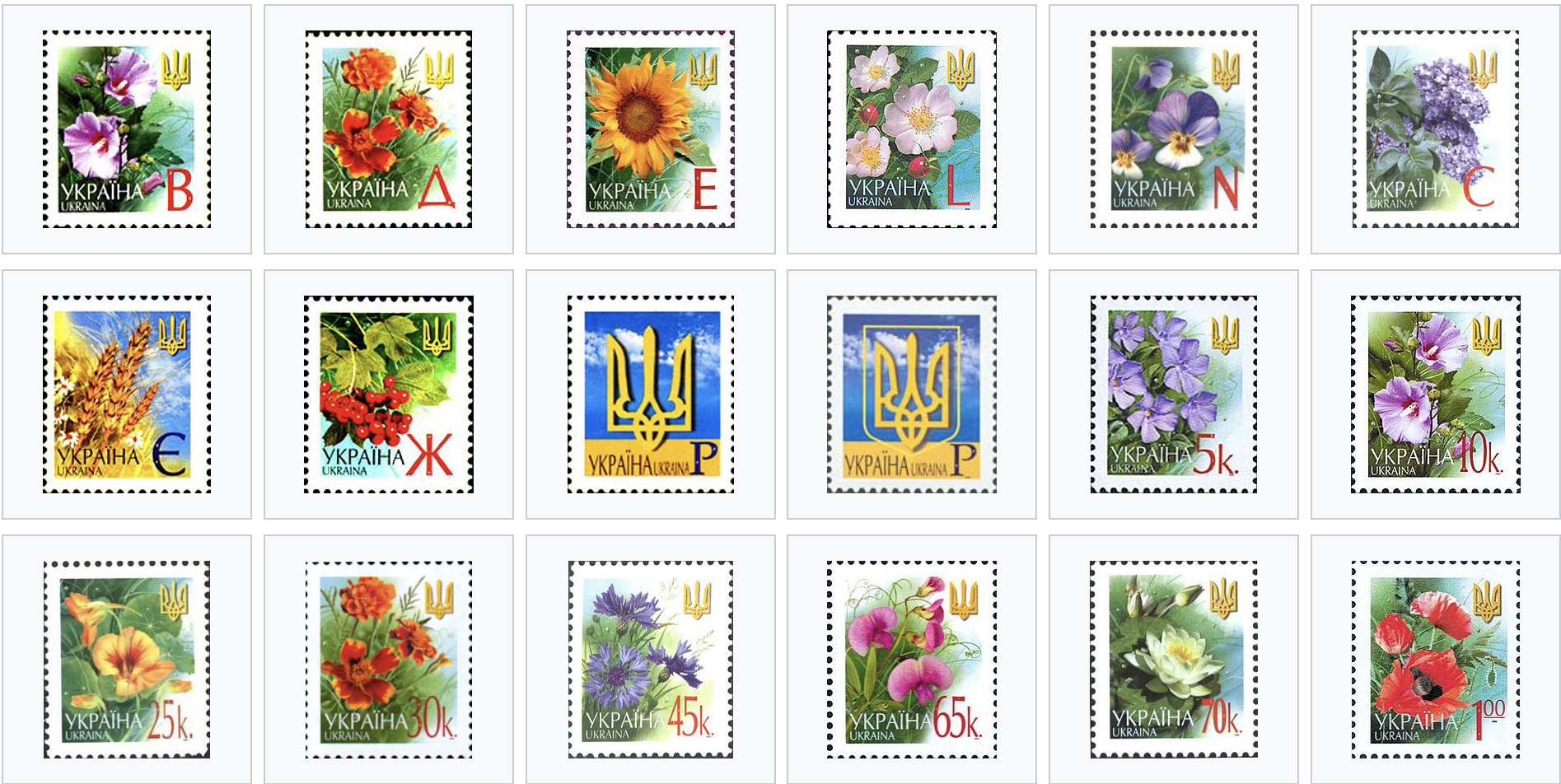
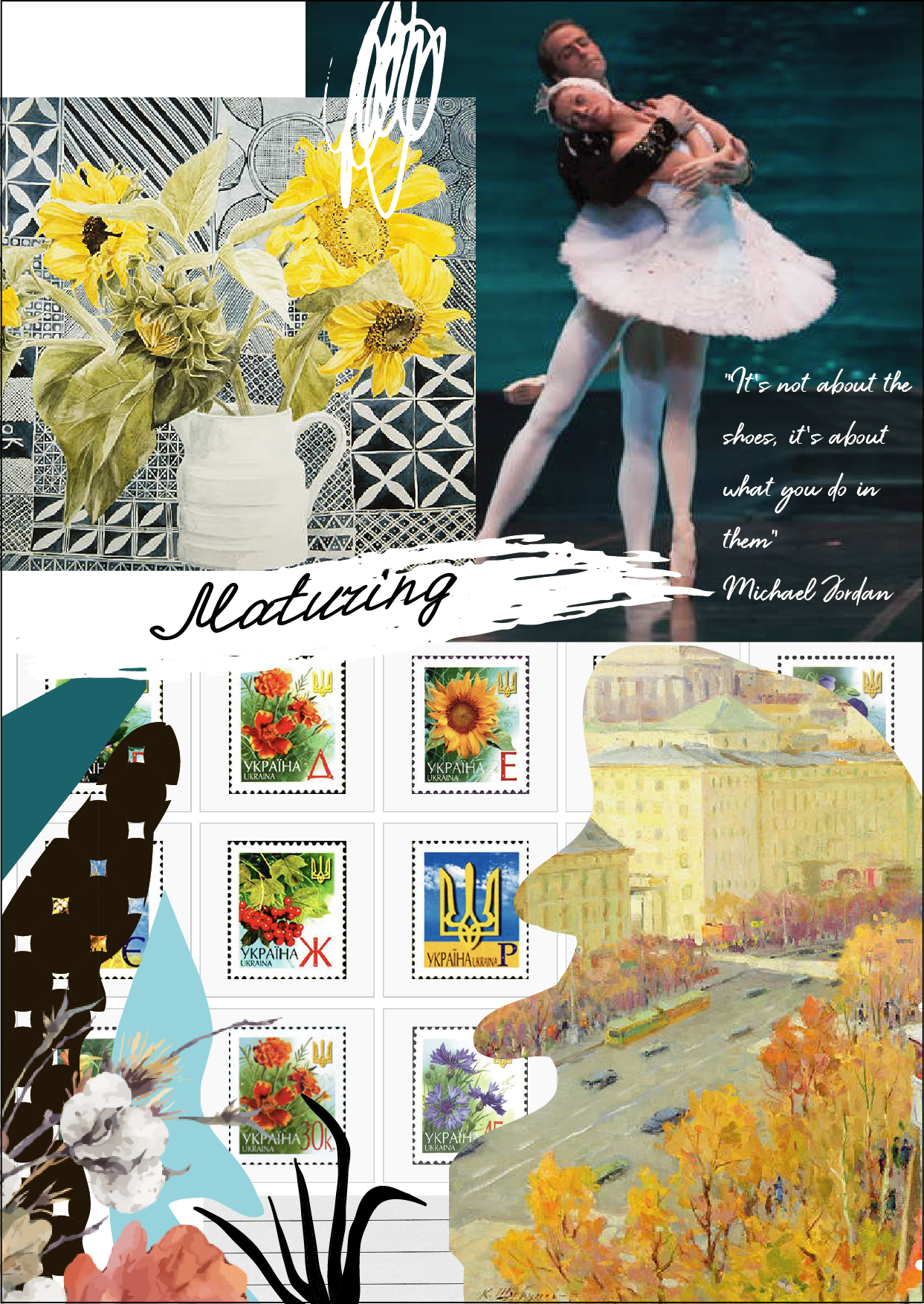
Secondly, after the country where I was growing up, I will go to another part of myself, which is the country where I lived for 25 years until I moved to the UK. That country is Ukraine, a place where summer fields are in blossom of sunflowers, 🌻 where the sky is a dark blue colour, and wheat is bright and yellow, which creates a beautiful combination in contrast. In that card, I would like to picture my country as a collage of main places that inspired me during my life in Ukraine. When I moved to Ukraine for the first time, I was 6 years old. It was the time when I started to learn a new language, which I really enjoyed. At the art lessons at school we had tasks to paint traditional places of Ukraine, so when I see sunflowers, viburnum or ears of corn like on the postmarks below, they remind me that they are all a part of myself.

marks
Traditional Ukrainian Post Stamps/ Wikipedia

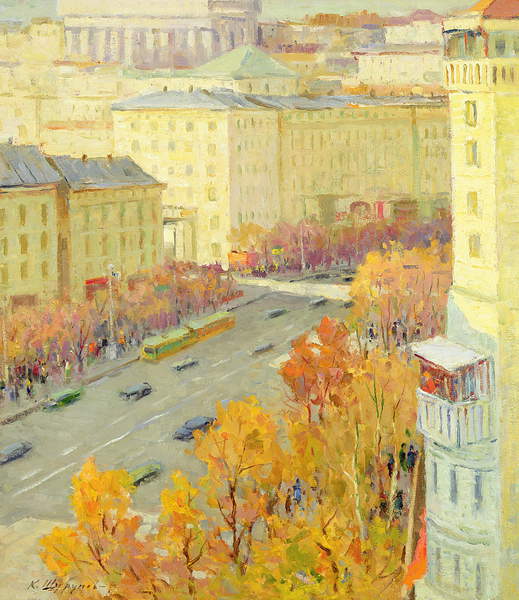
My native city was Kiev, a place with a huge wide Dnipro river, where on the Volodimir Hill you can have a panoramic view of the big green city. High buildings and hills covered with fluffy bushes and trees. As my first impression of Kiev was from the Soviet Union, I would like to use old photographs to picture my city, as that is firstly what came up into my memories from that place.

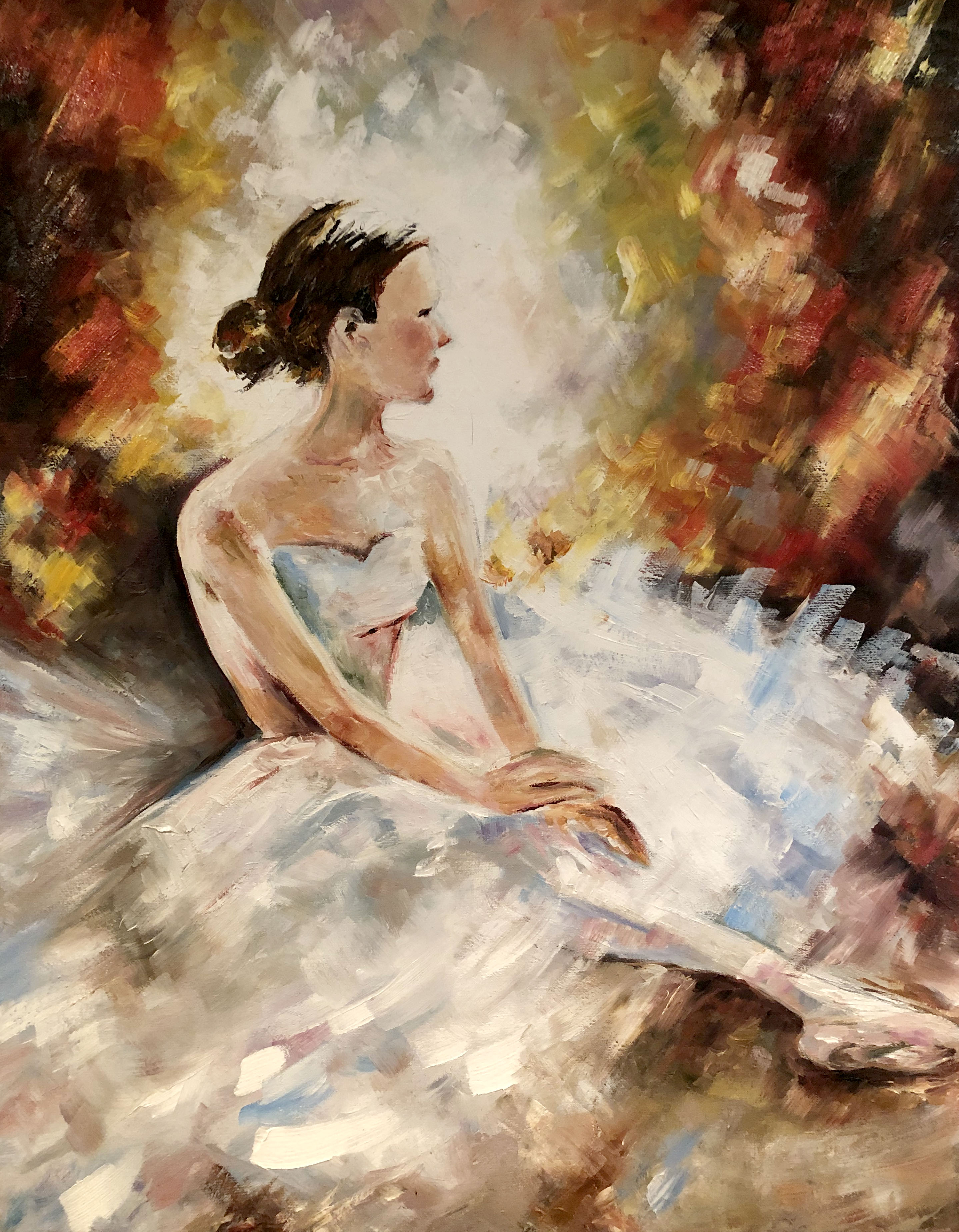
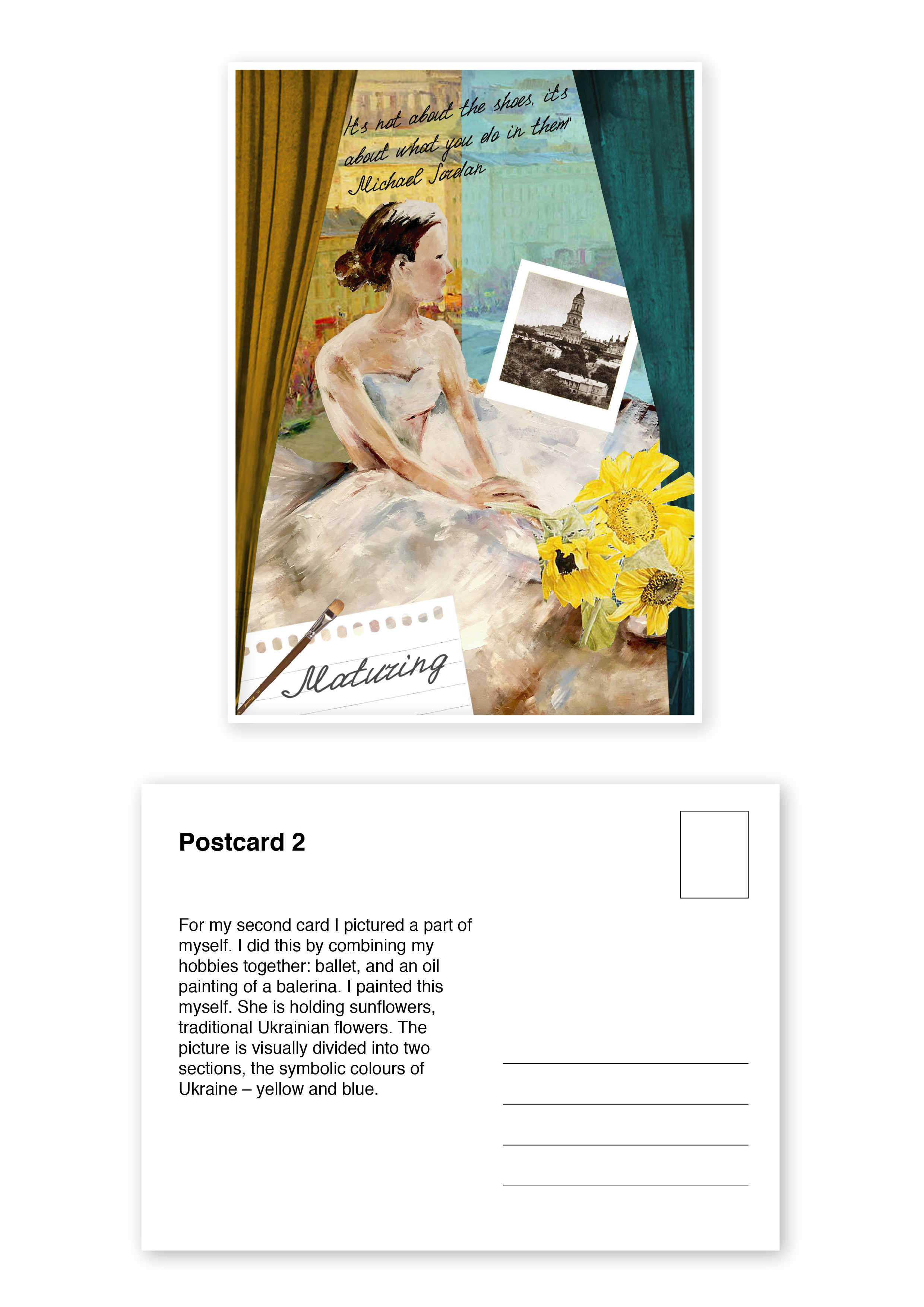
One of my hobbies in Kiev was visiting Ballet Performances at the National Theatre of Opera and Ballet of Shevchenko. I loved the theatre by itself, the decoration of the performance, orchestra music and tender classical dances from some of the best dancers in Ukraine. 🇺🇦 I have visited many performances, starting from Swan Lake to the Nutcracker. In the honour of my love of the ballet, I have painted an oil picture of a Balerina.

212652
Kiev at Kreschatik Street / Bridgeman Images

IMG_1746
Ballerina. Oil on Canvas


412585
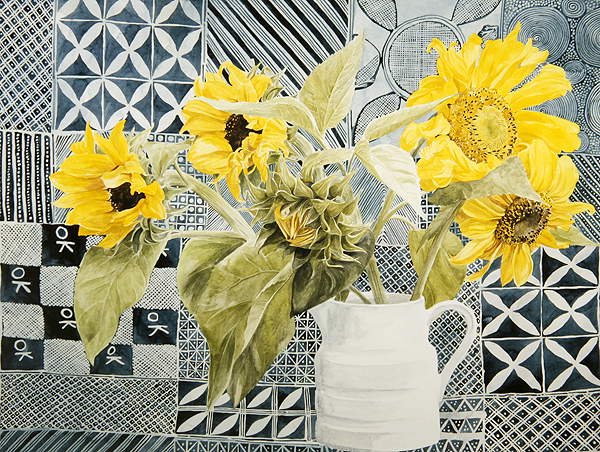
Sunflowers and batik cloth (w/c on paper) / Bridgeman Images

Cards A6-03
Postcard 2

It’s not about the shoes it’s aboit what you do in them, – Michael Jordan

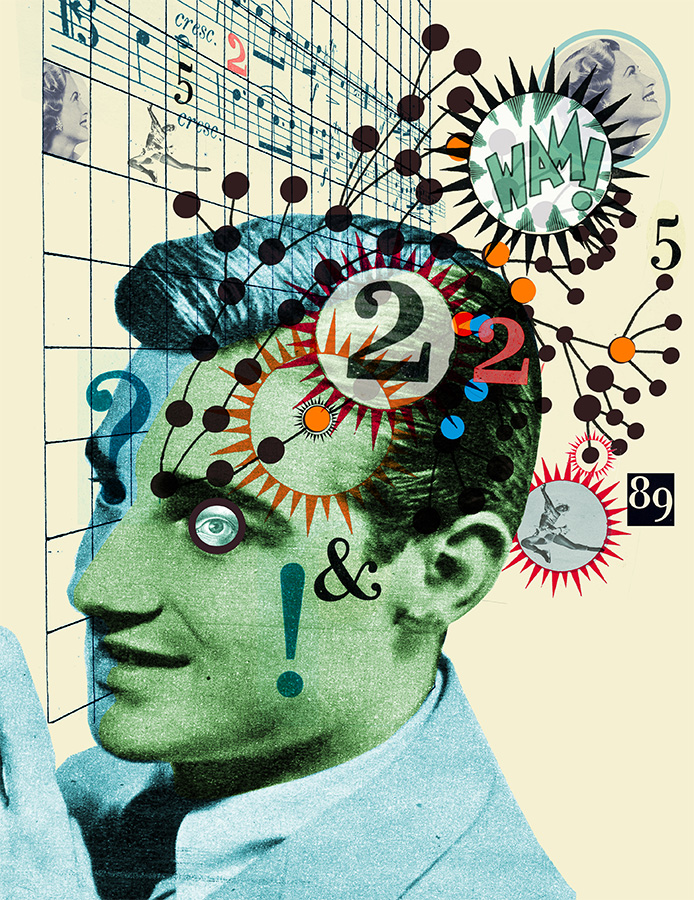
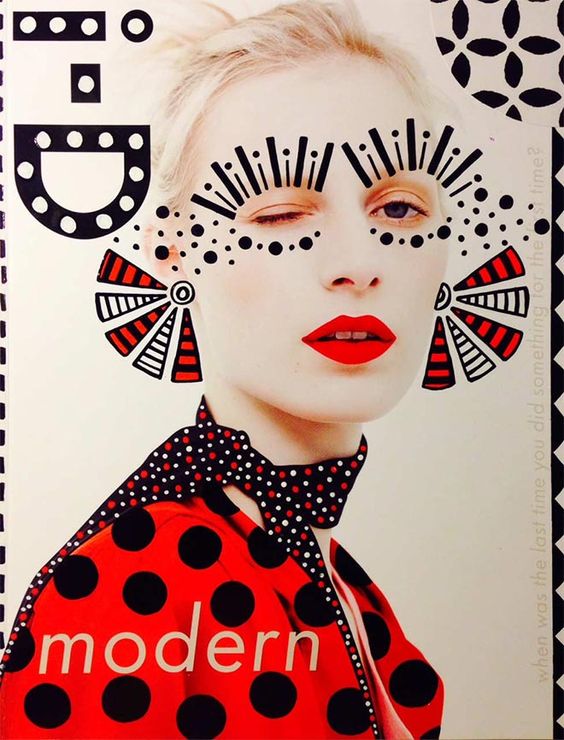
The postcard design that I a got in the result was a bit flat, also I couldn’t fit there domination of blue and yellow colour, so I decided to go deeper, where I would be able to use my own painting. For inspiration, I went to the website to analyse famous Illustrators ideas. I found some source of inspiration for myself from Darrel Rees design style and the complexity of collages combinations, as I noticed my cards where missing foreground and background. So my updated design had a completely new look. Below are designs that inspired me.

rees_darrel_07-1

rees_darrel_03-1

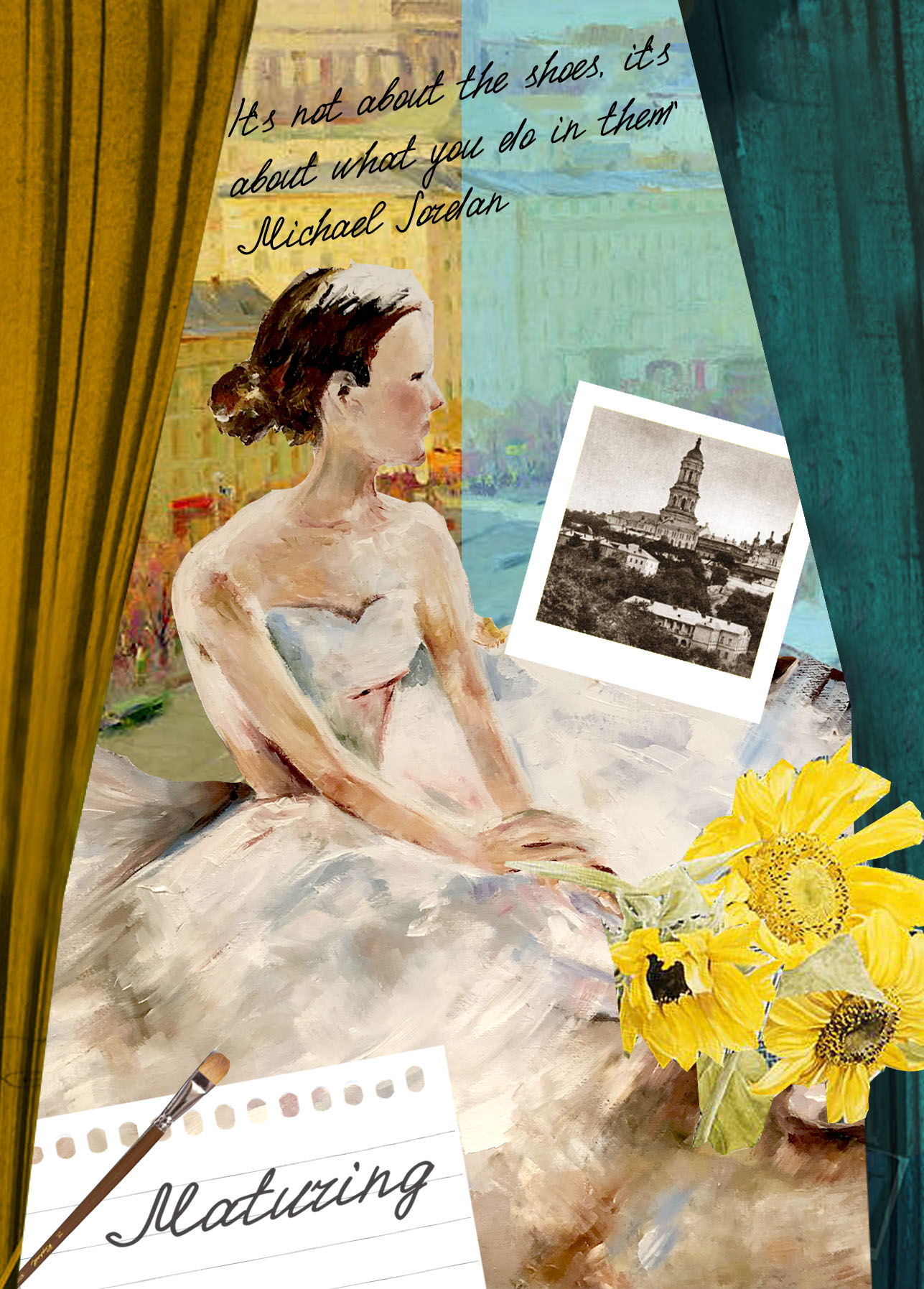
This time I decided to use my own painting. I used a picture of a ballerina, for the background I used a picture of Kiev. In ballerinas hands, I put some sunflowers – symbolic Ukrainian flowers. Visually I divided a space into two colours – yellow and blue, which are traditional Ukrainian colours. In the corner, I used an old photograph of Kiev, place where I had been living for 25 years. A postcard that I got in the result presented below.

Cards Travel
Postcard Maturing

In conclusion for the second impression, I would like to say, that the main influence from the country where I lived was:

  • the Slavonic culture is open-minded and close to my spirit
  • it’s a place I will call home anytime

Third Impression. At the present

1126479
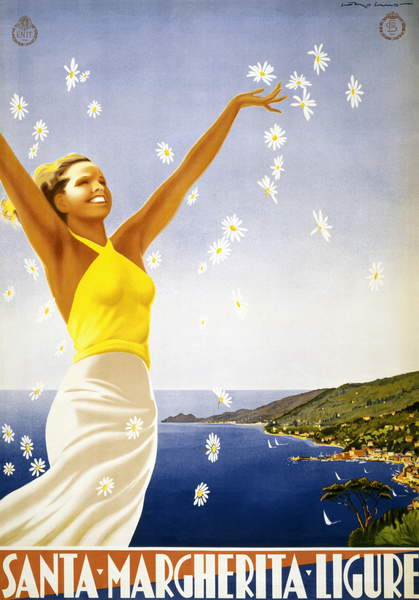
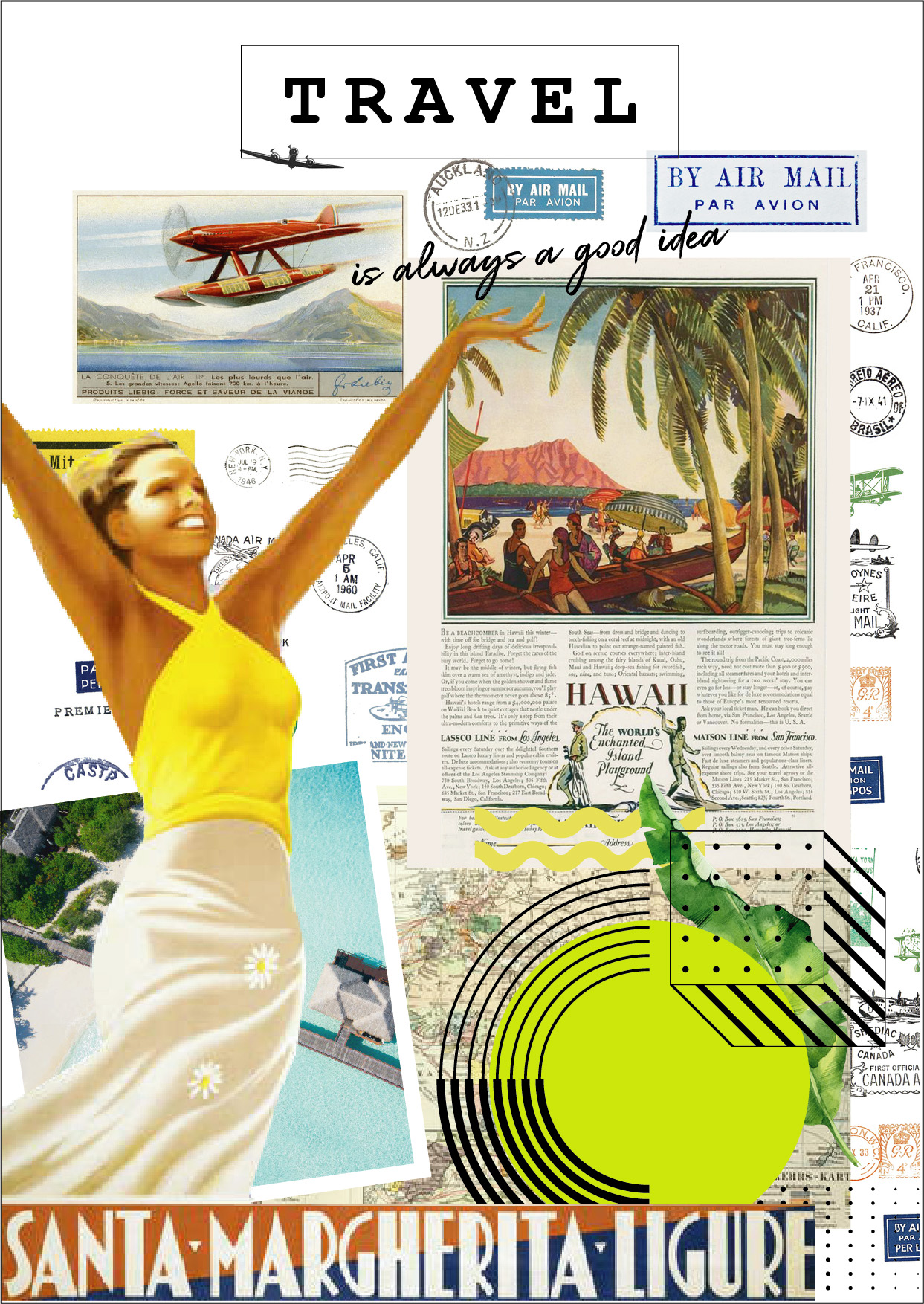
Vintage Travel Poster for Santa Margherita Ligure, c.1950 (colour litho)

During my work career for a travel company, I’ve opened for myself a new world,🌏 with big beautiful oceans, exotic fruits and far away islands. As I worked as a visual graphic designer, most of the time I was looking for photographs to attractive places to visit for tourists, and at the same time, I was looking for places I dream to go too. Since that time I have a wish, travel around, and see the most unseen places in the world. In my third card impression, I would like to visualise journeys and travels as a part of my life.

This young lady on the poster from Santa Margherita is a symbol of happiness and excitement of the new world discover, I love that she is open to the world and with a big smile on her face, also she is wearing yellow, the colour of energy and activities.

“There is a kind of magicness about going far away and then coming back all changed”― Kate Douglas Wiggen


I liked the idea of the presence of yellow colour, and the spirit of happiness that woman brings into, but I thought that my postcards look too similar to each other, as most of them were made in the style of flat collage, therefore I went for inspiration and searches to the famous graphic design and illustration artists.

Eleonora Davydovska 518265 Third Impression copy

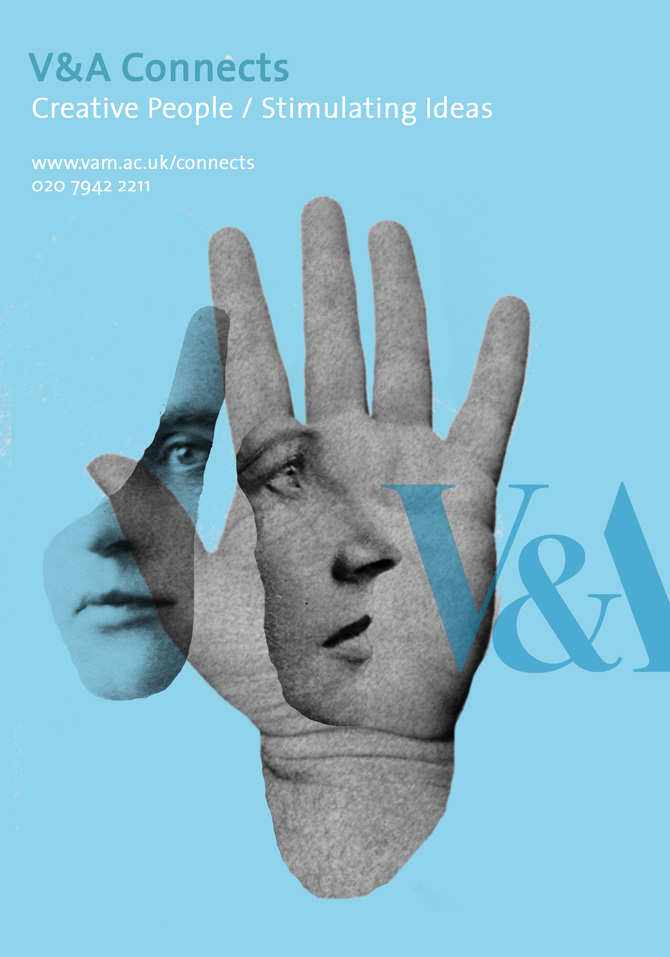
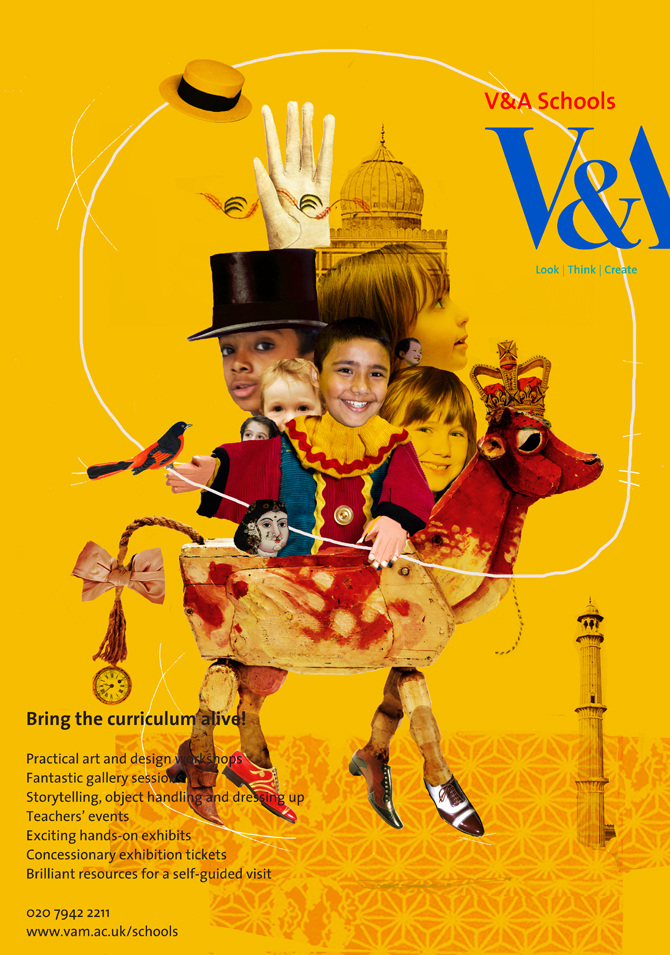
I found some ideas which were leading me to some new way of thinking, where I could combine not related images to each other, that to create some new sort of image. I loved the idea from illustrator Matthew Richardson of using transparent images and full-colour images, which created a kind of mystery effect. At the same time, my personal expression told me that I more keen on using a bright background, as though the colour we can express our personality as well.

Connects4_670.jpg

schools_670

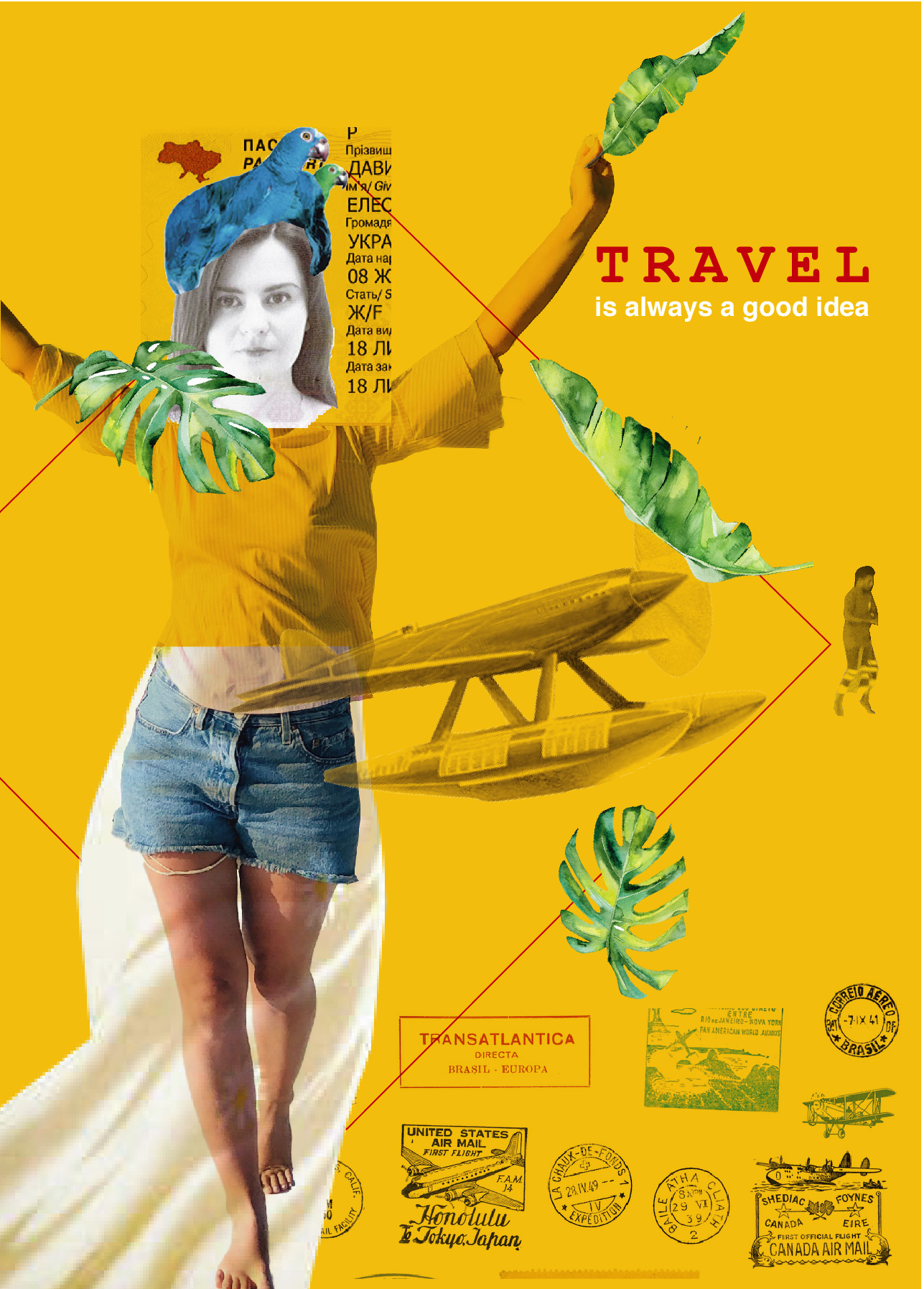
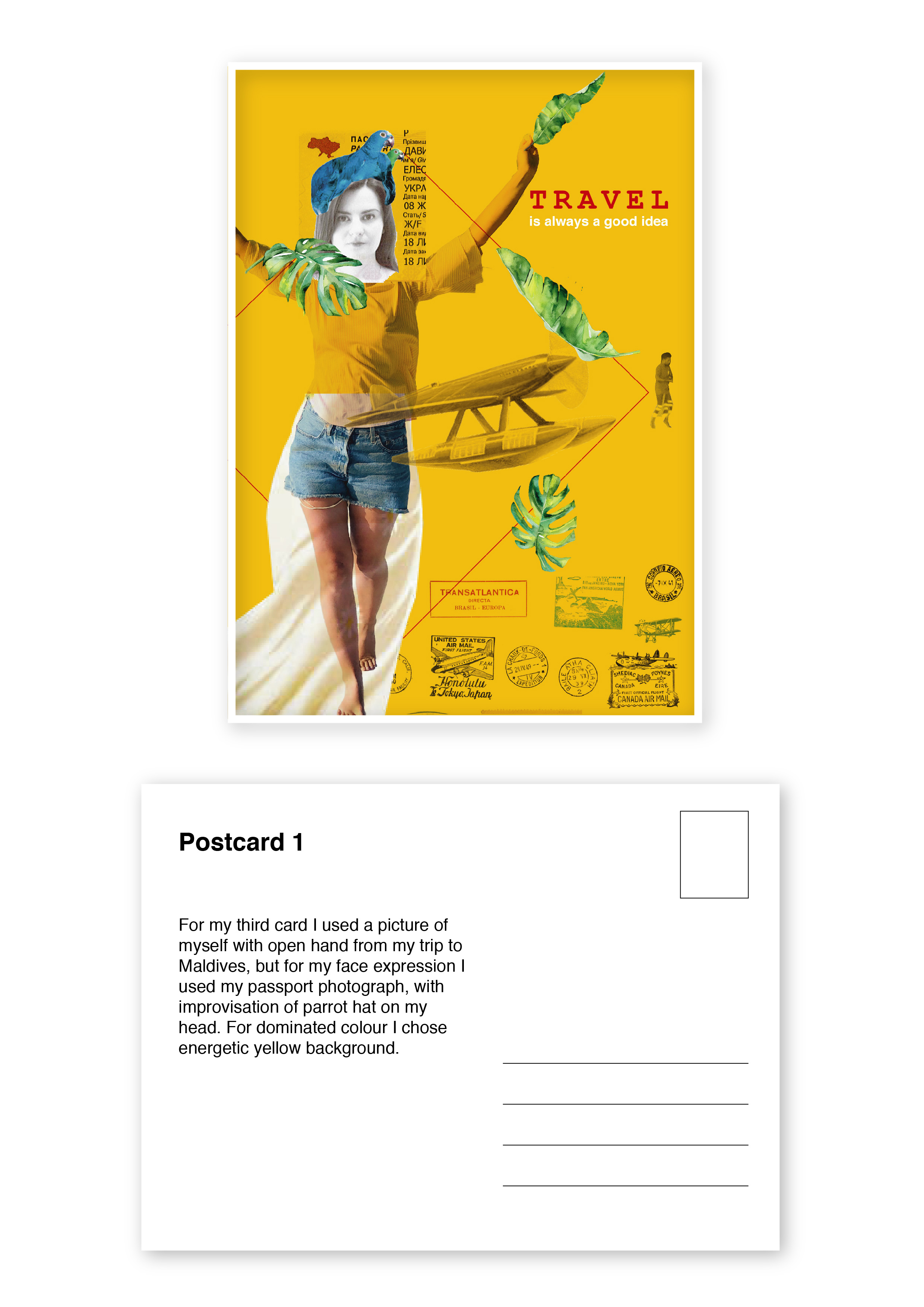
By trying to combine different images, I’ve decided to try to use two pictures of myself, first one a picture from passport, as that is related to travel abroad, another one a picture of myself with open hands, as I’m open to the world and travels. At the same time, I used some images from my journey to the Maldives. Leaves and parrot I used as a decoration for my clothes. I liked the slogan “Travel is always a good idea”, I used Helvetica font for it, that to keep its message clear and simple. In the corner, I put a picture of dancing Maldivian man.

Cards Travel-01
Postcard Travel

In conclusion for the third impression I would like to say that:

  • travelling is what makes a person happier
  • travels open up new horizons, changes the live view, gives the opportunity to look at familiar things from a completely different angle.
  • this is what fills us, inspires and makes us fall in love even more.

Final Cards Designs. 

Postcards explanation-01

Postcards explanation-02

Postcards explanation-03

Creativity takes courage

Thanks for joining me! Here is my new graphic design and art blog where I’m going to post my graphic design assignments, inspirations and art ideas. I hope the journey to the world of creative art and graphic design is going to be exciting and full of creative researchers.

“Every artist was first an amateu”. — Ralph Waldo Emerson

Pinterest Image