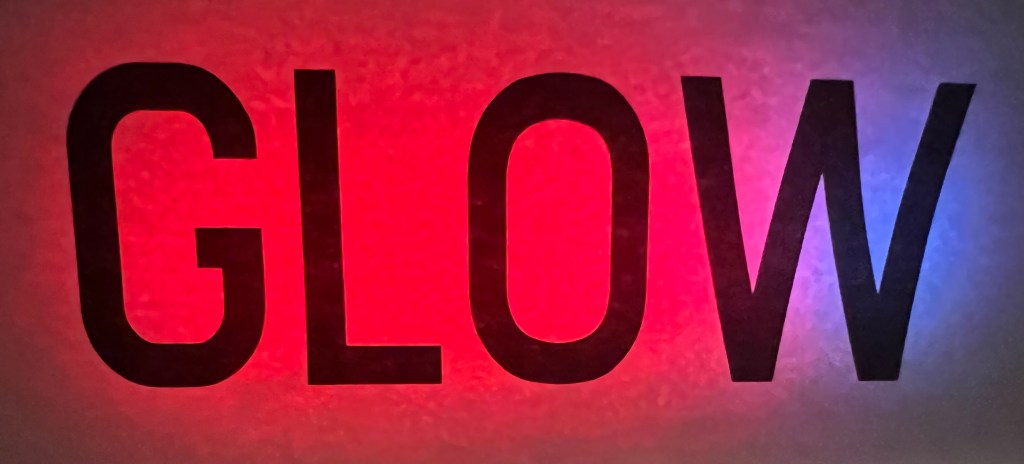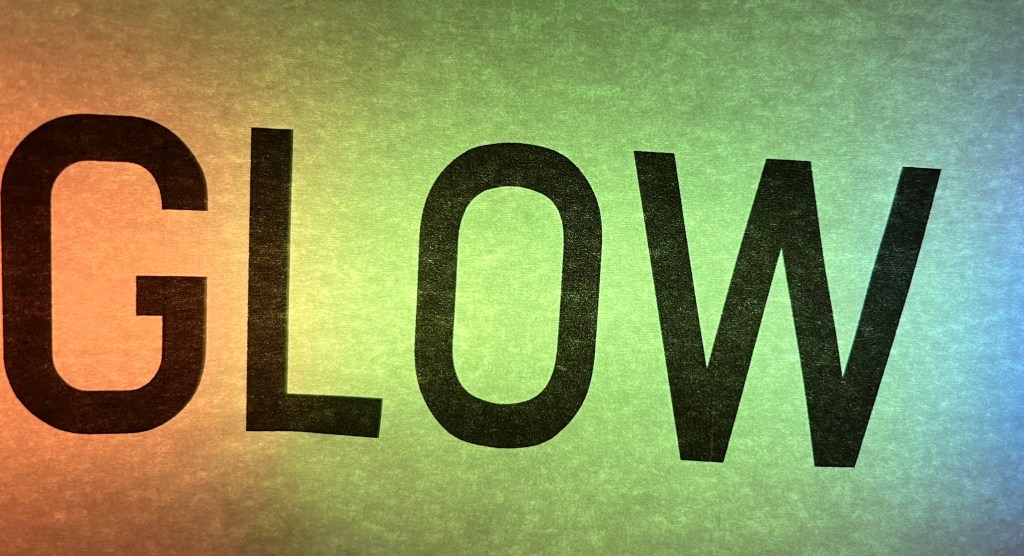
Assignment 5: Your choice

Extend your exploration of typography by continuing to develop creative approaches to how typography, layout and your material choices can help generate meaning. Develop a book that explores one aspect of typography in more detail, or combines a variety of approaches. Just because your project explores typography it doesn’t mean you can’t also include images, colour and narrative.

OCA.

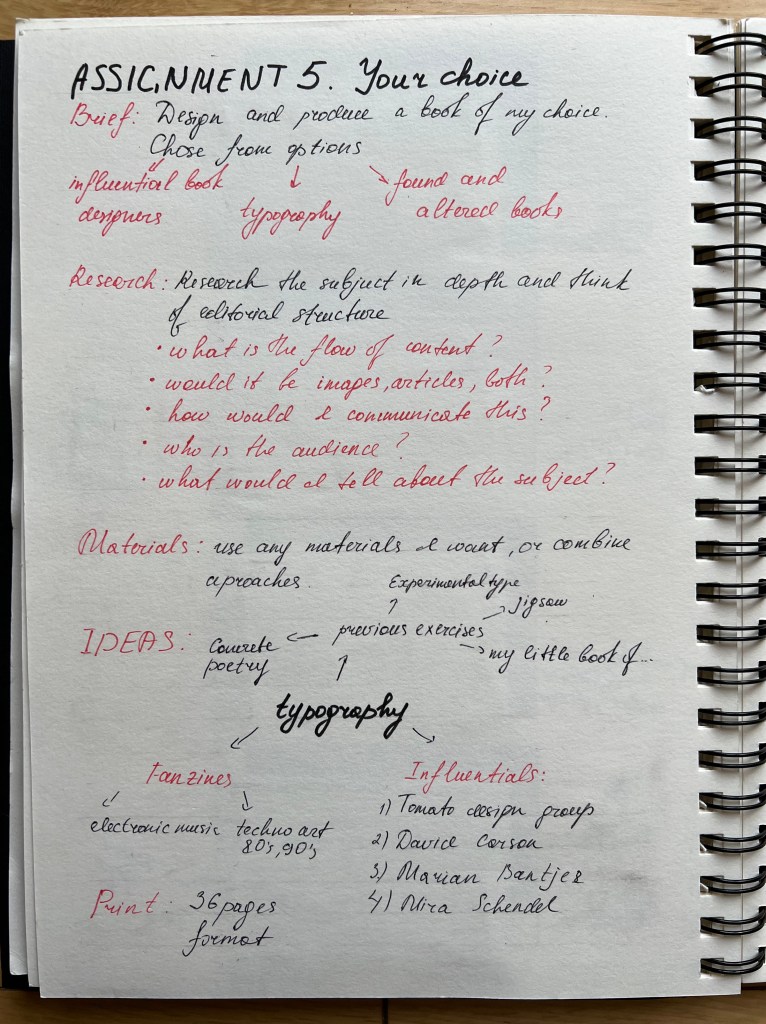
In this brief, I was asked to draw on all the skills, insight and experience I have gained during the course, by designing and producing a book of my choice. The choice for the subjects to explore was great, and I didn’t know which exactly to design till the very last moment. In addition to choosing a particular subject, I was free to choose the author, book or movement I’m inspired by. I was hesitating between two briefs, between exploring the typography and identifying influential book designers to investigate. Both those subjects were close to me, as enjoyed doing the exercises with researches on Book designers in Part 2, and, also, I found fascinating exercises on Experimental Typography and My Little book of… Also, I remembered a valuable experience from my previous unit on Core Concepts, where we explored the structure of the font at A typographic jigsaw puzzle, and designed our own font in the assignment Show Me… I thought that I could gather that knowledge together, and create a book out of them, also, adding some extra research and investigations from my experience on typography. Now, when I’ve decided on a subject, I’m looking forward to tackling it.
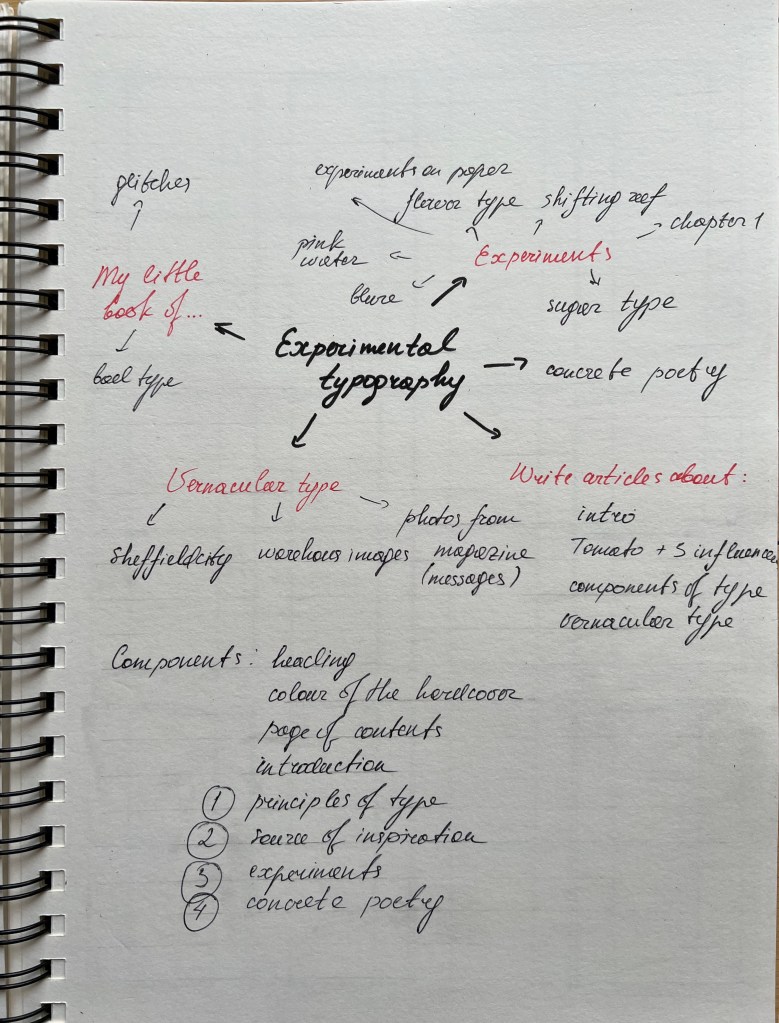
Research

I wanted to start by exploring the fanzine stylebook and remembered about one famous piece of art that I was recommended, and that was a fanzine book. I thought by learning the structure of the book, which I never examined in detail, will help me to understand the future scheme for my own book.

Cyla Costa, ¿Me acompañas? (2008)

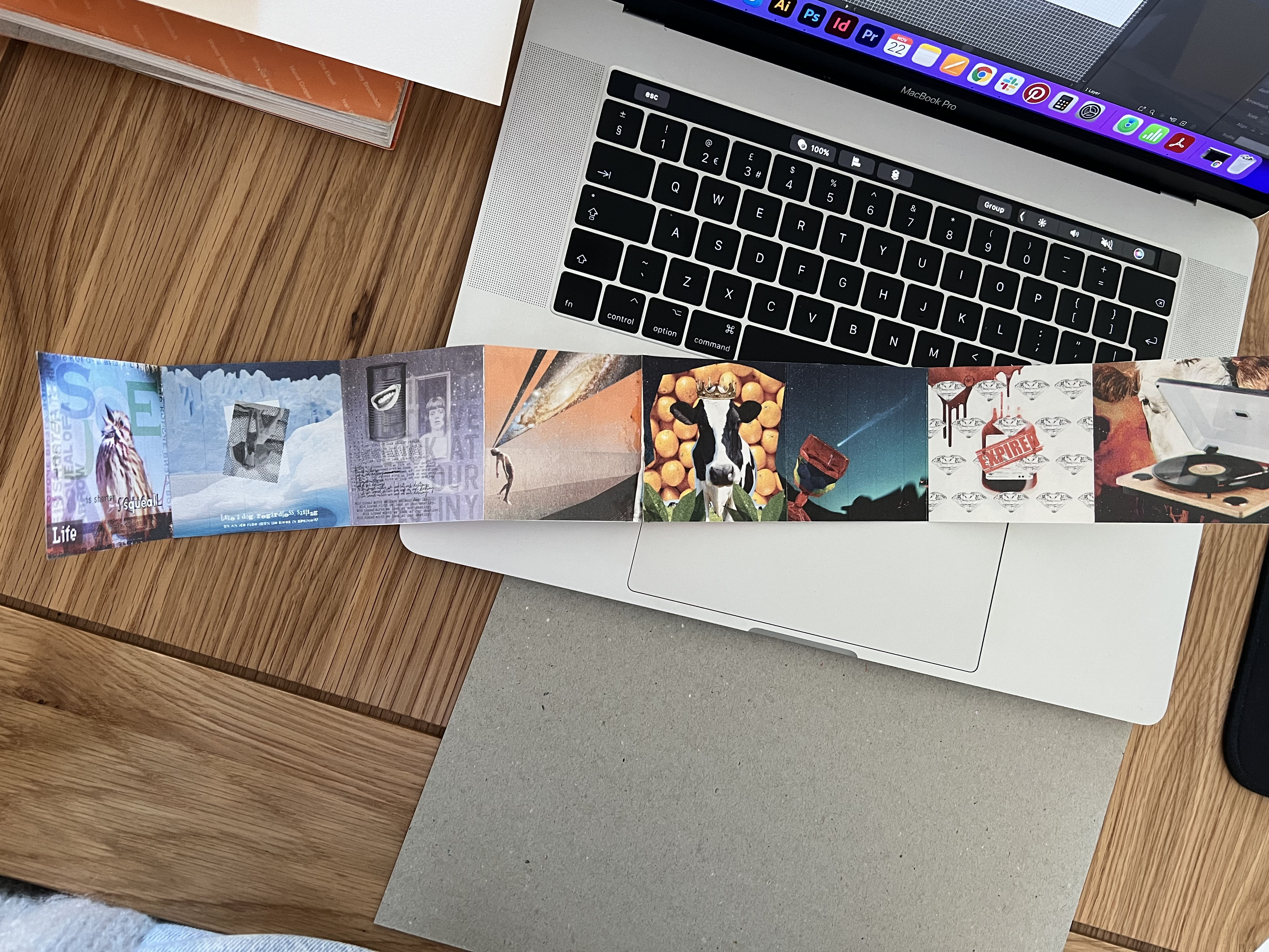
¿Me acompañas? is a fanzine created in 2008 by Cyla Costa for the Barcelona School of Design and Engineering. The inspiration was Costa’s own life in Barcelona, and the impressions made on the artist by the city – both good and bad. What’s so fascinating about it, is that it was made completely manually, without computers – just using collage, a Xerox machine, stickers and flyers about Barcelona cultural events. What I particularly like about this book, is the different format and sizing of the page, it’s a special touch that is not easy to recreate in the digital print, only manually. The author implemented several approaches to it, like a fanzine, collages, experimental typography and concrete poetry. The book is a loop that can be read upside down: the end is the beginning and the middle closes the circle. The theme is Barcelona’s huge cultural offering. Cyla Costa used different forms of lettering, and she likes adding collages in her work. I’m keen on the idea of lettering as the best way of communicating.

La carne de niño by Pilar Gonzalez Bergez

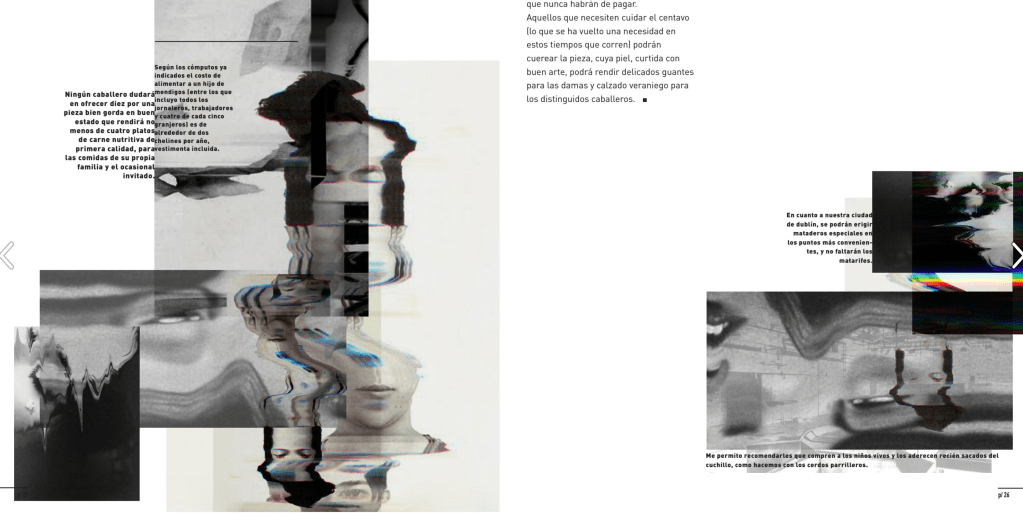
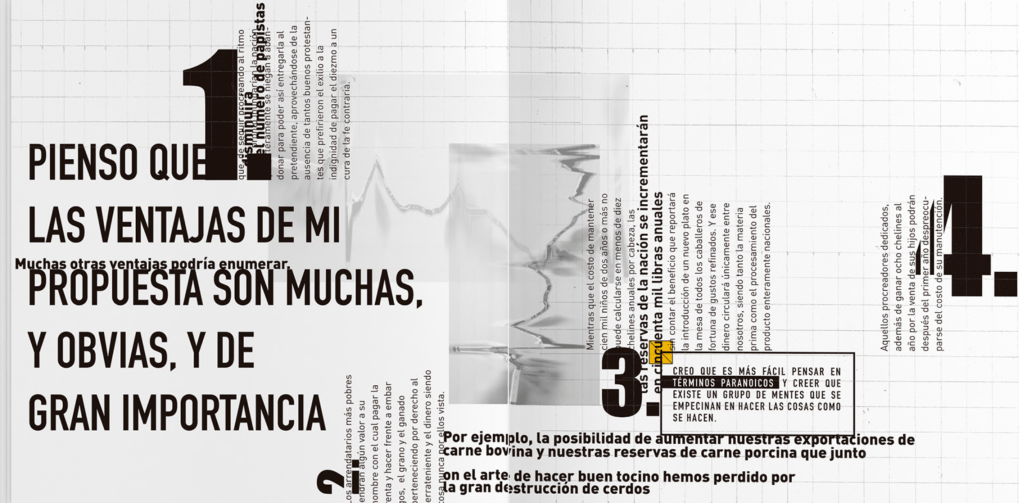
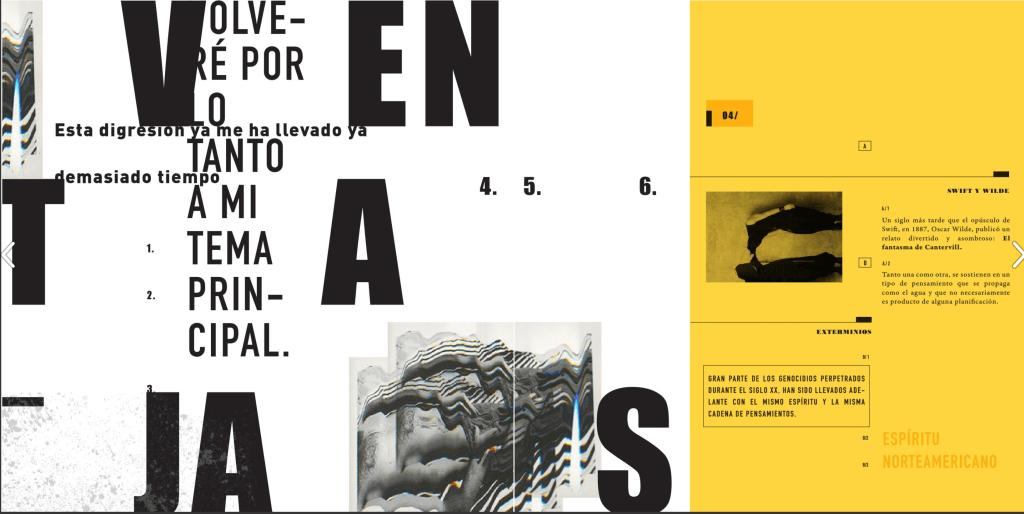
Another intriguing book that I stumbled on was La carne de niño designed by contemporary Argentinian author Pilar Gonzalez Bergez. The original idea was coming from the analysis of the satirical essay ‘A modest proposal’, written by Jonathan Swift in 1792, and re-written by Marcos Bertorello. Throughout the book, these two voices are displayed using the colour and typestyle chosen to represent each author. The first author is presented as a psychopath who proposes
a ridiculous solution to poverty, while the Bertorello text addresses the Swift psychosis. The typography defines the structure of the whole book, did the two voices are present throughout the piece. The reduced palette reveals the difference between the two authors: one is represented by black and grey tones generated by the typographical chaos, and the other author is recognised by the structural order and the use of yellow highlighting – showing his obsessive control. This book is the prime example of strong narrative, structure and design representation, that I was keen to reproduce in my book as well.

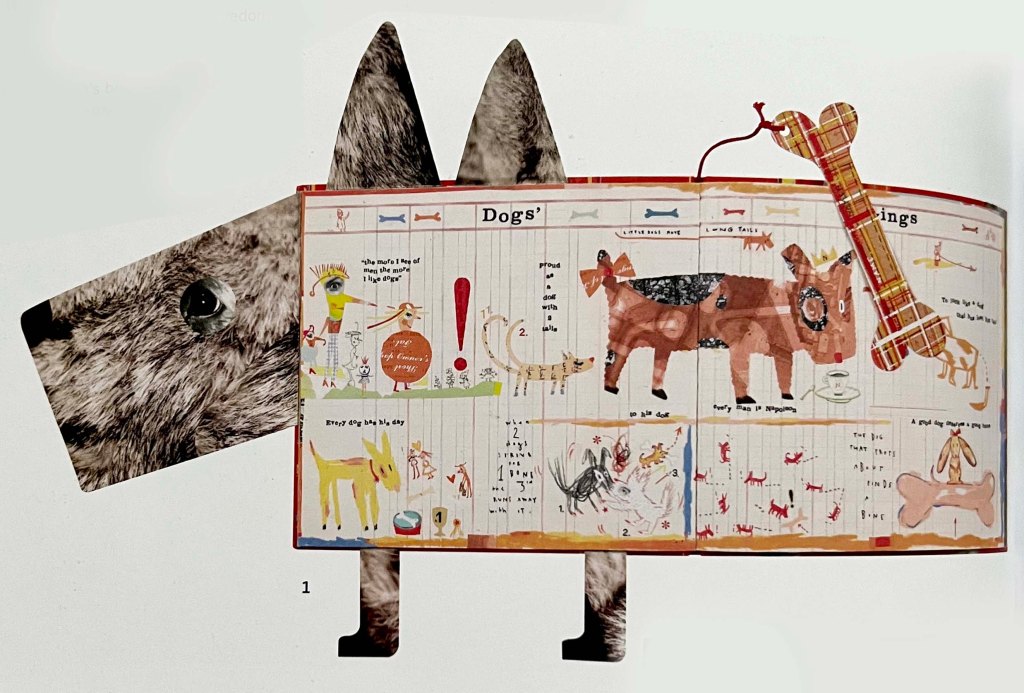
A Dog’s Life by Sara Fanelli

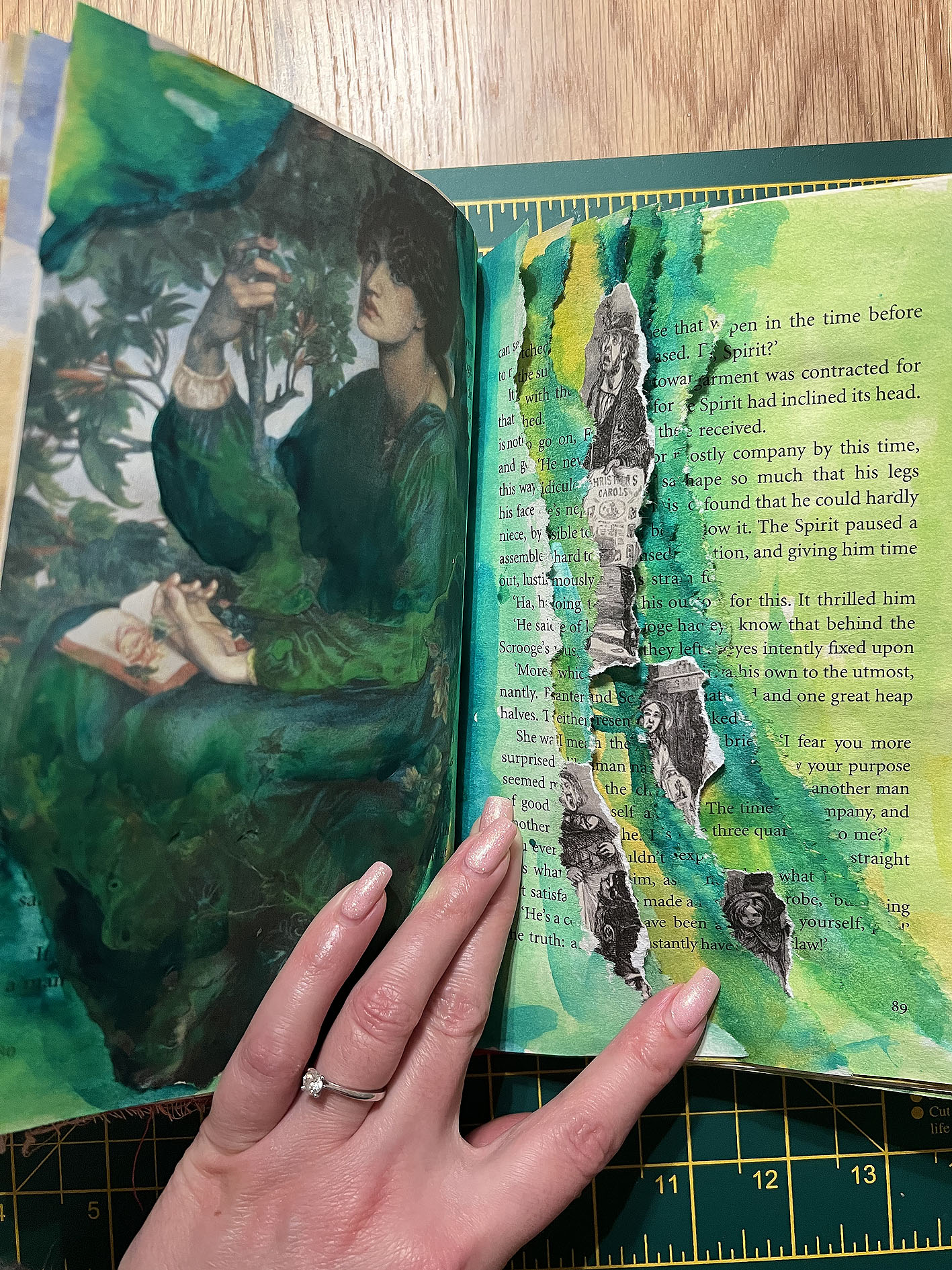
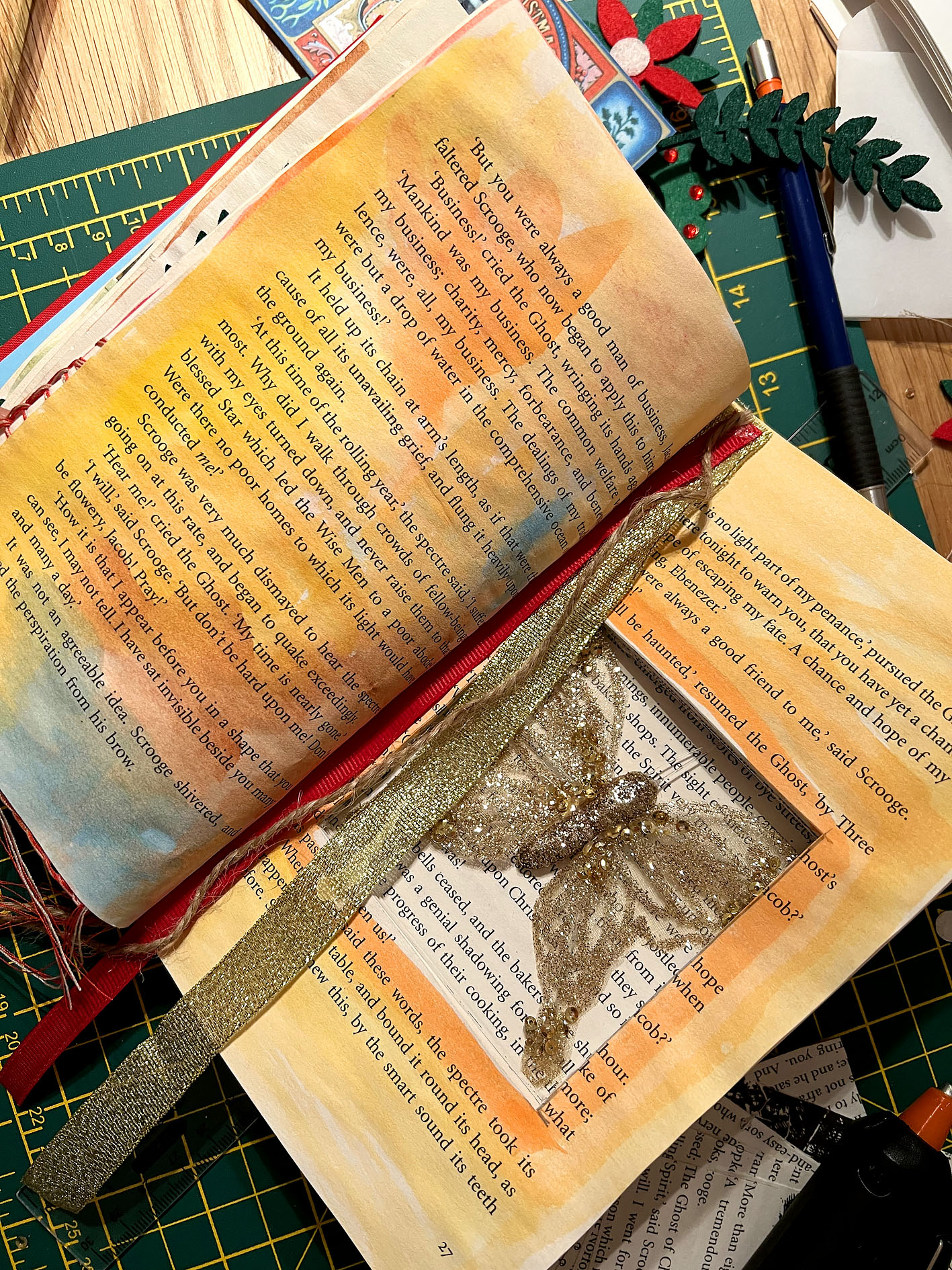
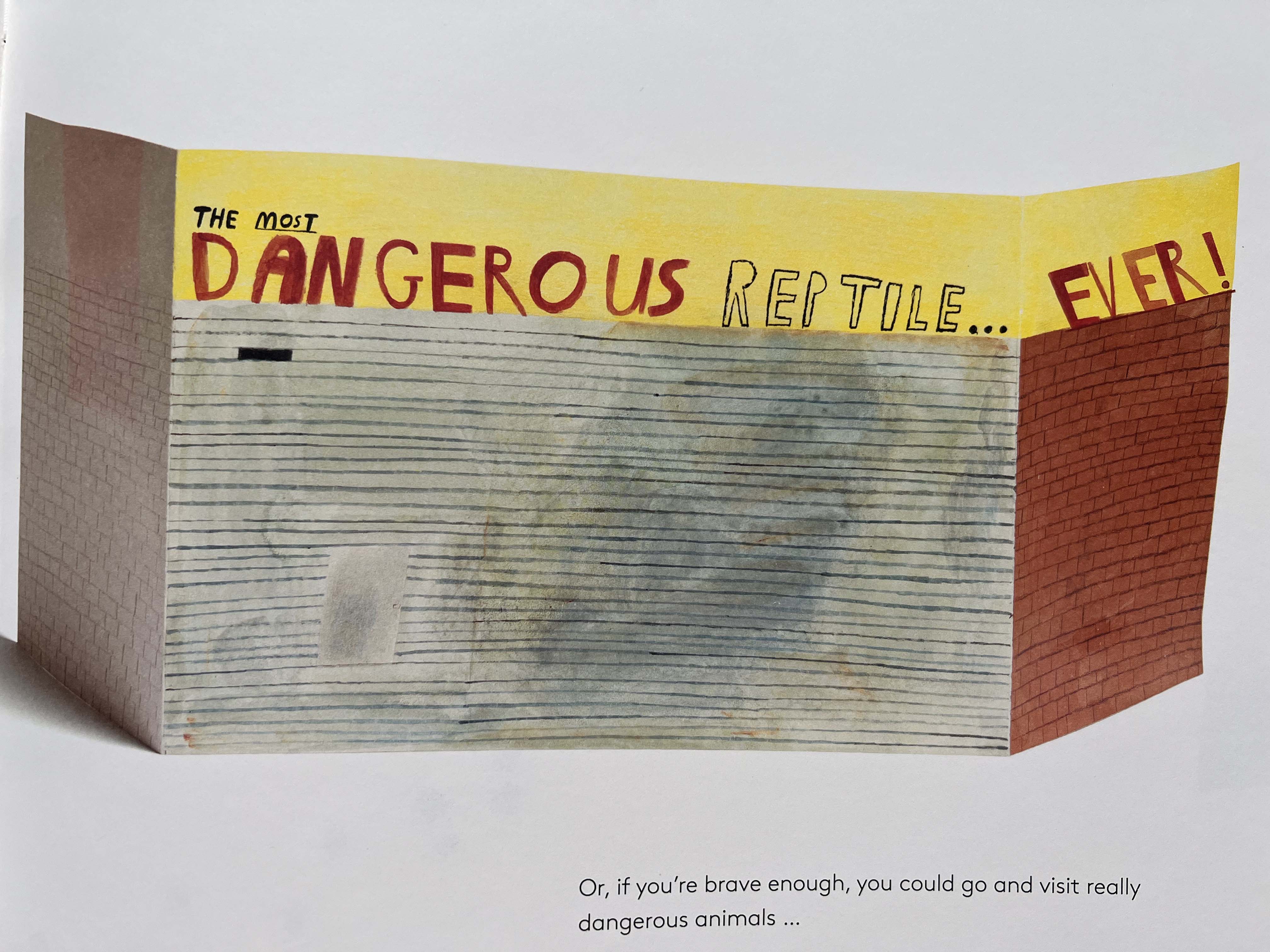
A Dog’s Life by Sara Fanelli is an amusing illustrated book that combines drawn imagery with photographic montage. The text is set in an irrelevant way and combined with some hand-drawn lettering. The front and back endpapers have fold-out elements so that the book becomes a dog. Sara usually works on coloured backgrounds, but in much more subtle colours, such as ochre, misty blue or orangey-red, often using pieces of paper torn from exercise books, graph paper and wallpaper, frequently stained or marked in some way. On these backgrounds she sticks fragments cut from photographs – eyes are a common motif, as are pictures of herself as a child – pieces of fabric, details seemingly randomly cut from prints of old masters, music and snippets of newsprint, often mixing print in several languages including English, Italian, French and even Chinese. She plays with different typefaces, superimposing pieces of print on top of her illustrations, or using them as part of a drawing – the body of a butterfly, for example. The use of historical typefaces, such as pieces giving price tags in old pounds, shillings and pennies, give an old-fashioned look to the work and hint of influences from Duchamp and other Dadaists. She often draws or prints in black ink on top of these collages, using doodle-like scribbles, which pull the focus of the work back from the adult world to the realms of childhood. I liked this example, as it is quite imaginative, and has some odd drawings and little notes around it, altogether creating a weird but unique book.
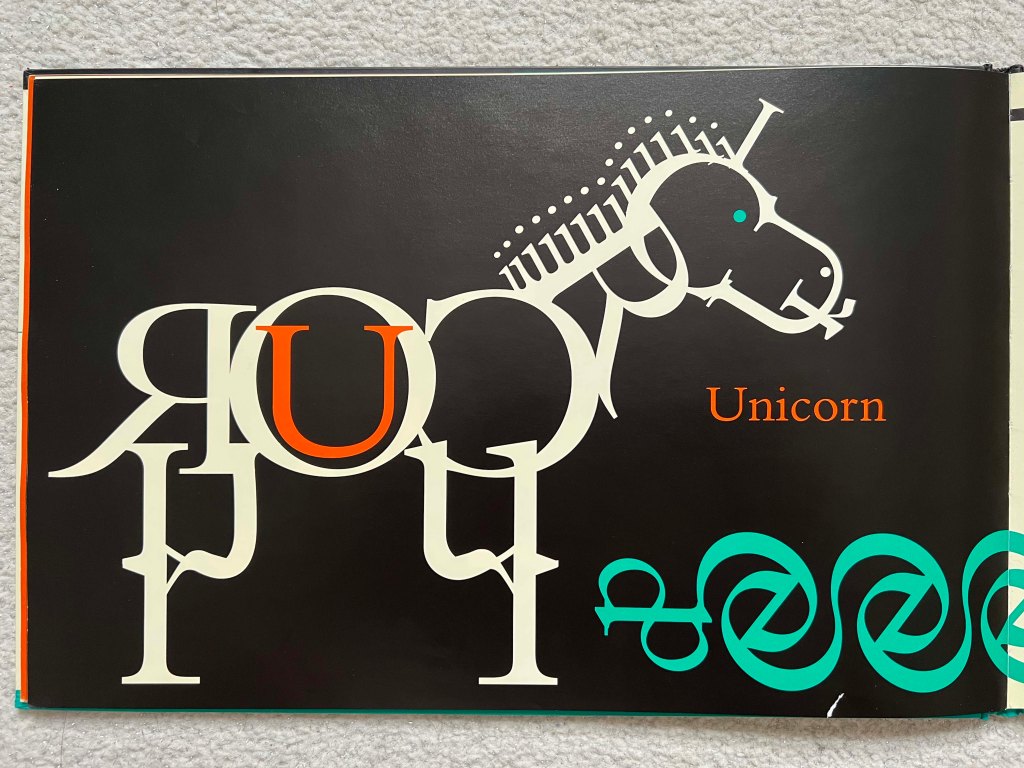
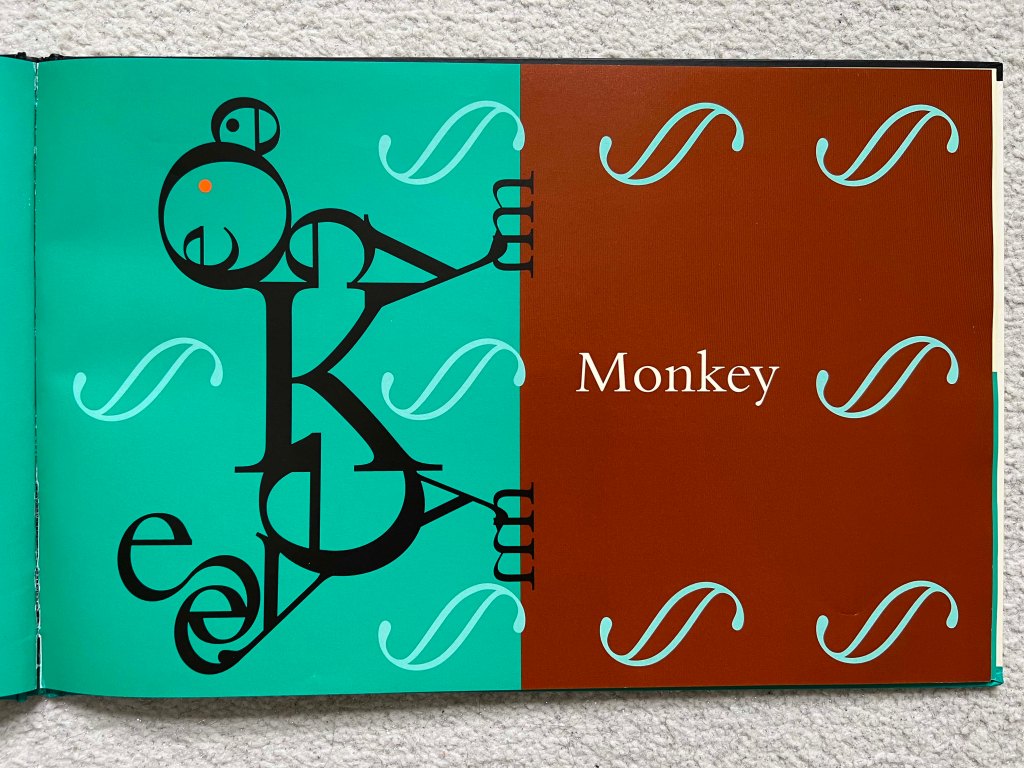
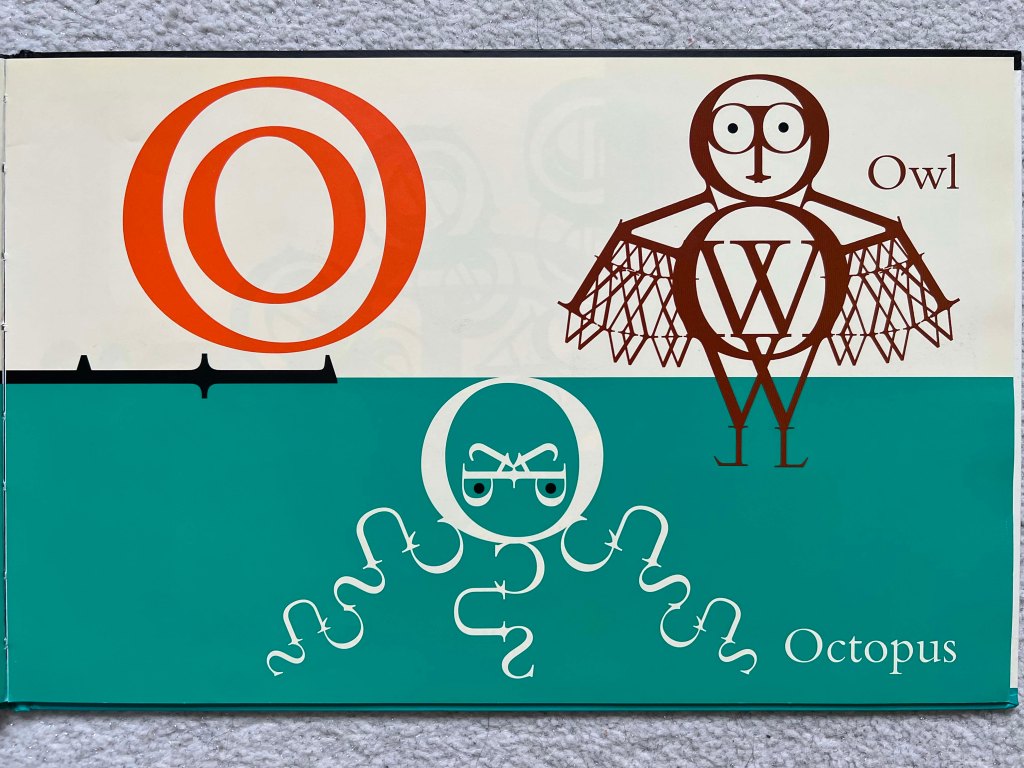
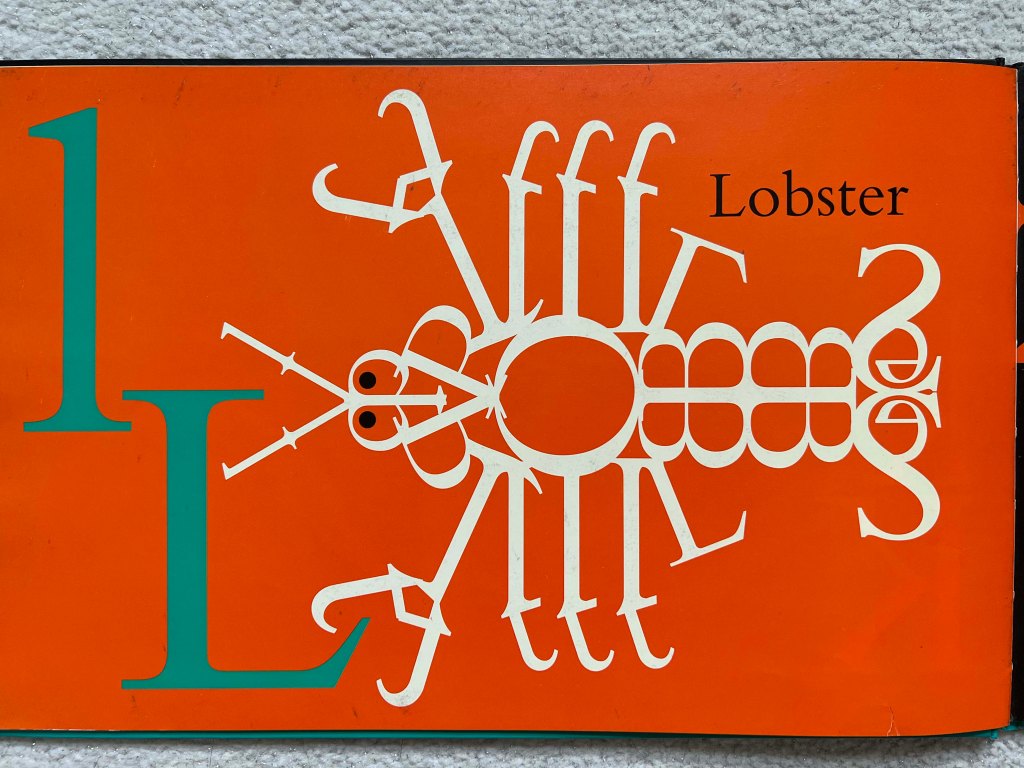
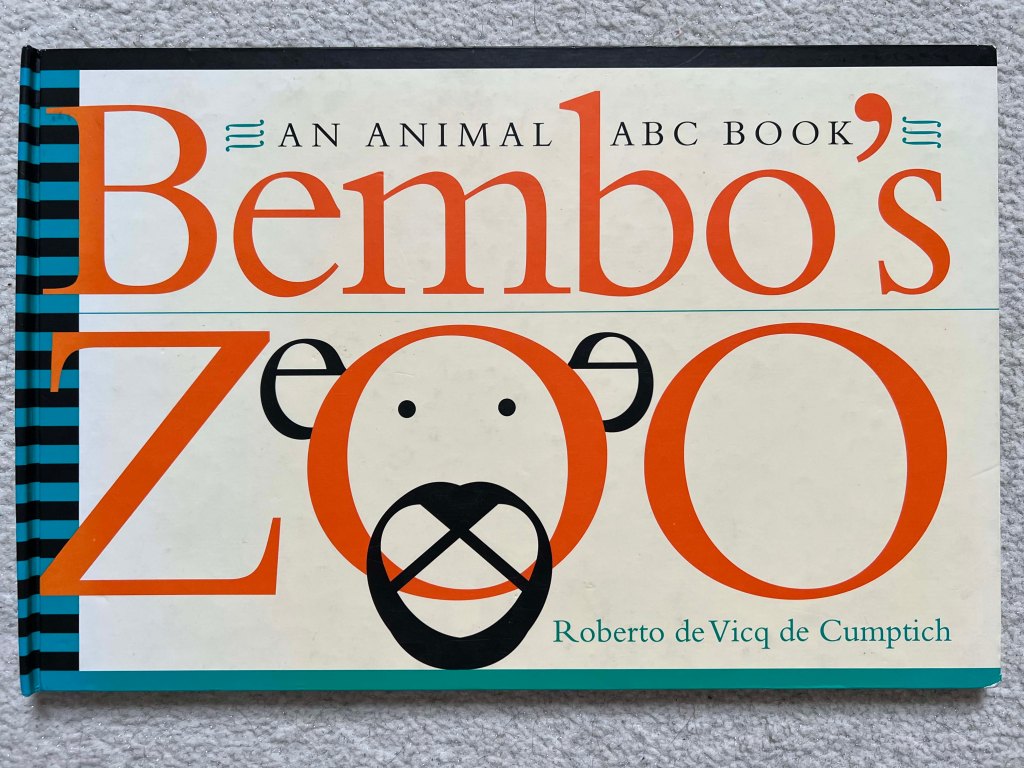
Roberto de Vicq de Cumptich. Bembo’s Zoo: An Animal ABC Book

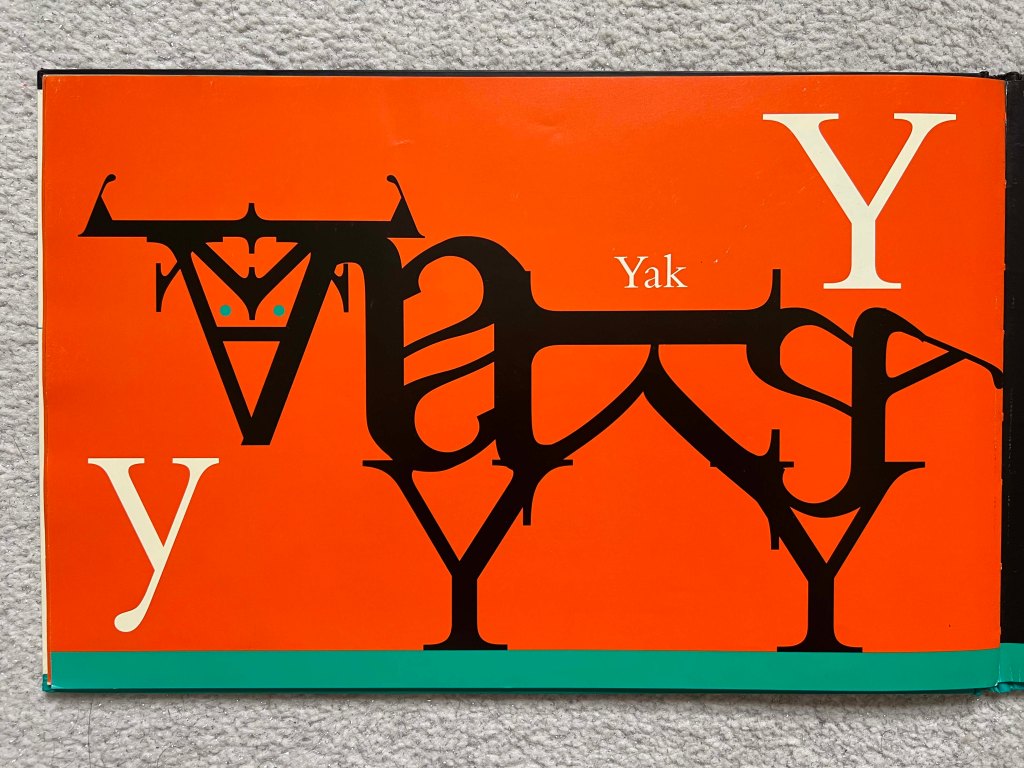
Here I went a bit away from fanzine and experimental typography. This bold colour and simple yet striking graphics with a unique alphabet. A great example of experiments with typography, which almost makes it look concrete, but in a colourful and bold way. I loved how skilful the author played with the shapes of the letters by creating an alphabet that finds curious not only children but graphic designers as well. The Bembo typeface is one of the most elegant of the classic typefaces, and its clean, graceful lines inspired the artist to use the letters in a wholly new way. I’m admiring the sophisticated art and sleek design of this sumptuous book.
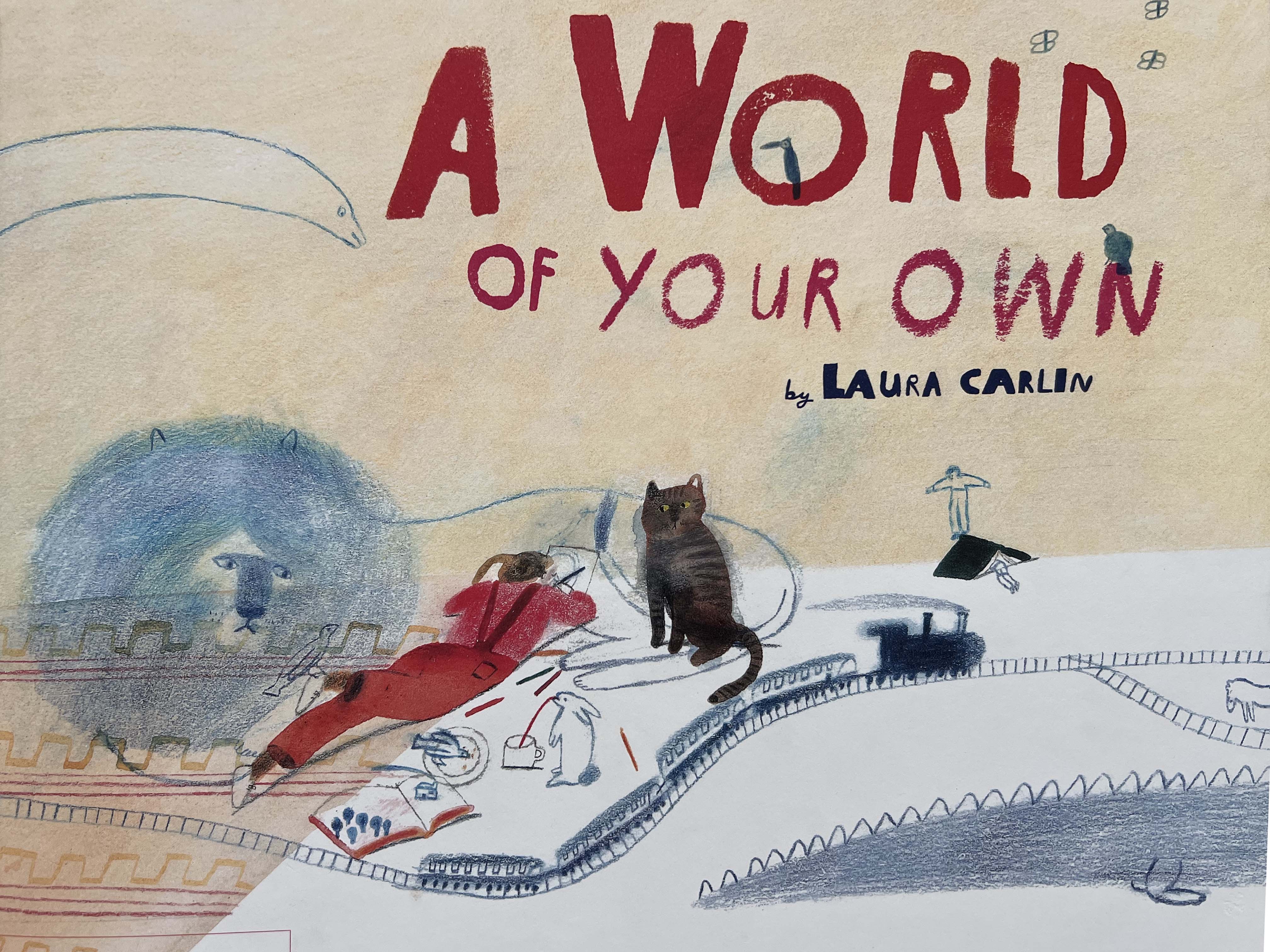
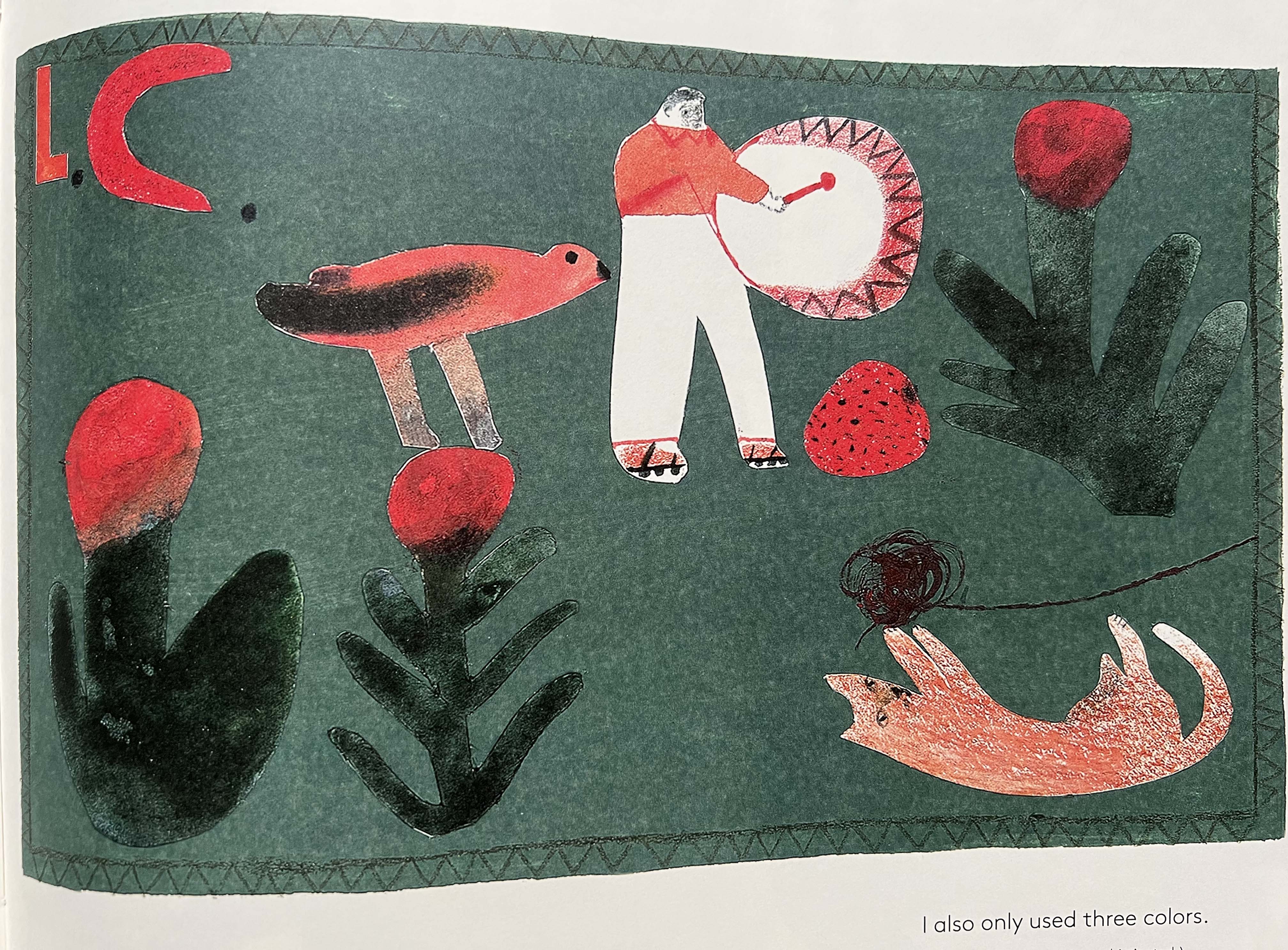
A world of your own by Laura Carlin

Laura Carlin encourages kids to draw and create inventive pictures in her own distinctive way that constantly surprises. I love the playful way how she integrates wording into the illustrations and handmade font for the messages, which smiles and brings happiness. She demonstrates how to create our own version of the world could be by using imagination.

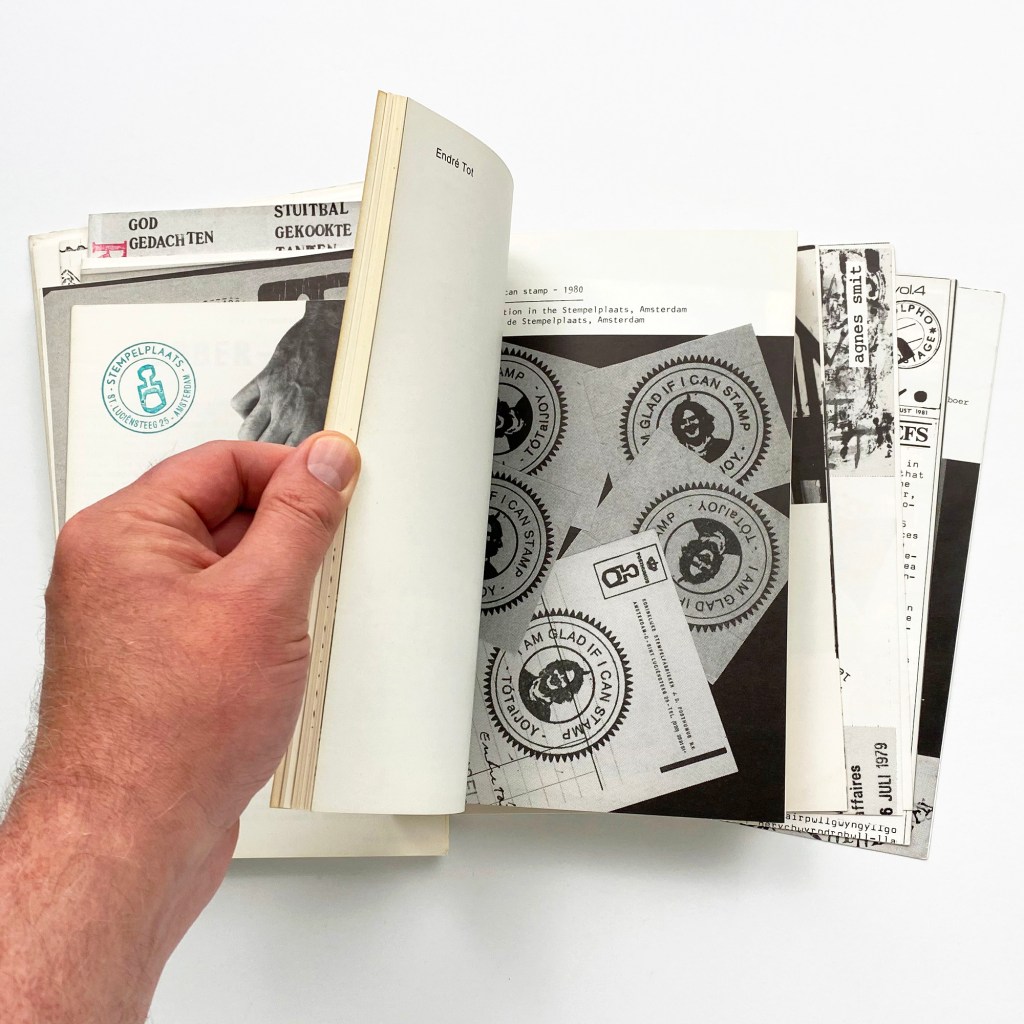
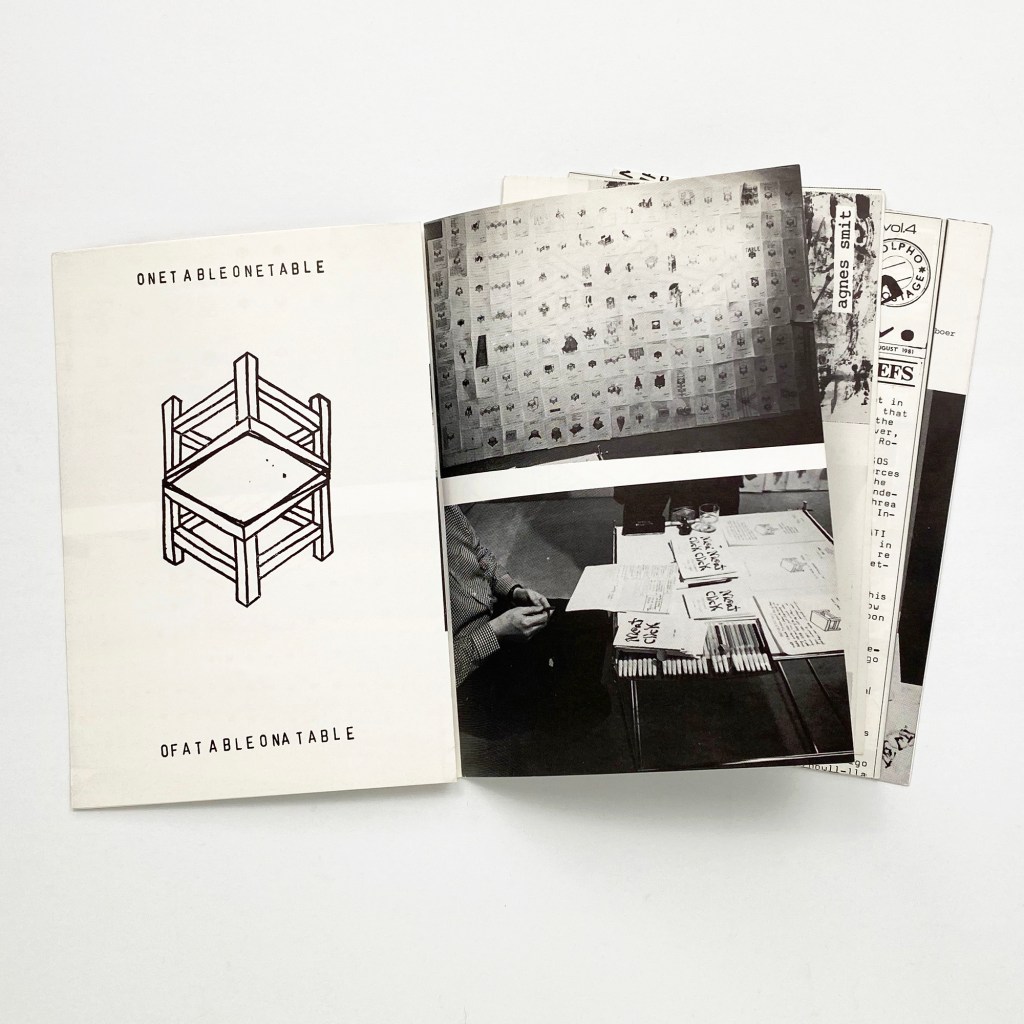
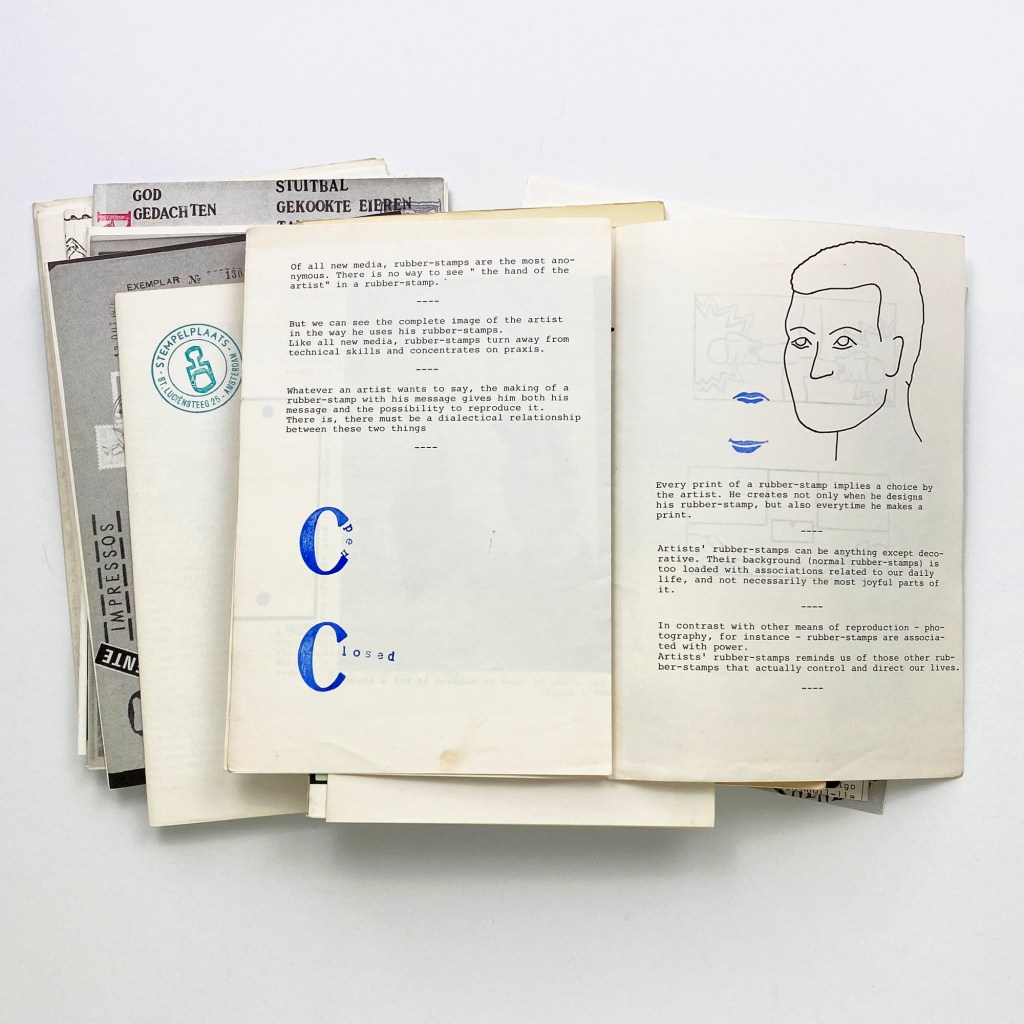
A Monthly Bulletin On the Use of Rubberstamps in the Arts

Another interesting example of a handmade book I stumbled on by accident. This is a unique example of a creative magazine, which is quite a valuable piece of art on the market. Book designed in self-wrappers, printed in minimalistic, colours, mainly black and white and rubber-stamped in various colours.

After some research and ideas, I realised that my inspiration came from different sources and was very broad. The book is going to be a collective of experiences and knowledge I gained through these years focusing the subject on experimental typography, visual poetry, some fundamental parts of type, history and influences in design. I knew that my book desperately needs some structure, as there were quite a few points I was going to include, I decided not to concentrate only on a particular point, like only exploring concrete poetry or only fanzines, I wanted to explain the possibilities of typography and its flexibility in graphic design and art.

What is the flow of the content, would you write articles or create imagery or both?

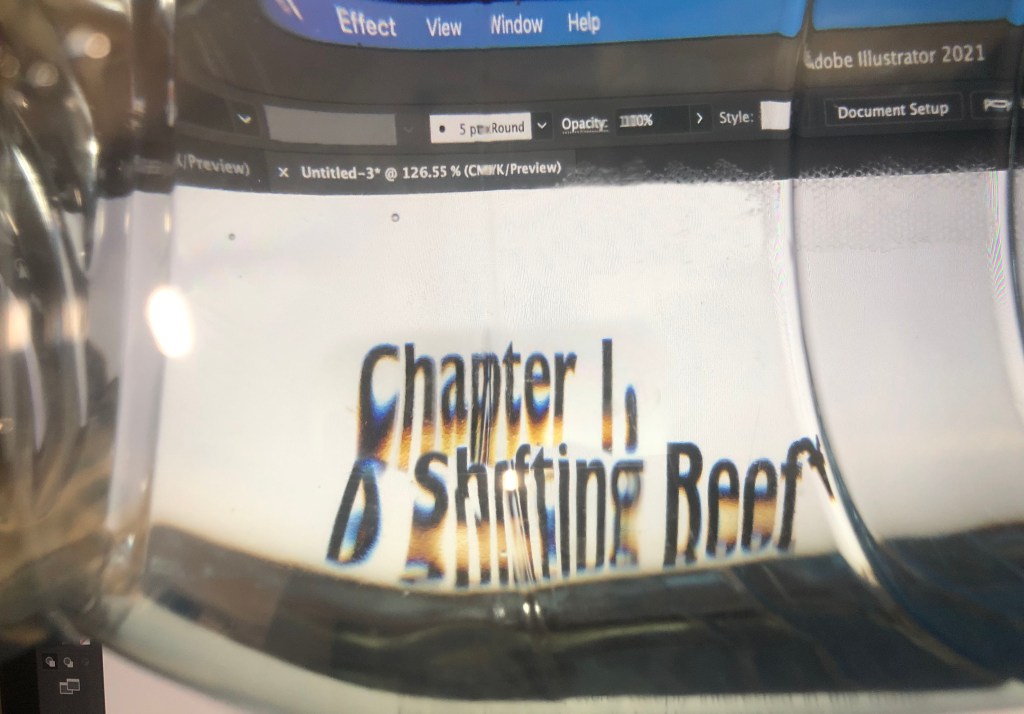
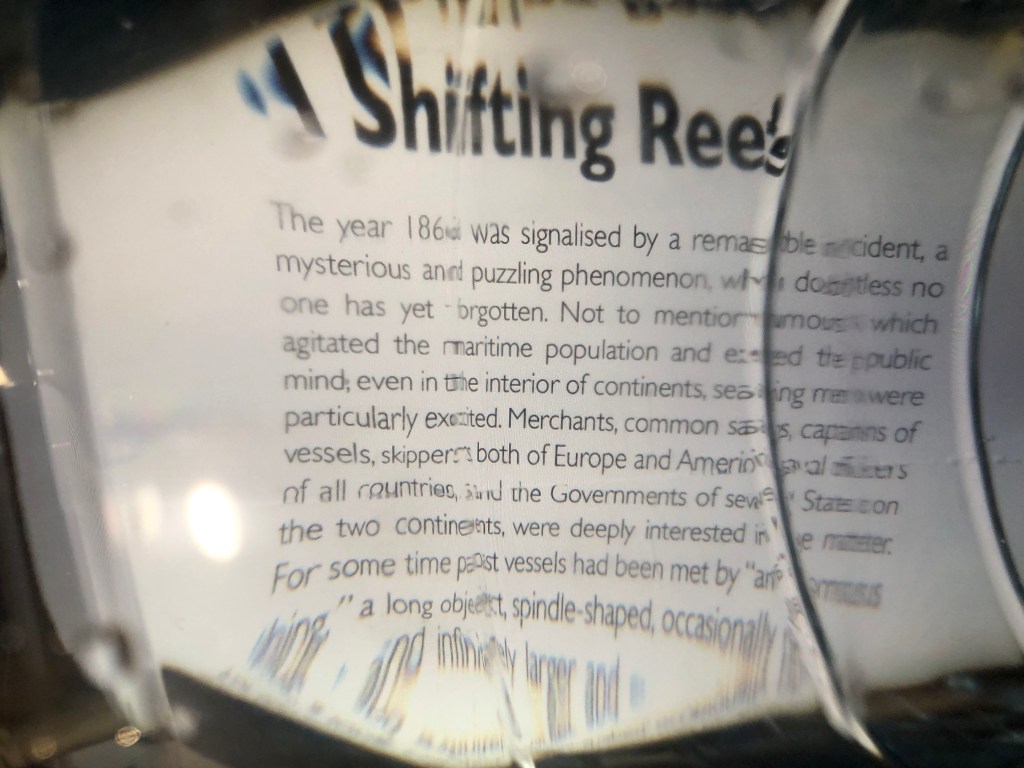
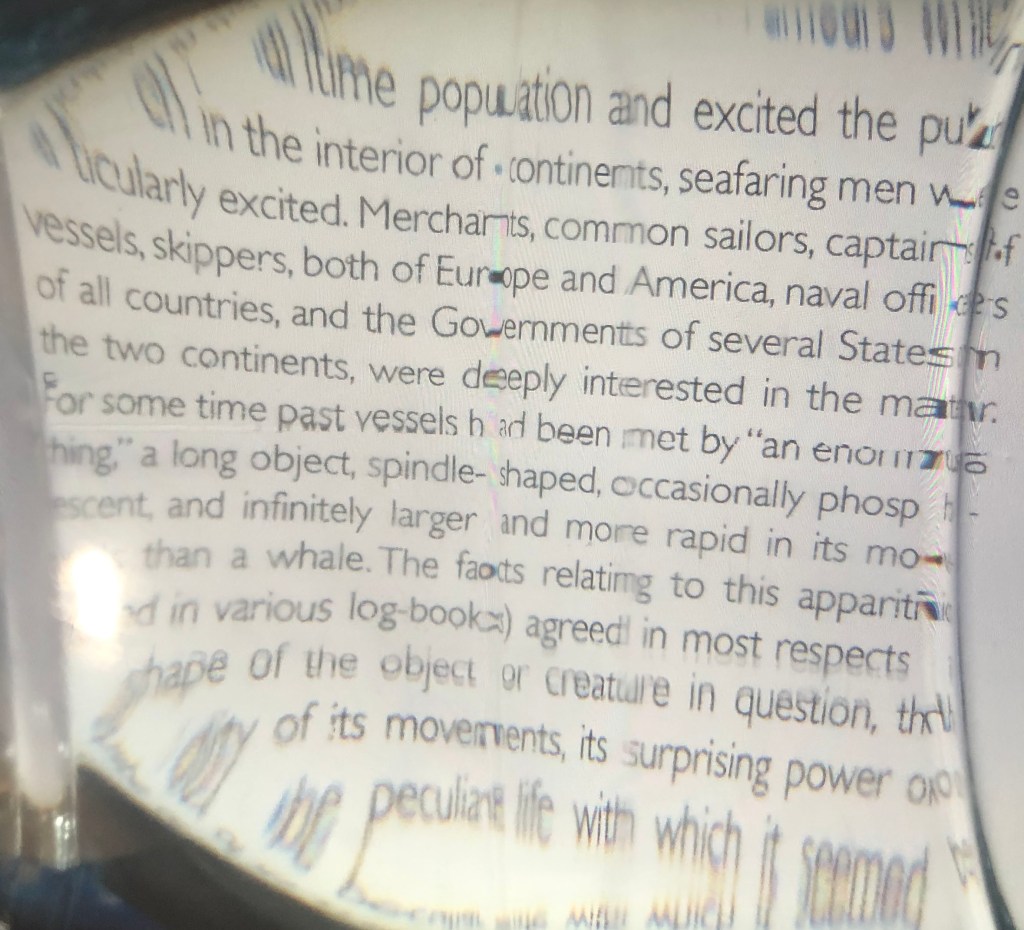
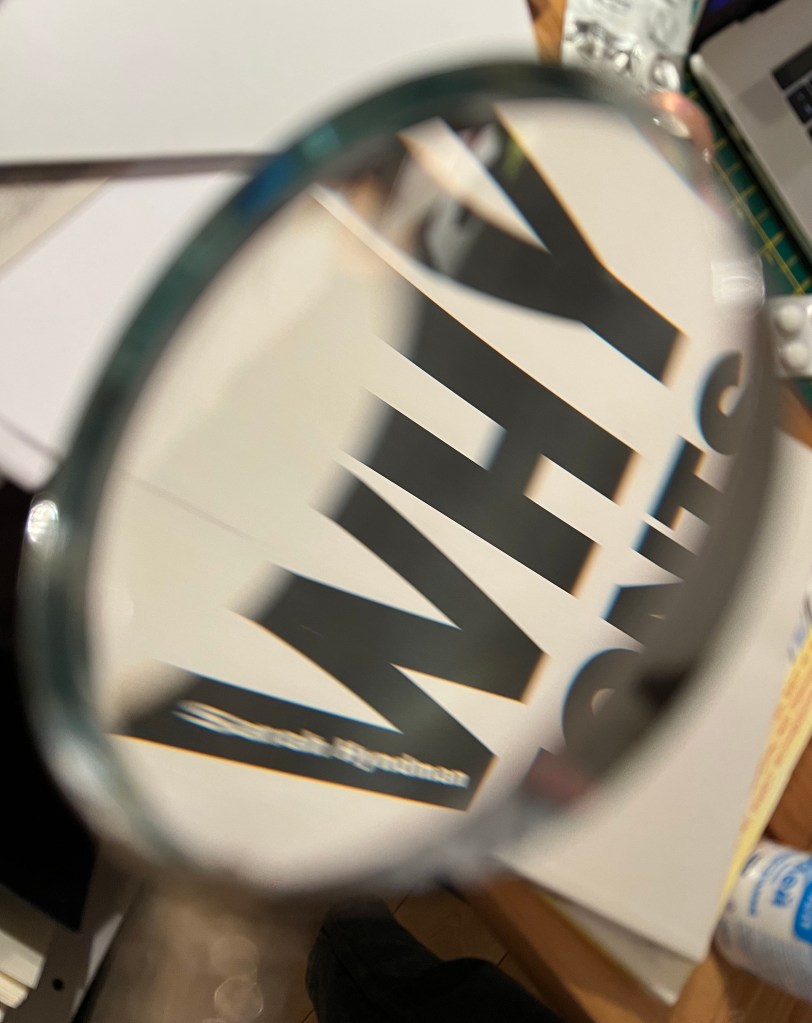
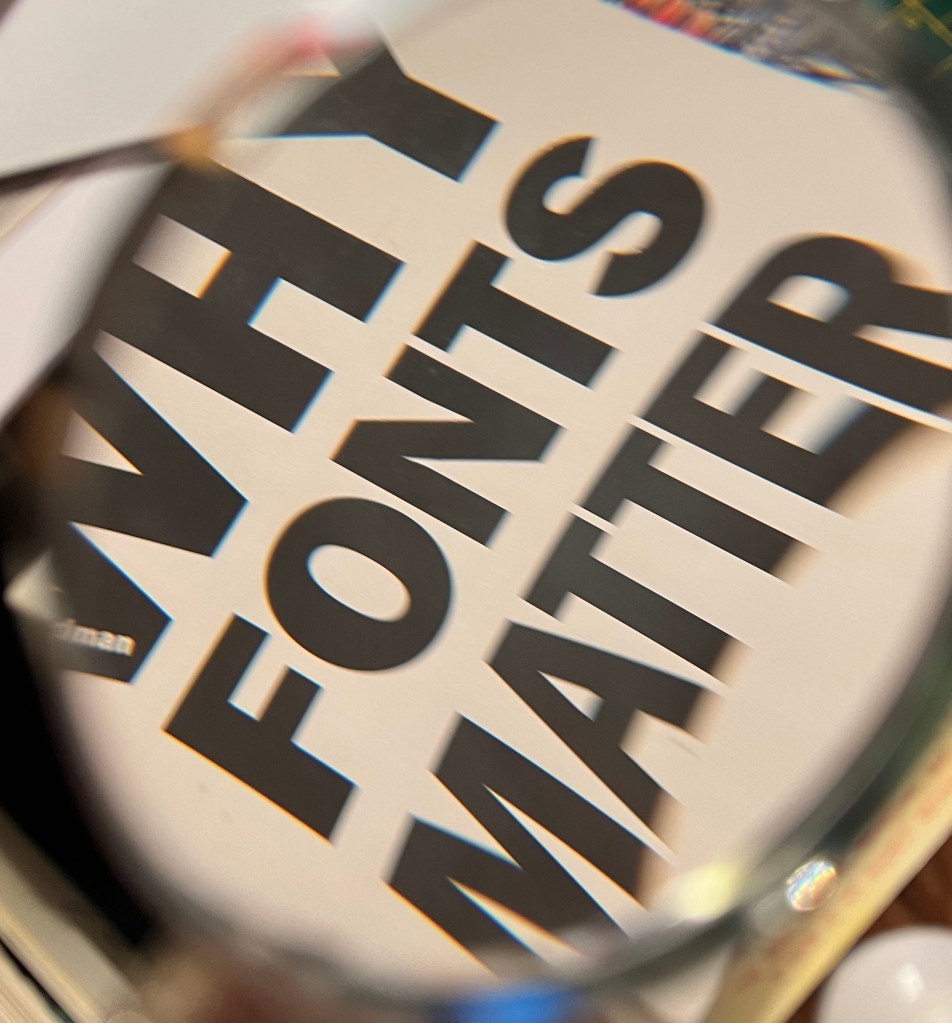
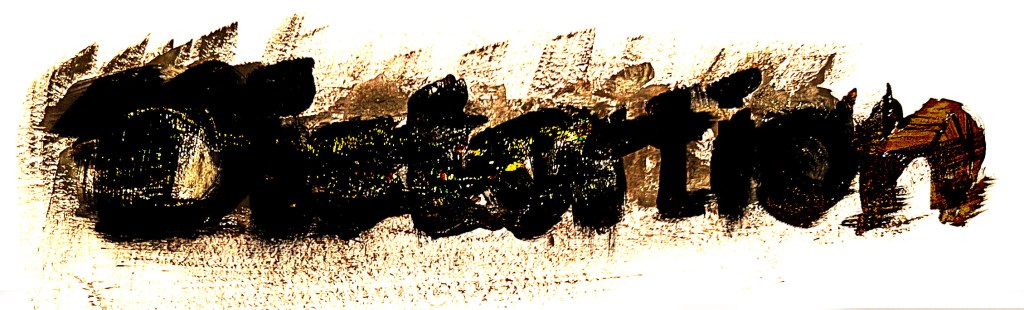
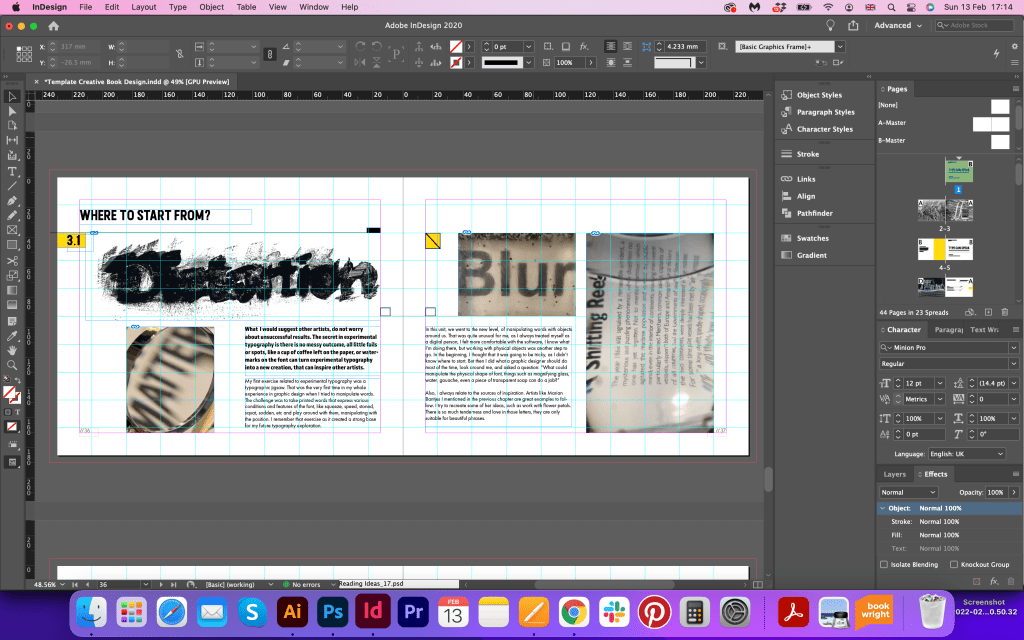
I think that I would like to write a couple of articles on subjects such as the history of typography, vernacular typography, and brief explanations of why fonts matter, and also, include some articles about influential designers, I found the inspiration. I’m thinking to include concrete poetry as well. Also, I wanted to share a couple of spreads on examining fanzines and posters on electronic music, which from my point of view is the centre of experiments in typography and there is a chance that flyers and posters from the ’80s and ’90s became more and more popular nowadays. In addition, I wanted to include some typographical experiments, same as digital and hand-made, such as distortion of typography in Photoshop and creating distorted typography from objects around, such as water battle or magnifying glass.

What do you want to tell about the subject?

My goal — is to share with other designers and artists the learning path I gained through the course, explain the importance of typography in everyday life, and show that typography can be exciting and inspiring subject to explore. I want to create a personal style within the book as well, and present it imaginatively, as example with La Carne de niño by Pilar Gonzalez Bergez and Cyla Costa, ¿Me acompañas? I want to create an informative book and include visuals, such as collages, photographs and typography experiments.

How would you communicate this?

I’m going to use a mixture of typography experiments, hand-made fonts from the objects around, use some information from books I collected, such as terminology, history of the fonts, history of fanzines in electronic music.

Who is your audience?

My audience is people in art and design, possibly other students who just started to learn more about typography, and looking for some ideas to develop in their works. I would say they are young people, in their twenties. I think it’s nice to create a guide for beginner designers, and for someone who just started to establish their taste in graphic design, to learn something new from others to implement in their designs.

Objects around me

I had so many ideas, that I was not sure where to start. I think I got overwhelmed with the amount of work that had to be done, plus completed work by other students gave me the feeling that I need to make sure I’m keeping up with the same level. There was a lot of pressure on my shoulders as that is the final assignment, the conclusion of the whole learning process in Creative Book Design Unit, and providing a clear and creative response to the brief was quite important in this assignment.

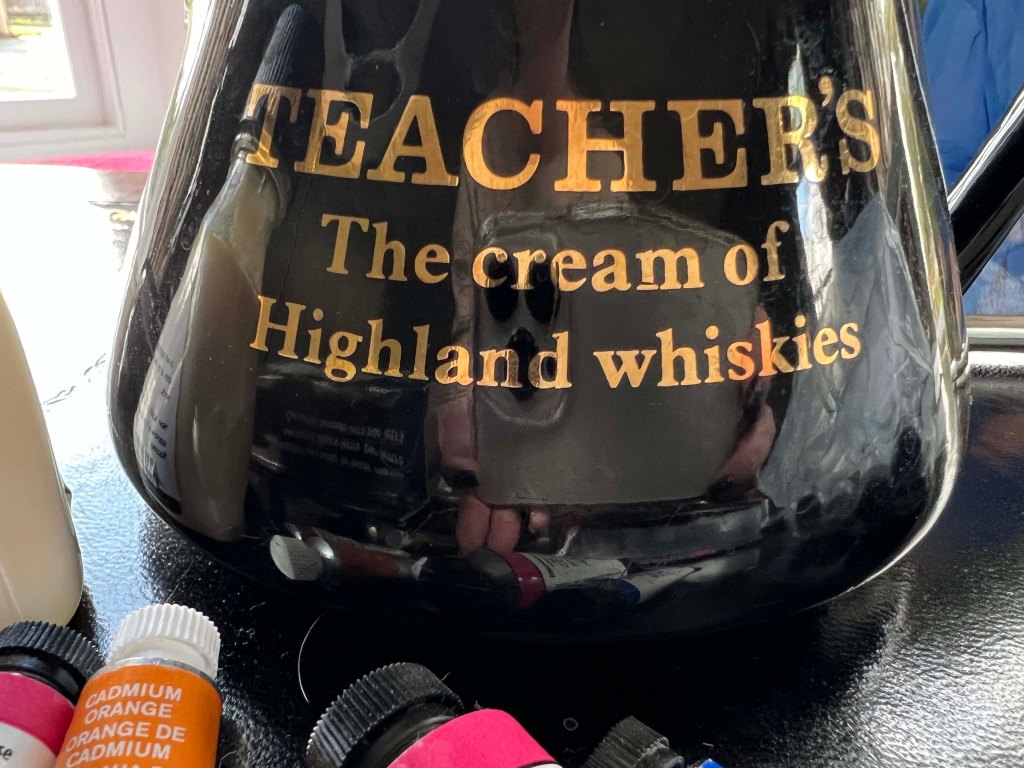
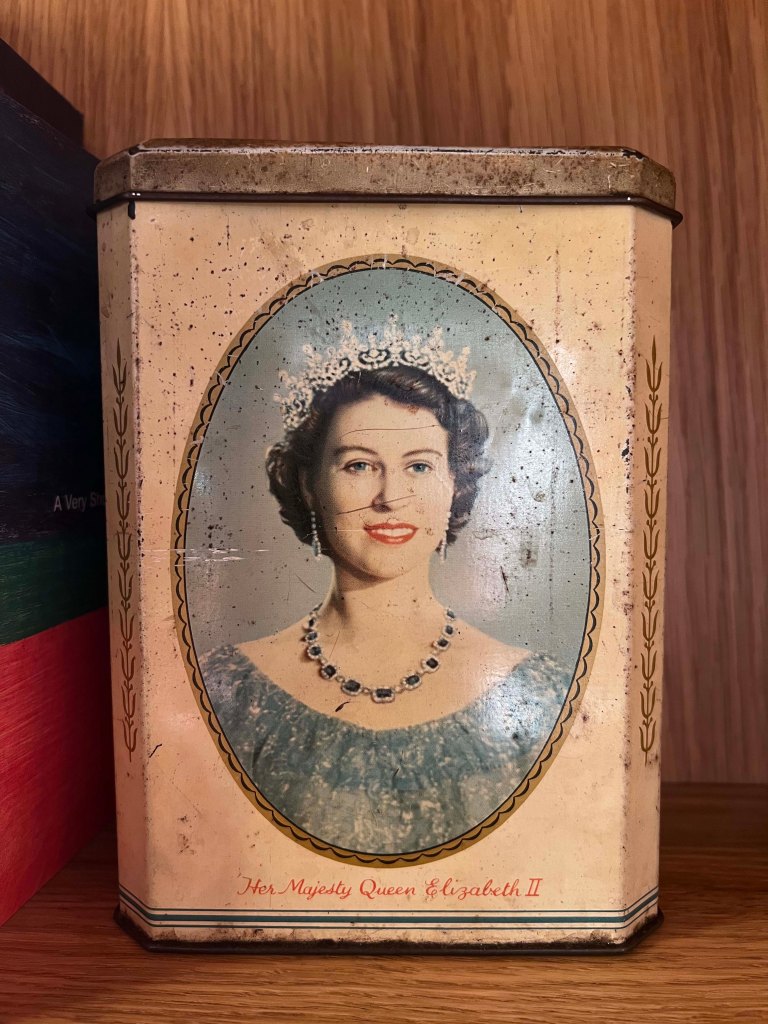
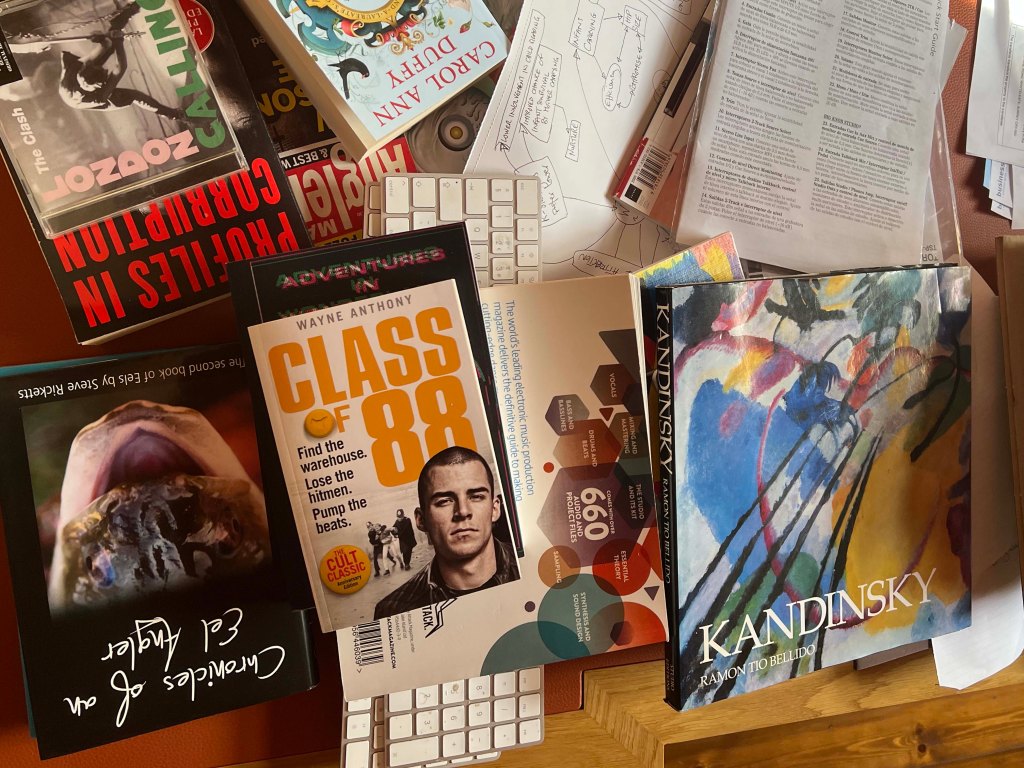
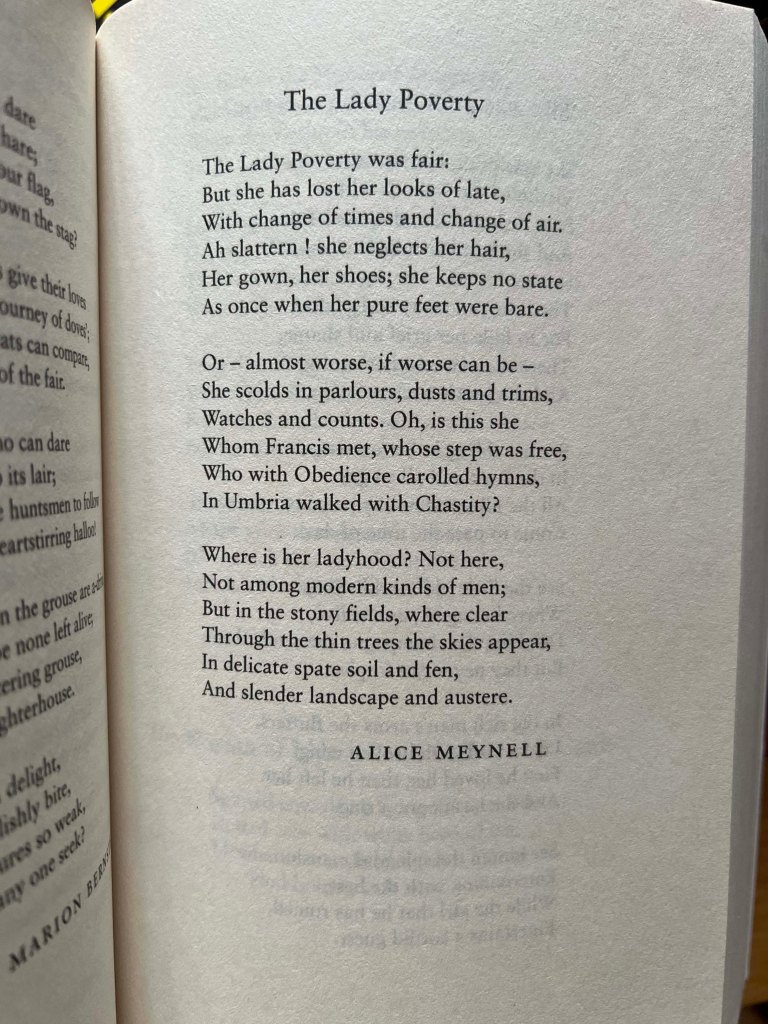
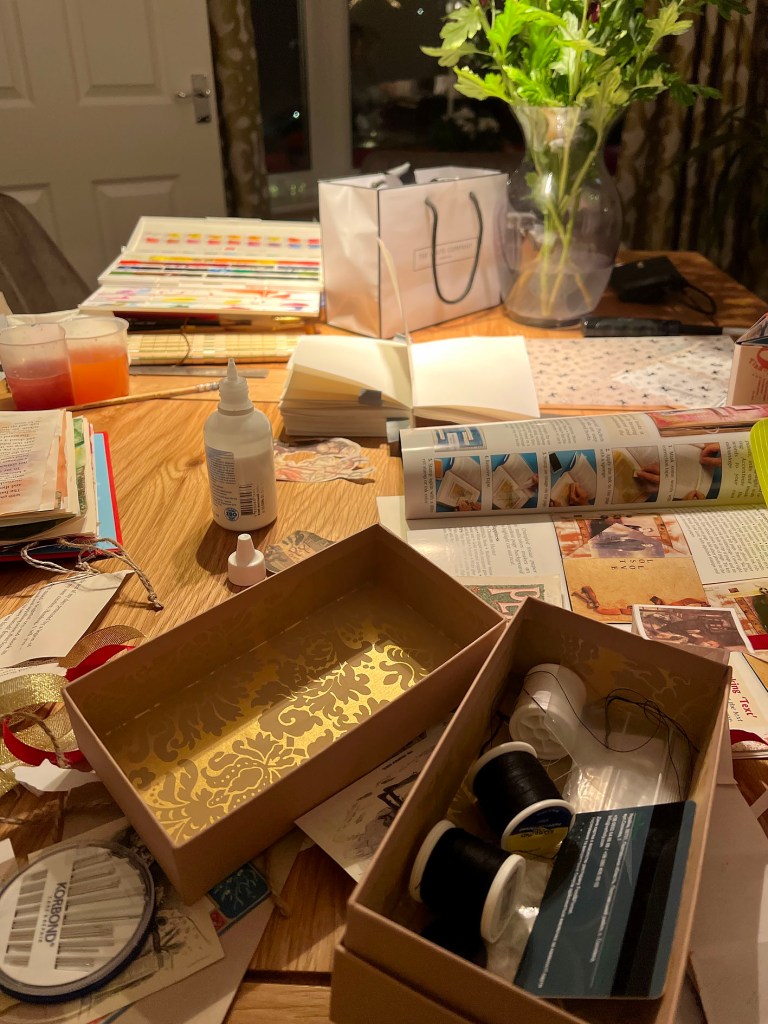
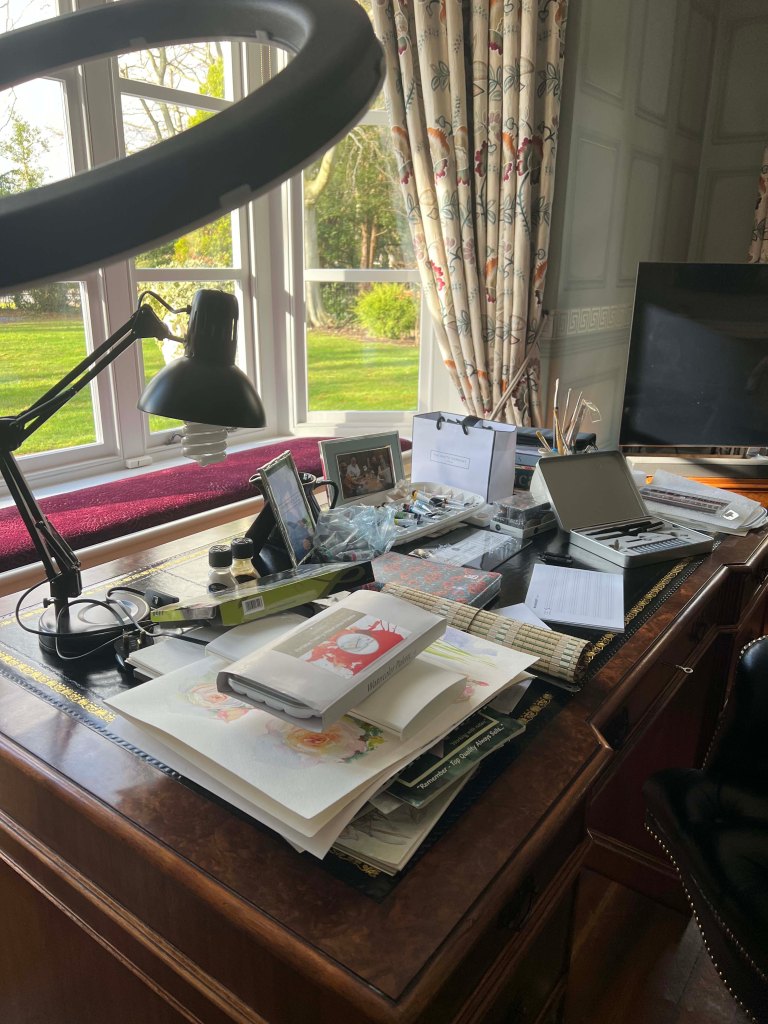
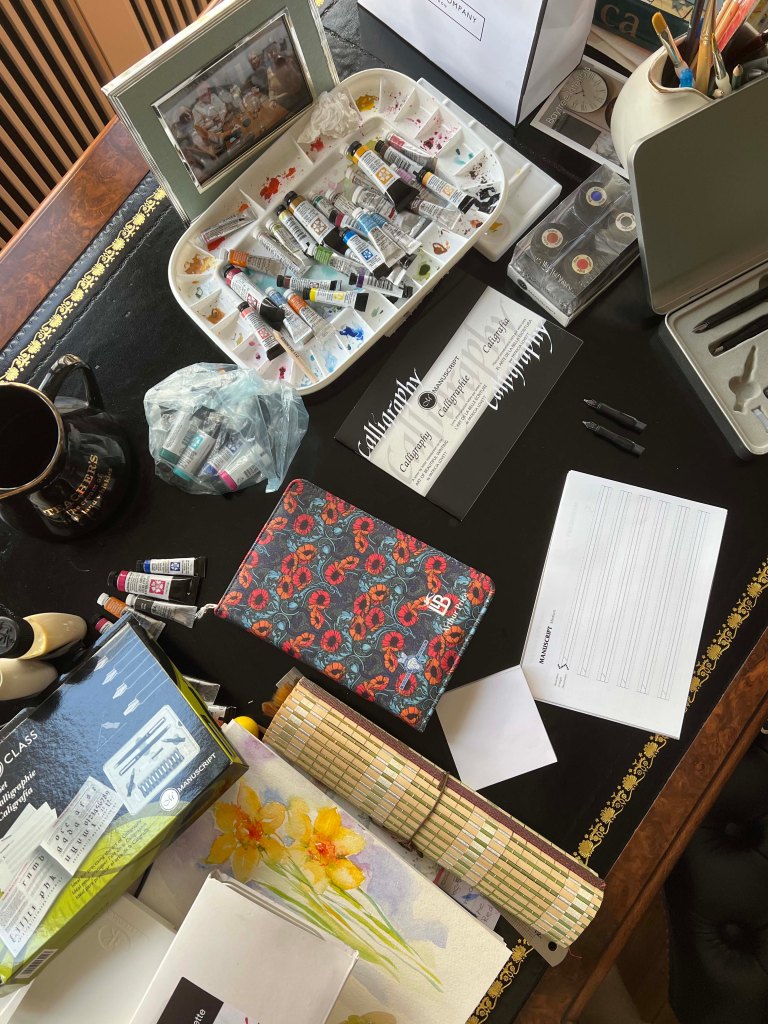
I decided, that the best way to start research would be to go around and look for some objects around me within the house. I took pictures of the working table, I thought I could include some of those photographs within the collage of the book. That’s how I set up for the working mood, by looking around and seeing what my subconscious thinking can bring. There was some typography as a part of vernacular typography, pictures of the poems with the intimate meaning, old records and snaps from the photography magazines. I thought it was a good start and I could move further down with my creative process.
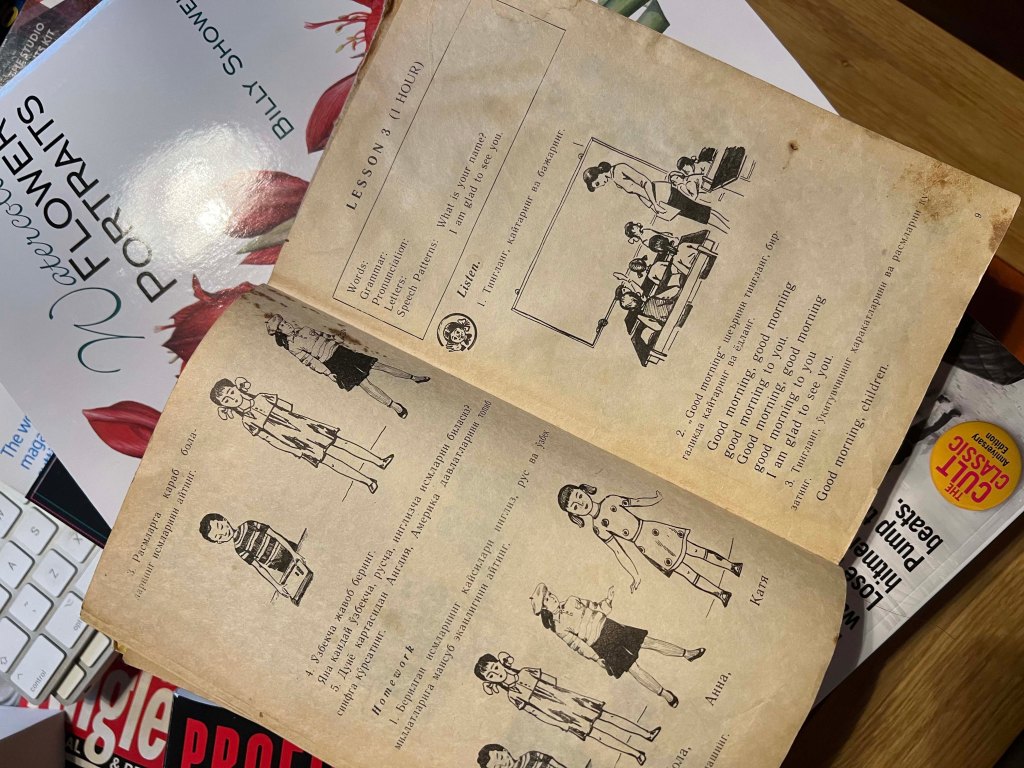
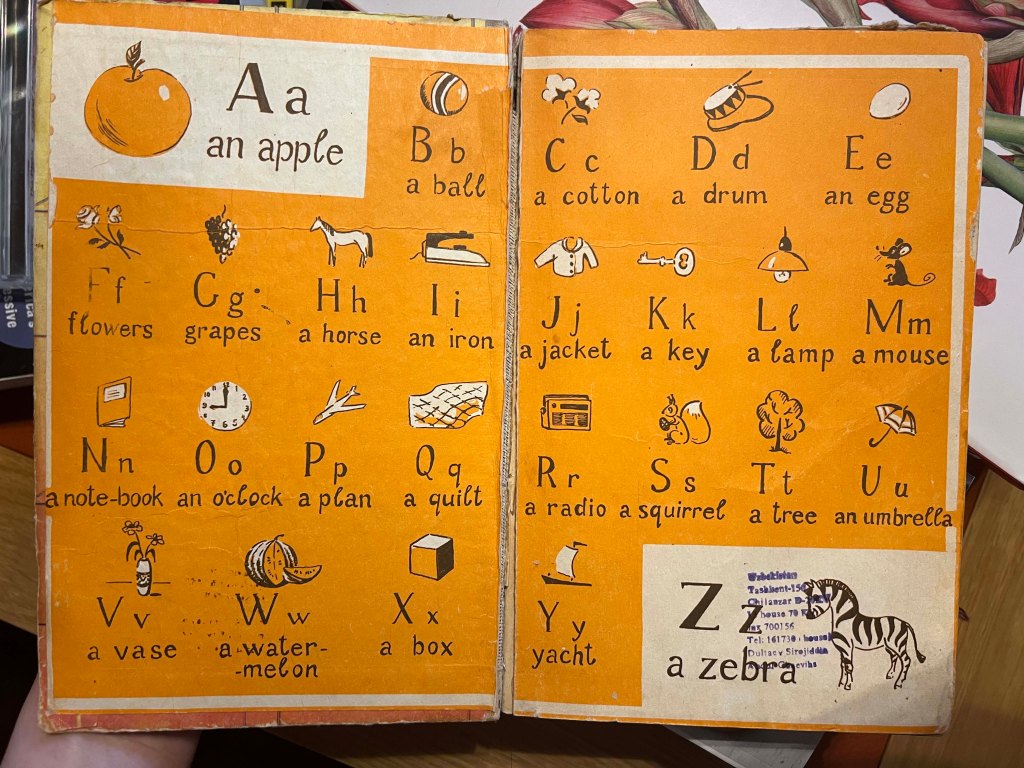
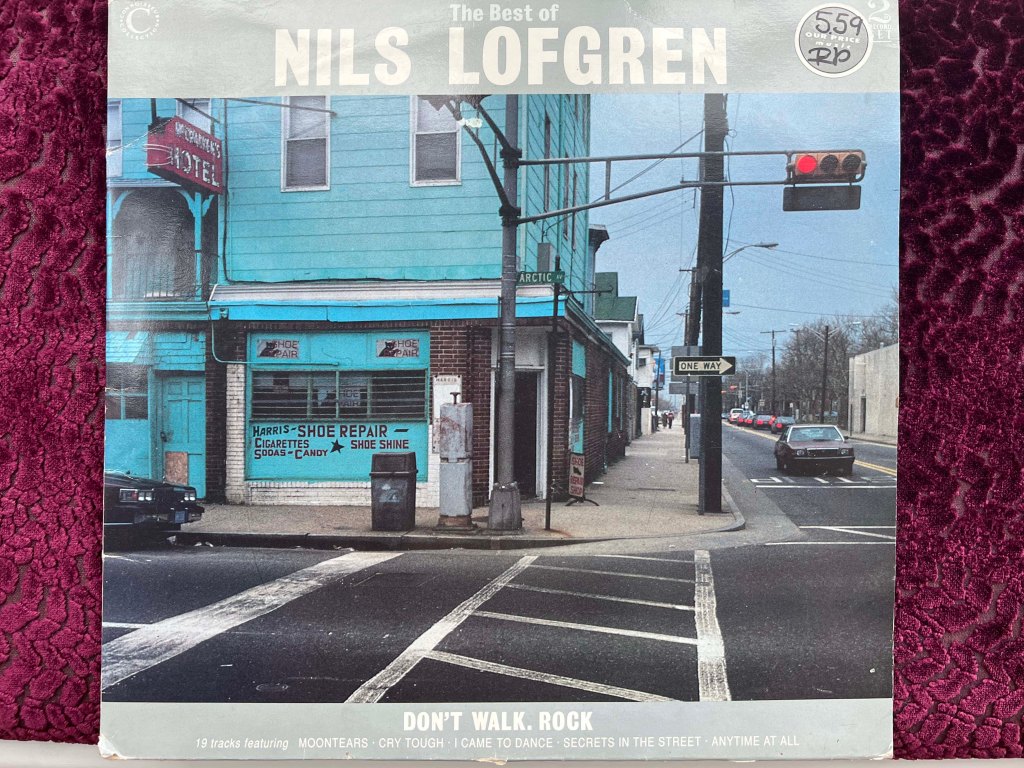
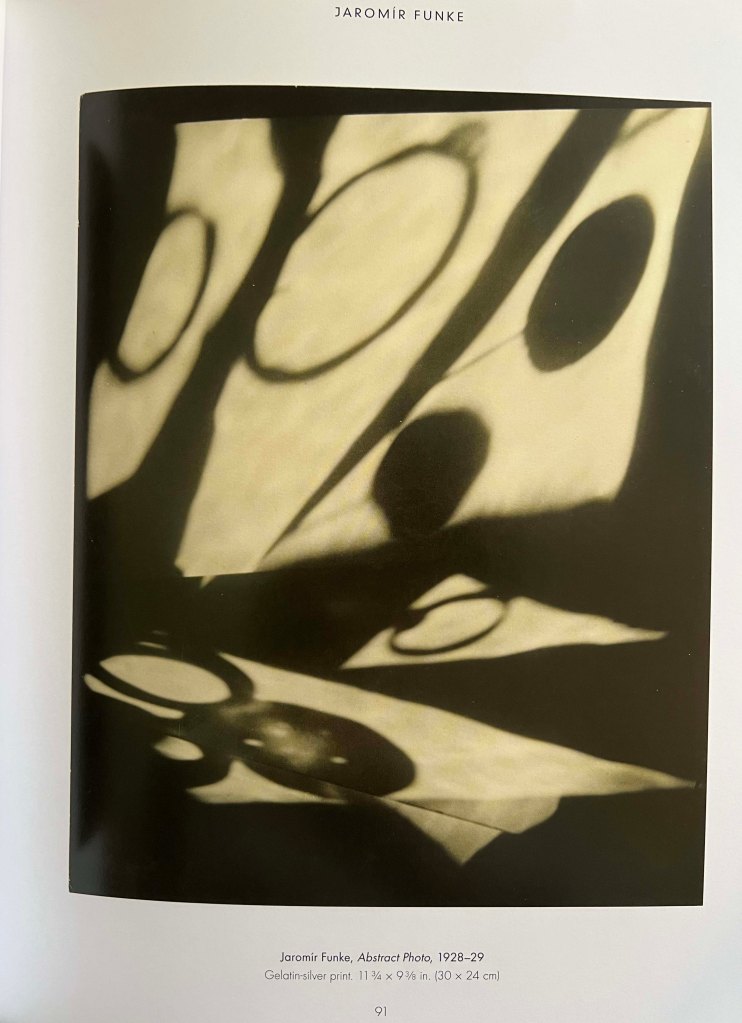
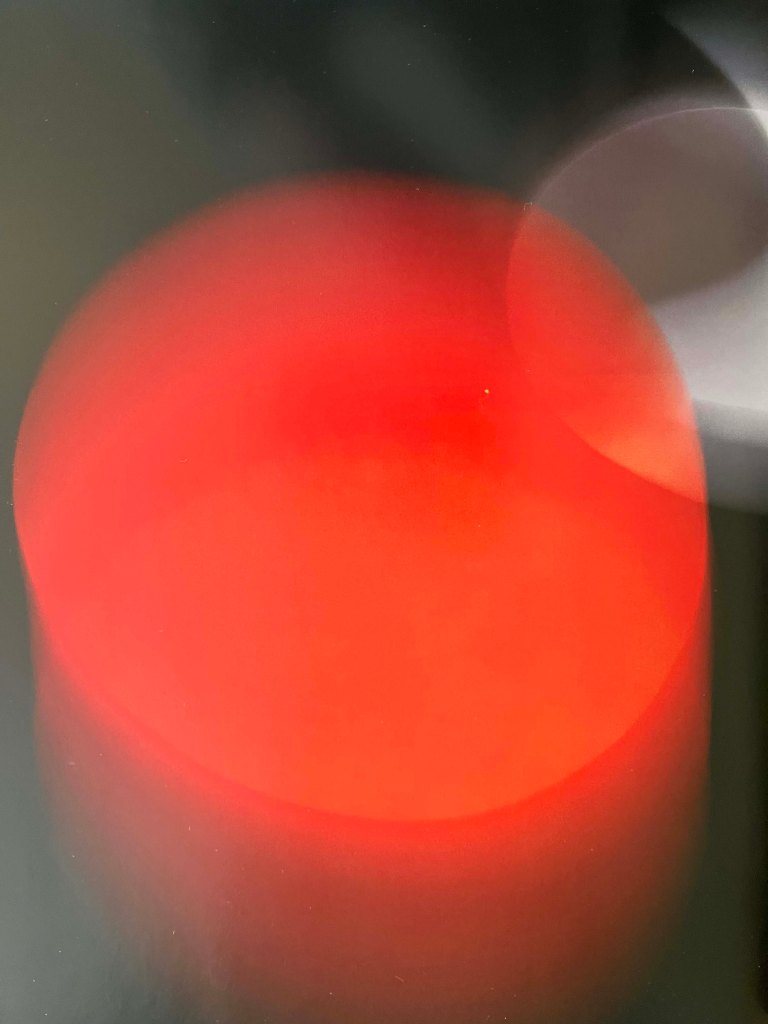
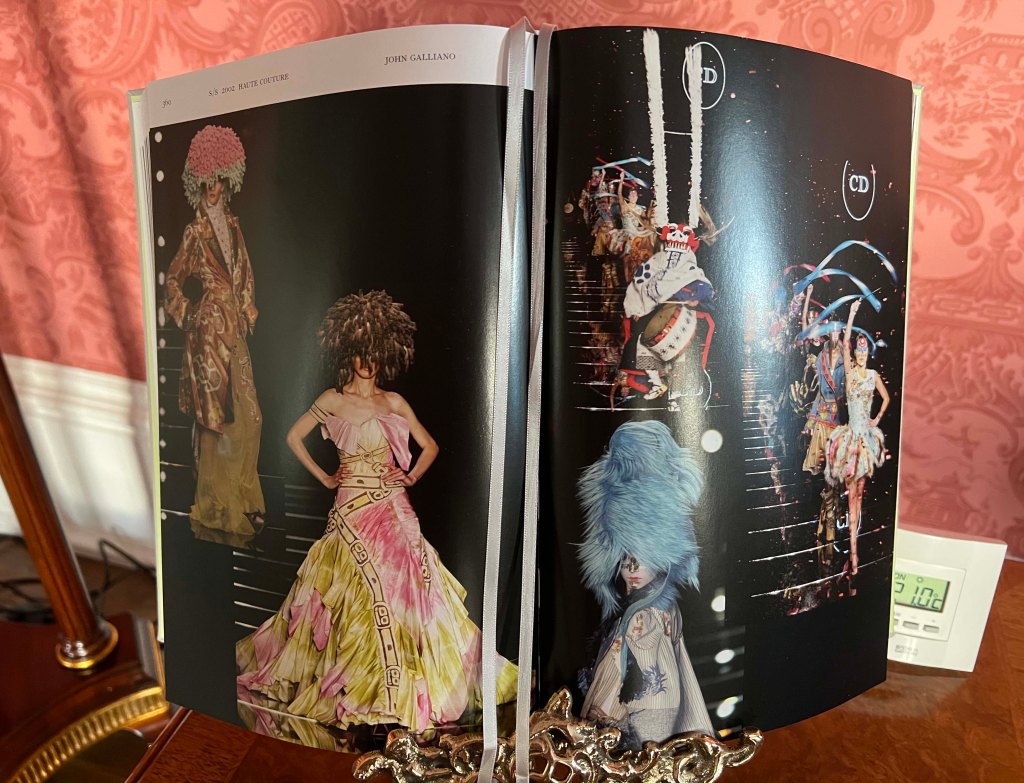
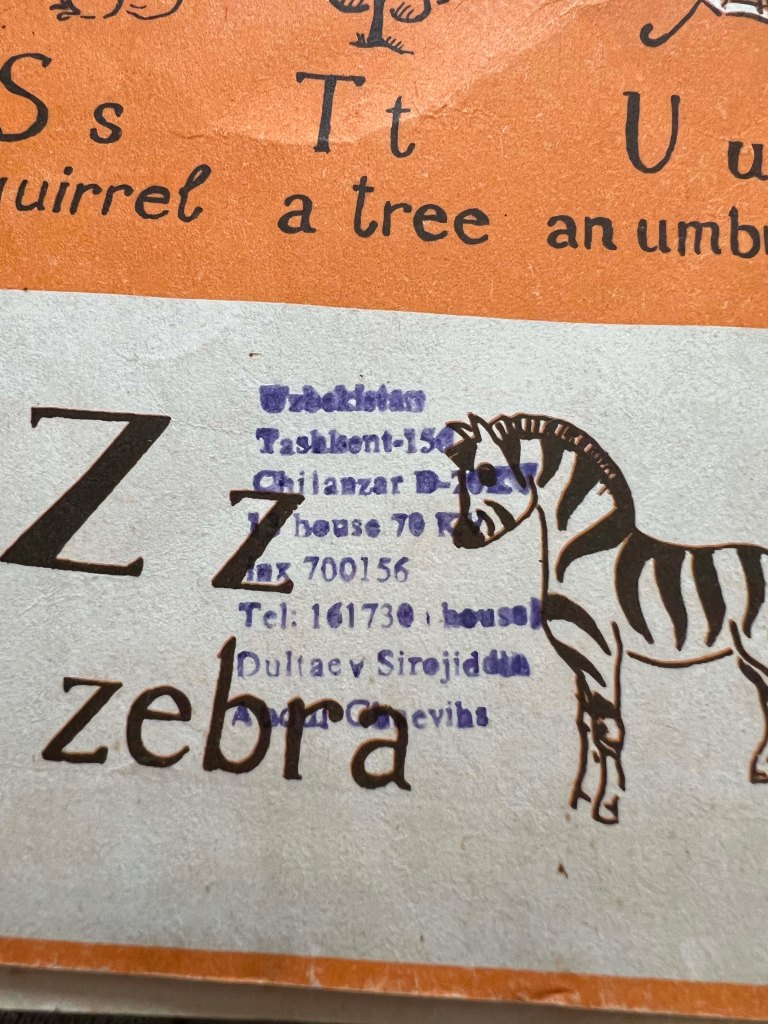
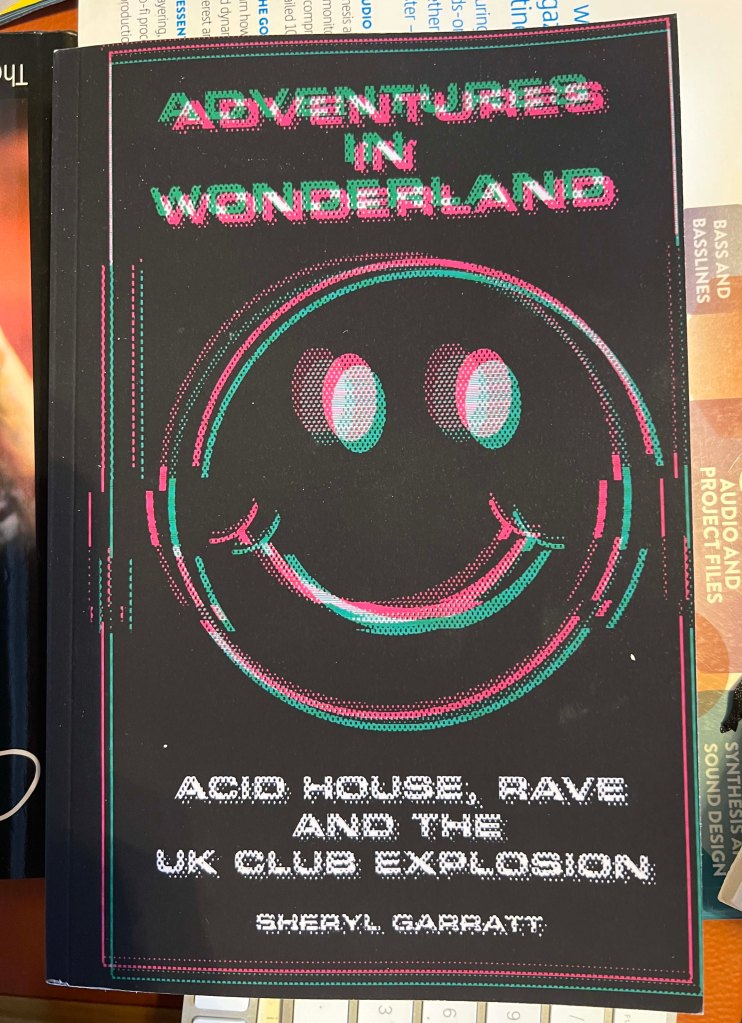
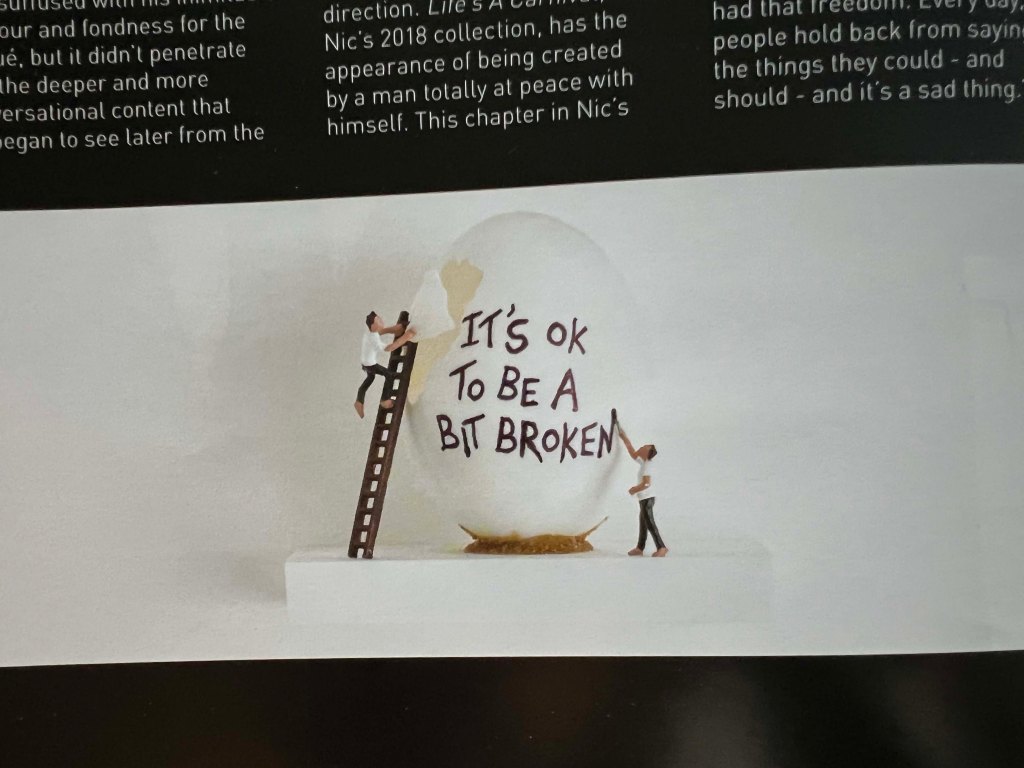
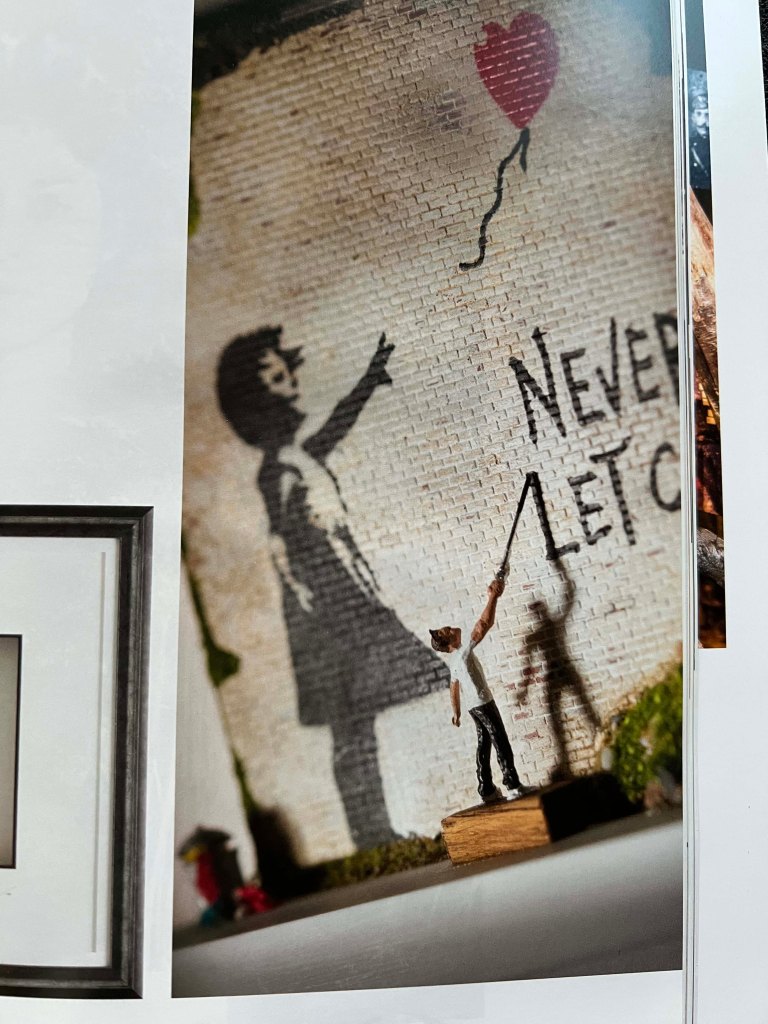
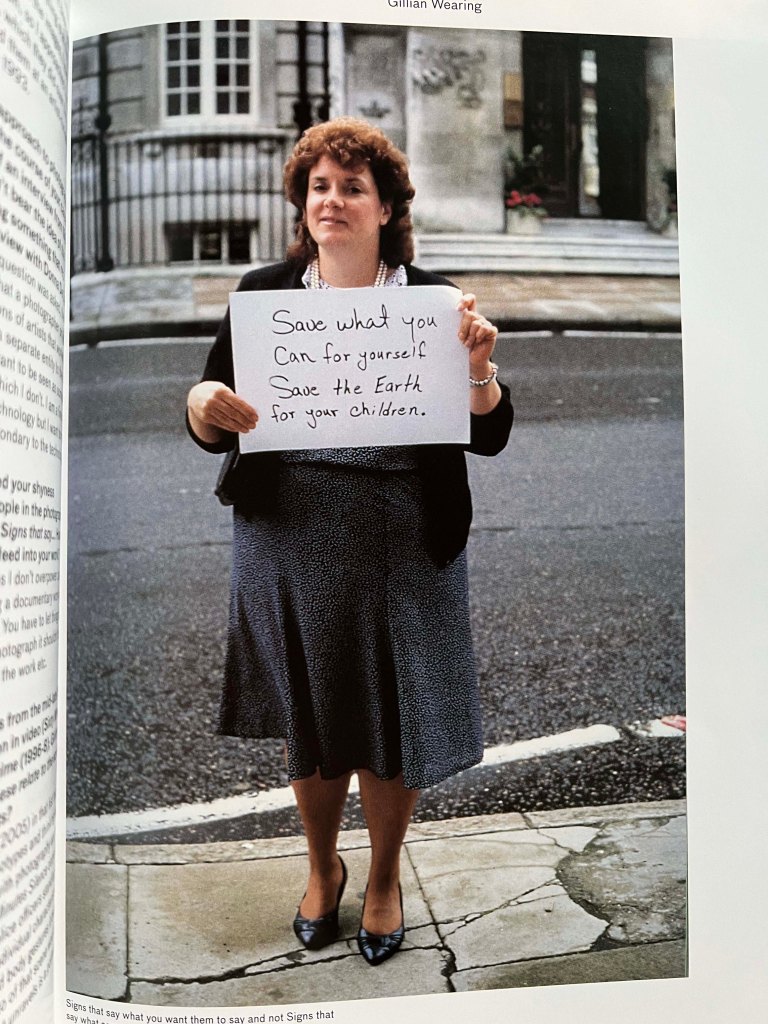
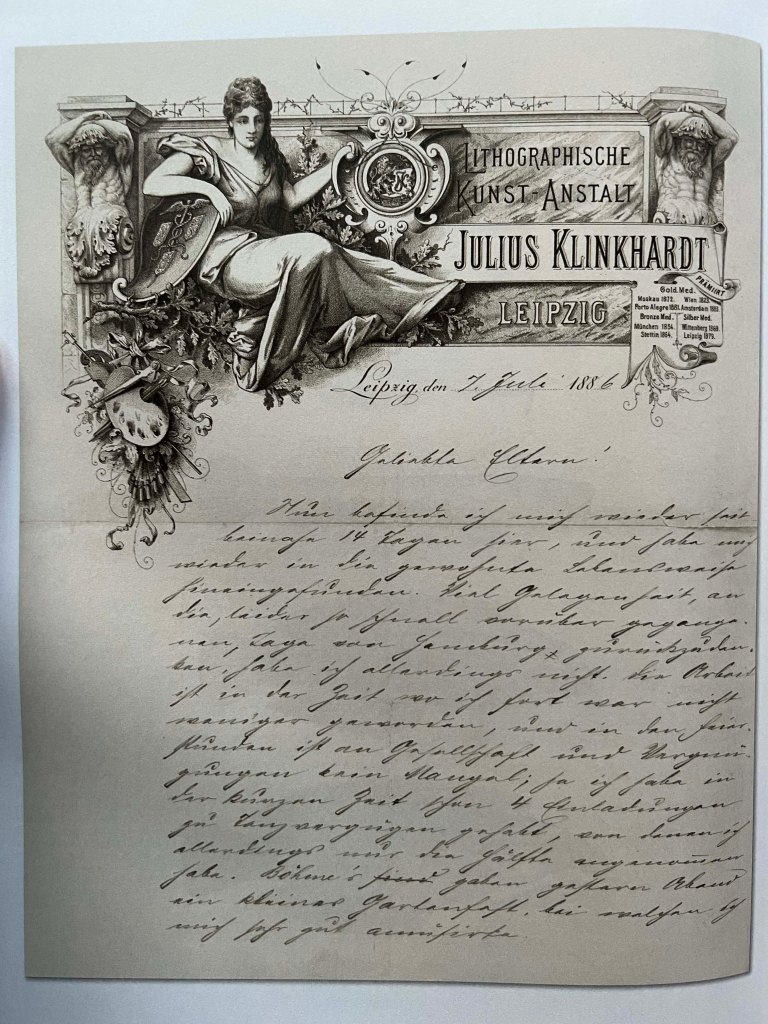
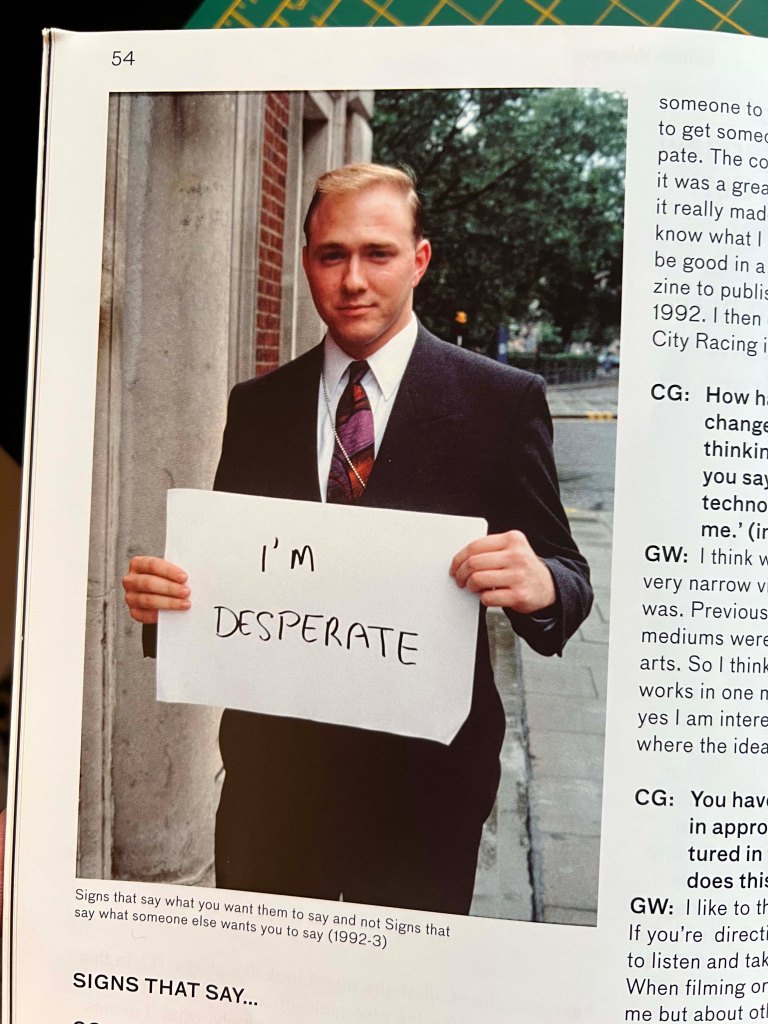
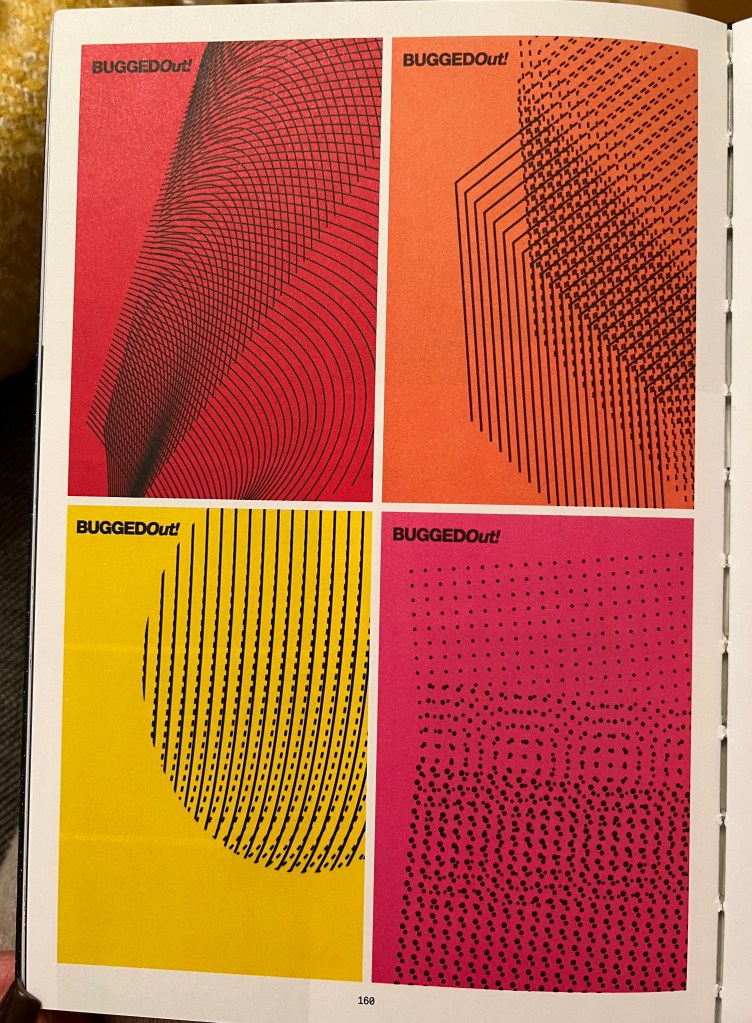
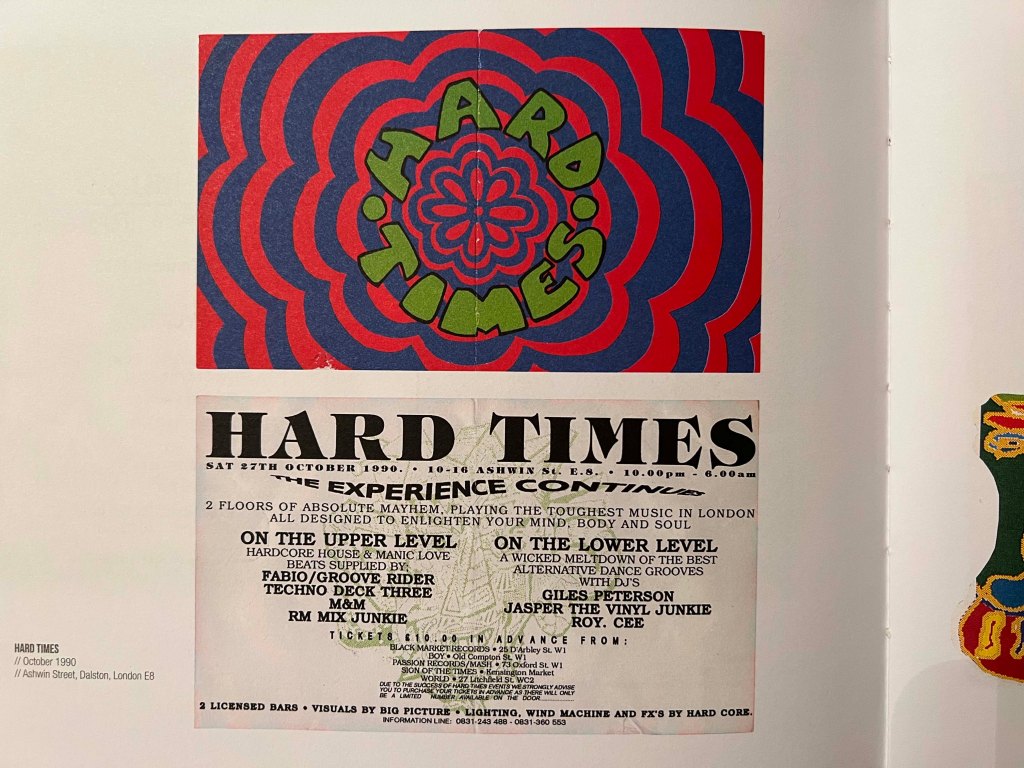
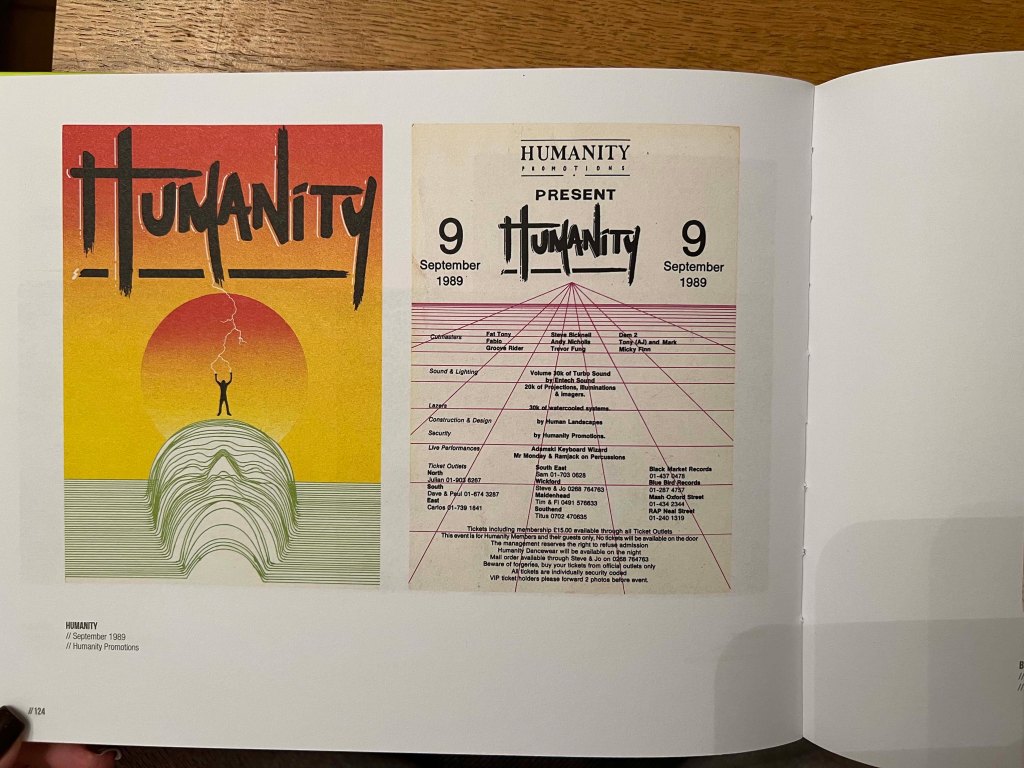
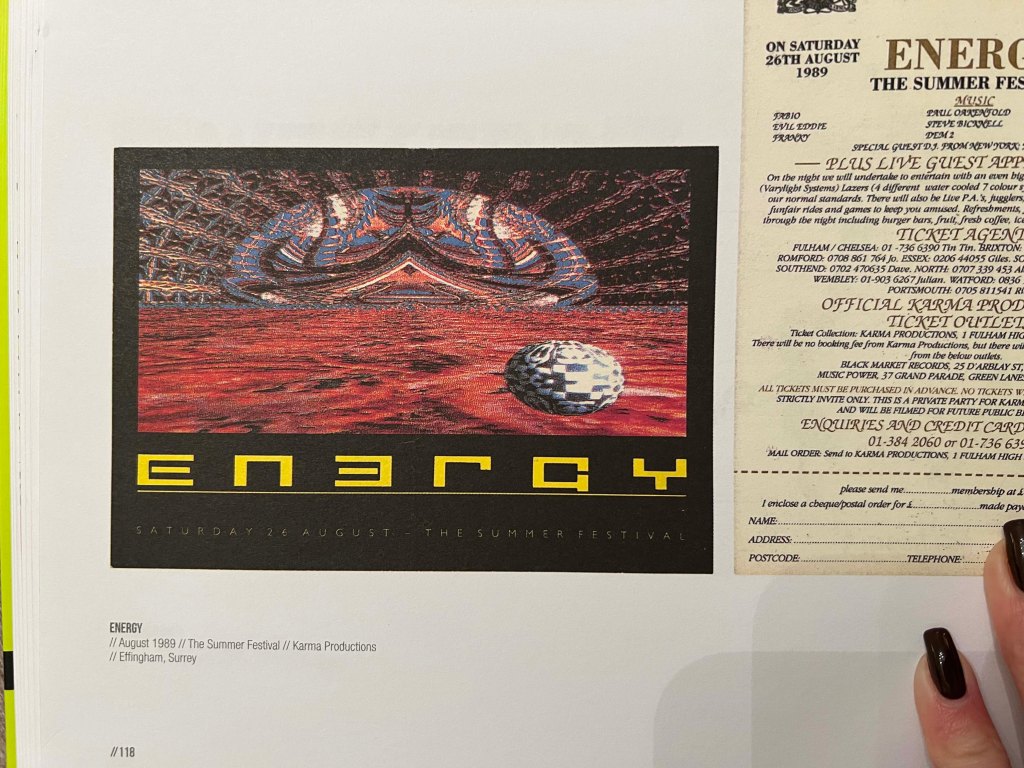
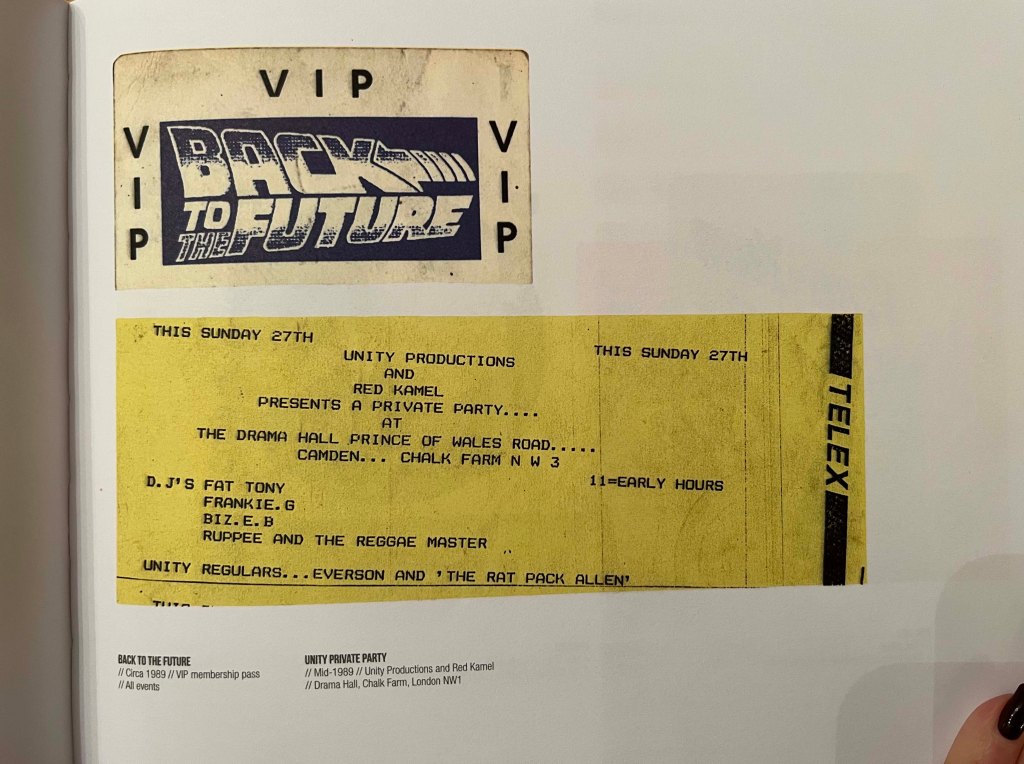
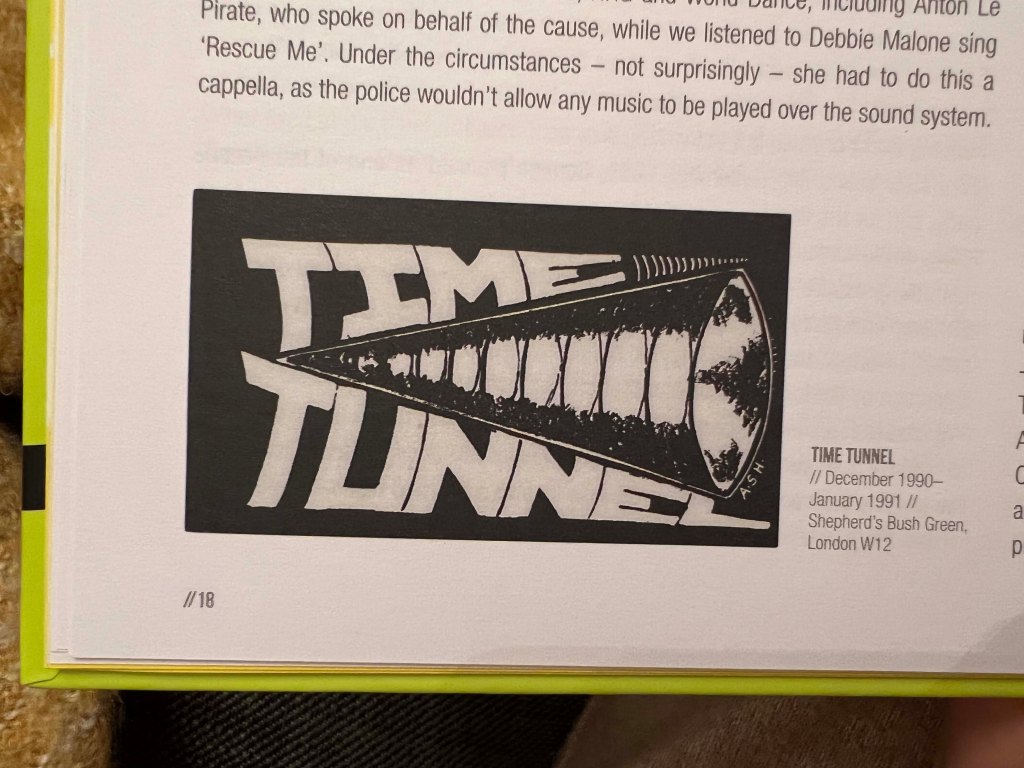
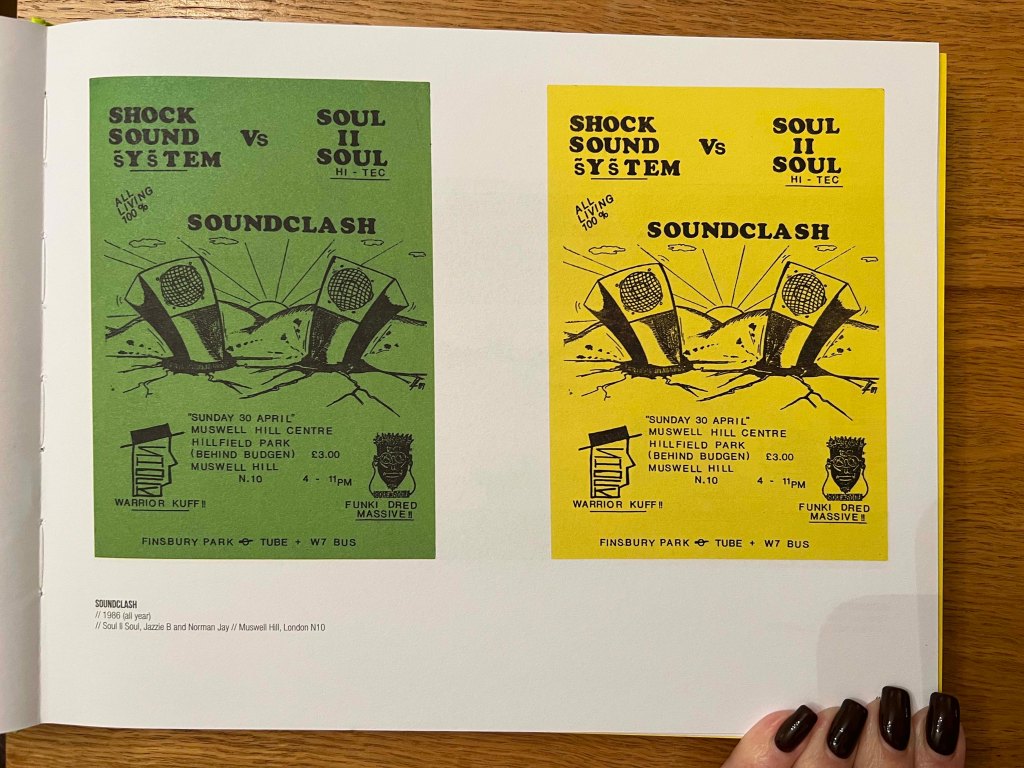
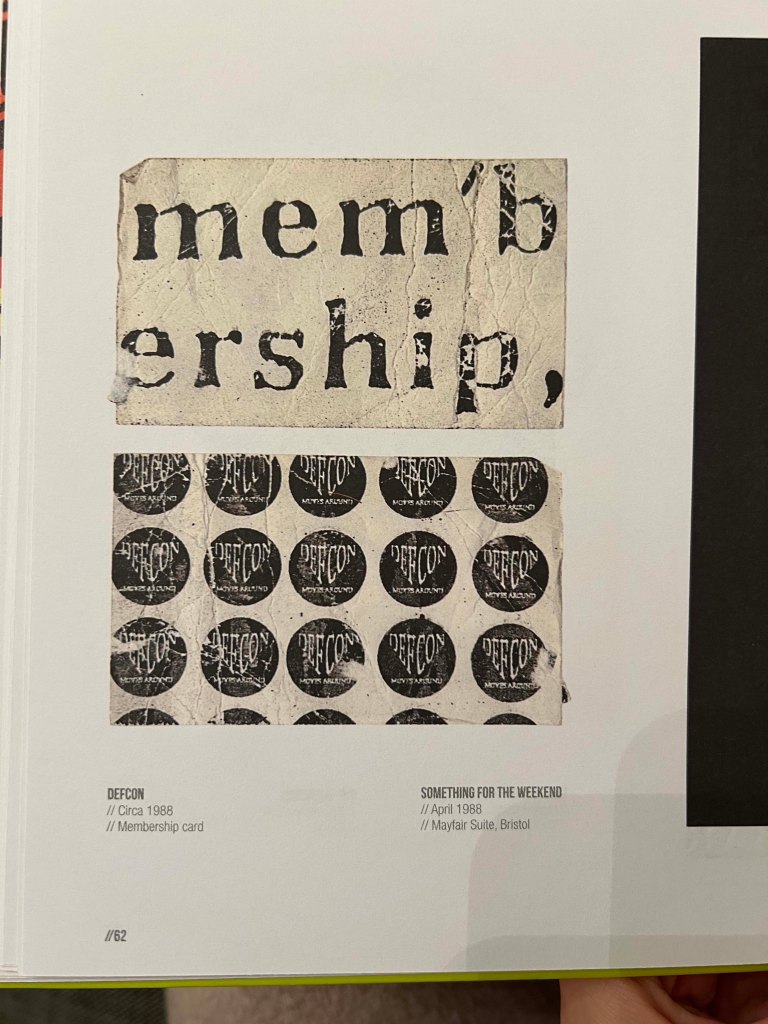
Some images were taken from creative photography magazines, that my stepfather keeps on buying all the time, they had some pictures of people with messages, like: “I’m desperate”, and “It’s okay to be broken”, “Never let go”, and I thought that kind of typography can attract attention and bring emotions for other people, they are close to the vernacular typography, and they are like visuals to demonstrate that handwritten typography can make an impact on the psychological level as well. Also, I found some abstract images of duo colours, I thought I could use them for distorted typography. There were some examples of letters within models by Marian Bantjes, and letterforms within the fashion figures. In addition, I found an old English book for kinds, dated 1991, that has an old stamp on it, probably I could implement it for my concrete poetry page. At the same time, I found a curious book, calls Adventure in the Wonderland, and I remembered, that somewhere I have a great collection of rave art from recent books Clubbed! and Rave Art. Below I created a moldboard of snaps from those books, there are hundreds of valuable posters, but I’ve taken just those most fascinating examples of creativity.

Fanzines and experimental typography in the rave culture

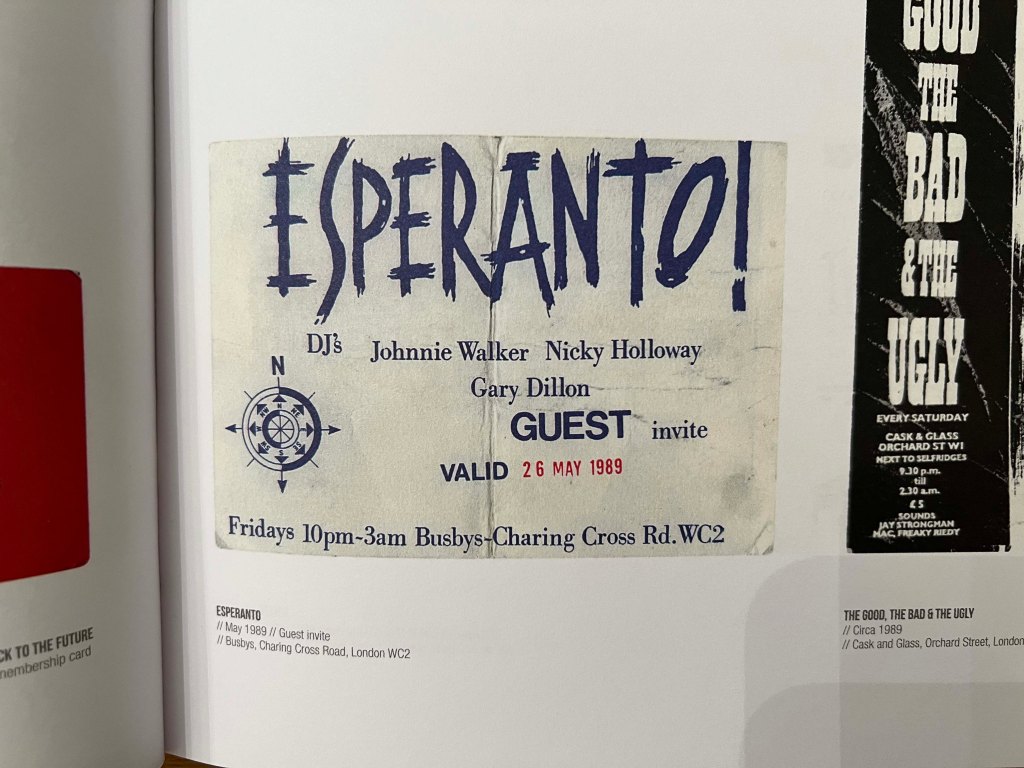
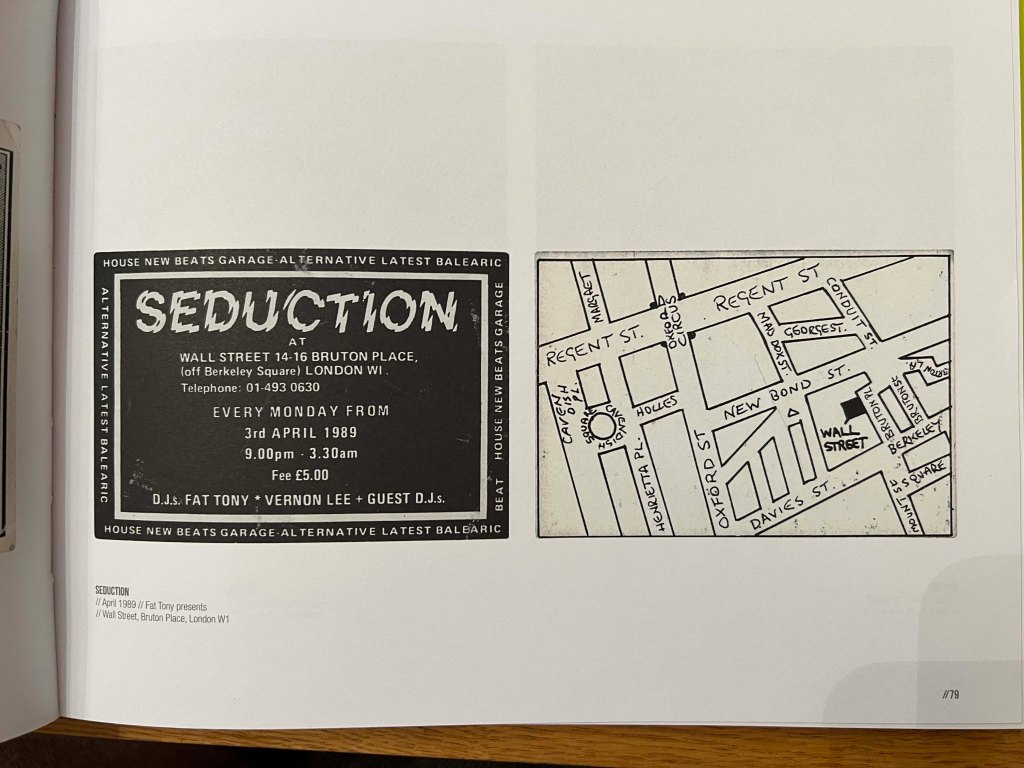
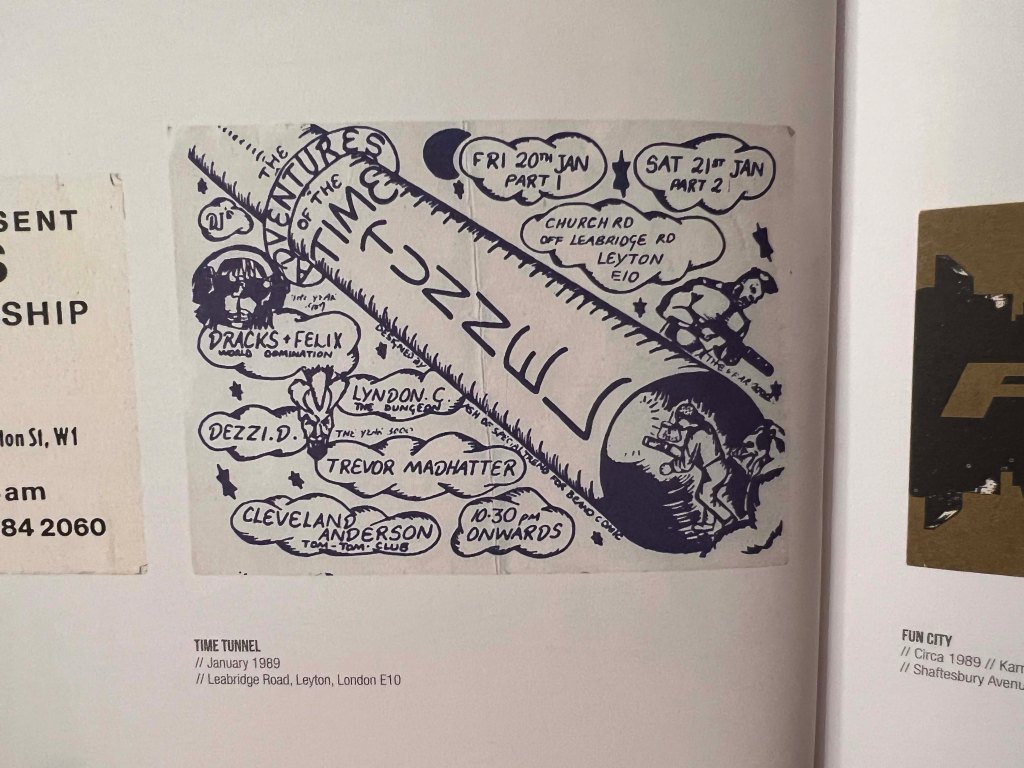
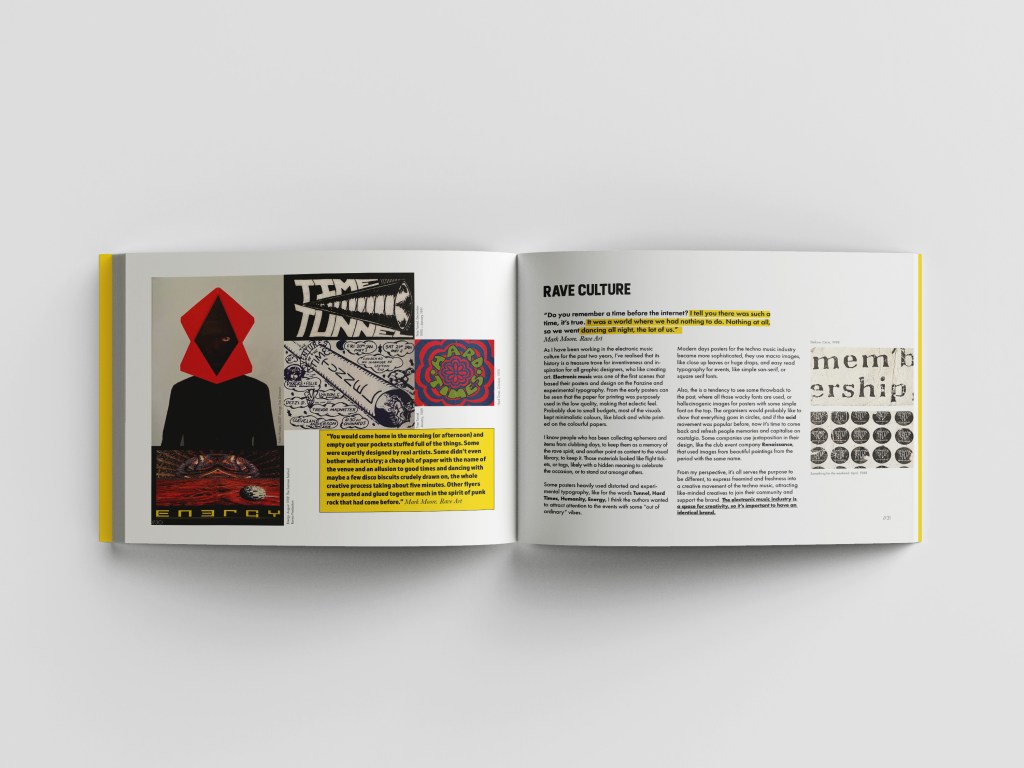
As I have been working in the electronic music culture for the past two years, I’ve realised that its history is a treasure trove for inventiveness and inspiration for all graphic designers, who like creating art. Electronic music was one of the first scenes that based their posters and design on fanzine and experimental typography. From the early posters can be seen that the printing paper was purposely used in the low quality, making that eclectic feel. Probably due to small budgets, most of the visuals kept minimalistic colours, like black and white printed on the colourful paper.

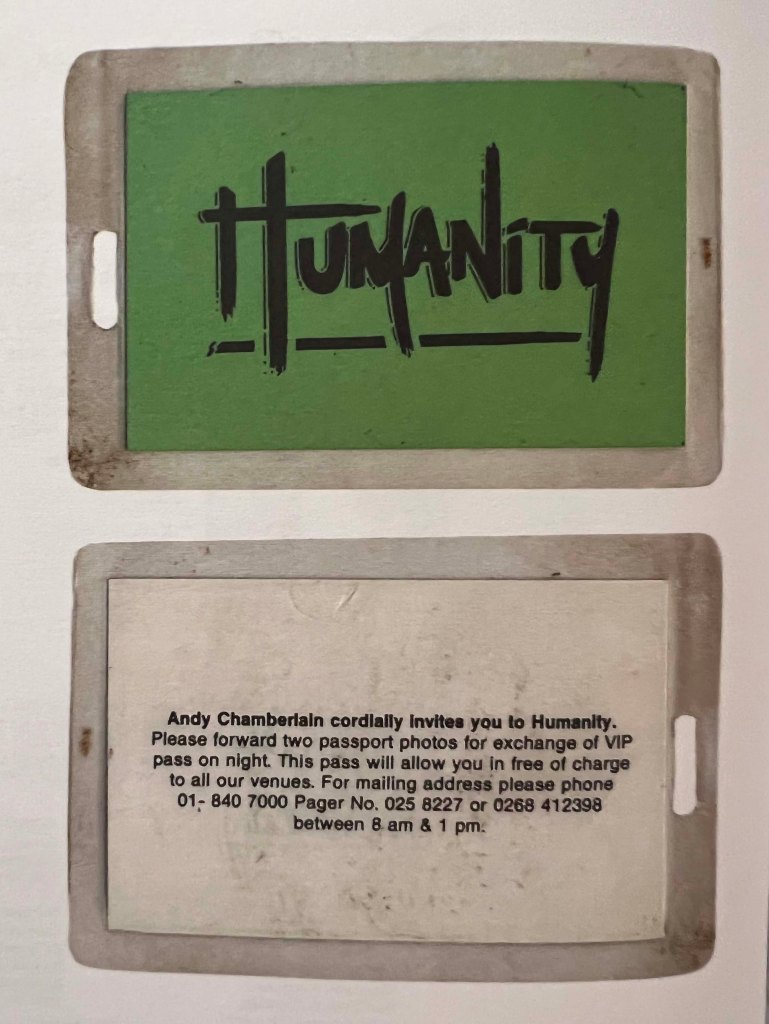
I know people who have been collecting ephemera and items from clubbing days, to keep them as a memory of the rave spirit, and another point as content to the visual library, to keep it. Those materials looked like flight tickets, or tags, likely with a hidden meaning to celebrate the occasion, or to stand out amongst others.

Some posters heavily used distorted and experimental typography, like for the words, Seduction, Tunnel, Hard Times, Humanity, Energy, Esperanto, I think the authors wanted to attract attention to the events with some “out of ordinary” vibes. 

Modern days posters for the techno music industry became more sophisticated, they use macro images, like close up leaves or huge drops, and easy read typography for events, like simple san-serif, or square serif fonts. 

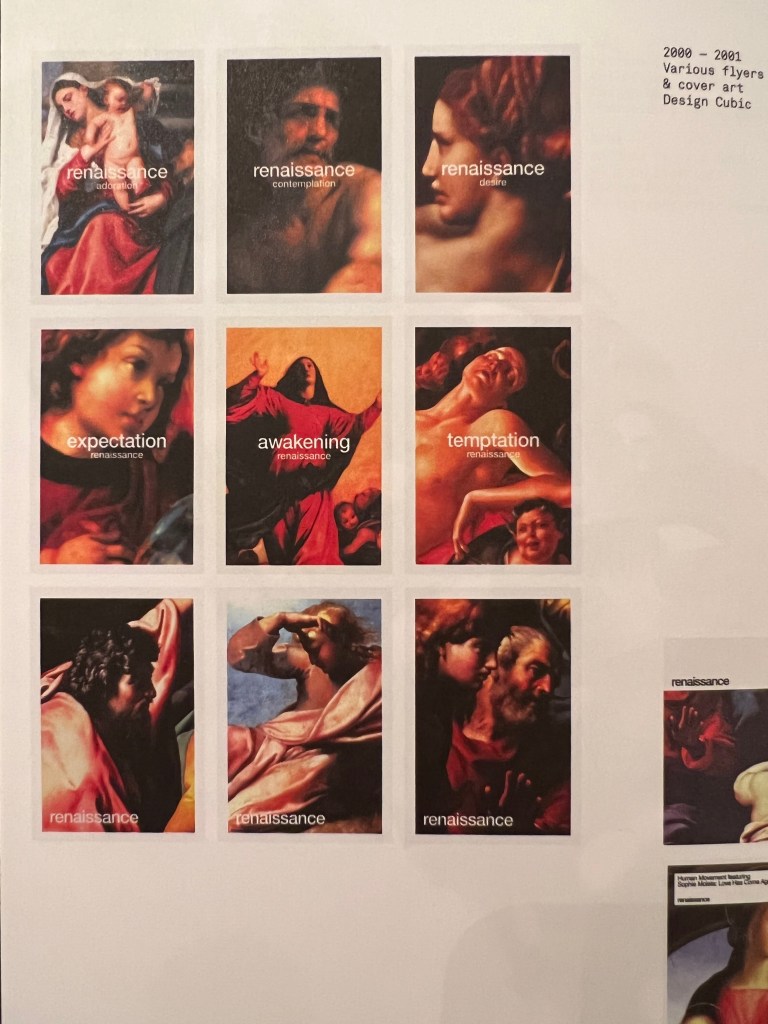
Also, the is a tendency to see some throwback to the past, where all those wacky fonts are used, or hallucinogenic images for posters with some simple font on the top. The organisers would probably like to show that everything goes in circles, and if the acid movement was popular before, now it’s time to come back and refresh individual memories and capitalise on nostalgia. Some companies use juxtaposition in their design, like the club event company Renaissance, which used images from beautiful paintings from the period with the same name.

From my perspective, it all serves the purpose to be different, to express free mind and freshness into a creative movement of techno music, attracting like-minded creatives to join their community and support the brand. The electronic music industry is a space for creativity, so it’s important to have an identical brand.

Experimental typography

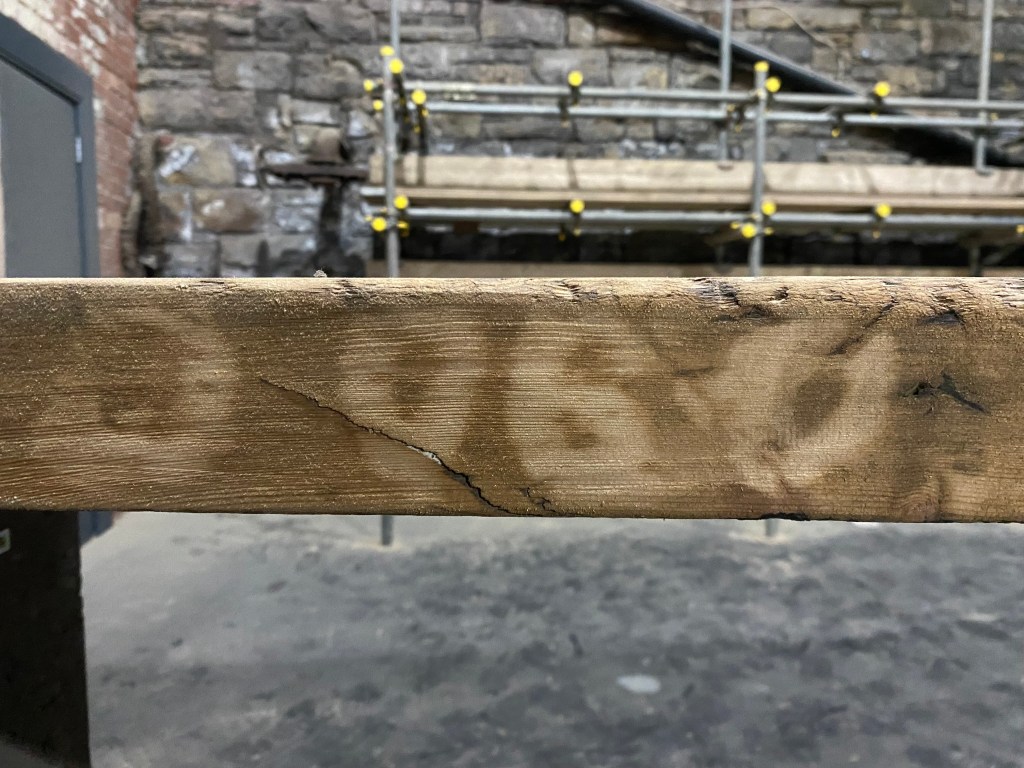
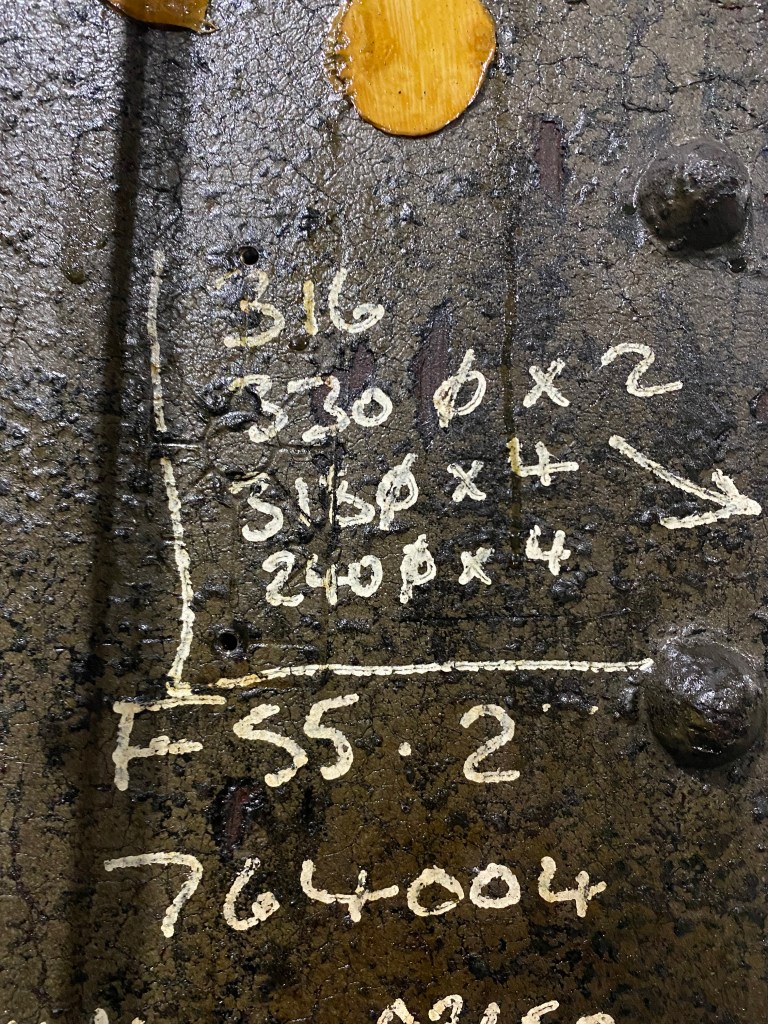
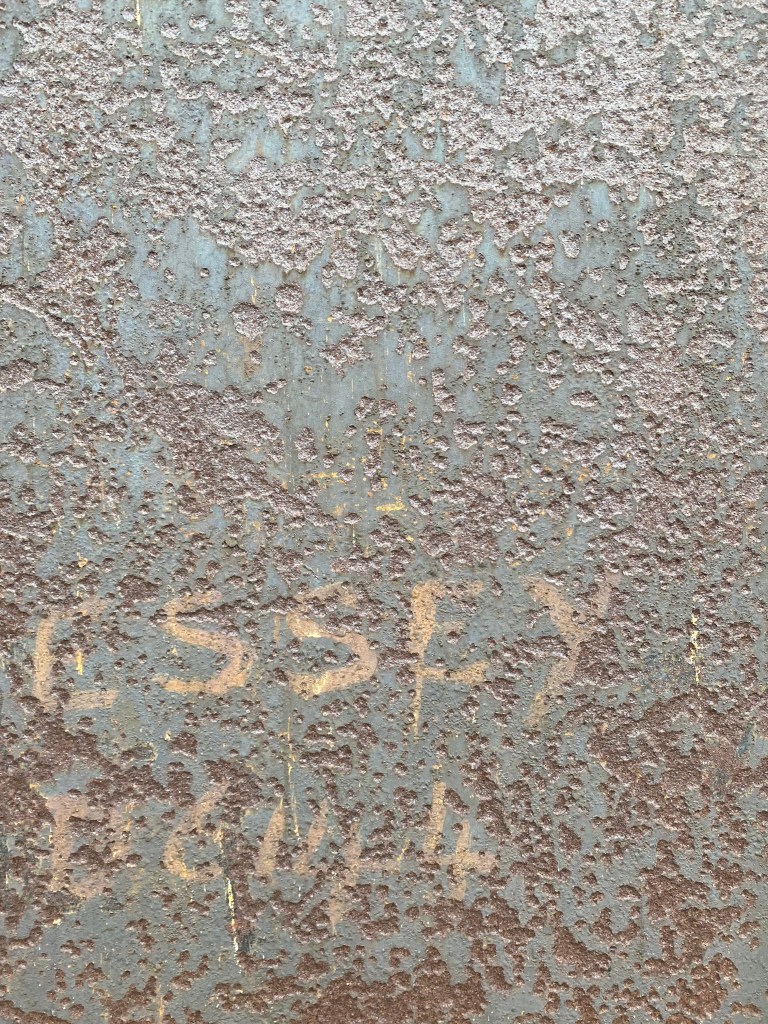
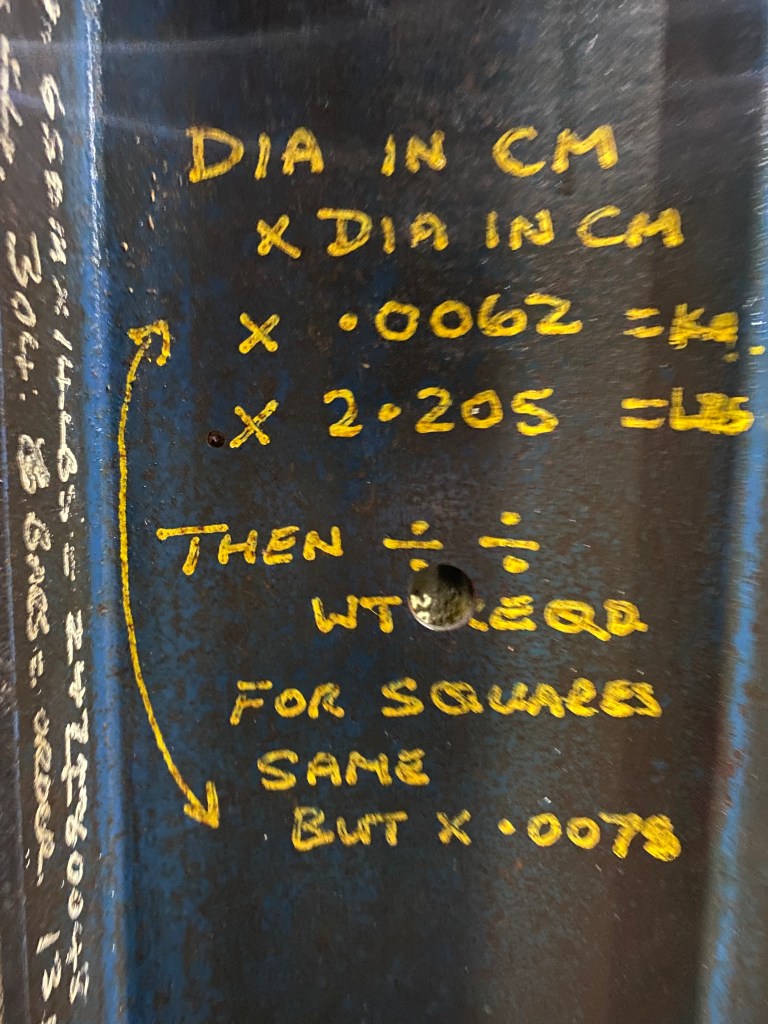
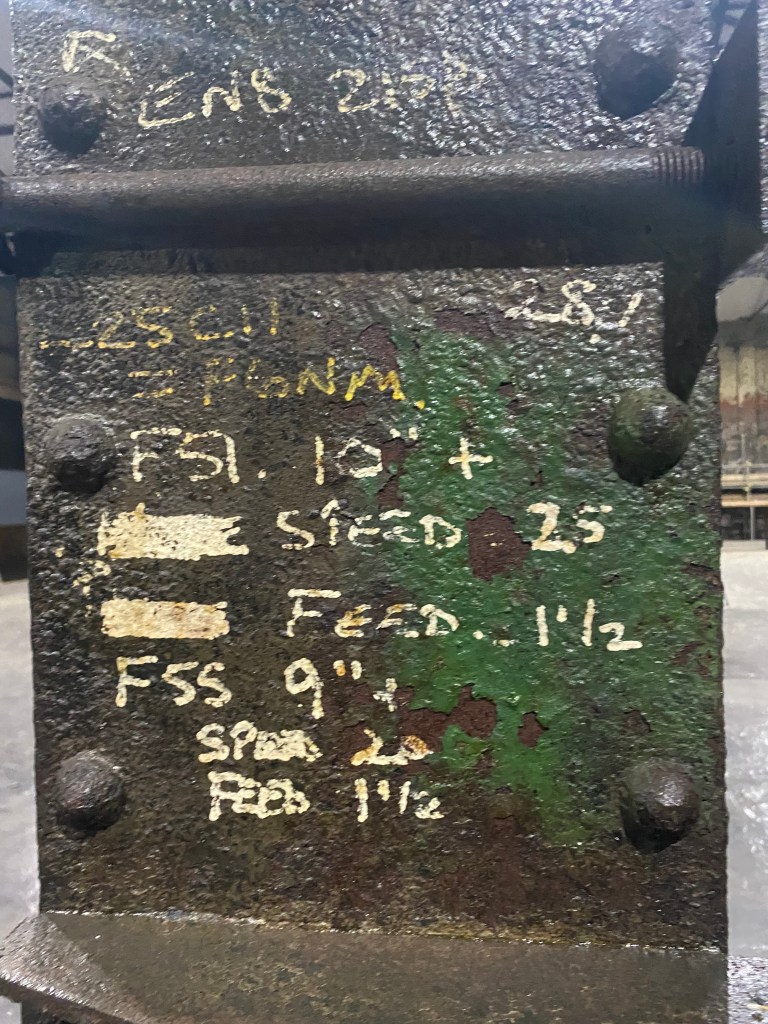
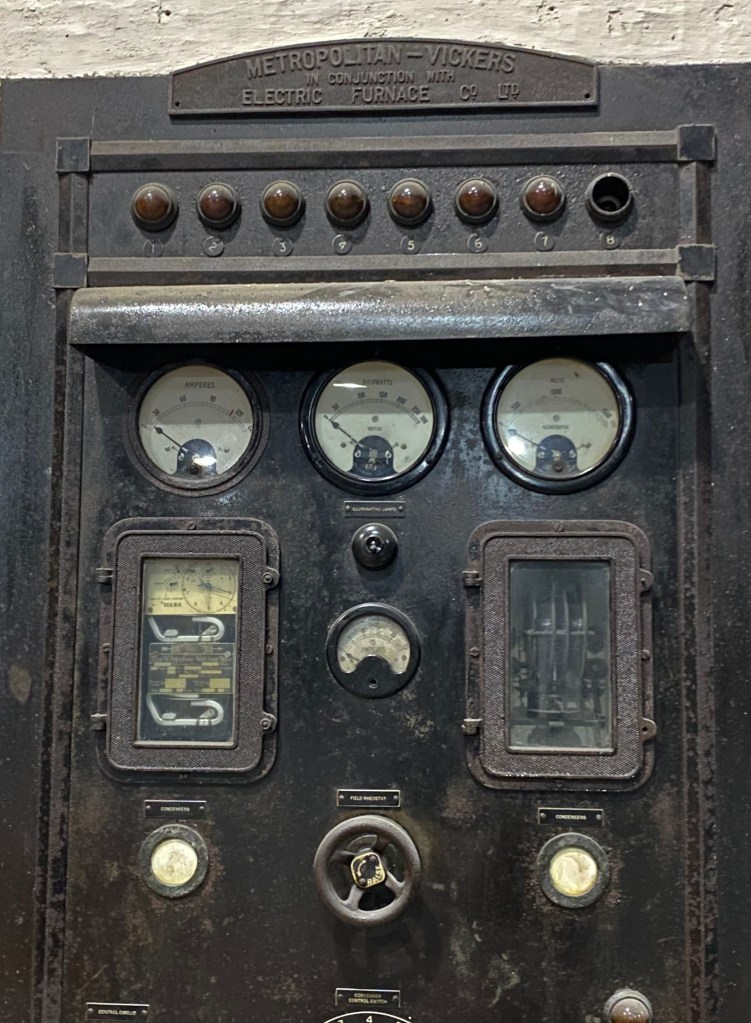
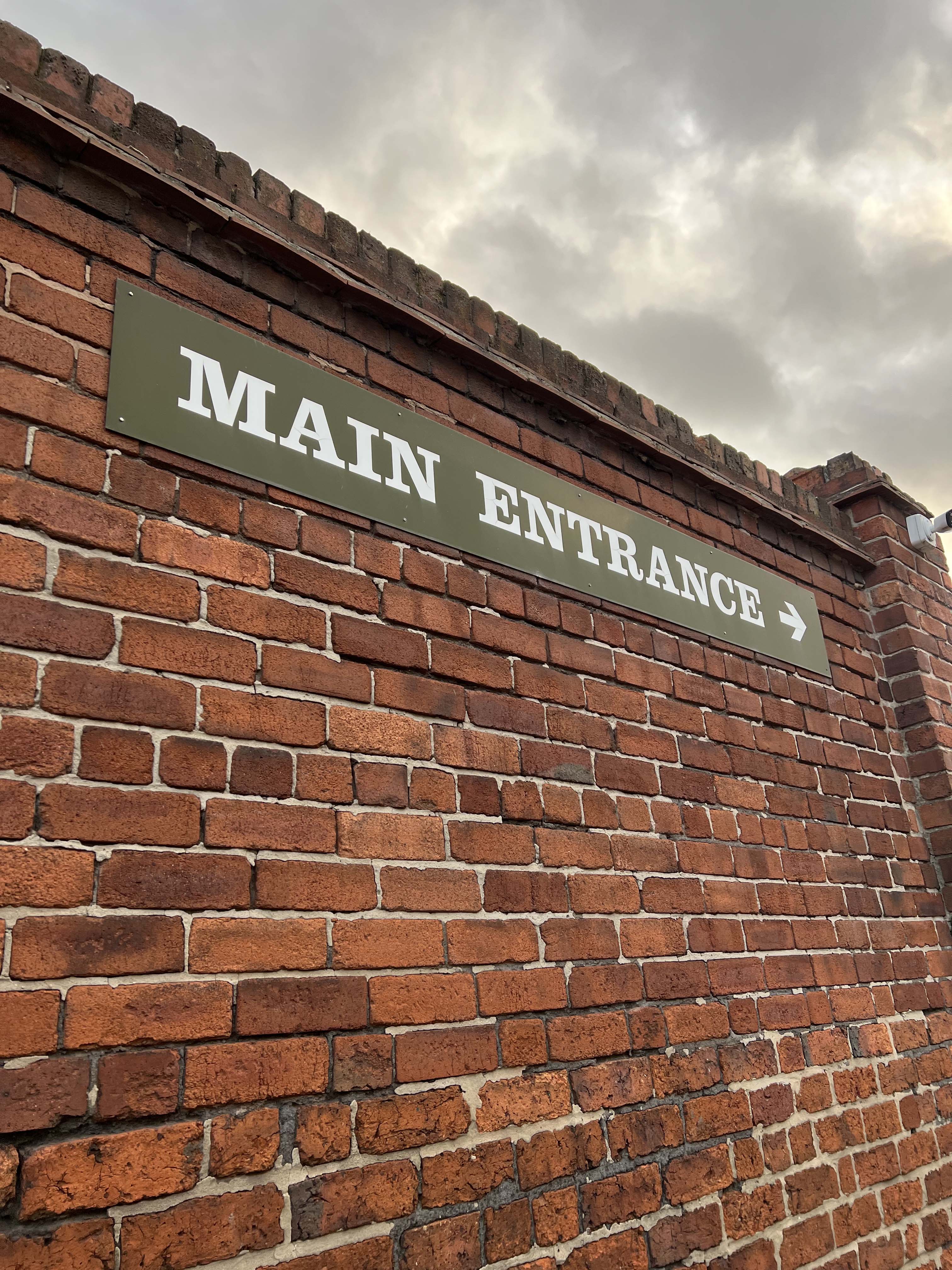
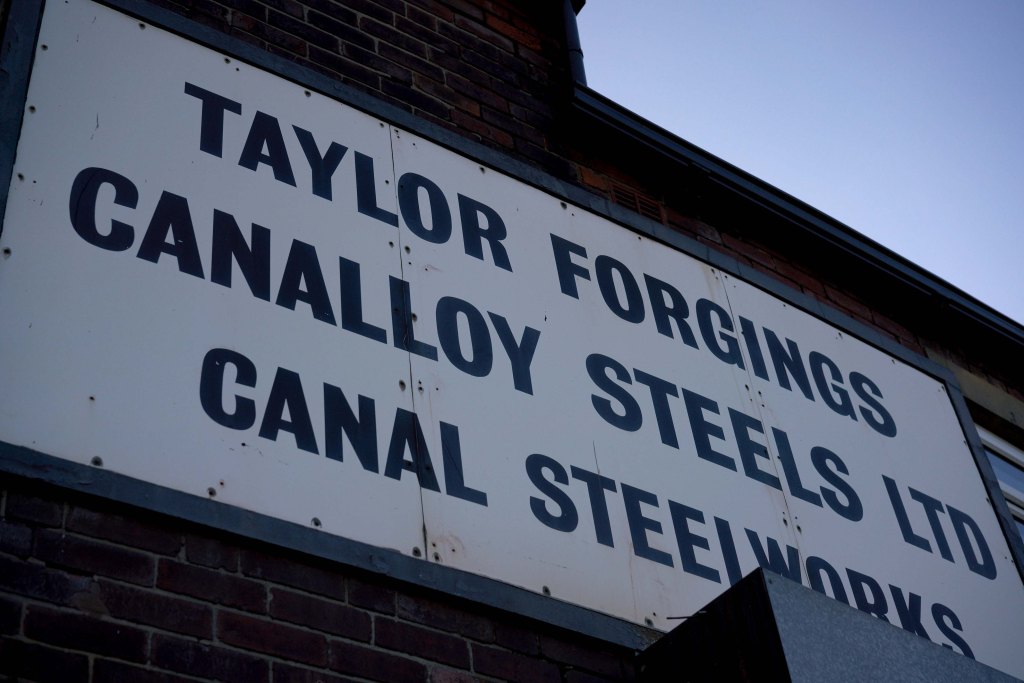
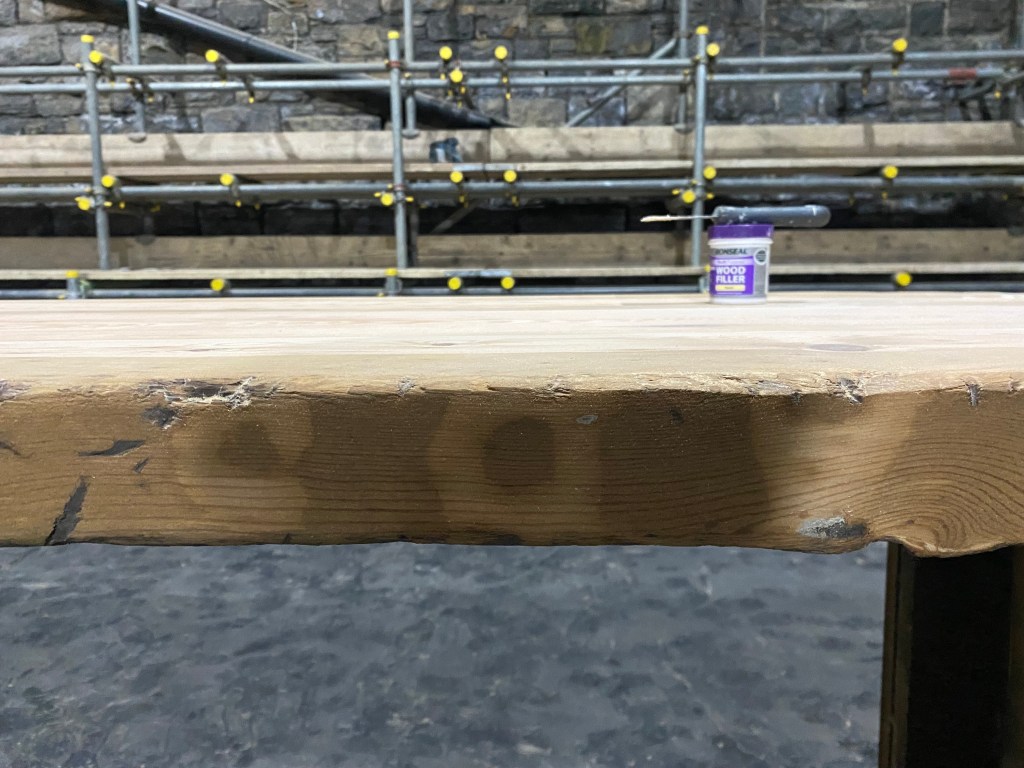
Actually, speaking of rave culture, I remembered about our venue, that my family is reconstructing at the moment, it used to be an old steel forge, and it still has some old notes from the previous workers, that perfectly integrates with the metal or wooden texture. I thought I can consider these writings somewhere in the middle between vernacular and experimental typography.

Flower Type

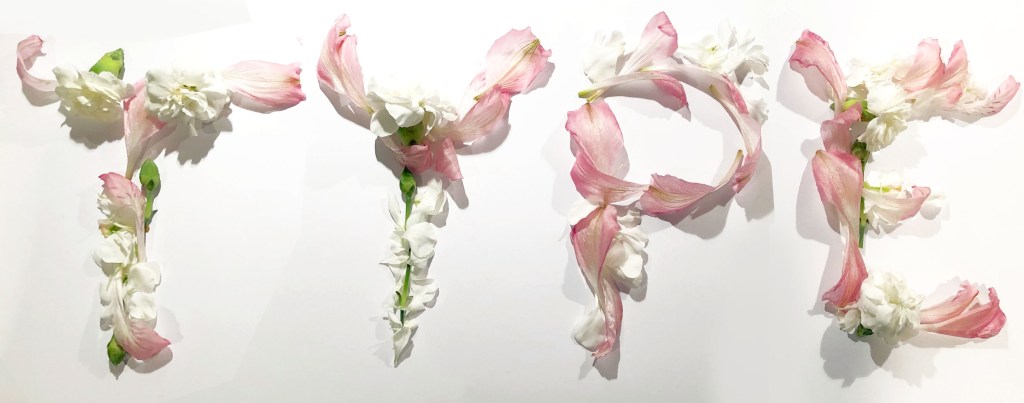
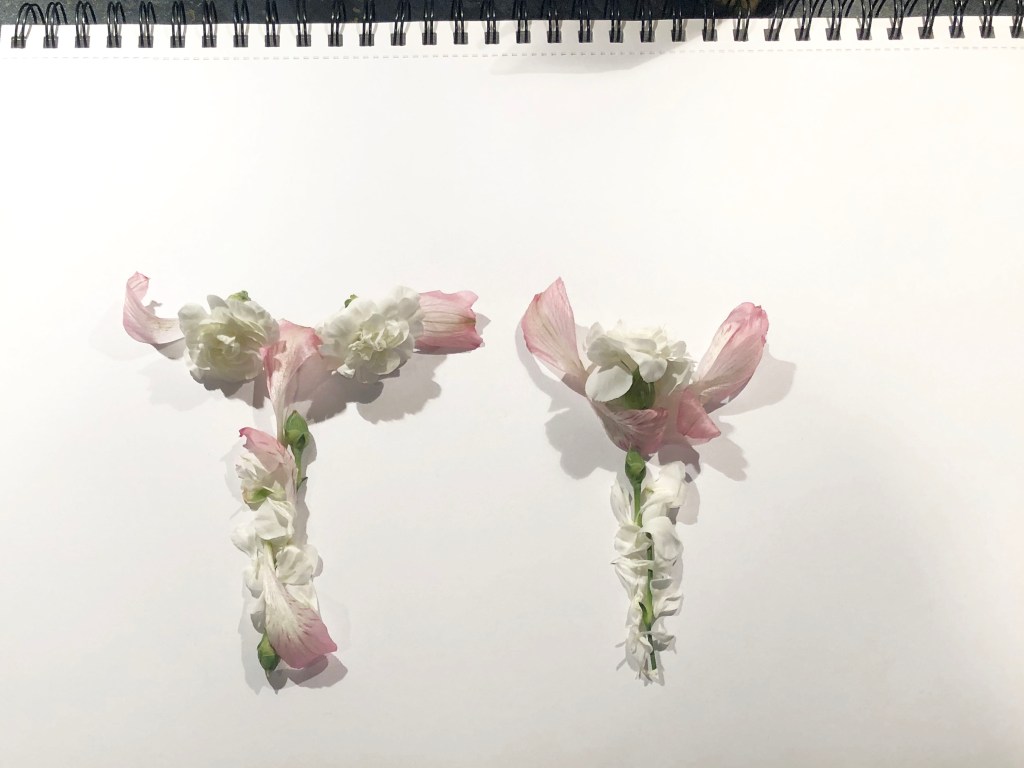
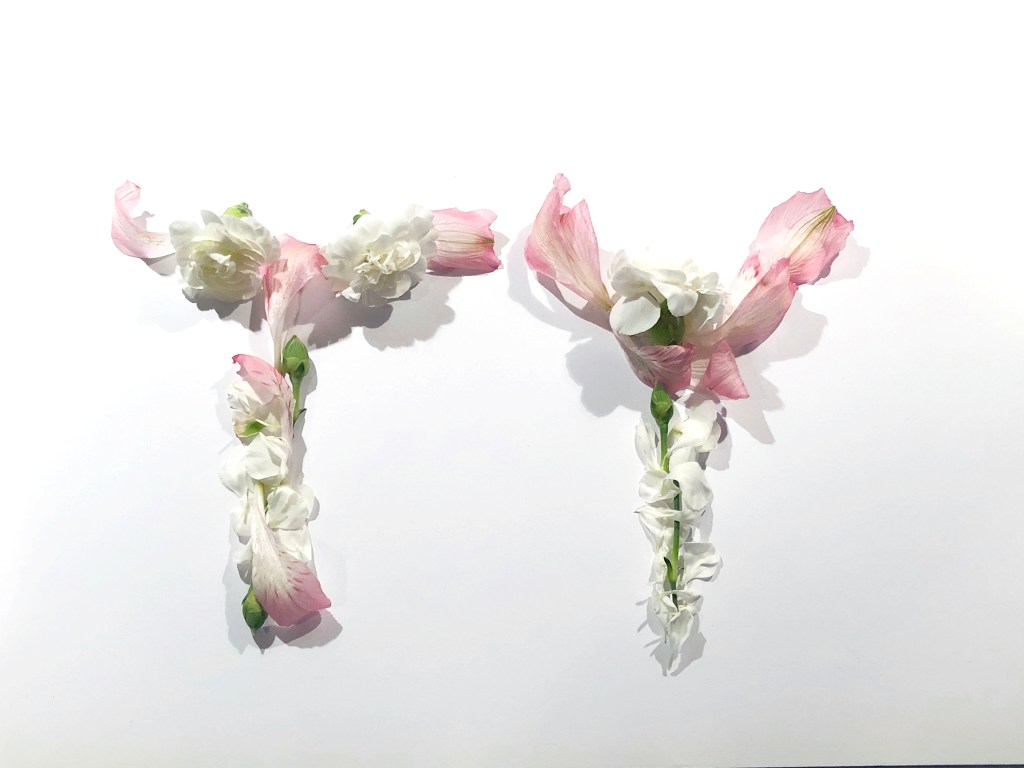
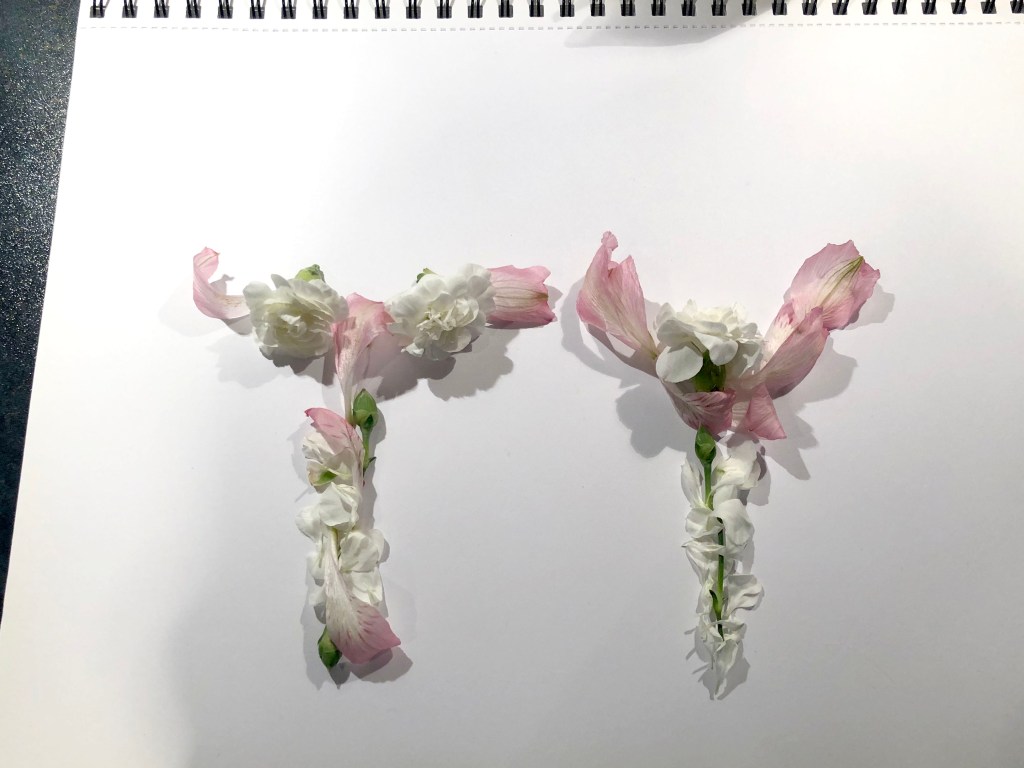
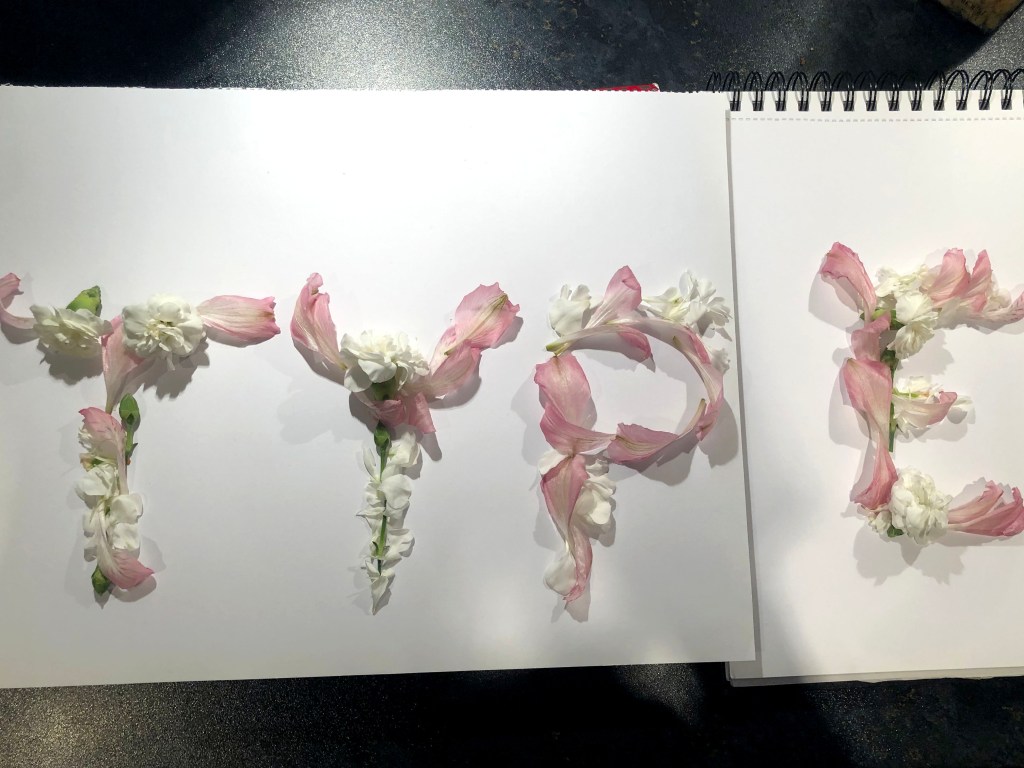
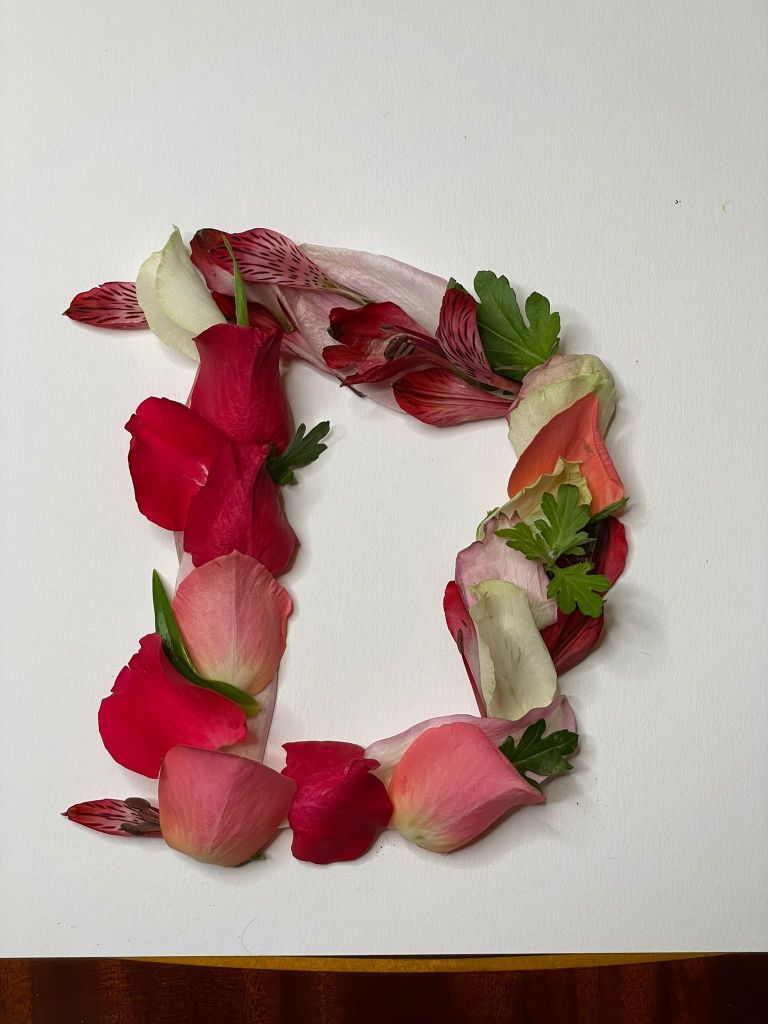
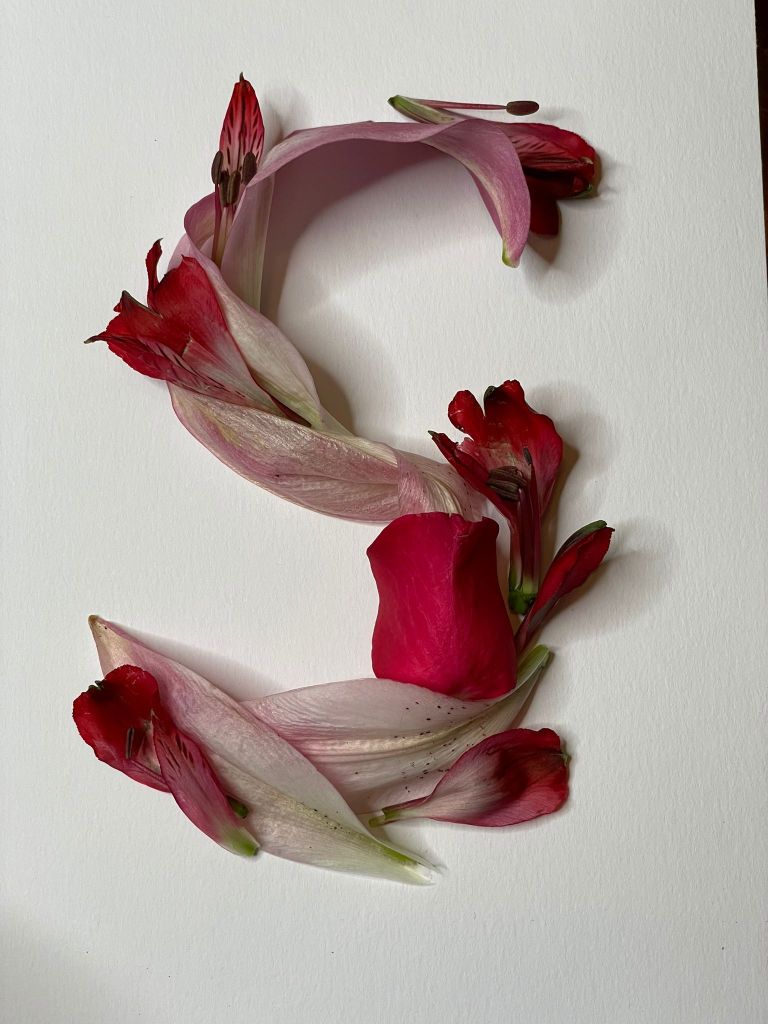
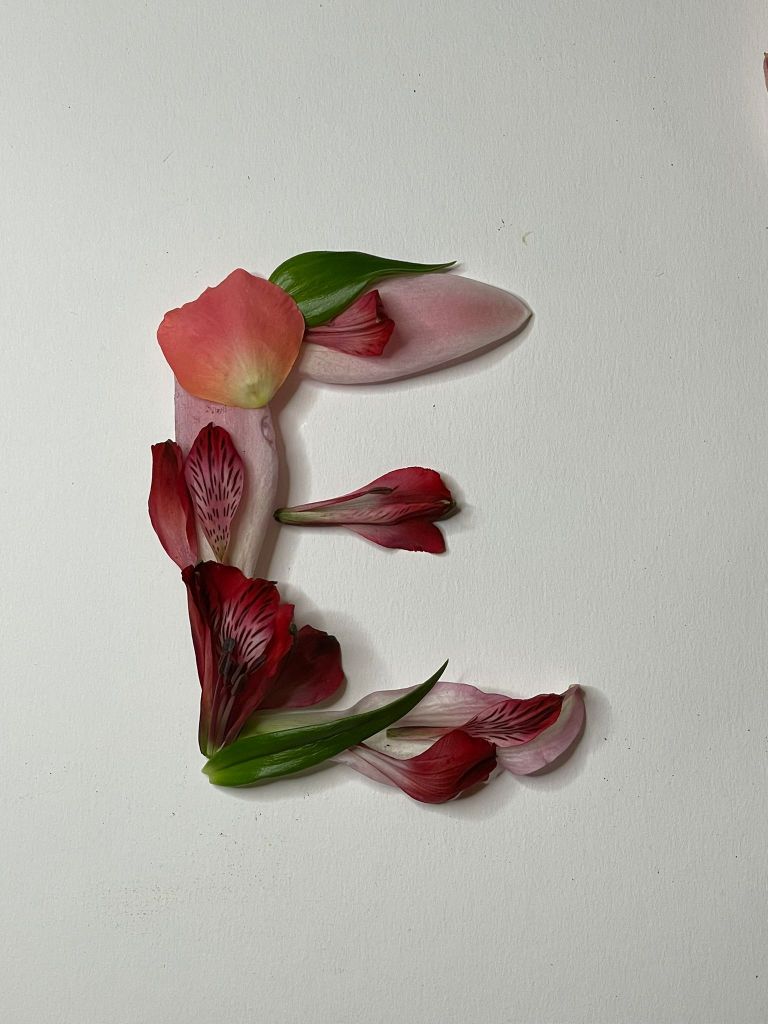
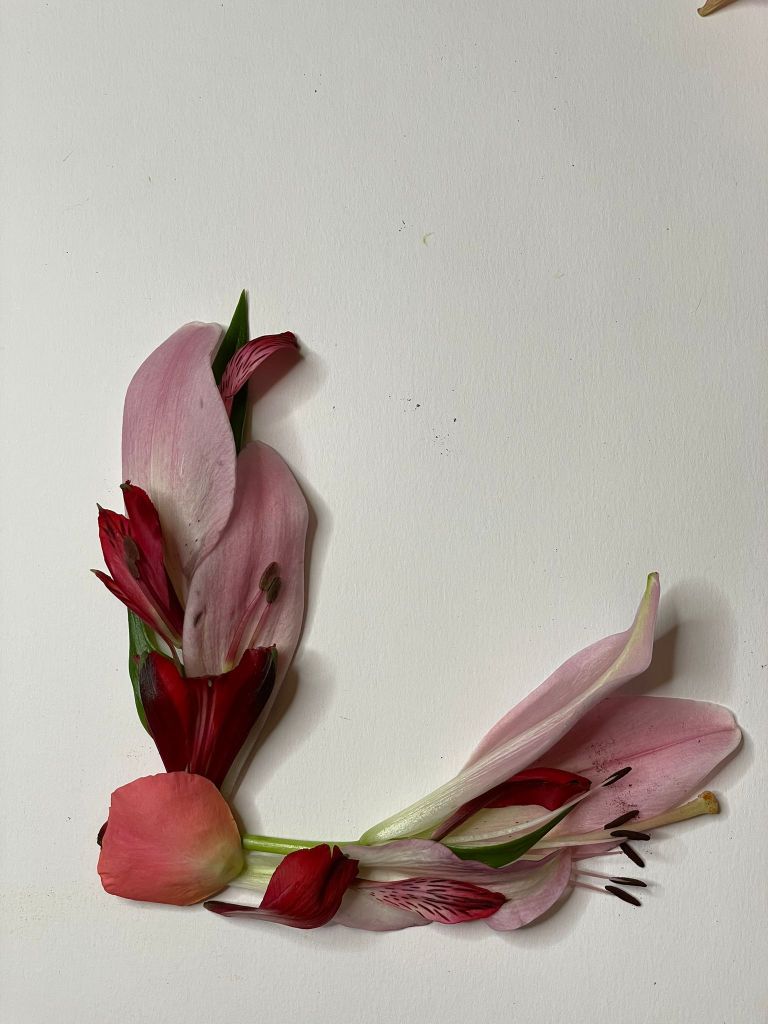
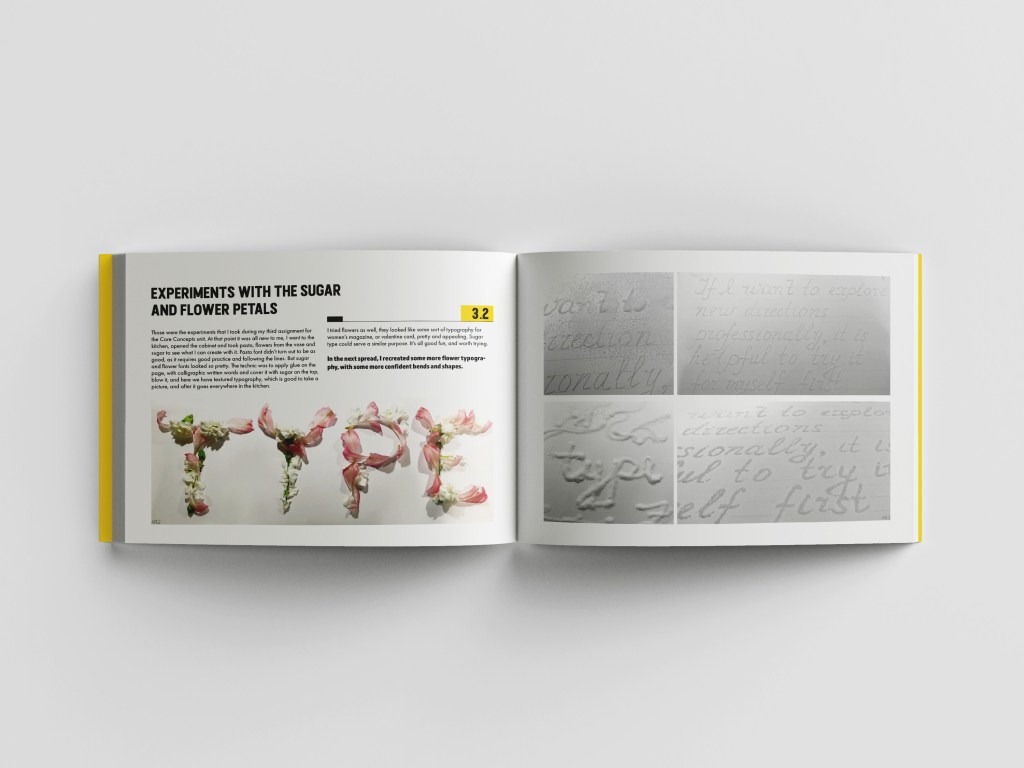
I remembered about those letters I did for the Core Concepts Unit, for my assignment four, where we had to invent type. I bought some flowers to create tender petals. I wrote it without special meaning, just word TYPE. Those experiments were not ideal for professional use, but I like the fact that I was brave enough to start, everyone has this learning process to go through, it’s good to explore, and do more investigations, that to find your perfect design solution. I definitely wanted to include it into the book, as a part of my first discovery of unusual type. I thought it’s great calligraphy for such things as cards, or women’s magazines, as those letters reflect feminity and tenderness.

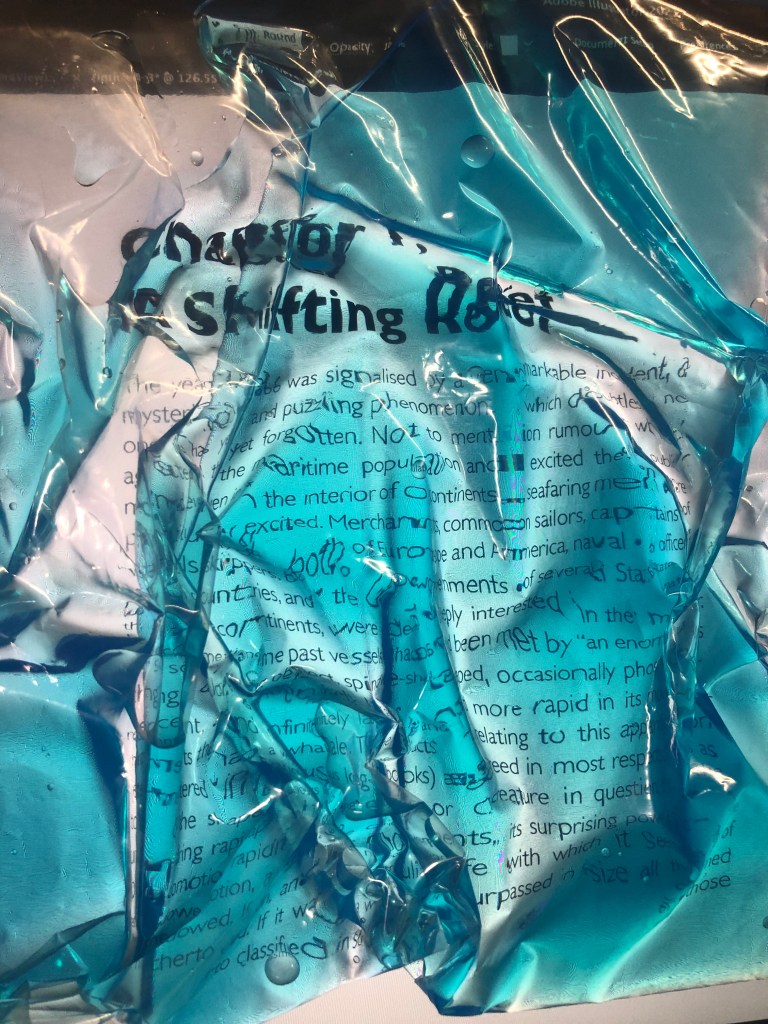
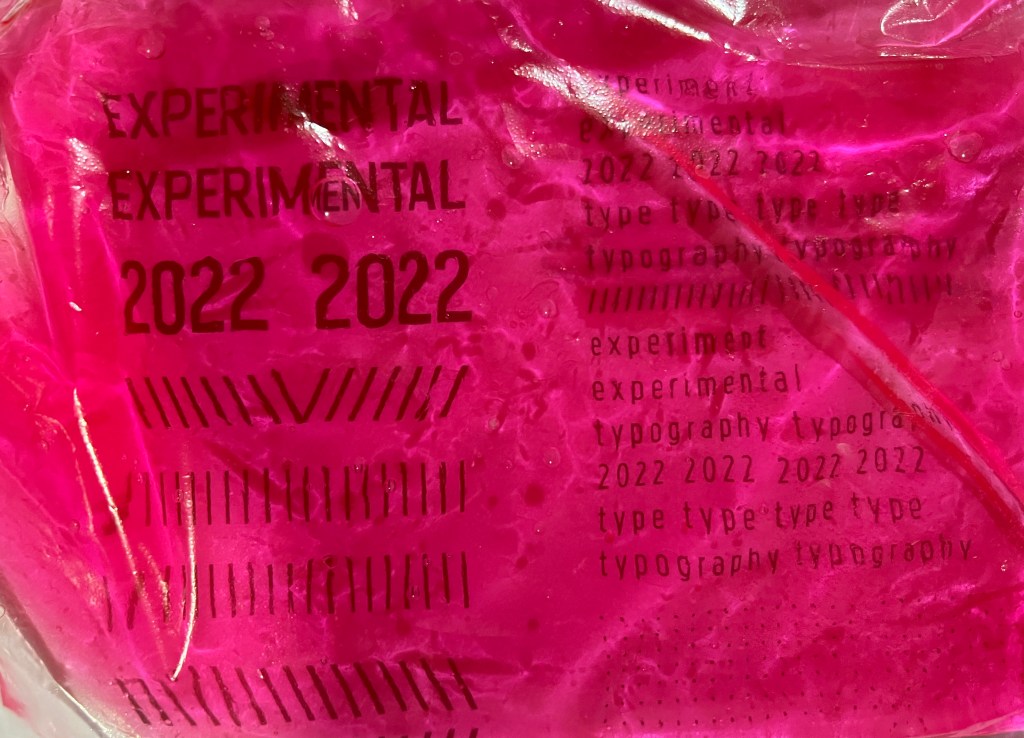
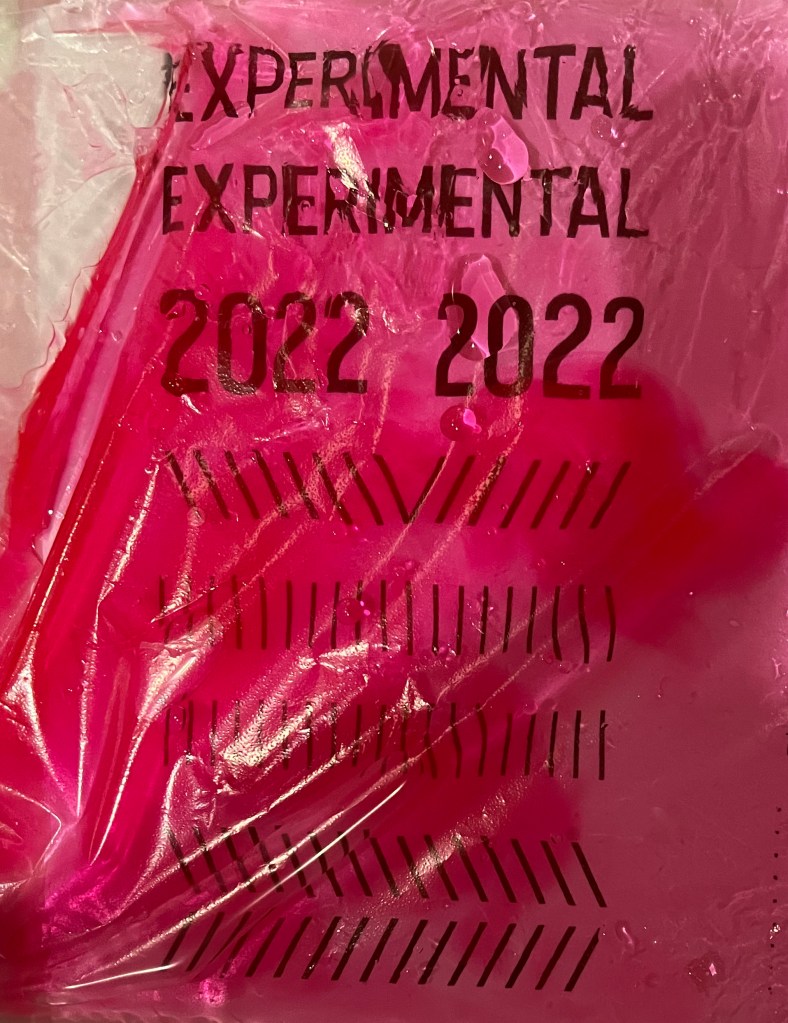
Watercolour bag distorted typography

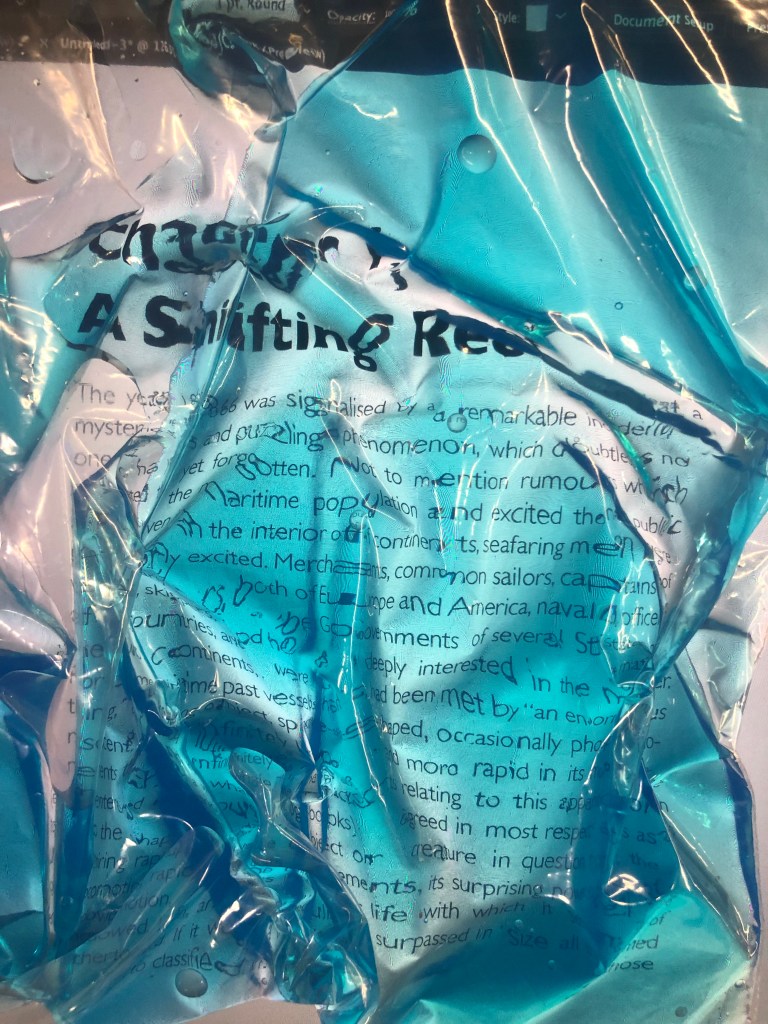
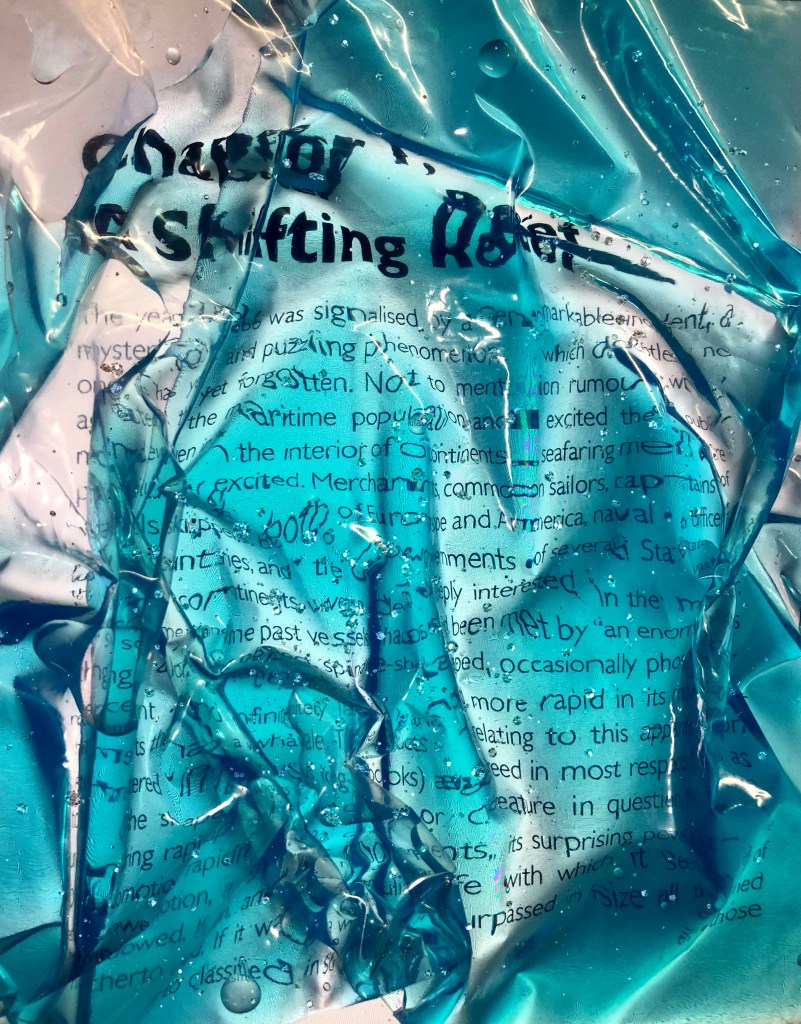
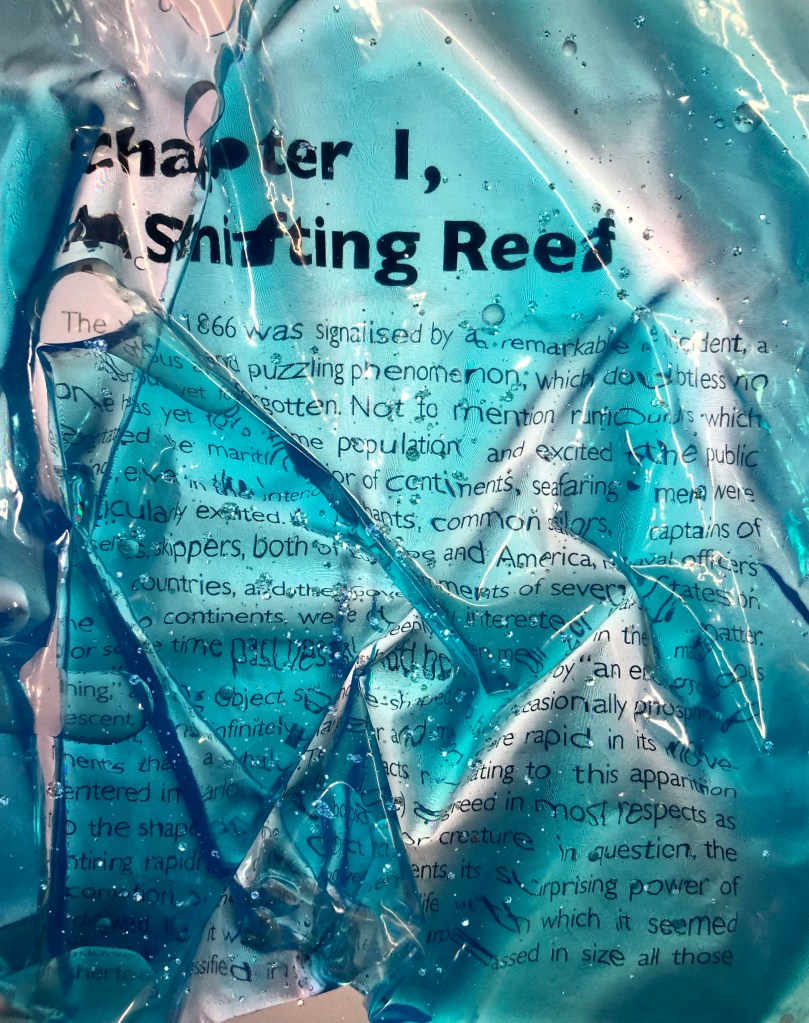
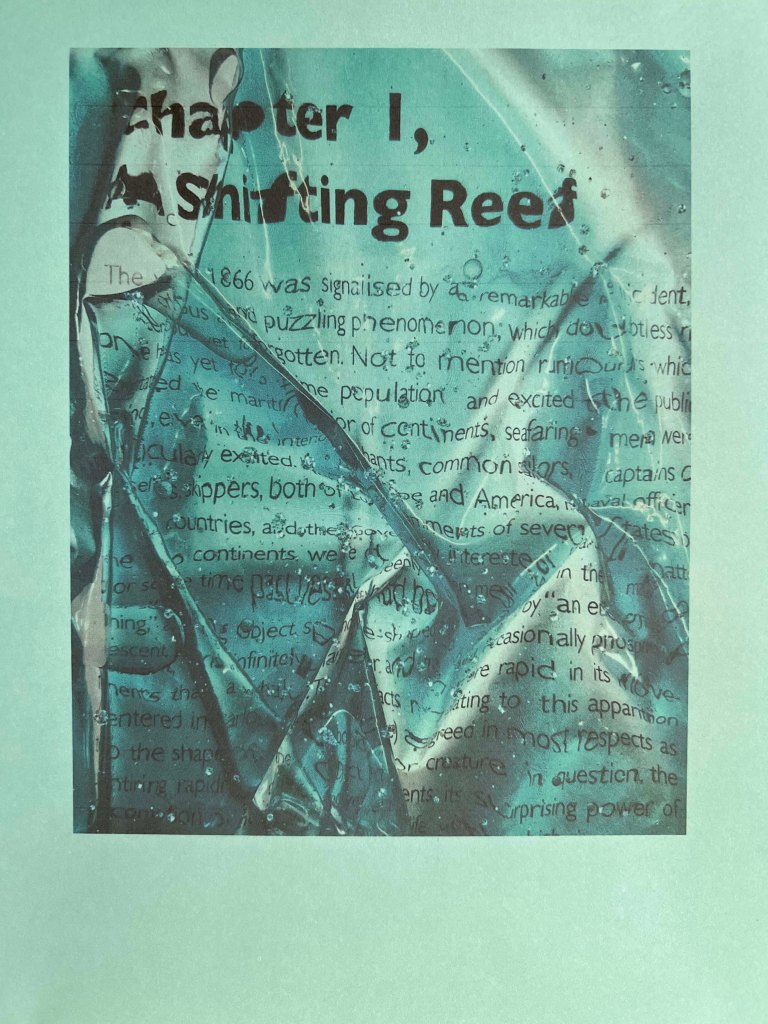
Those typography experiments from exercise 3 part three of Creative Book design gave me the push to experiment. It came out quite successful. I know that I used those examples in the previous brochure, where I printed on different pieces of paper, but I loved the fact that it was in blue colour, embraced the sea theme, and looked artistic. Definitely has a space in my book. I was going to recreate it again, but with pink water, to have a matching pair in my book.

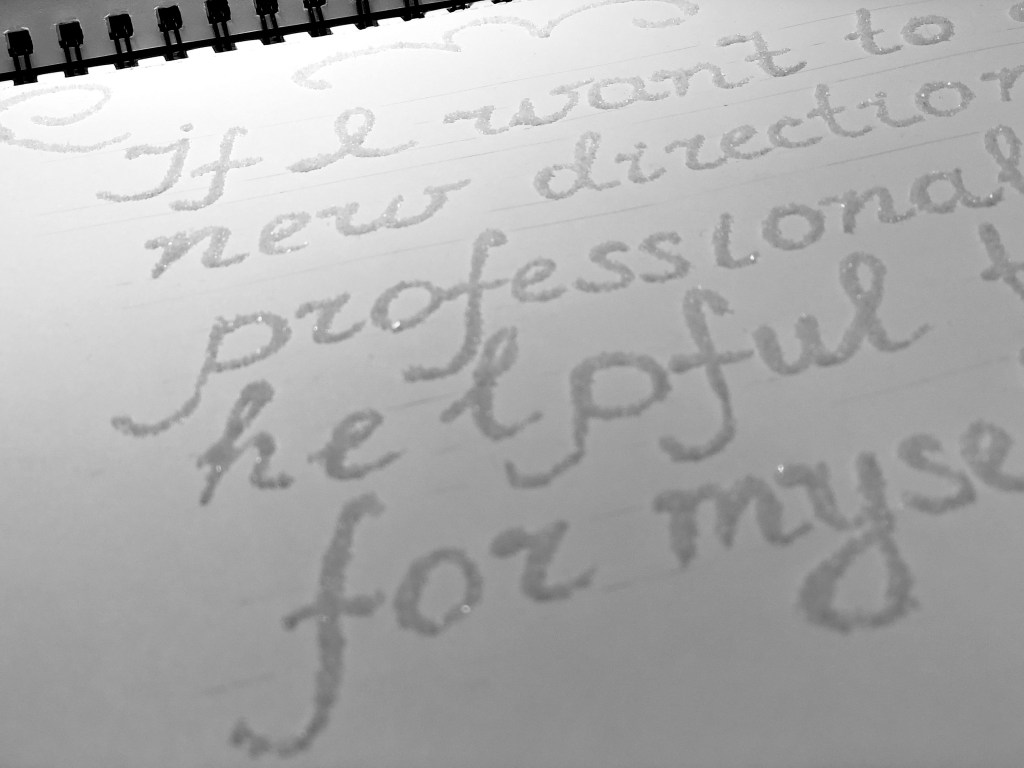
Sugar Type

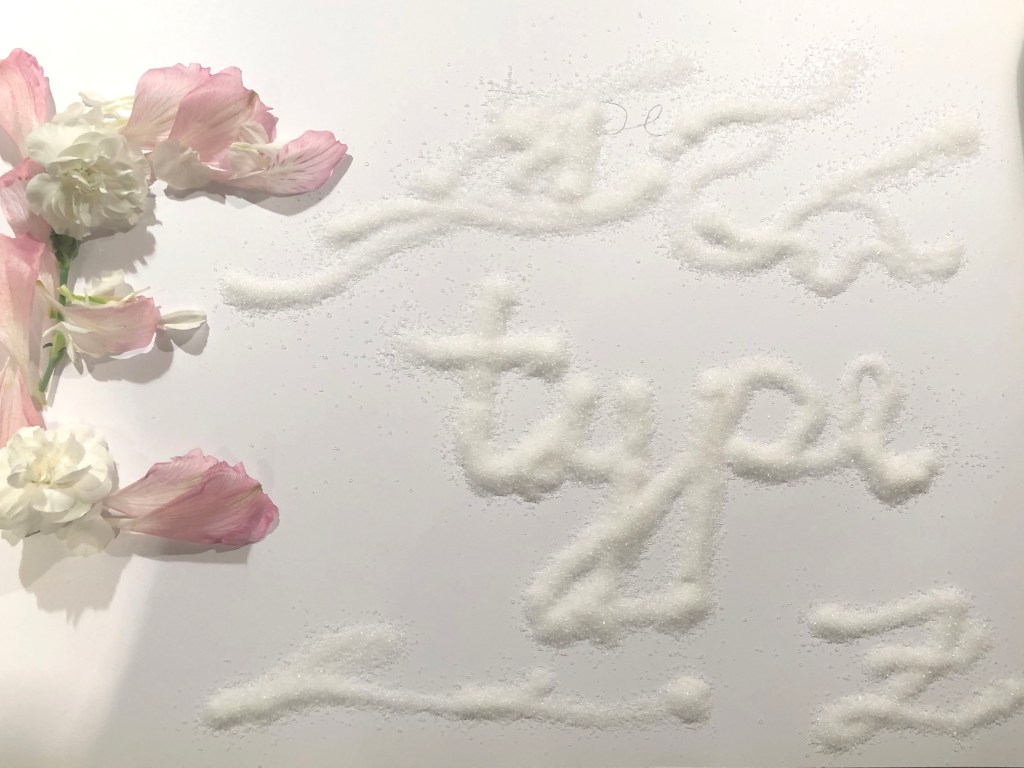
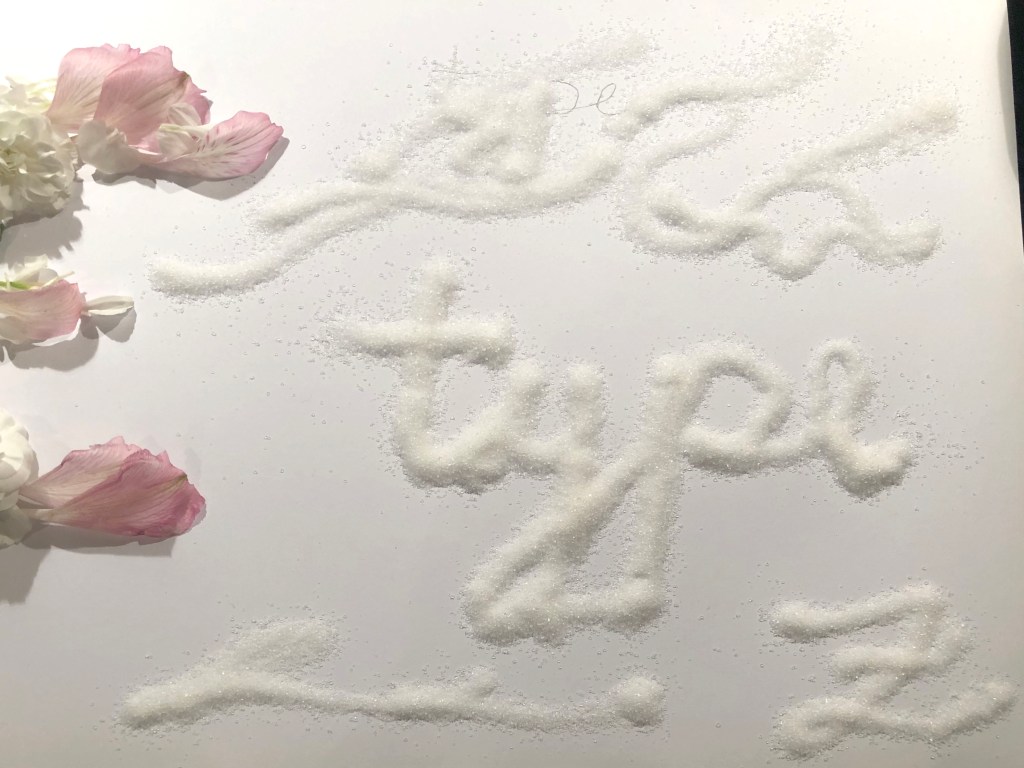
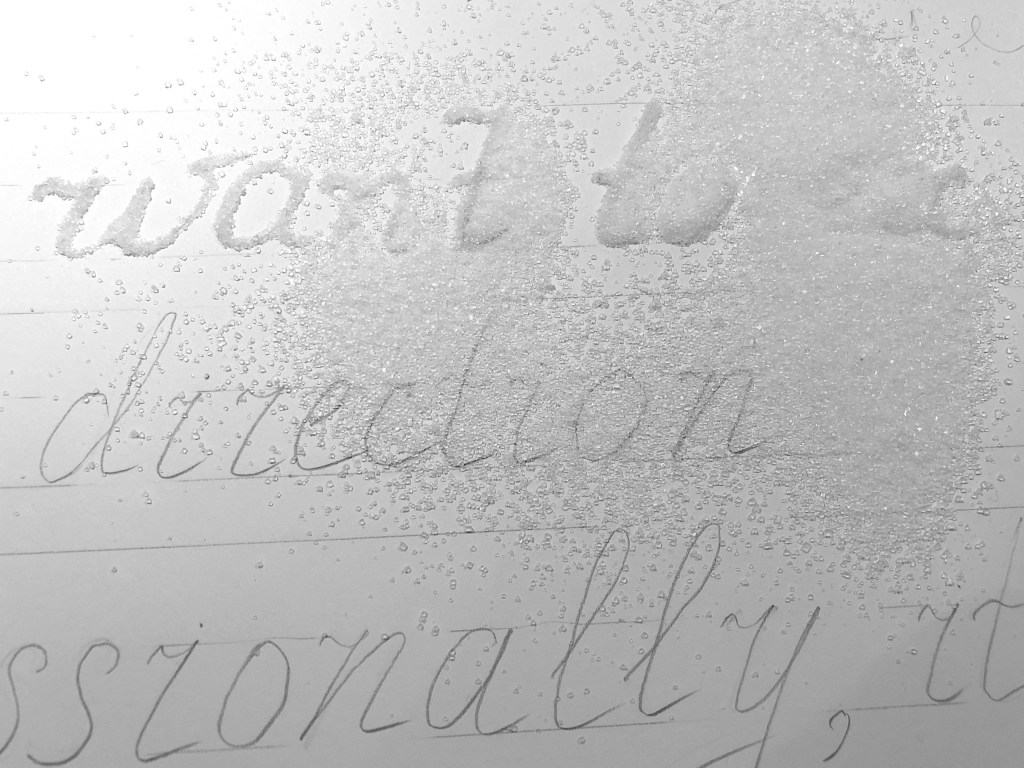
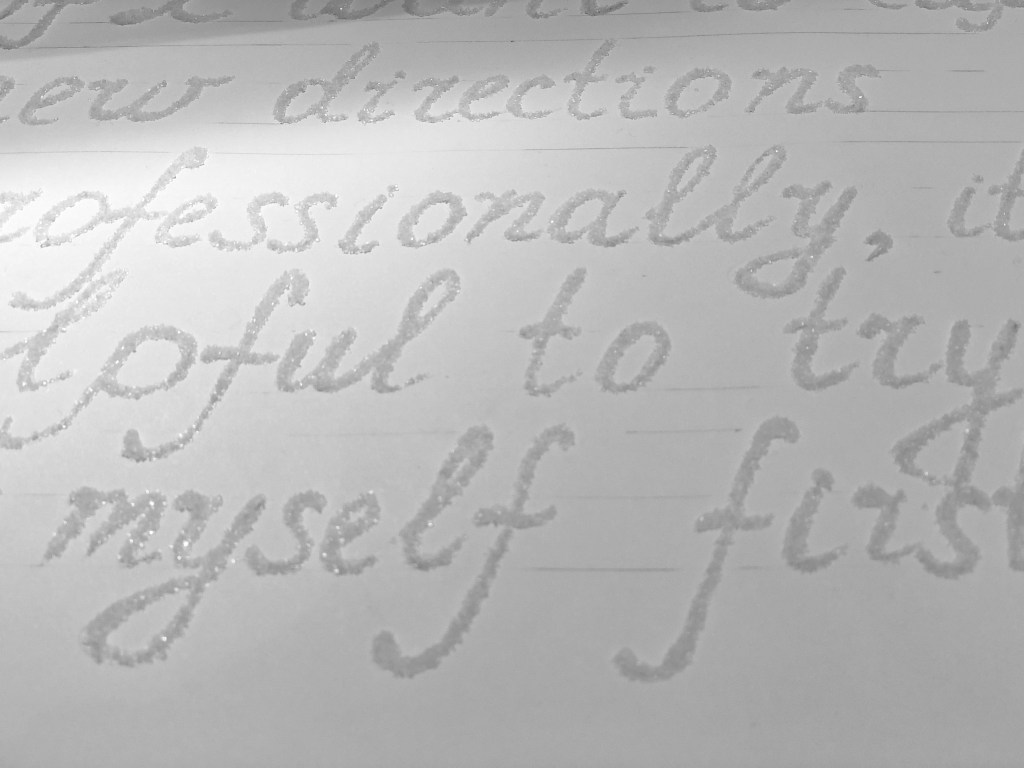
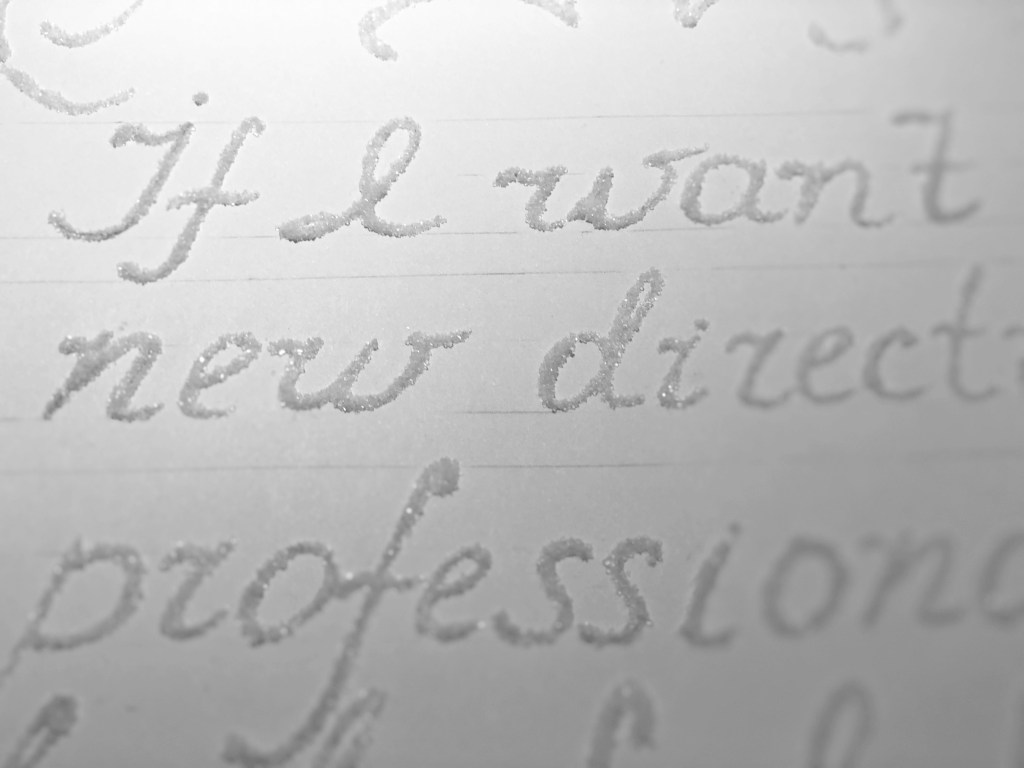
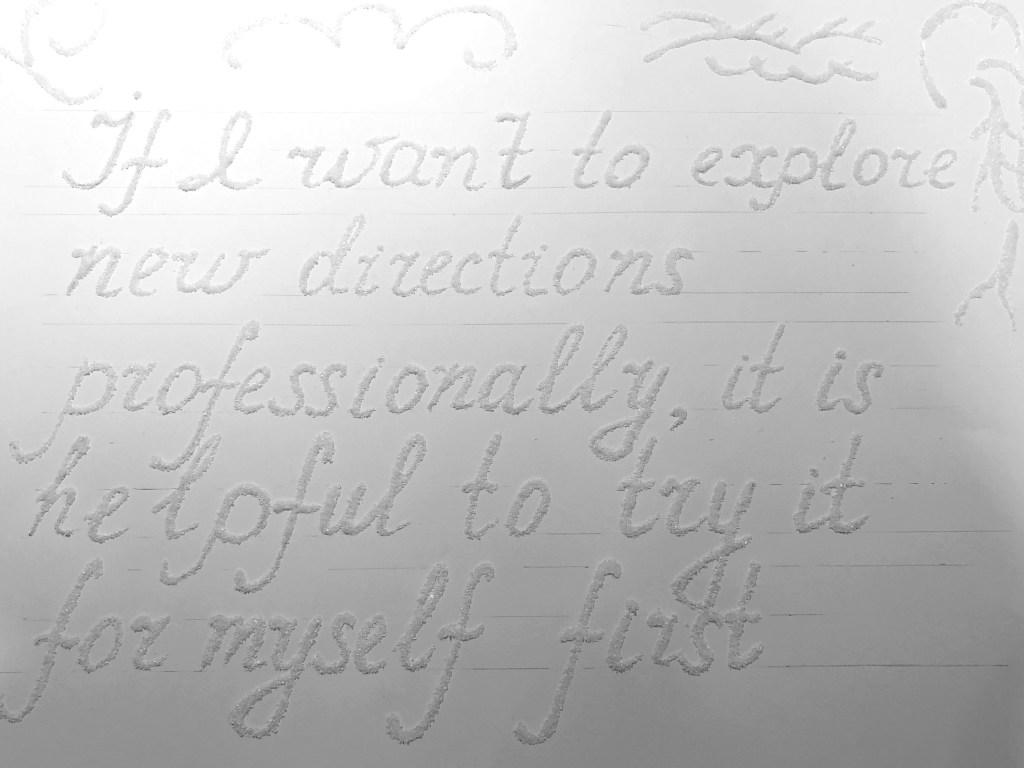
Another appealing example of experimental typography from my previous research for the Core Concepts Unit. I was following Marian Bantjes as my main inspiration, she is very good in that calligraphy style of writing and design, and I really wanted to learn from her. I loved the texture of that font, which is hard to say whether it’s sugar or salt, but it works so creatively within the magazine projects or for the advertising campaigns. I was going to include it in the book as well, the past experience that I still see the reflection in current projects.

Experiments with type

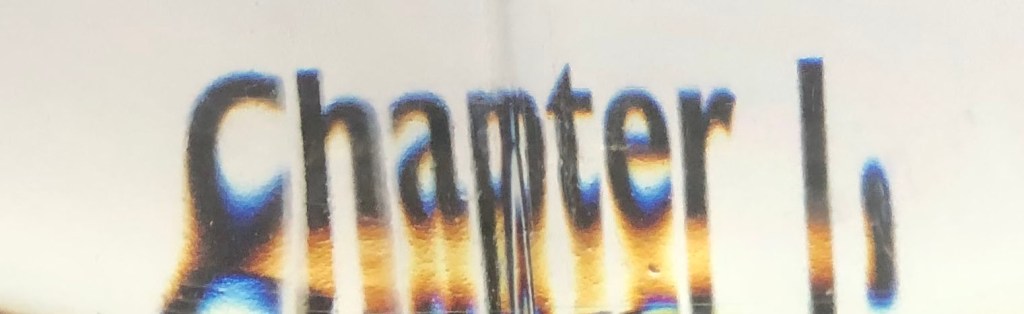
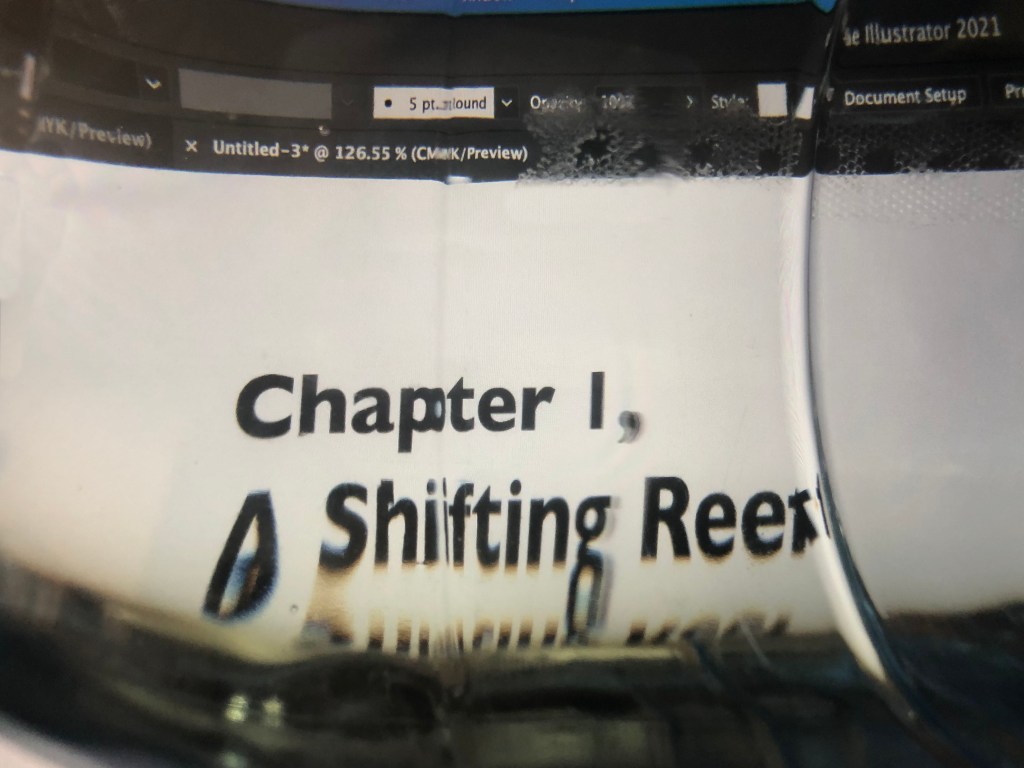
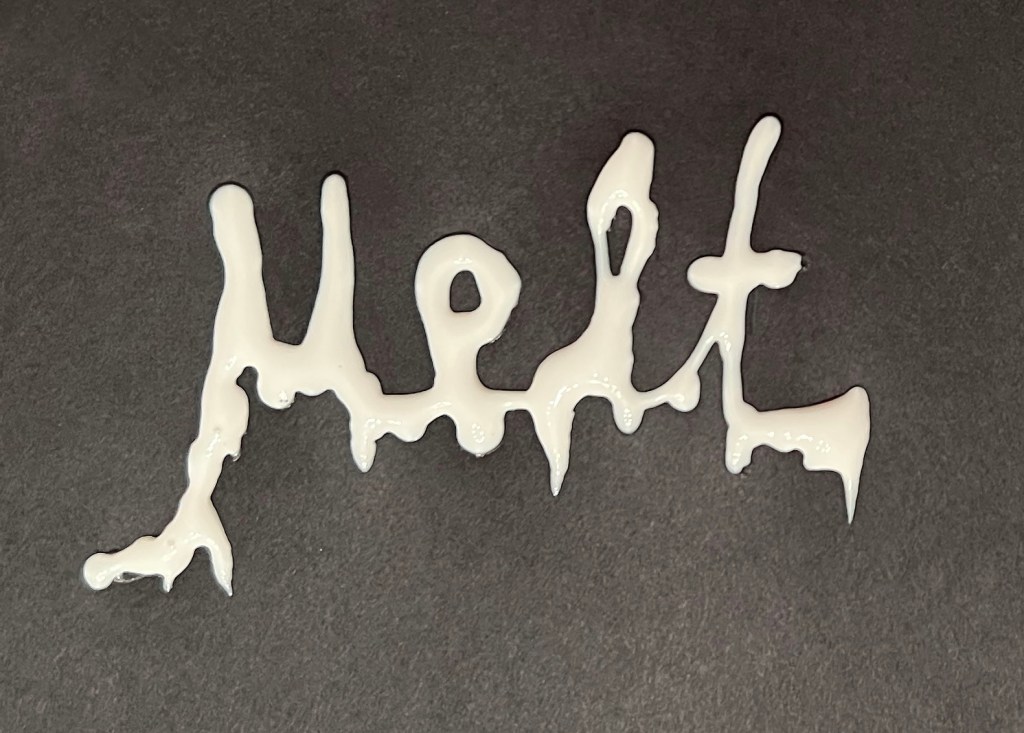
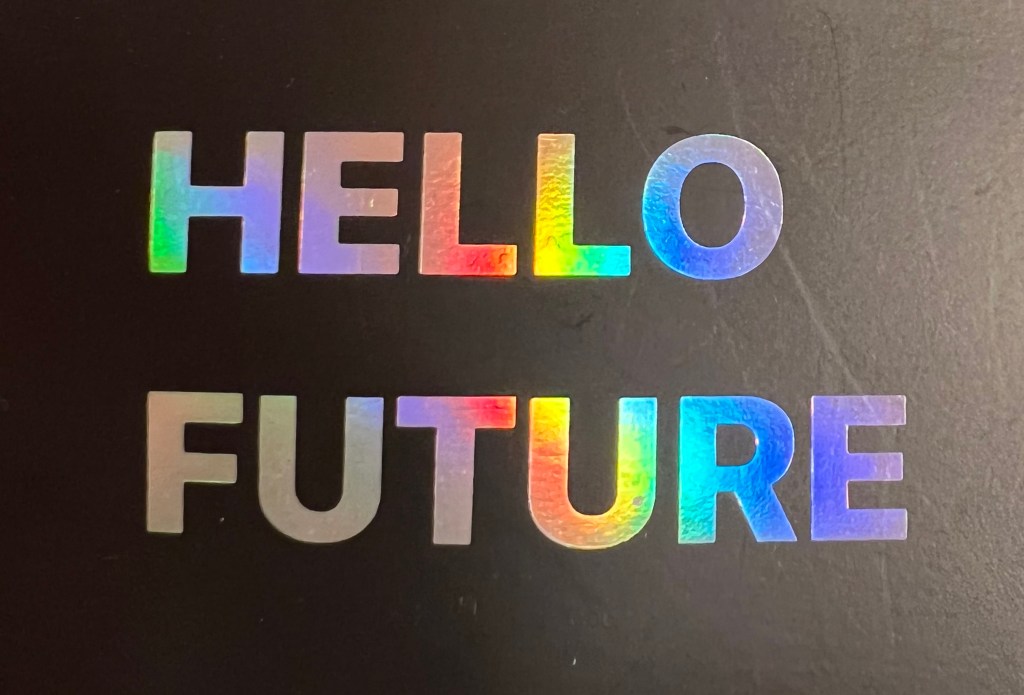
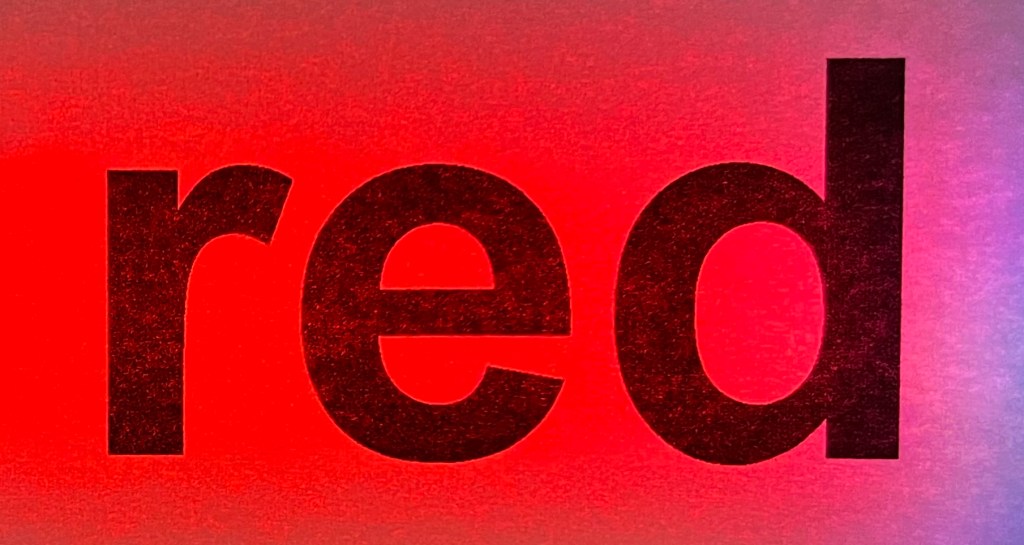
Those were my recent experiments. With all that experience I’ve gained, I still go through that stage: “Right, what am I going to do here now?” I think it’s all coming from the lack of confidence, that’s what I definitely should learn, do not be scared to fail, as that is how success is born, as we never know how many unsuccessful outcomes were prior to the amazing results. Same here, I went around the house with printed letters, trying to find some interesting objects to use for experiments. I printed words on the piece of paper and thought about what I can do, burn words, distort, use a piece of the soup, light bulbs, gouache, and anything else, that can push the boundaries. Some outcomes looked quite good, I thought they need a couple of tweaks in Photoshop, but altogether it was all worth doing.

Experiments with printer

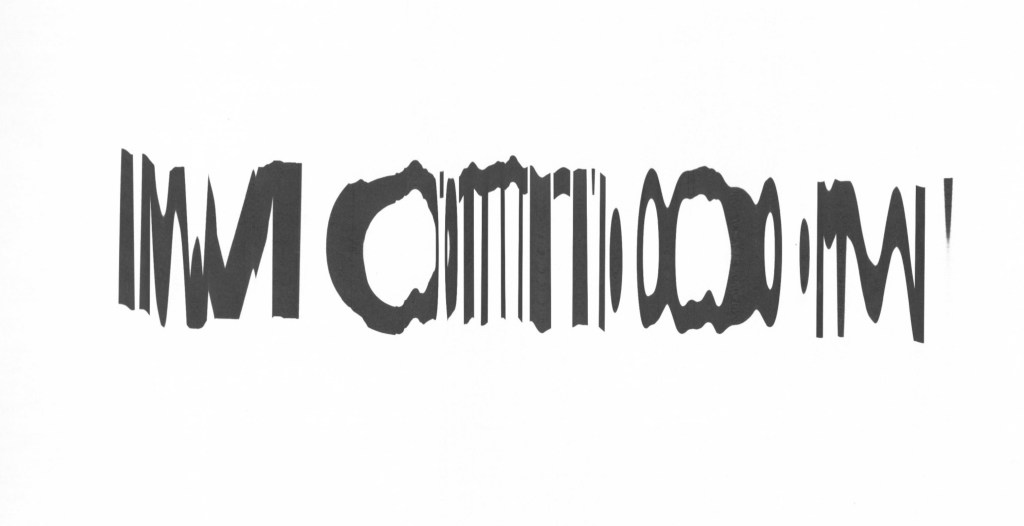
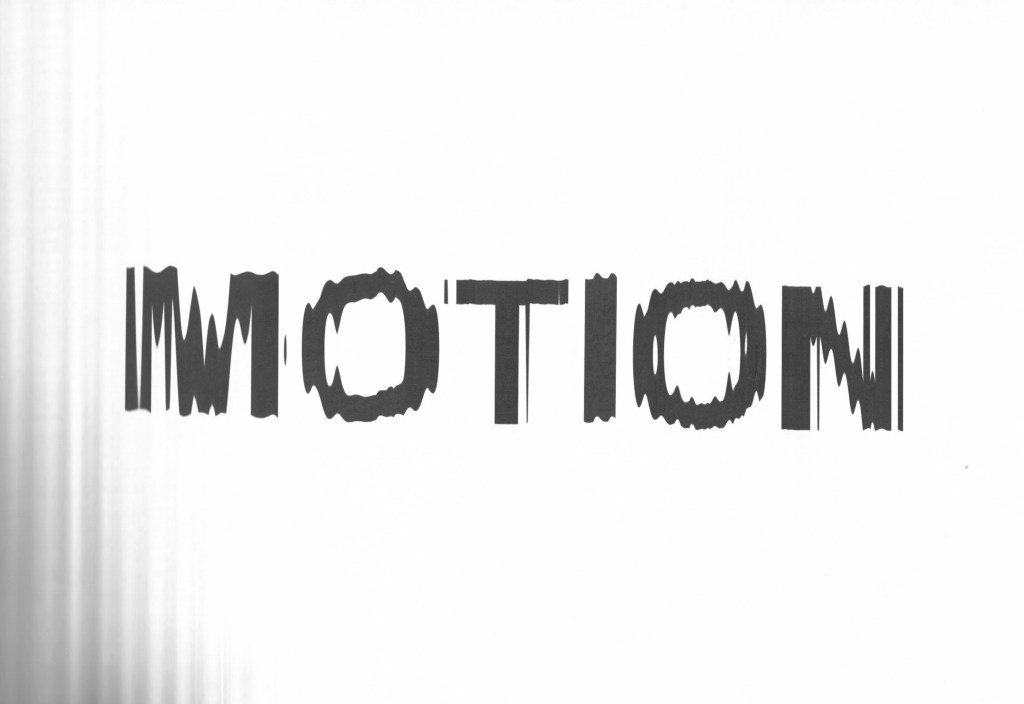
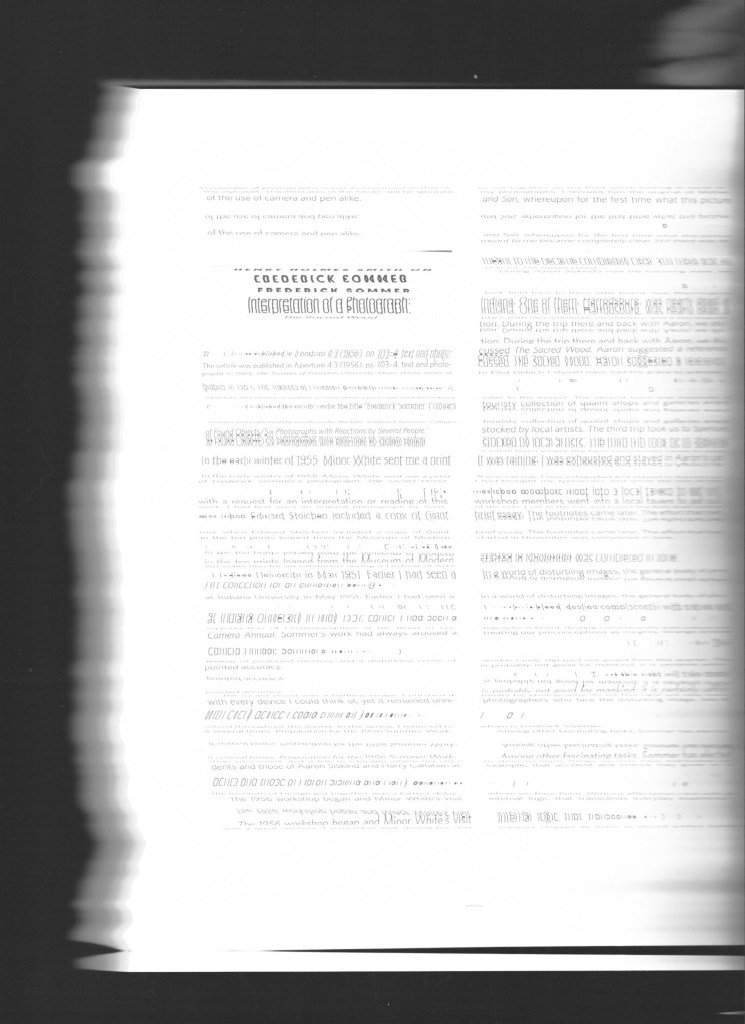
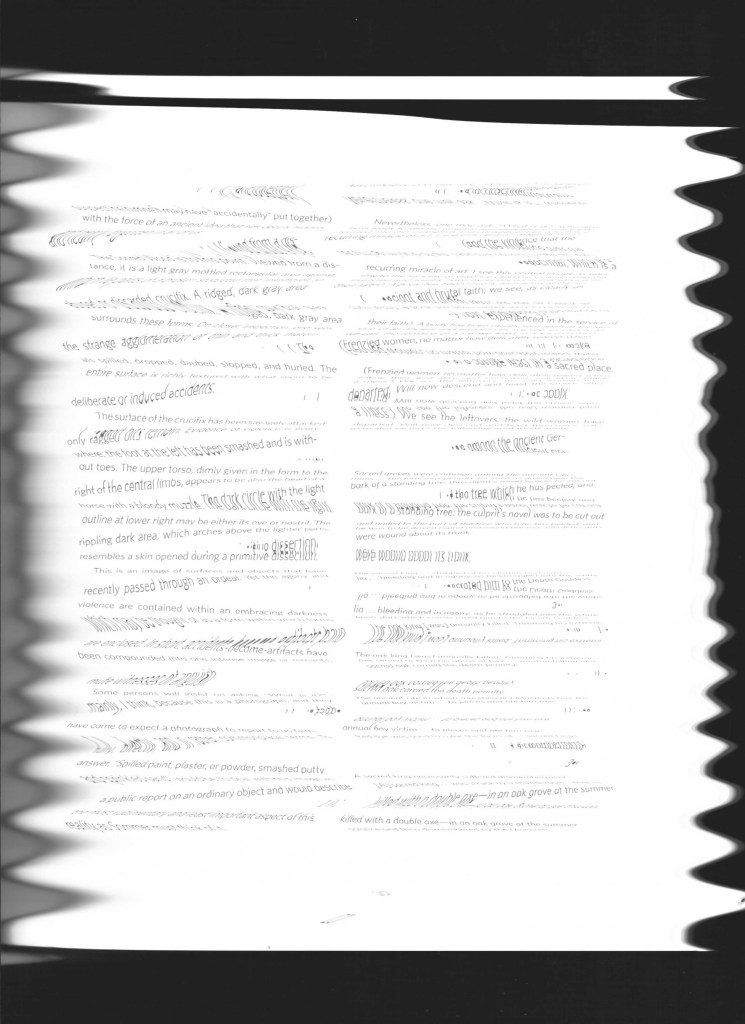
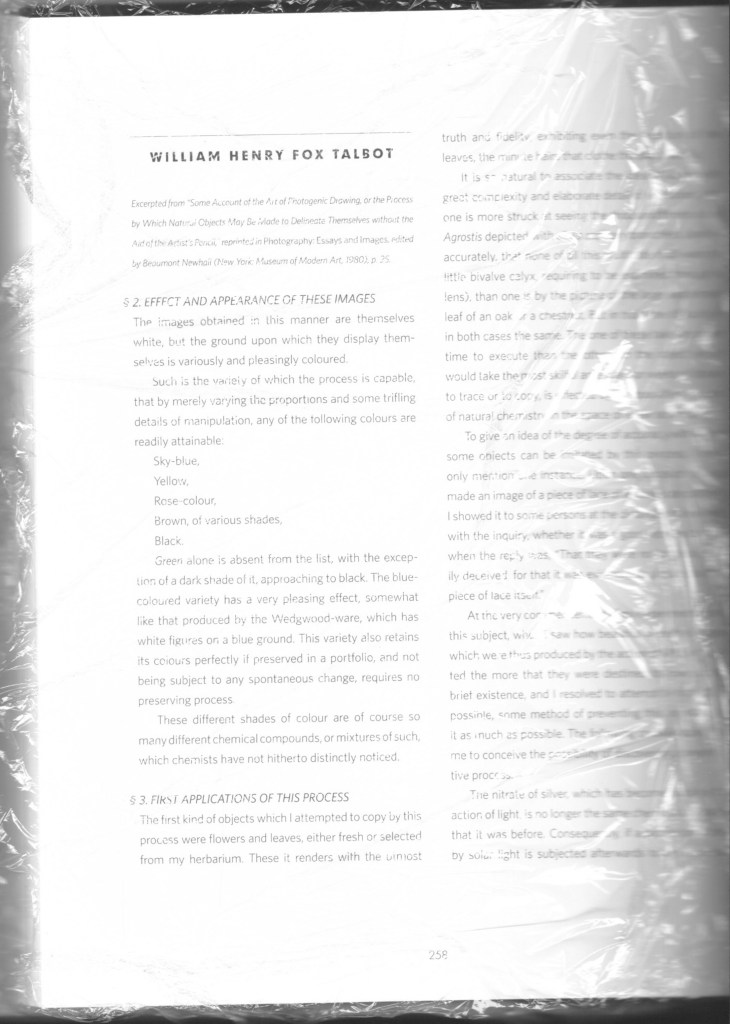
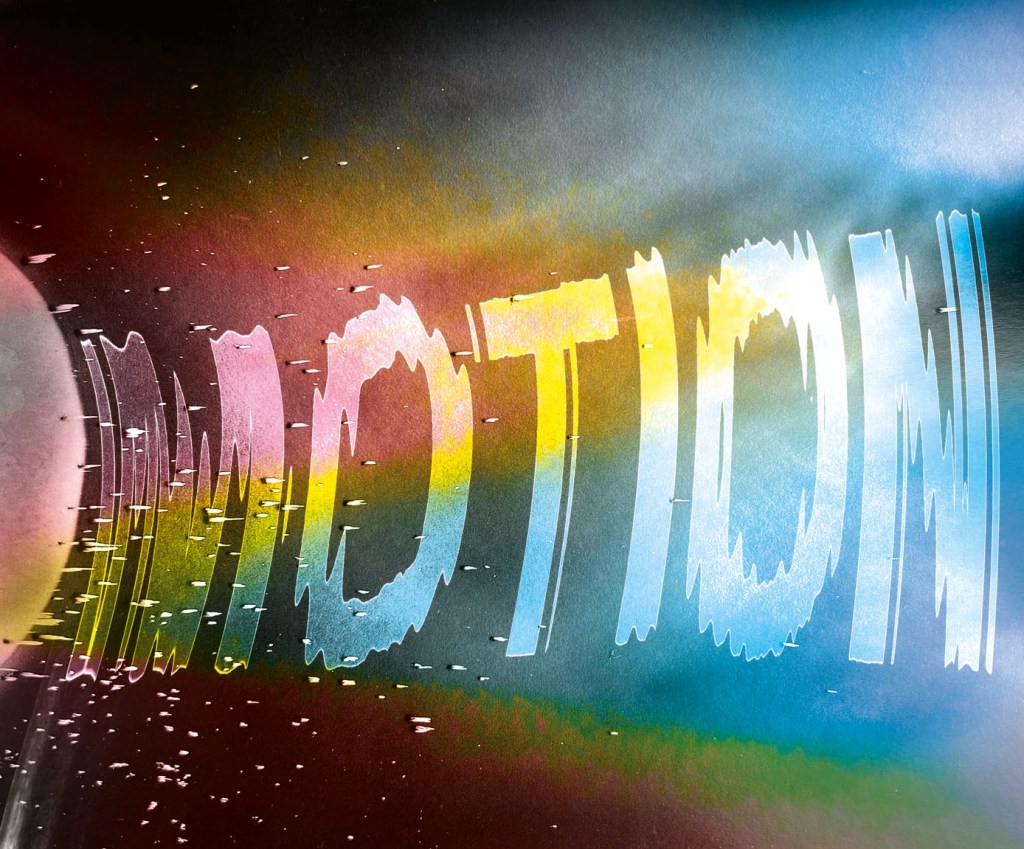
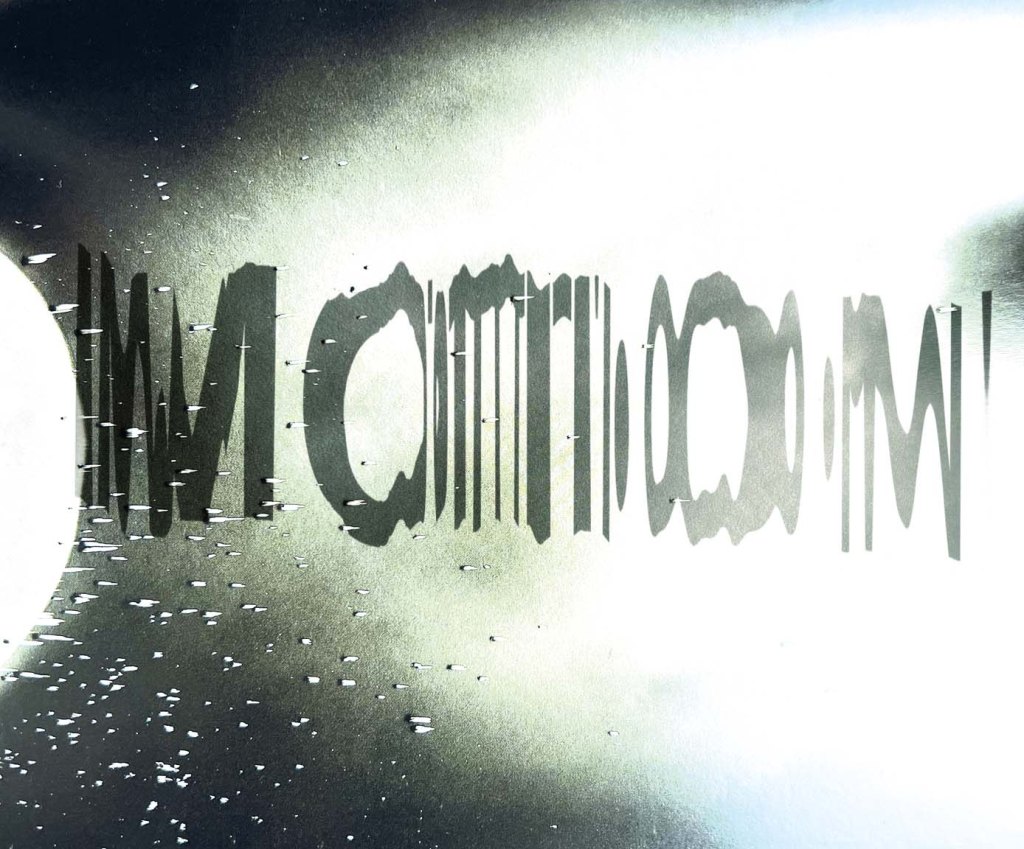
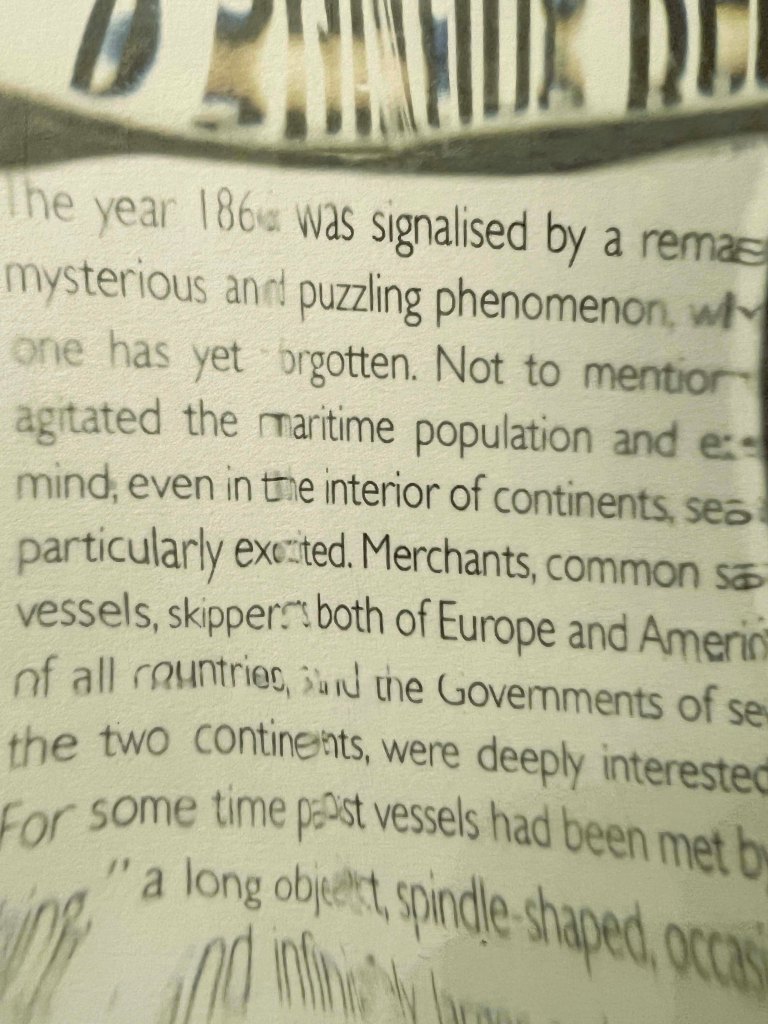
As I needed more materials for the book, it was going to have some pages to go through, I kept on doing the exploring. This time I took a magazine with the printed article and scanned it through the scanner whilst I was fighting the page. I’ve heard before, that there is the way how some creative projects are born, and it reminded me of concrete poetry or typewriter art. How great was that, I thought I can add a creative background, with some colours, and it will help the layout to have remarkable features. those experiments I was going to integrate somewhere within the book, and it’s inspired me that I was in the right pass. In addition, I could word MOTION, which I altered similarly through the scanner. Worth trying in future projects, and posters, I think the creative community are going to love it.

Glitchy Typography

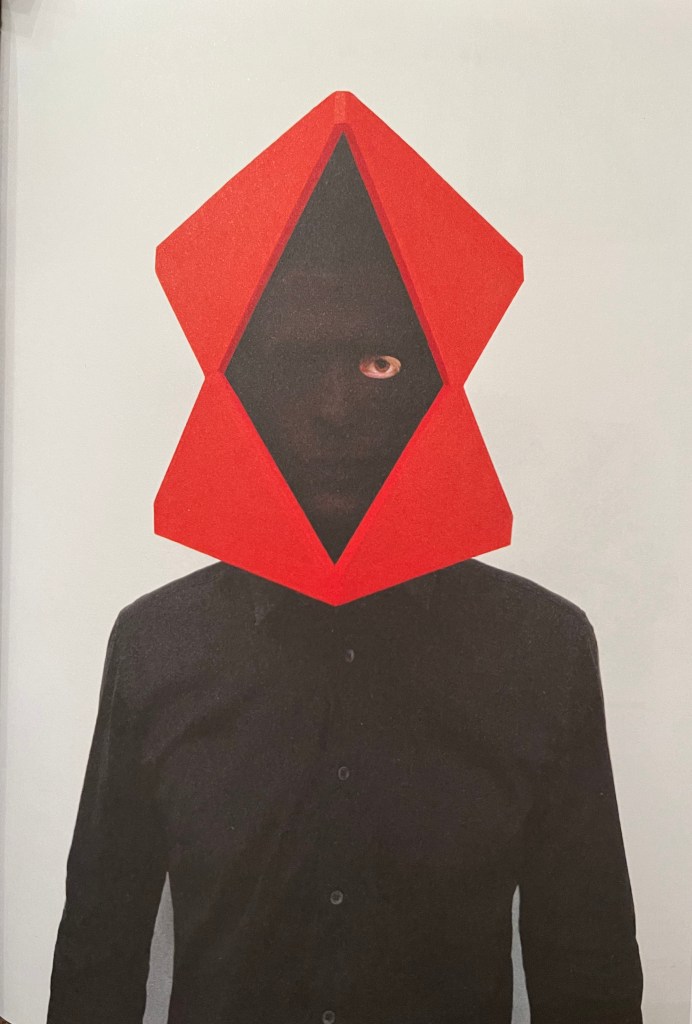
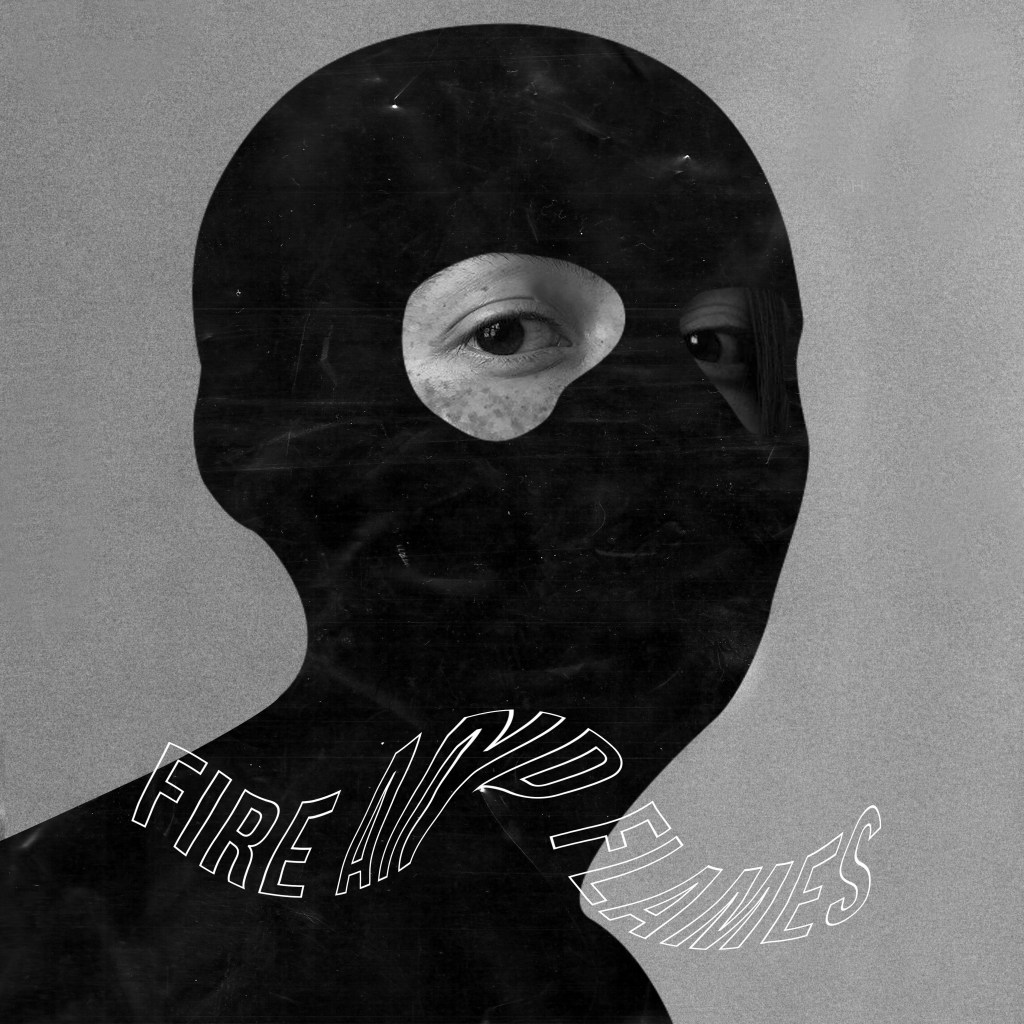
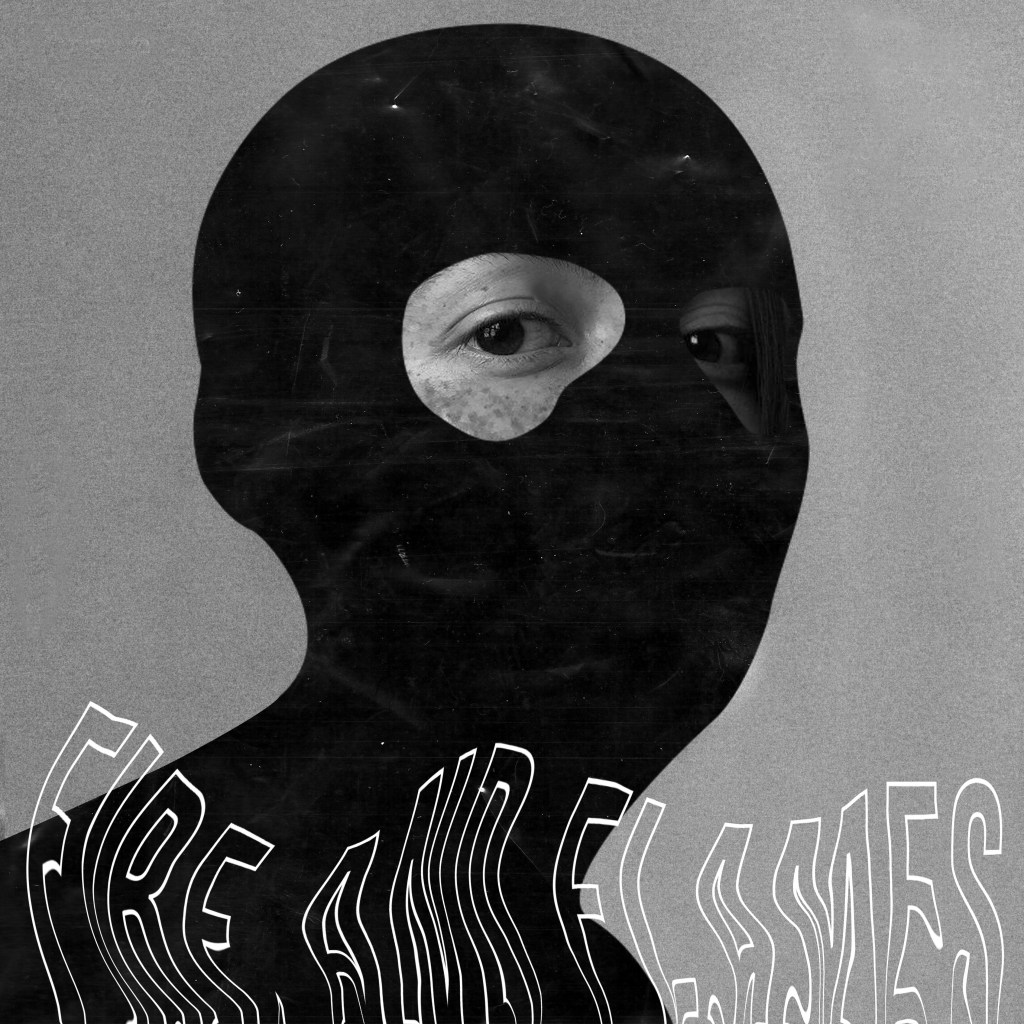
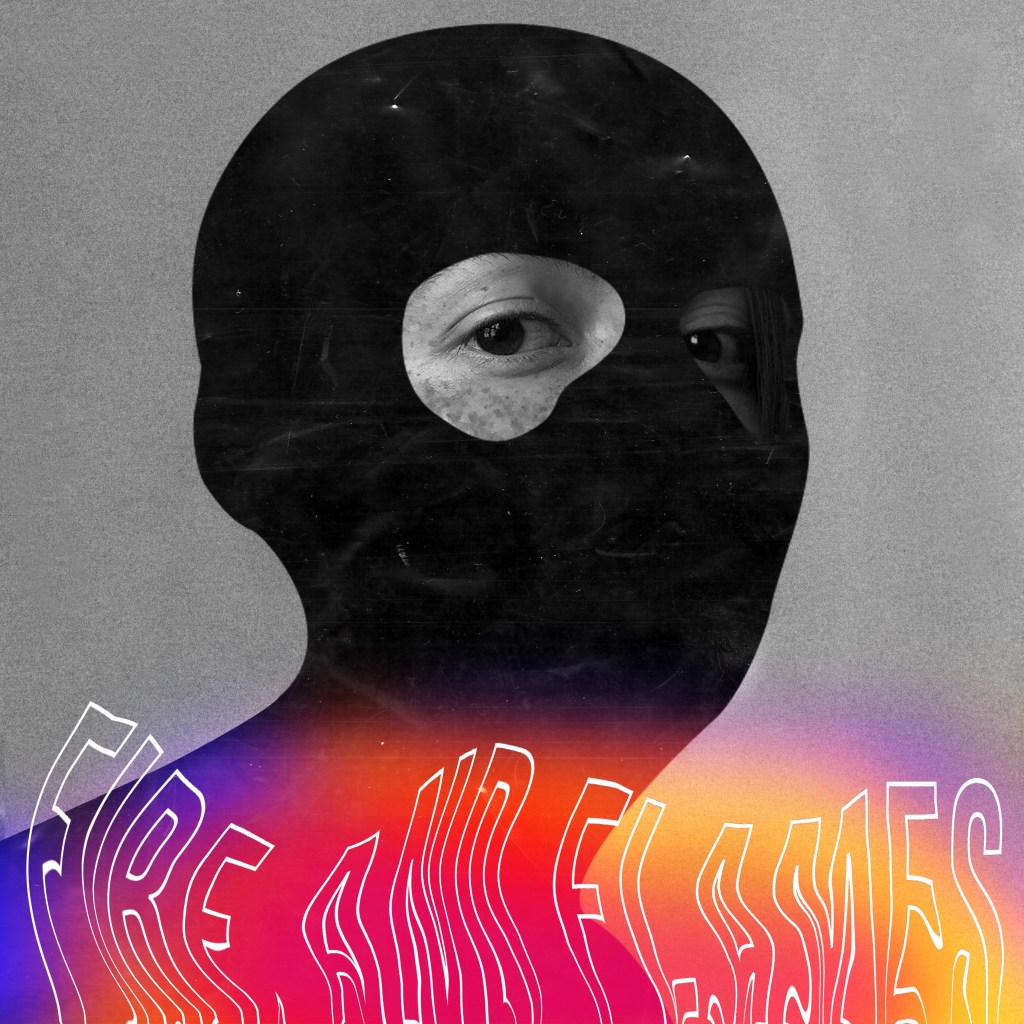
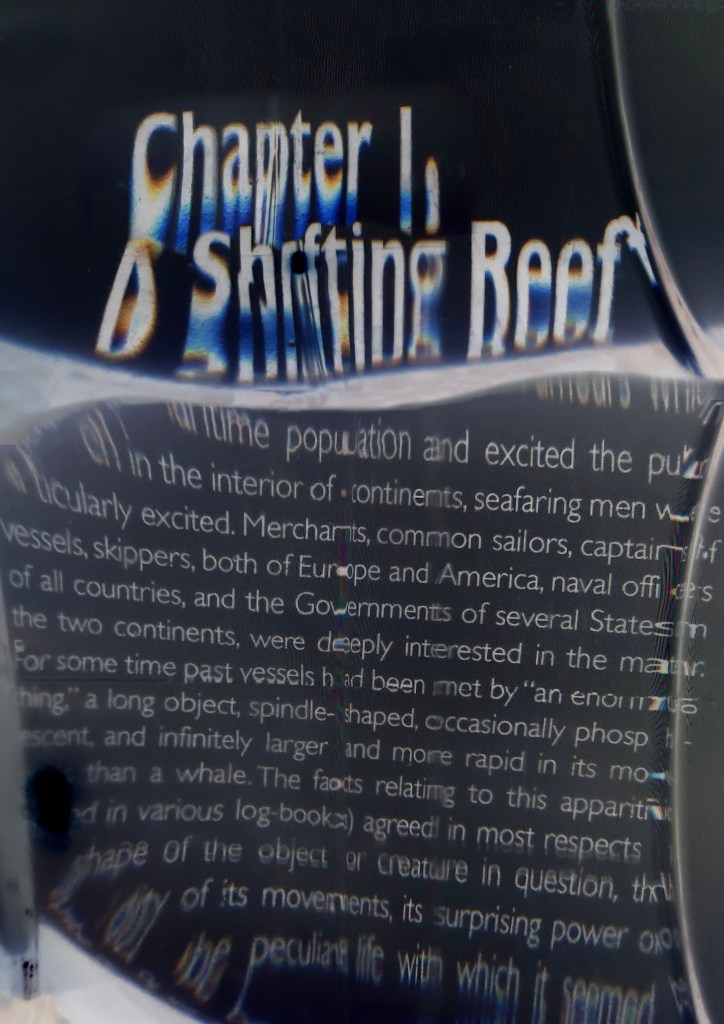
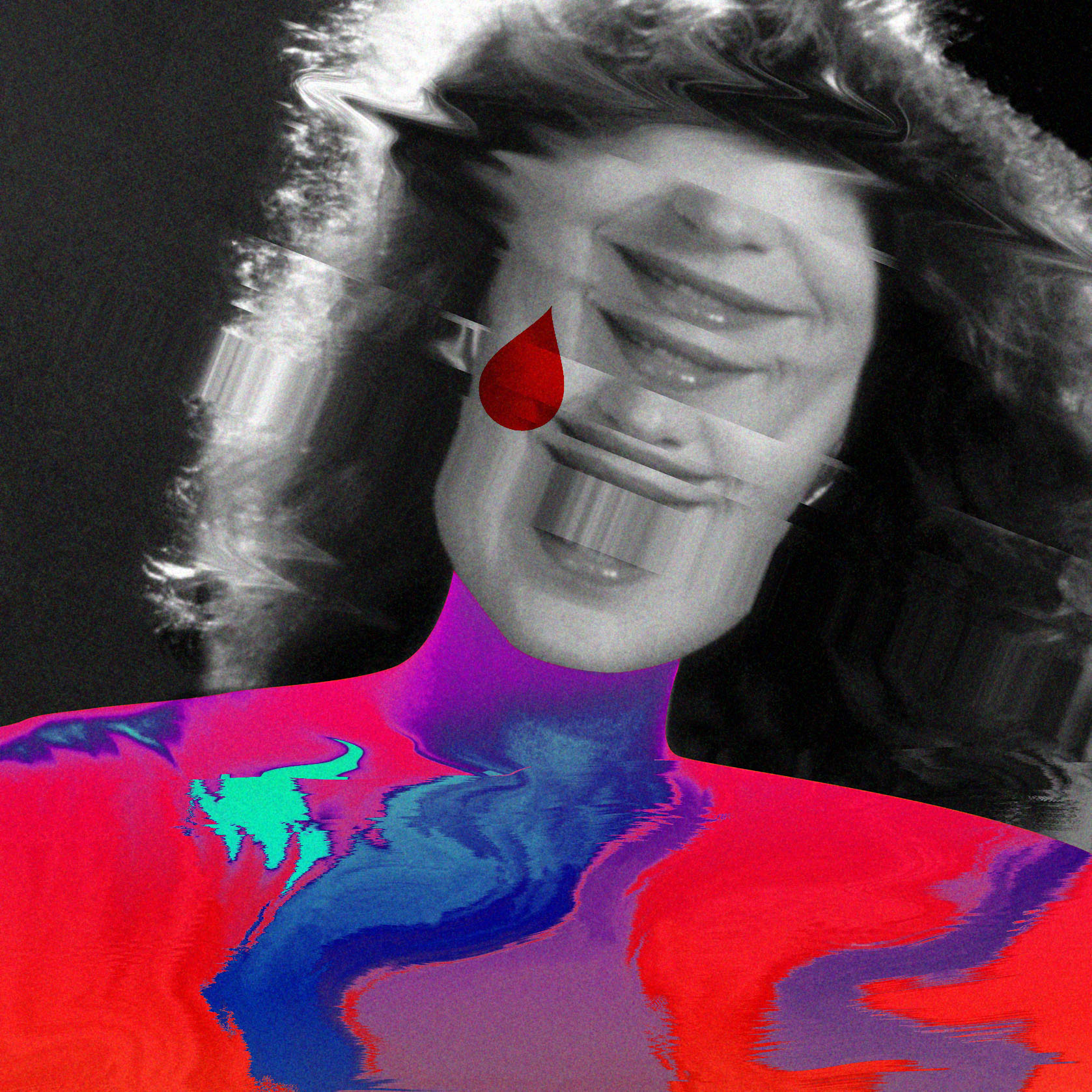
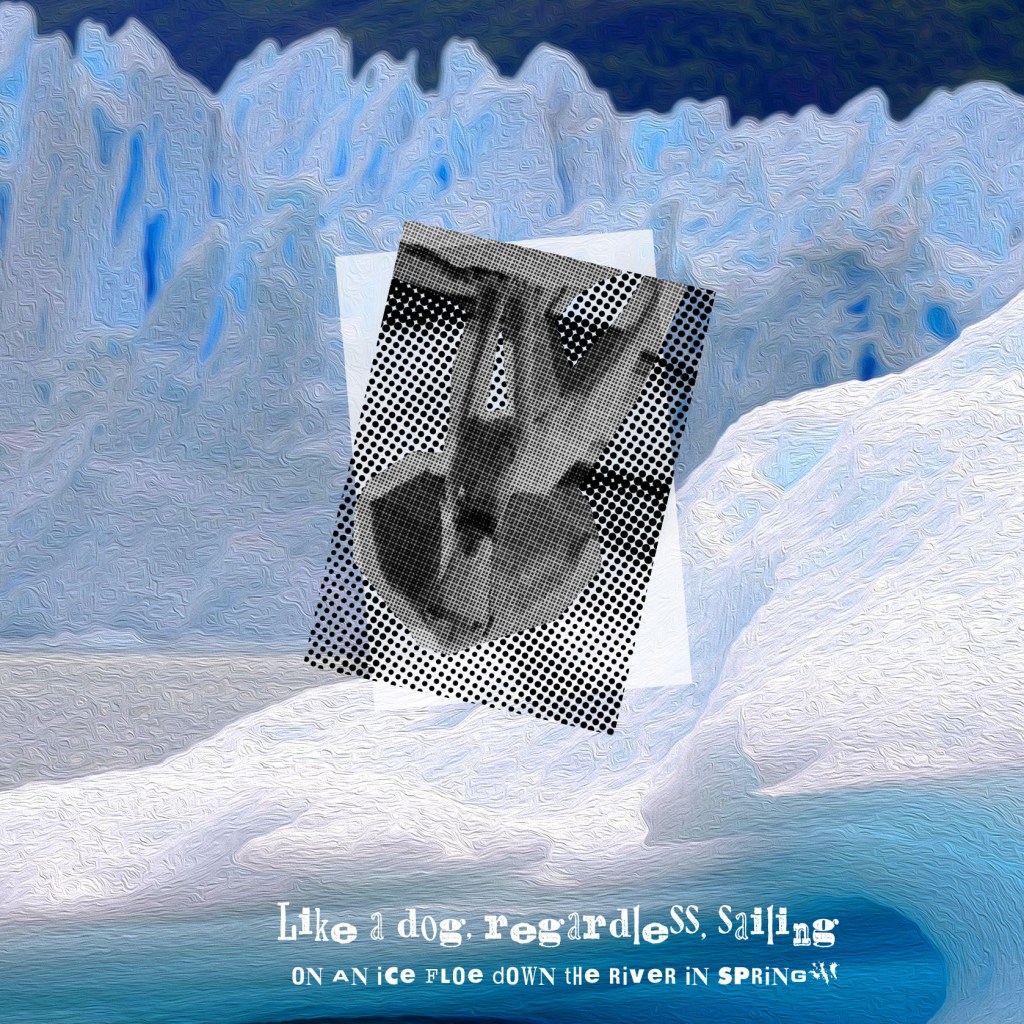
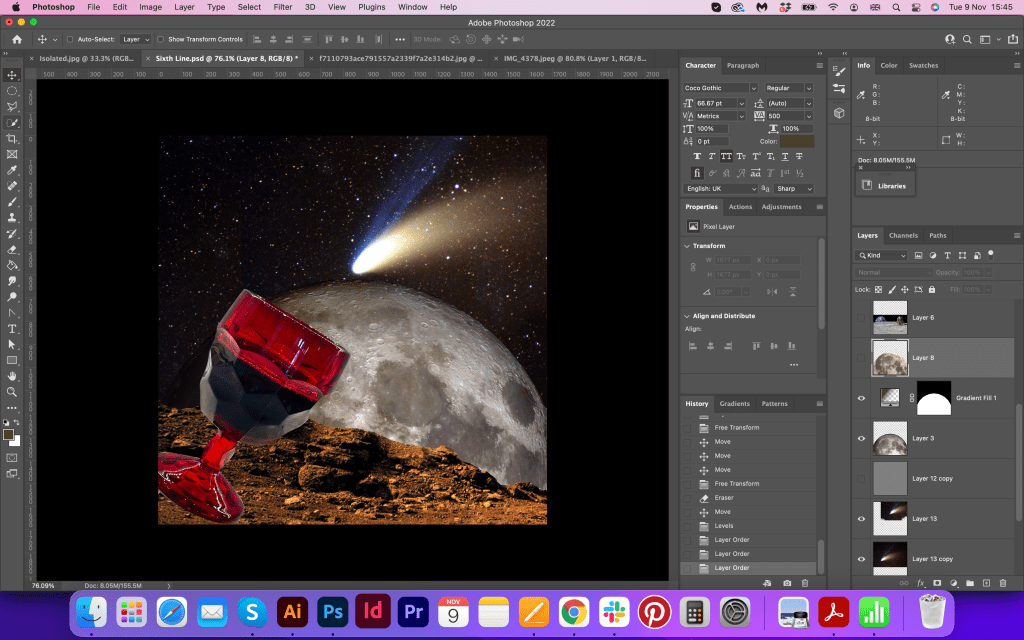
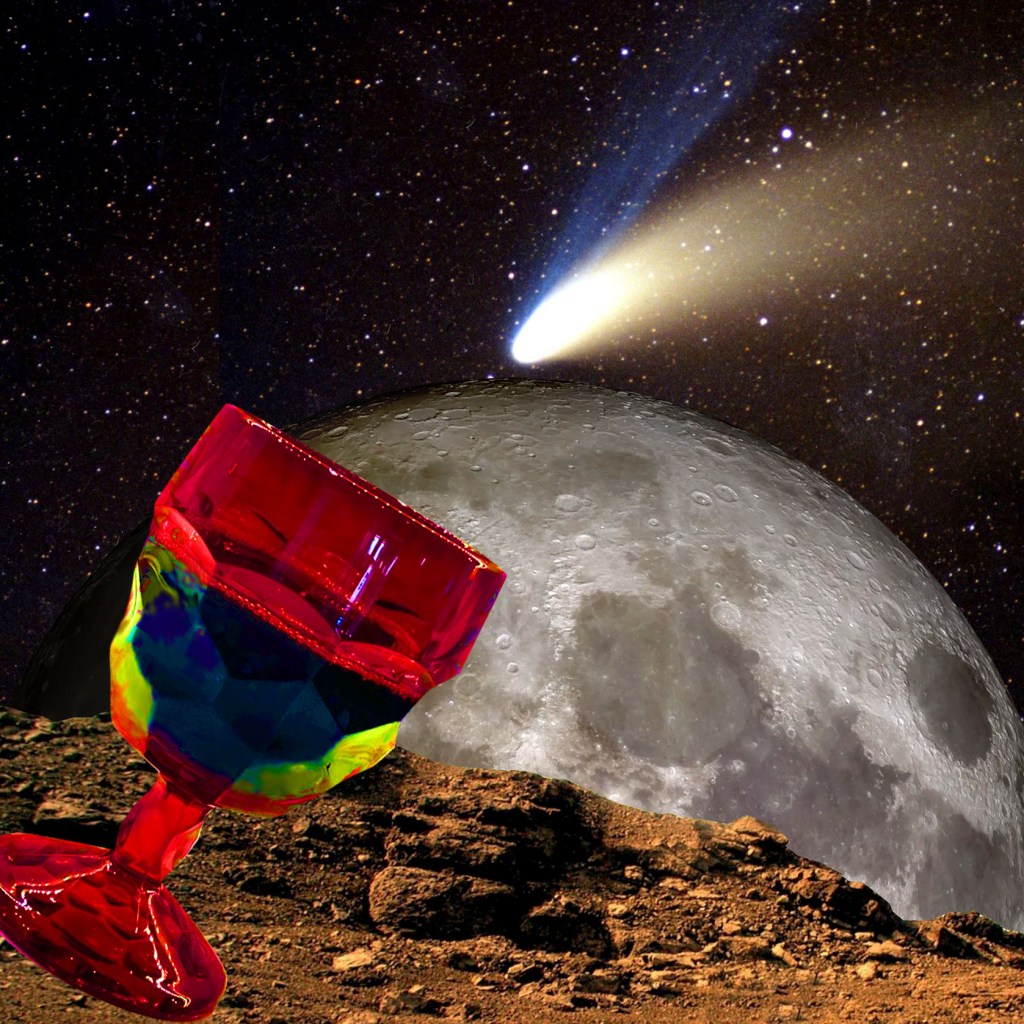
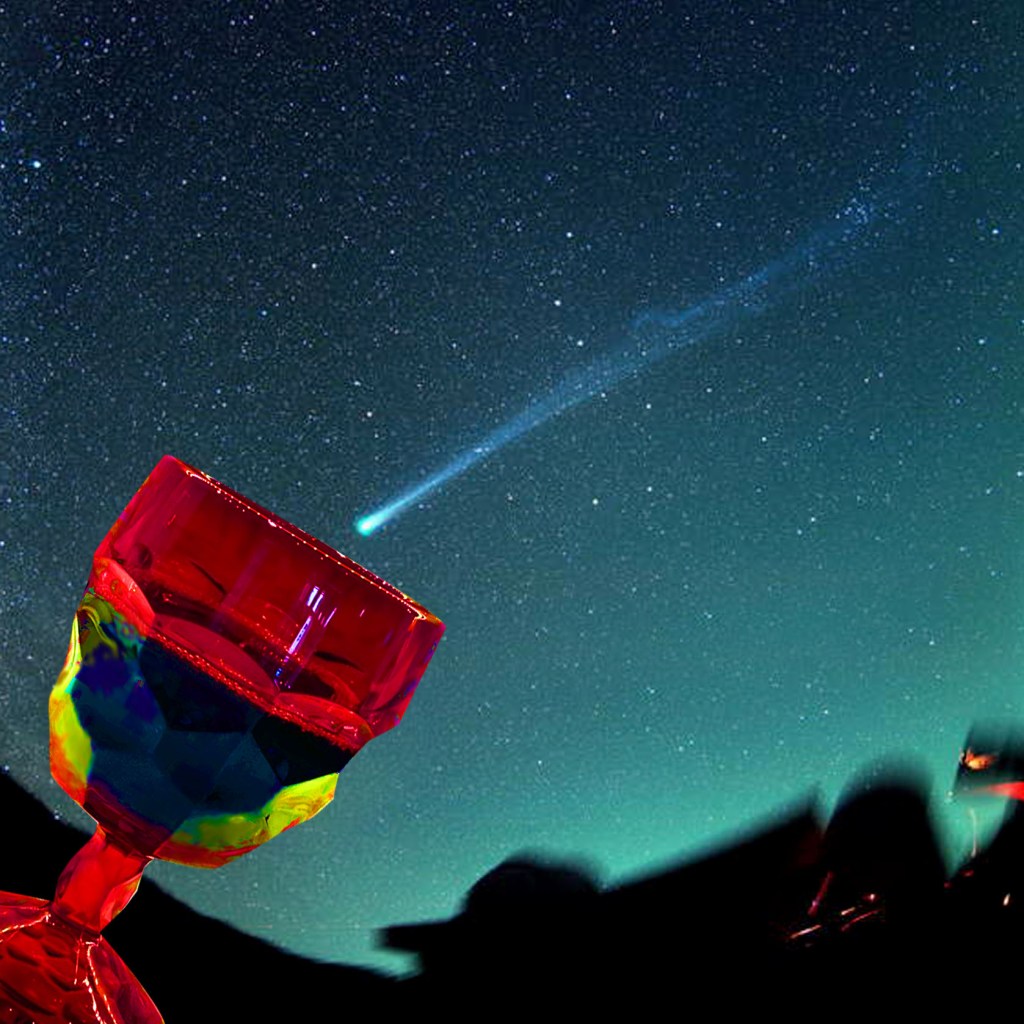
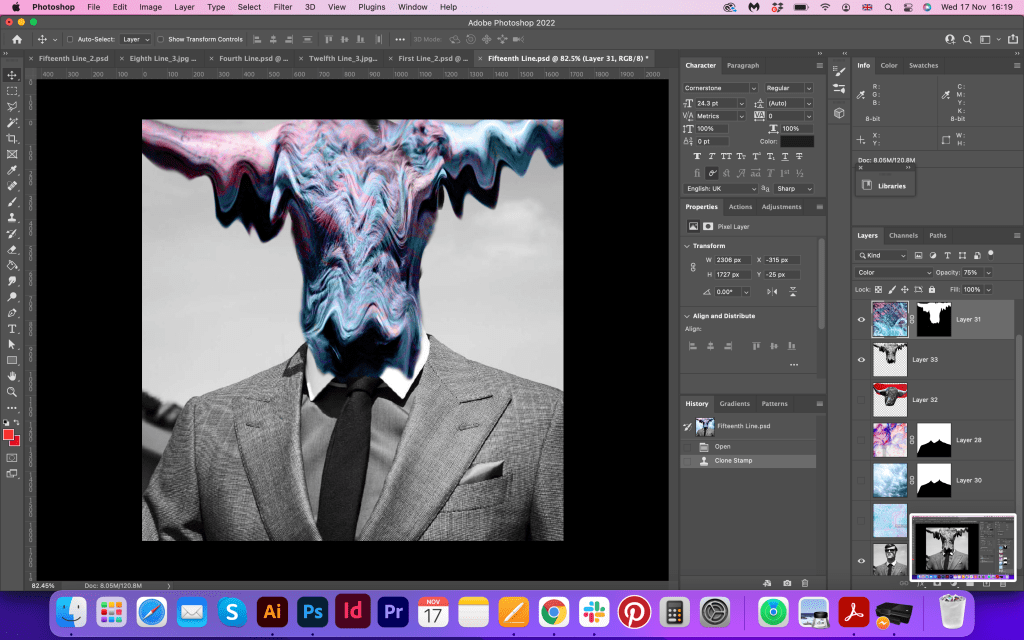
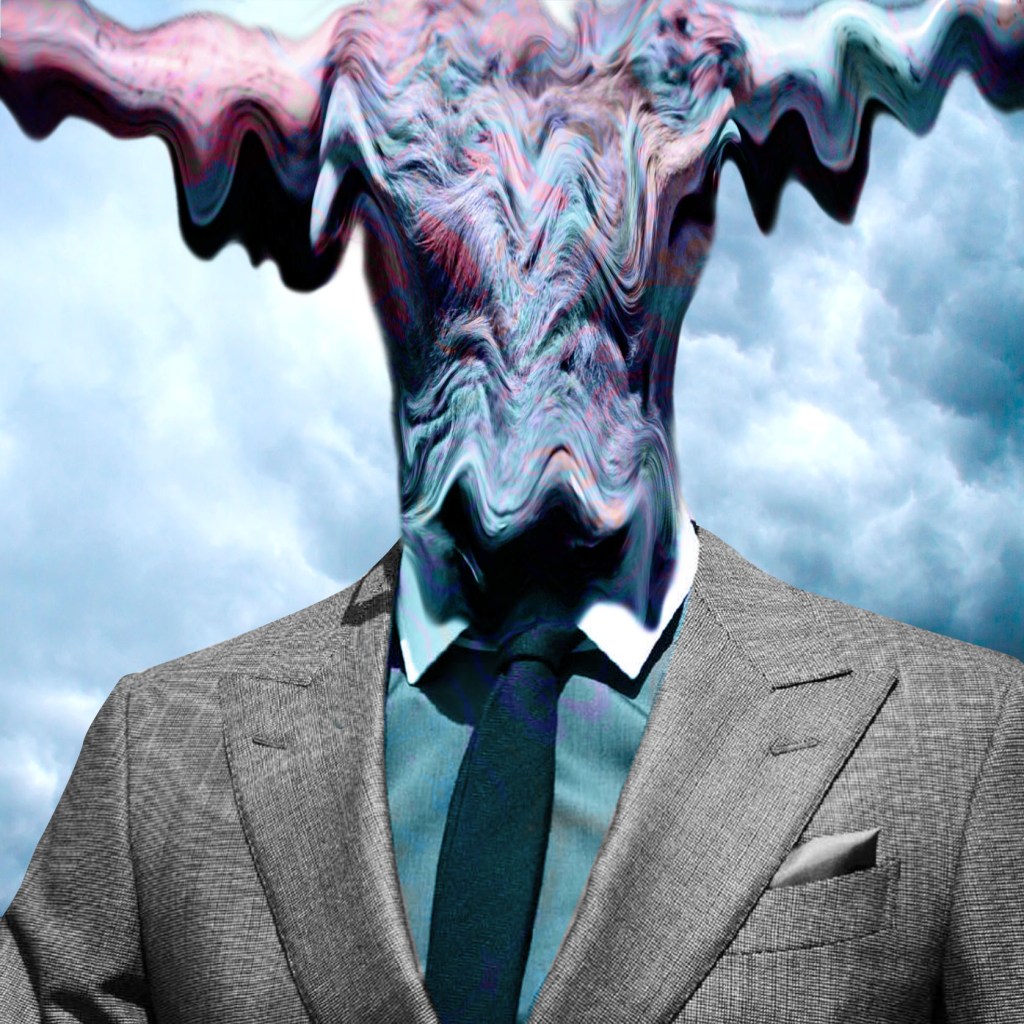
These technics of distorted typography I found somewhere on youtube whiles I try to learn how this glitchy font work. The tool is quite simple, liquify filter does its job for you, but the creative image of the table in balaclava add some extra darkness and mystery to this image. I was going to use it within the context of the book, as an introductory image, maybe that’s who I feel whilst I’m doing all those typography designs and experiments. My face isn’t shown, but the impact and creations are seen in this project.

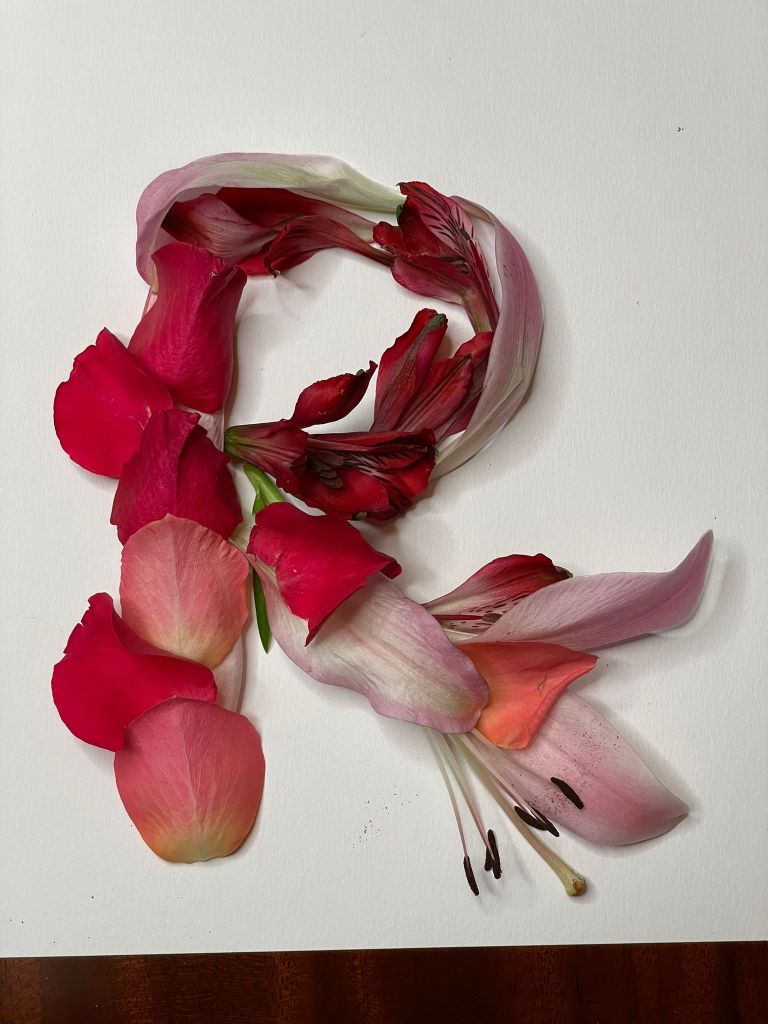
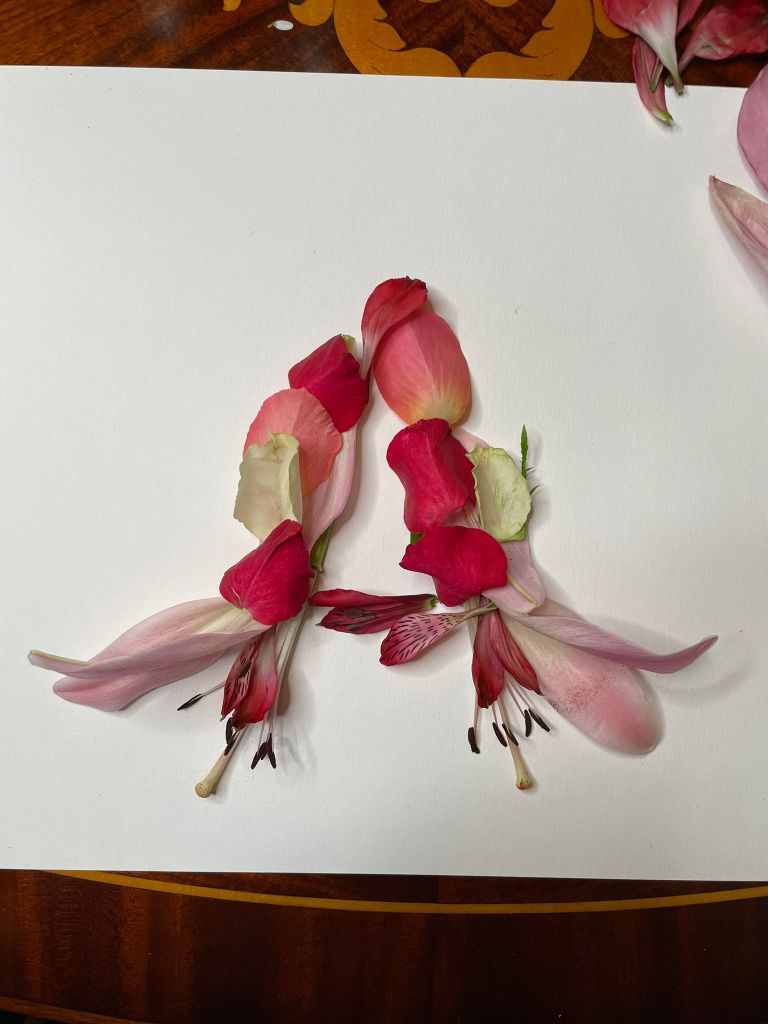
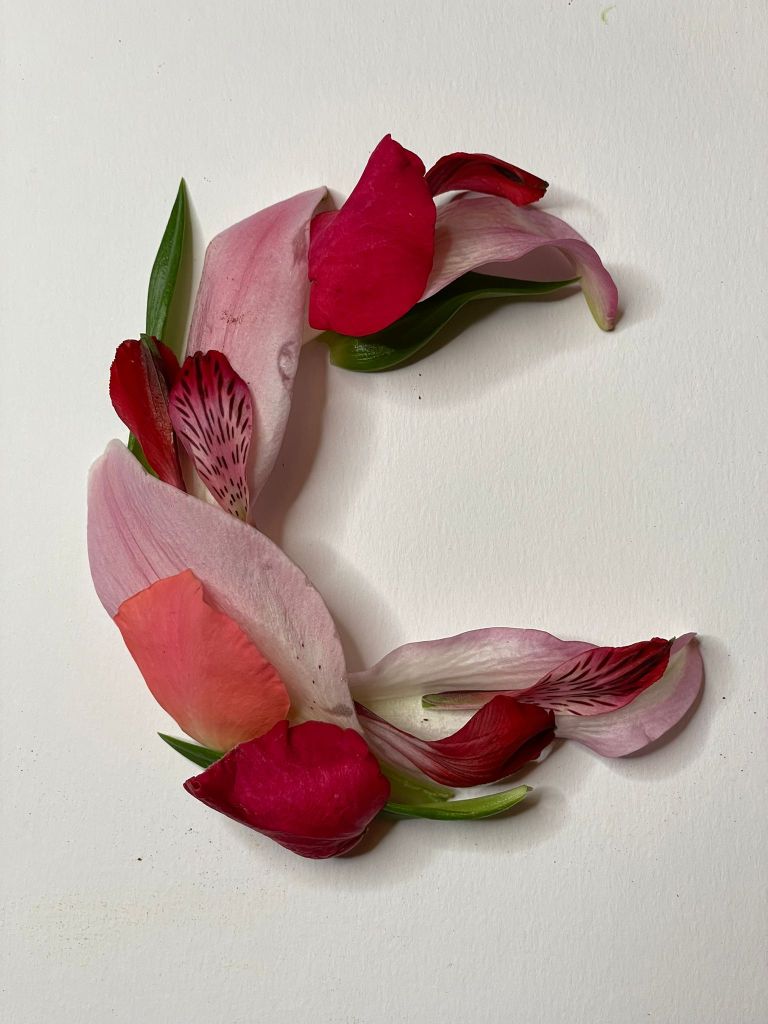
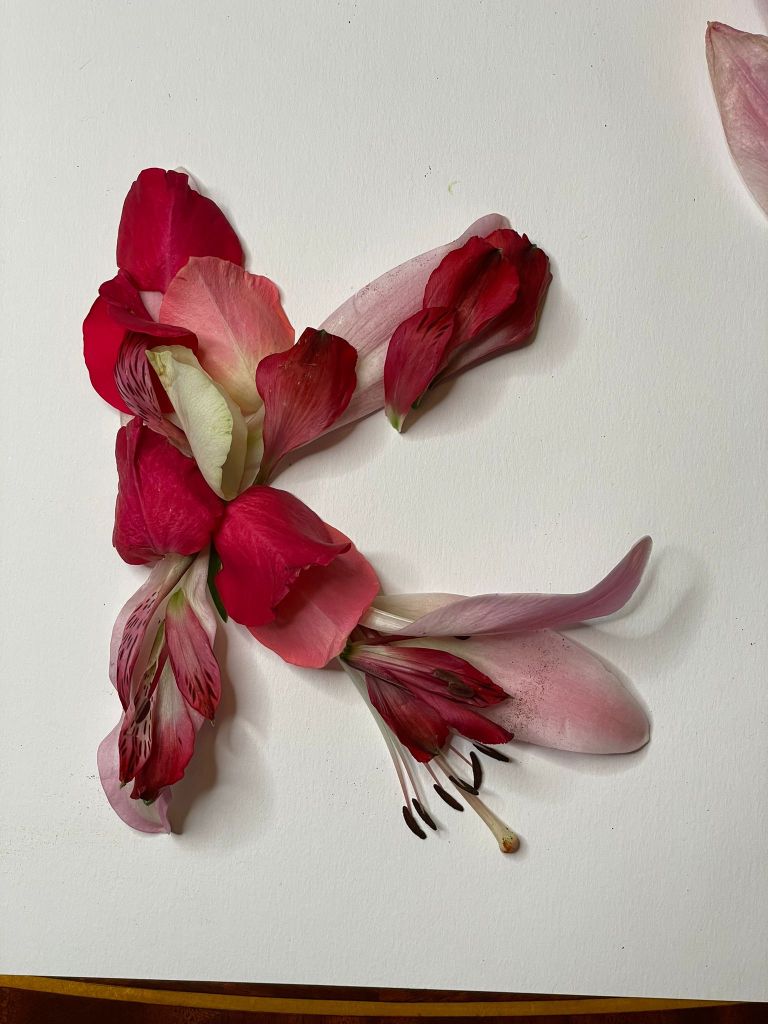
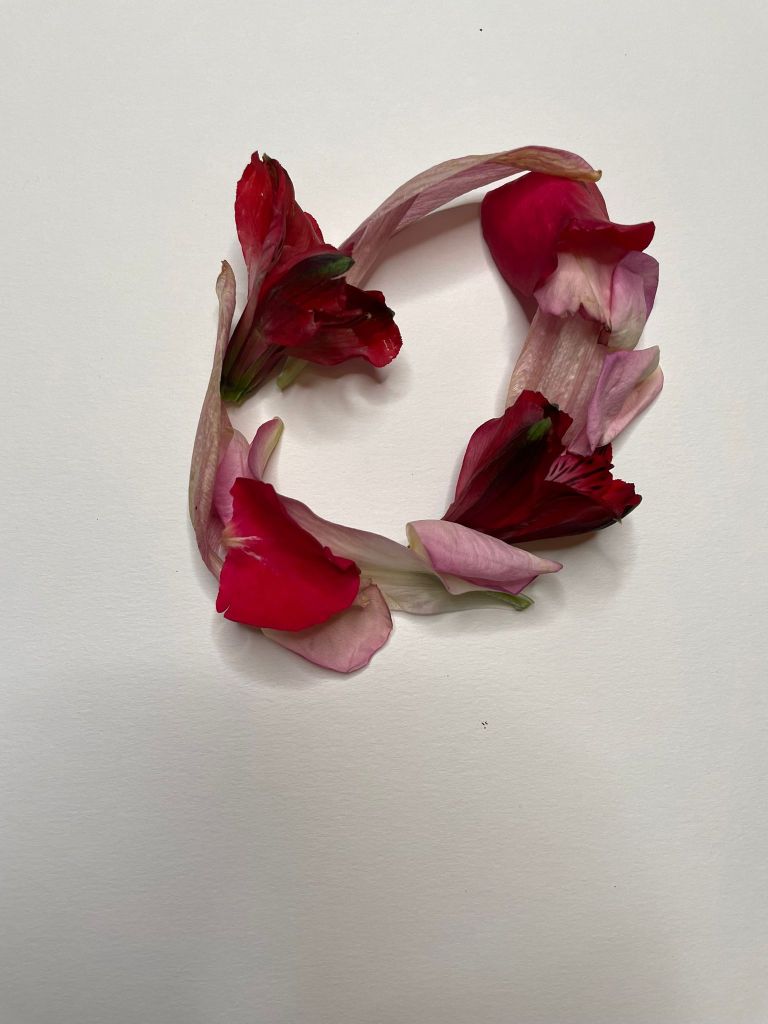
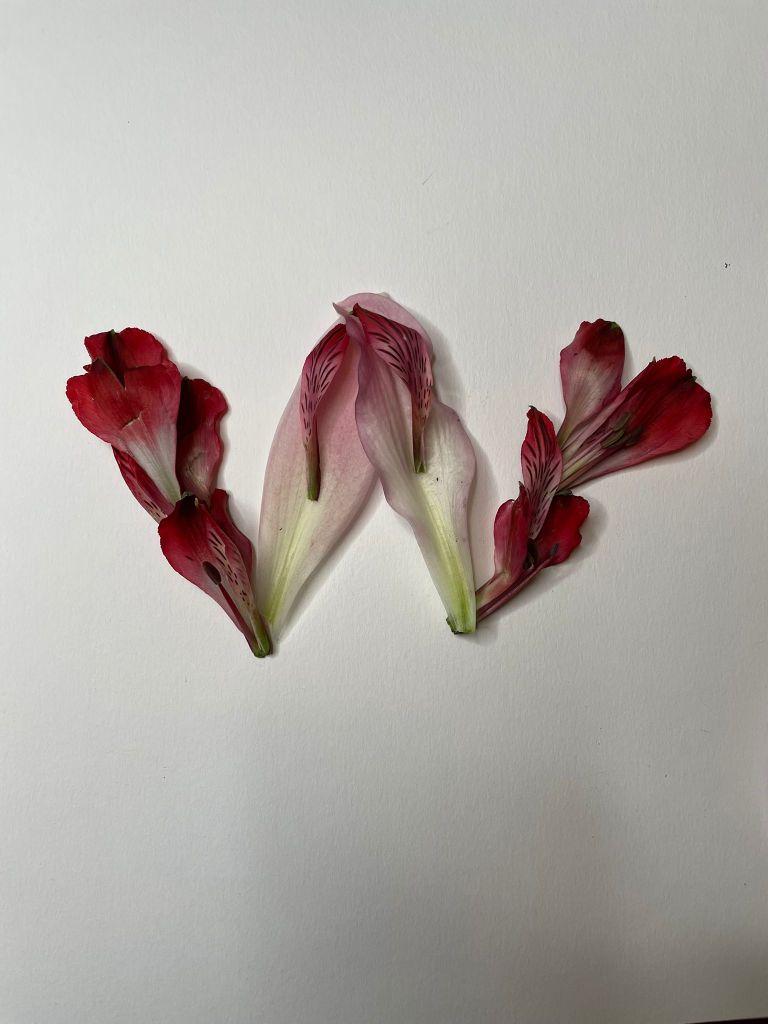
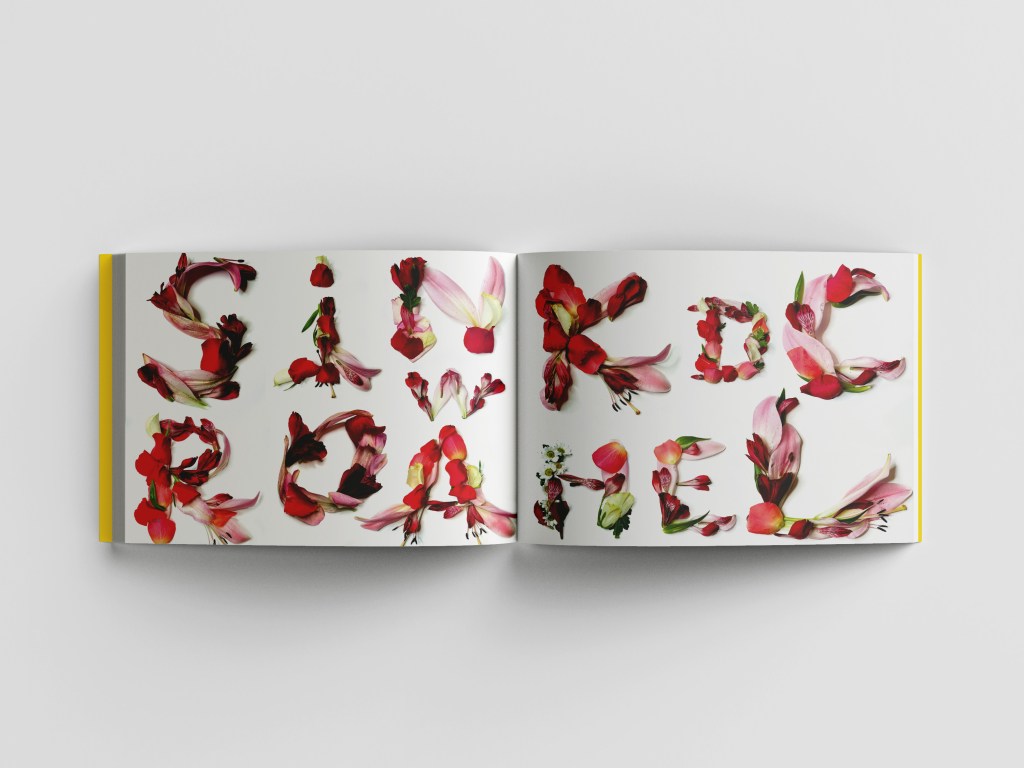
Flower Petals Font

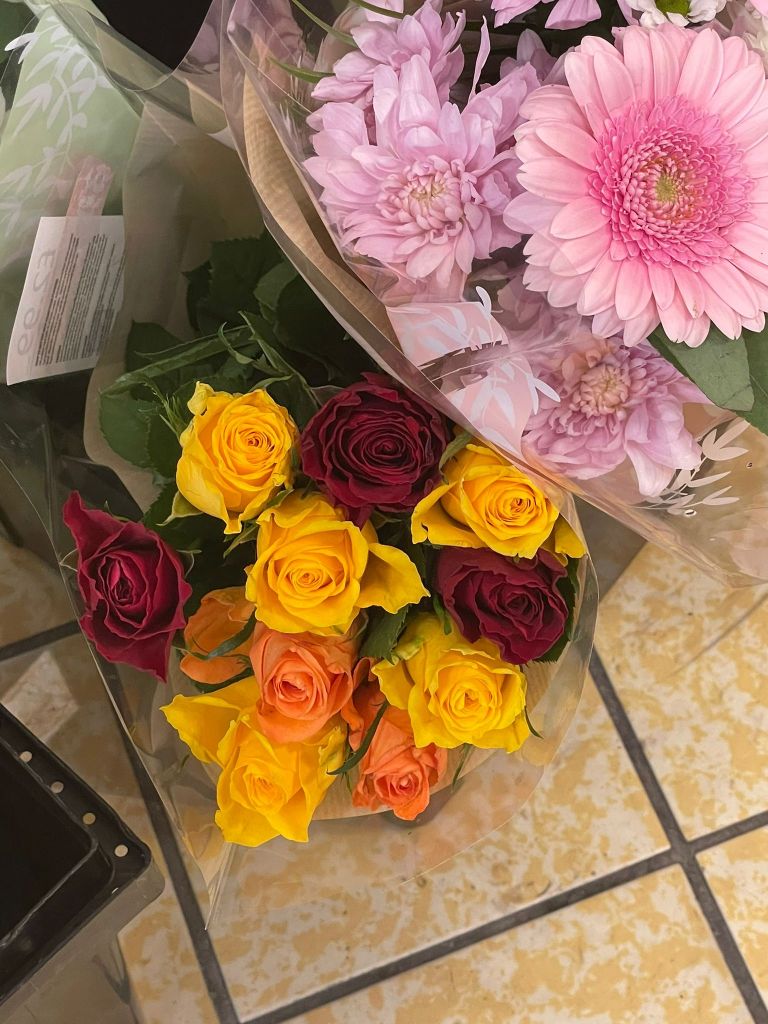
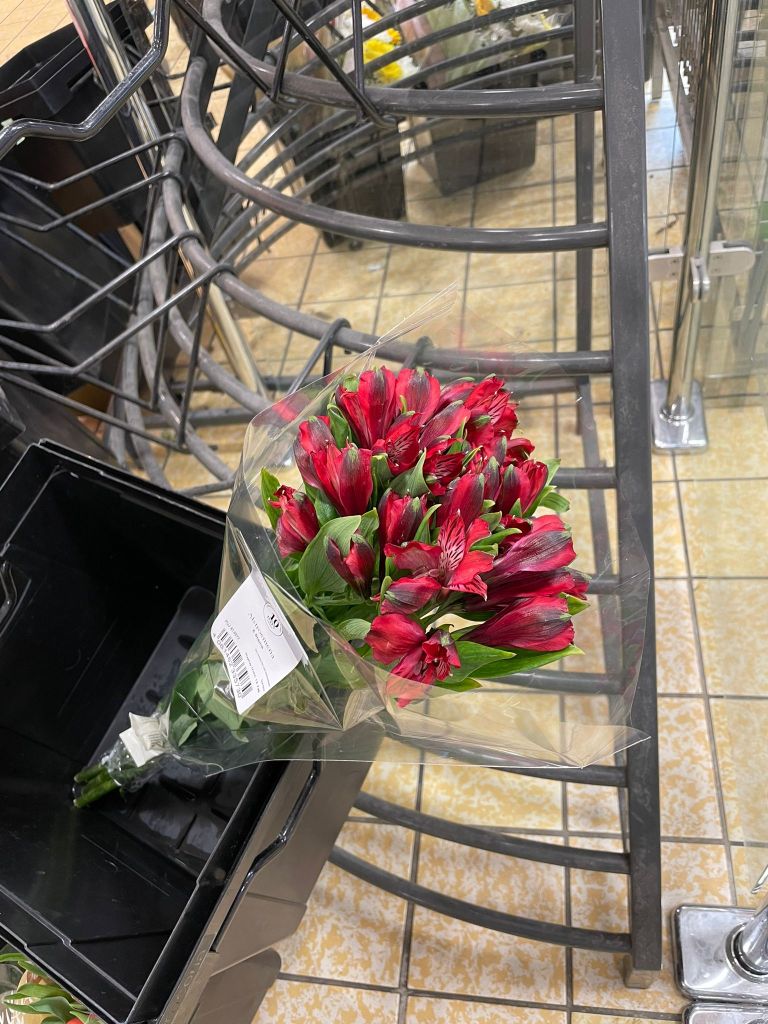
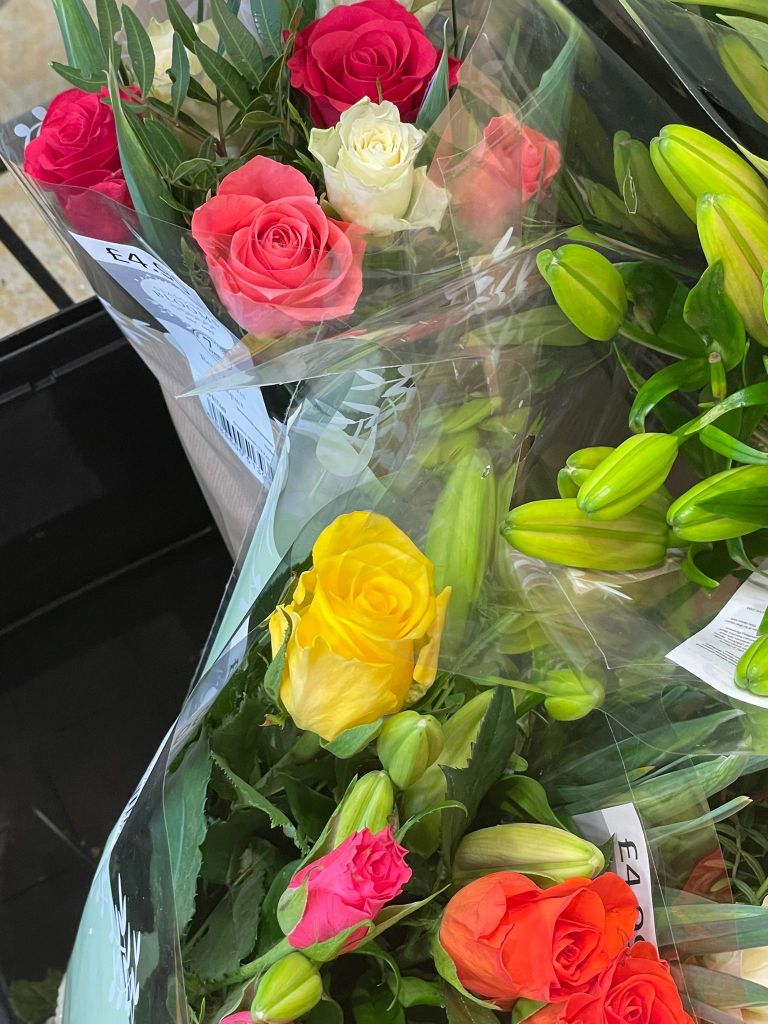
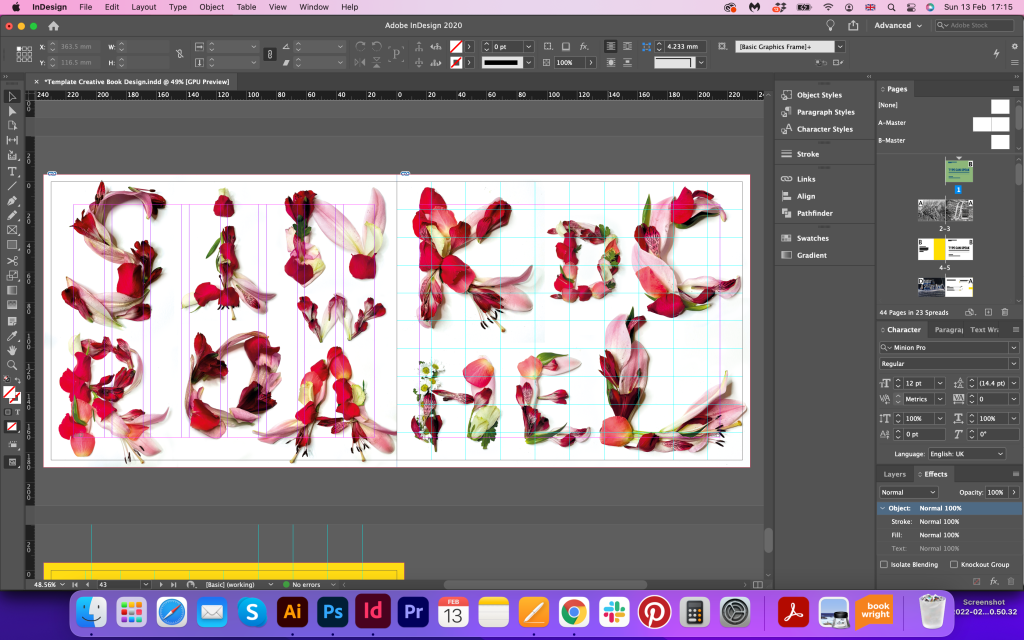
Those roses and lilies font I wanted to recreate again, following the path of my previous experience. I wanted to create a more confident type with brighter colour, and stronger bends around it, so the font is easier to read. I bought bright colours flowers and started organising them around. Those beautiful tender letters from the first look ideal for classical designs and will sit somewhere nicely within feminine designs, but in my book, I wanted to create juxtaposition and go against the rules. I wanted to combine rebel like design, with an unusual magazine layout, bright colours, and tender images. I wanted this book to be an experiment as well, so I thought it worth trying all ideas I have, and seeing the outcome of experiments, as the conclusion will show the final result.

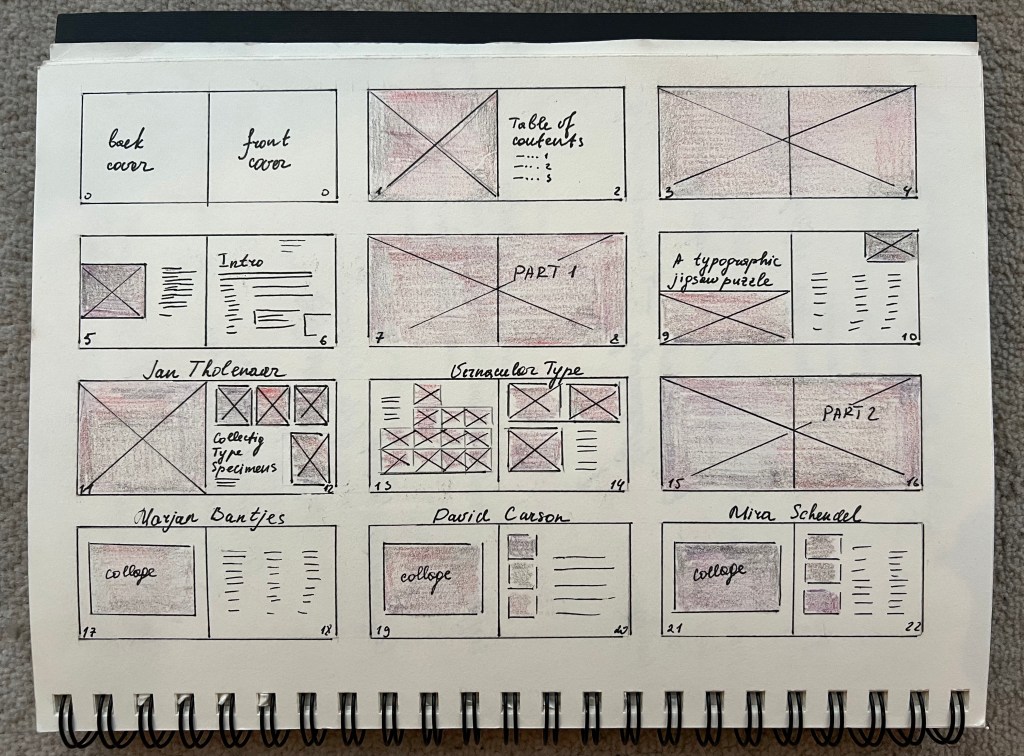
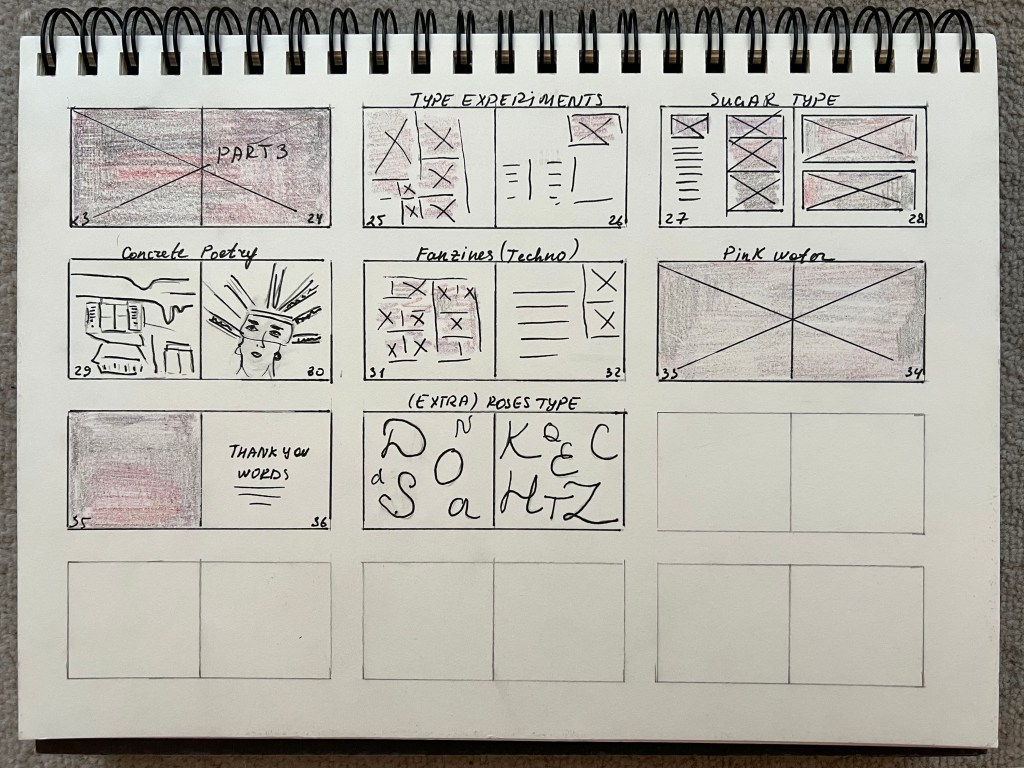
Flatplan

After generous research and inspirational ideas, which I’ve been doing for quite a long time, I proceeded to the next stage, of the flat plan. These sketches finally helped me to put down together all my ideas, and see the full picture of the future book. I can see the use of the habit using the flat plan, as it provides a detailed description before the actual designs. I think during designs I will adjust some layouts slightly, as I will be organising wording and visual material depending on the amount of wording and sizes of images. I decided that the book will be approximately 36-38 pages, I thought that the idea of creating a proper book is great, the only that was worried me that due to the deadlines I didn’t have enough time to produce more pages, with experiments, but I thought the most important is to use each page wisely and provide the full explanation of the chosen subject of the “Experimental Typography”.

Size of the book

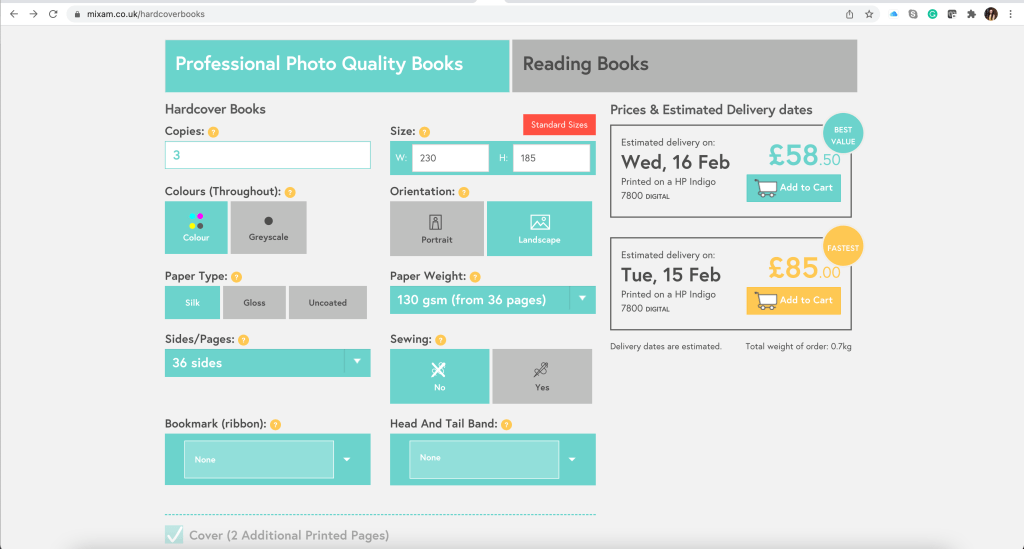
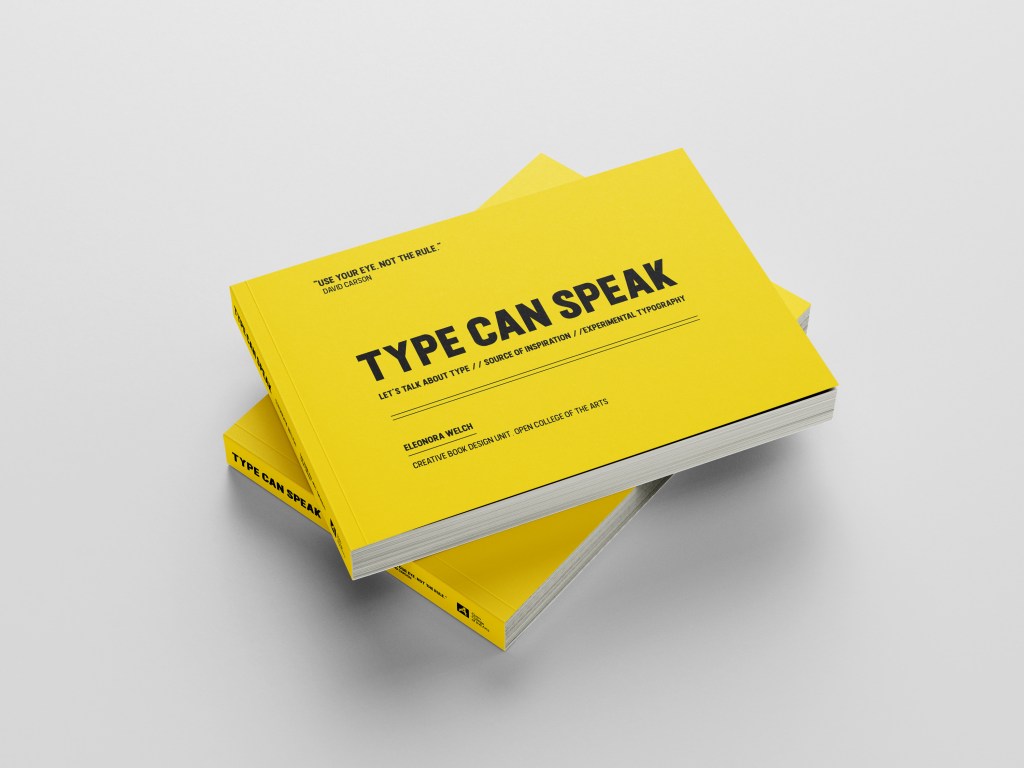
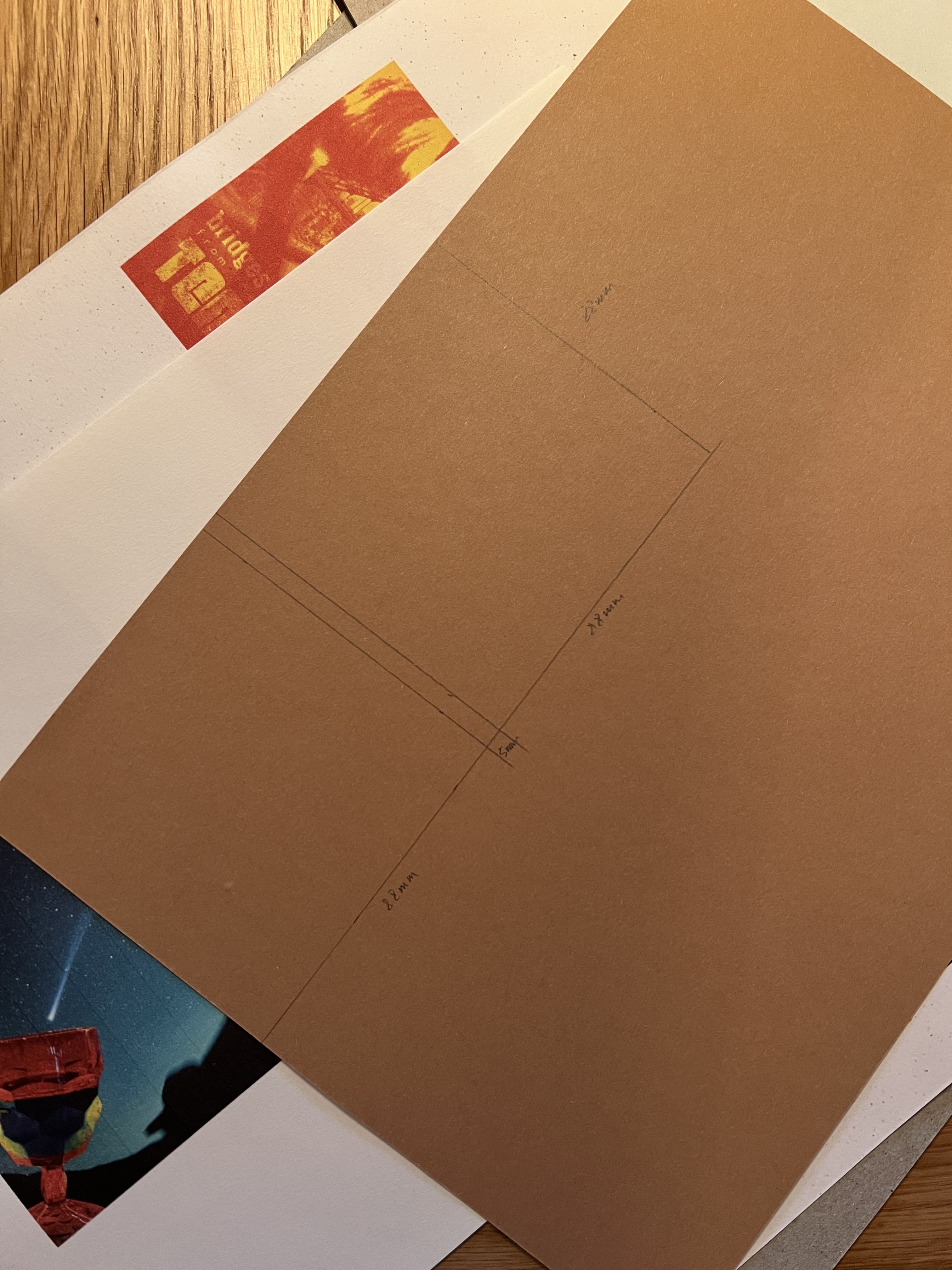
Prior to the designs, I went to the Mixam page for uploading the book, to see what sizes and prices were for the chosen book. I decided on the size 230×185 mm, landscape format book, I wanted the book to be different this time, as previous brochures I made were A5 portrait format, and I didn’t want it to be square, I liked that longer on the width sides look. I wanted to use recommended quality of pages, included in the price, and have a hardcover book. I wanted a book people to keep on the shelf, and relate to it when they look for some inspiration.

Book Creation

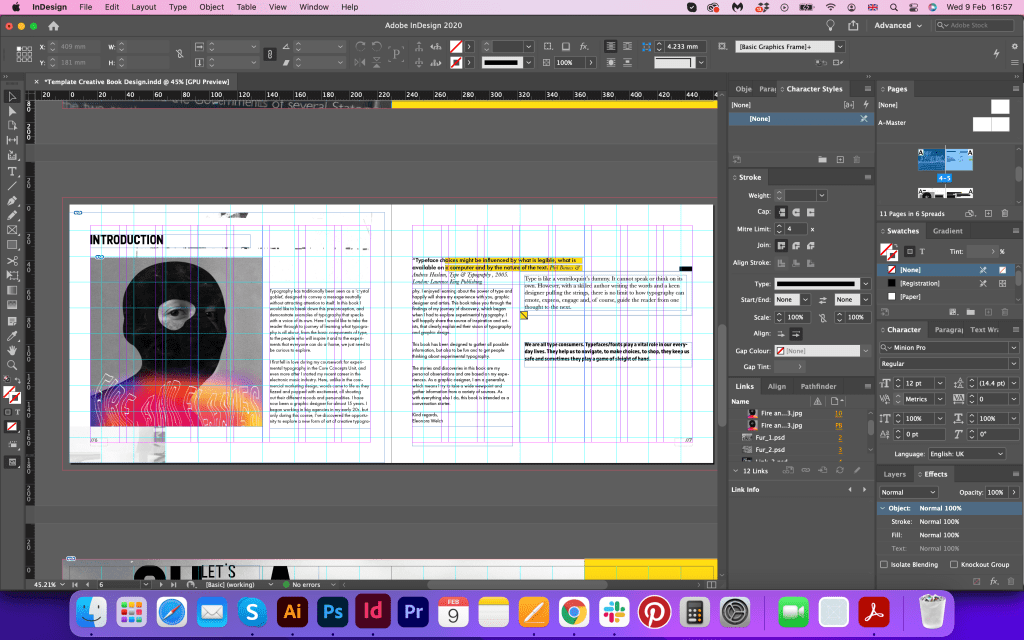
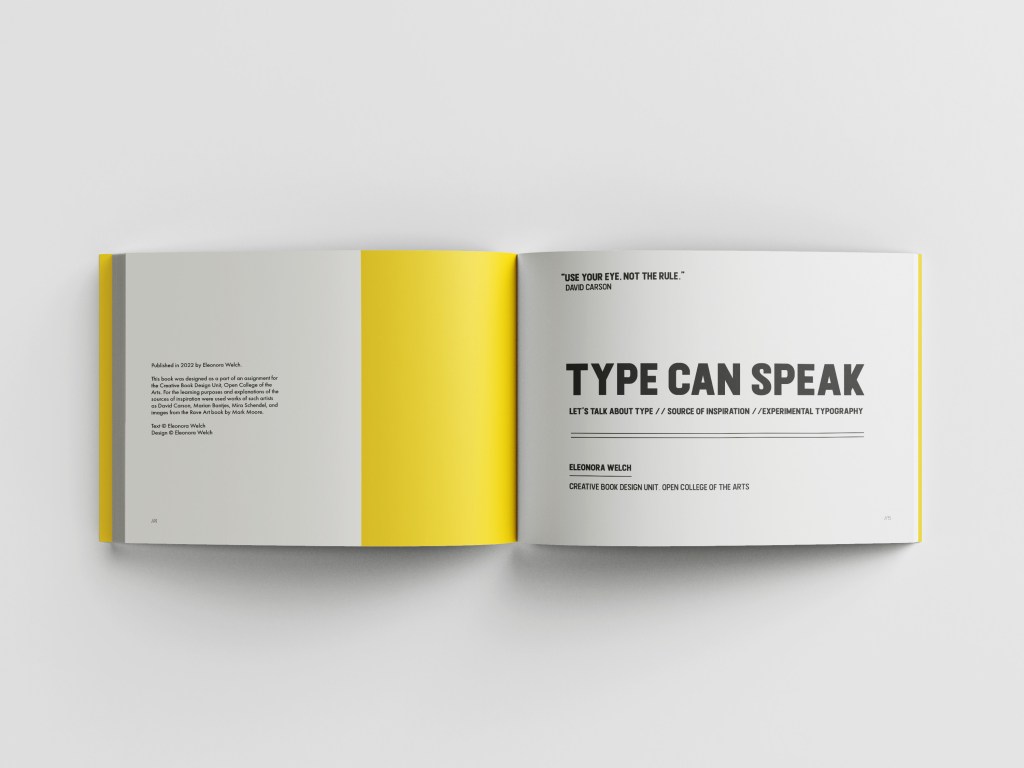
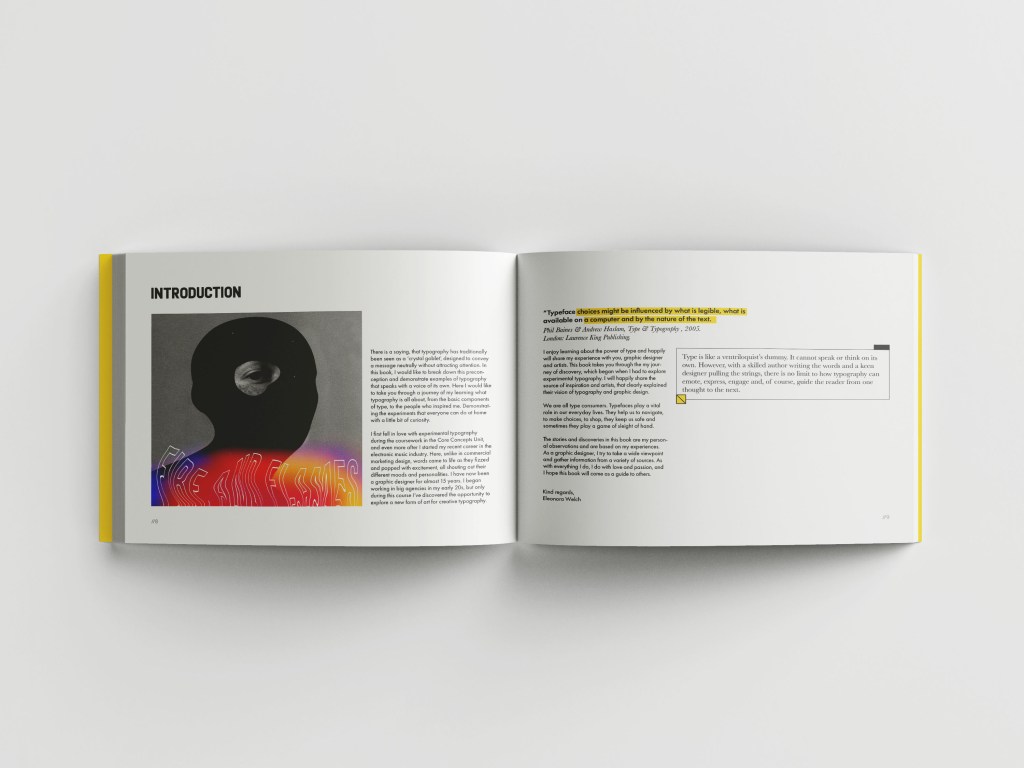
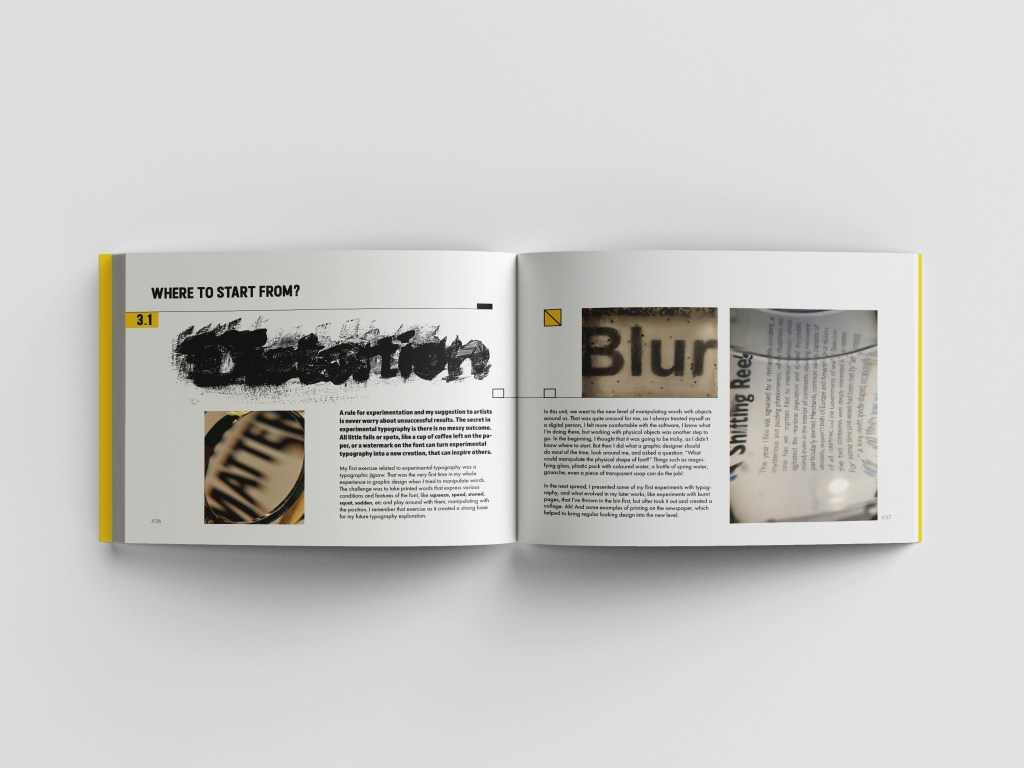
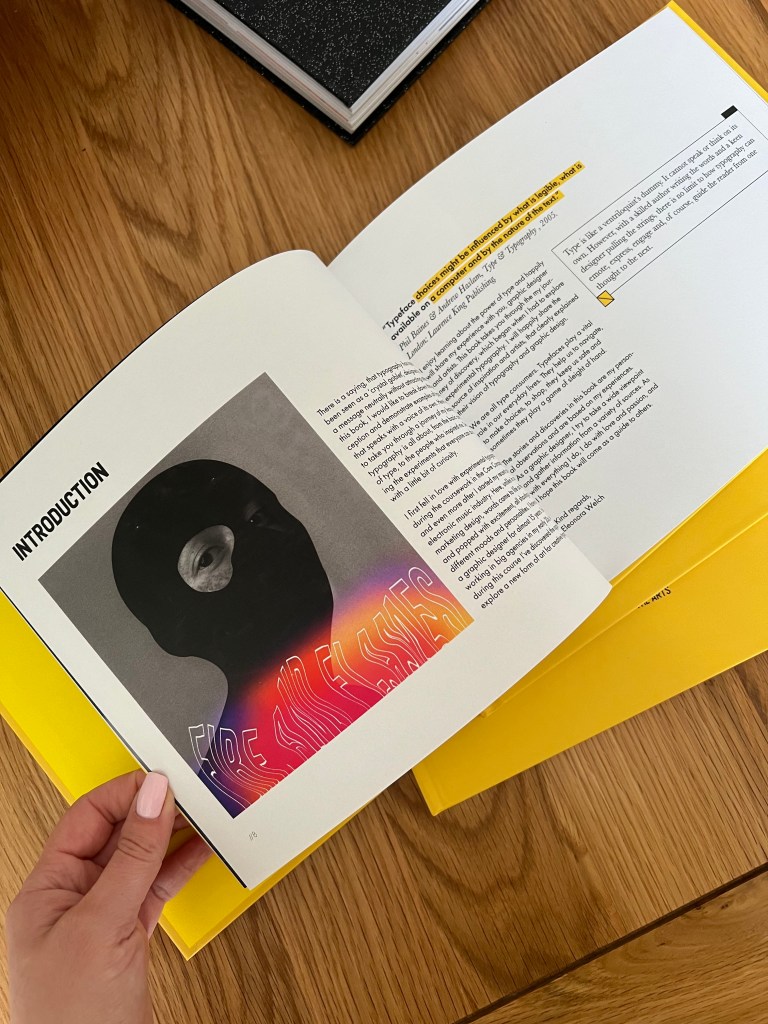
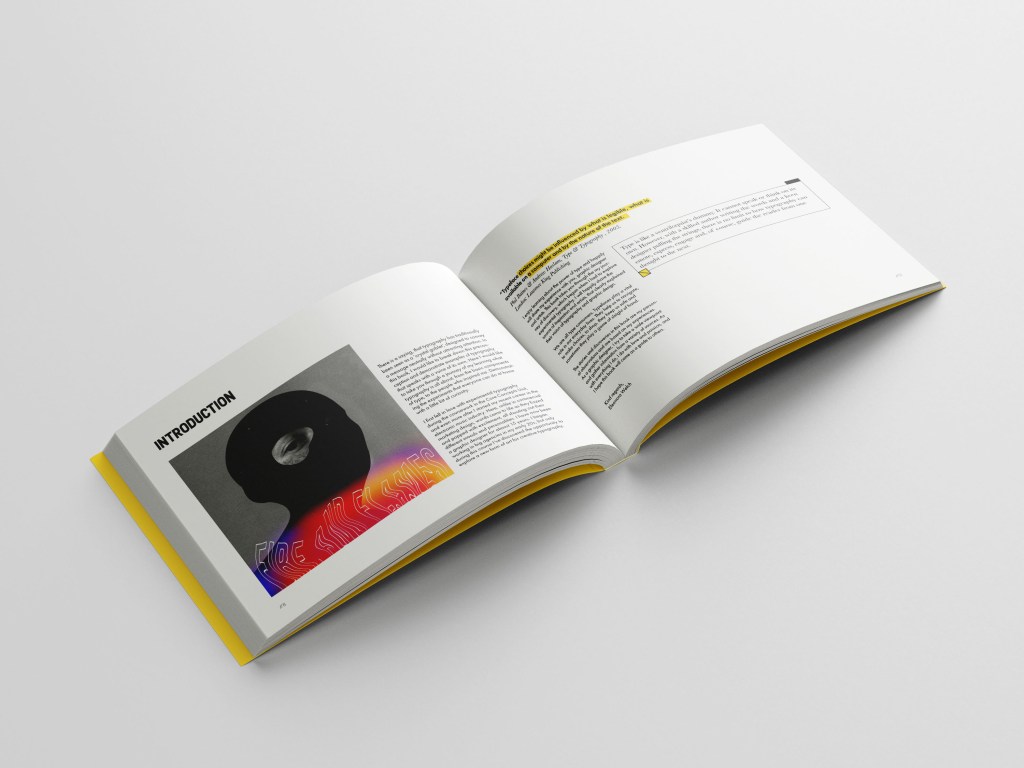
In my first spread for this book, I started with the Introduction page. I create a layout in In Design sizing 230×185 mm with the bleed 5 mm from each size. Within the page I created 8 columns with a 5mm distance between each, I was going to use different size columns for this book, as I wanted to bring the spirit of the Fanzine book. Another point that would make it look out of order, is the selection of typography here. I decided to go for the Futura font, size 9pt for the body text, with a combination of Baskerville font, Regular and Italic. They are both recommended by Derek Birdsall from the Notes on Book Design, those fonts are easy to read and matched the design I was planning to achieve. Also, I added Bold font Almaq, for the quotes, and phrases I wanted to highlight. For the general look of the book, I went for the provocative bright yellow design, with geometric lines and squares in it. I liked the idea of creating an unusual extraordinary looking book, like a hybrid between fanzine, magazine and book, as that is an Experimental Typography book, I wanted to be inventive for the book layout too, bring some yellow boxes for the quotes, little squares to pop up in the corners, all for the look of the playful and experimental book. At the same time, I wanted this book to be a celebration of everything I achieved during this course, and I hope I’m on the correct path.

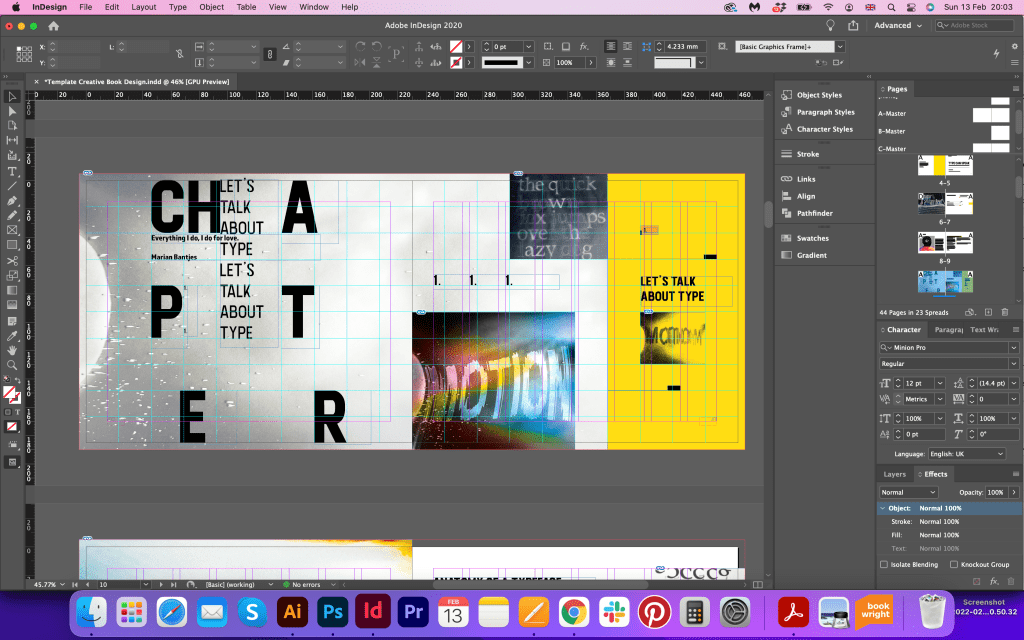
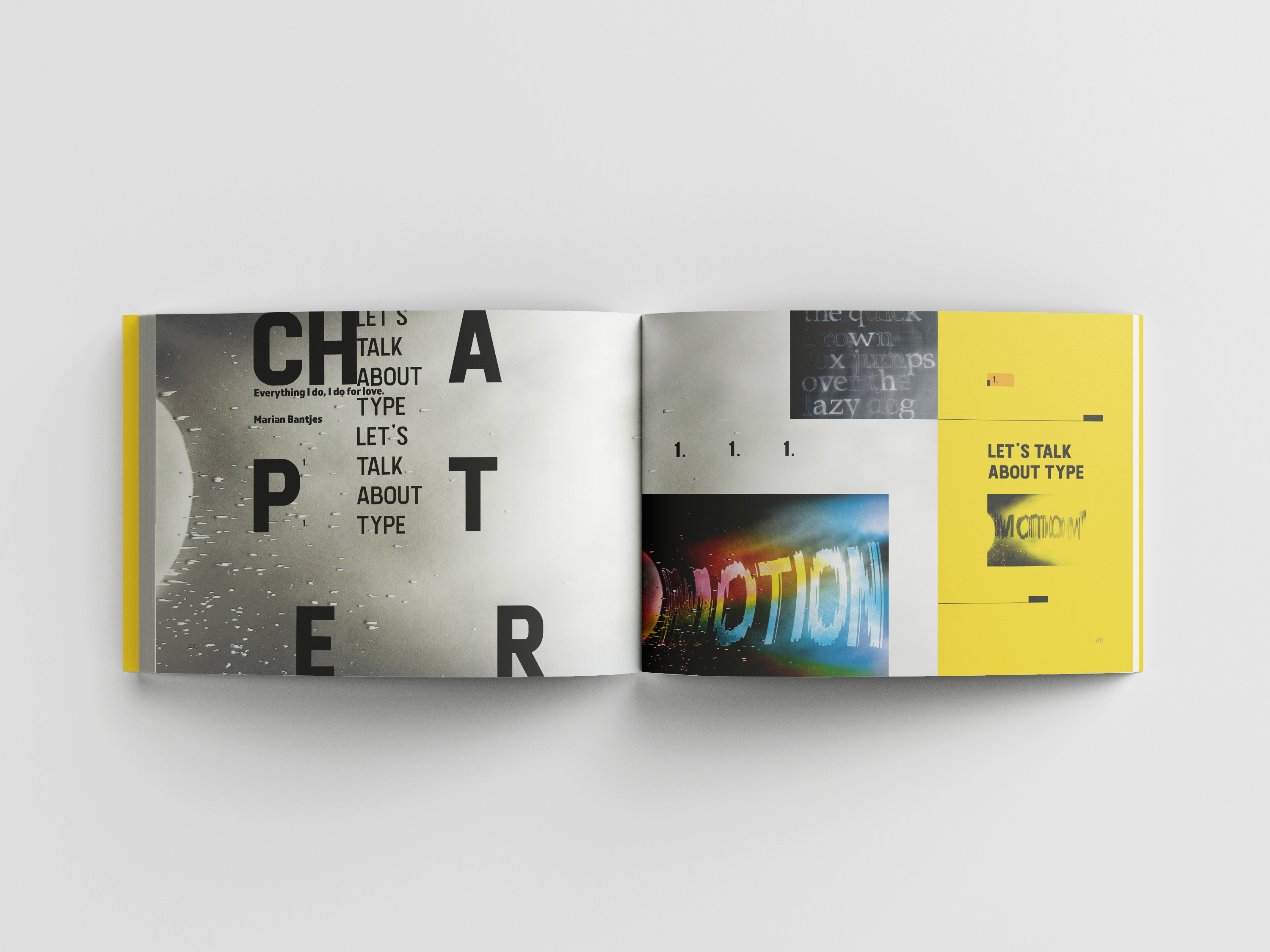
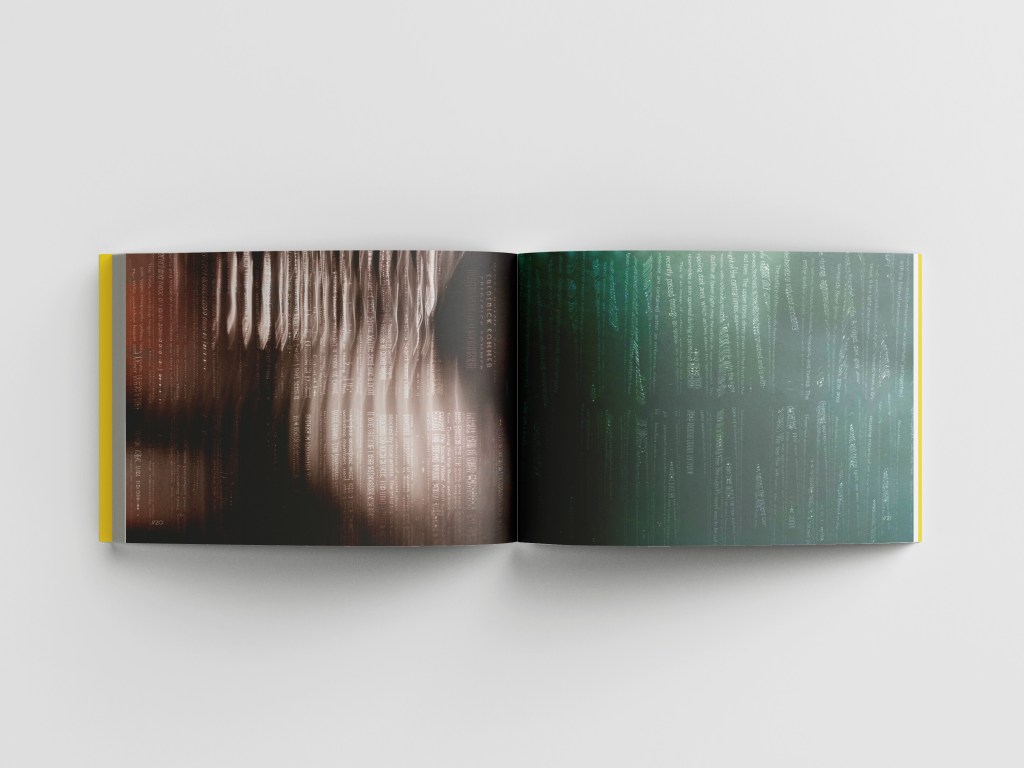
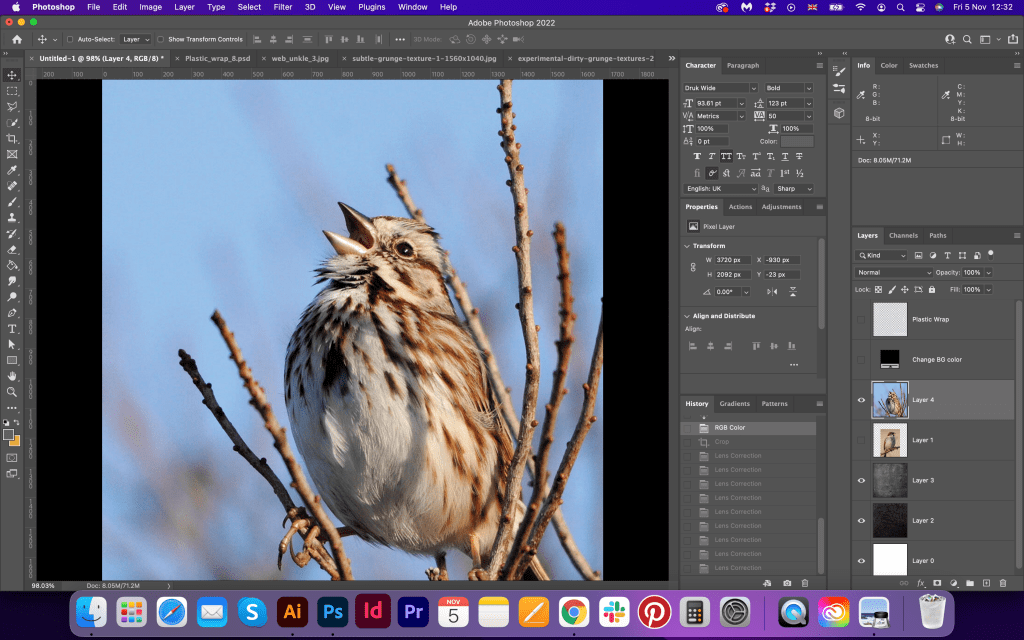
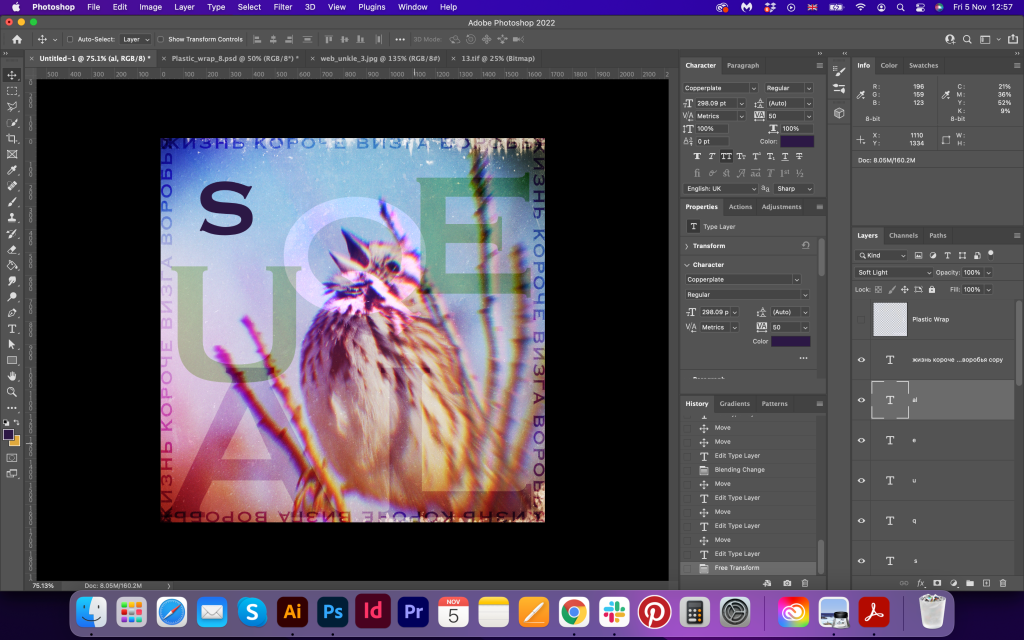
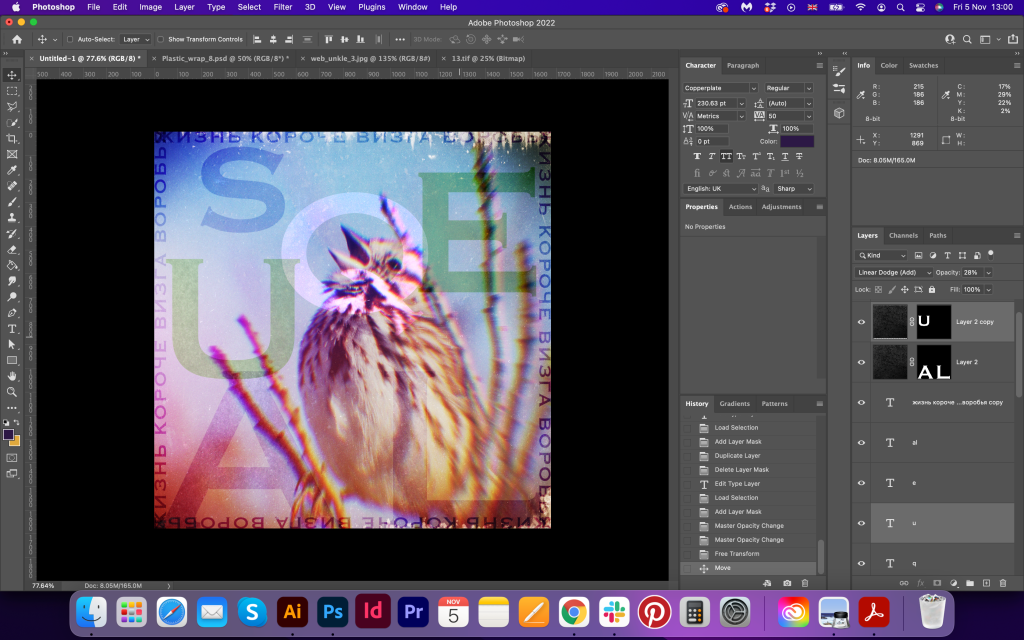
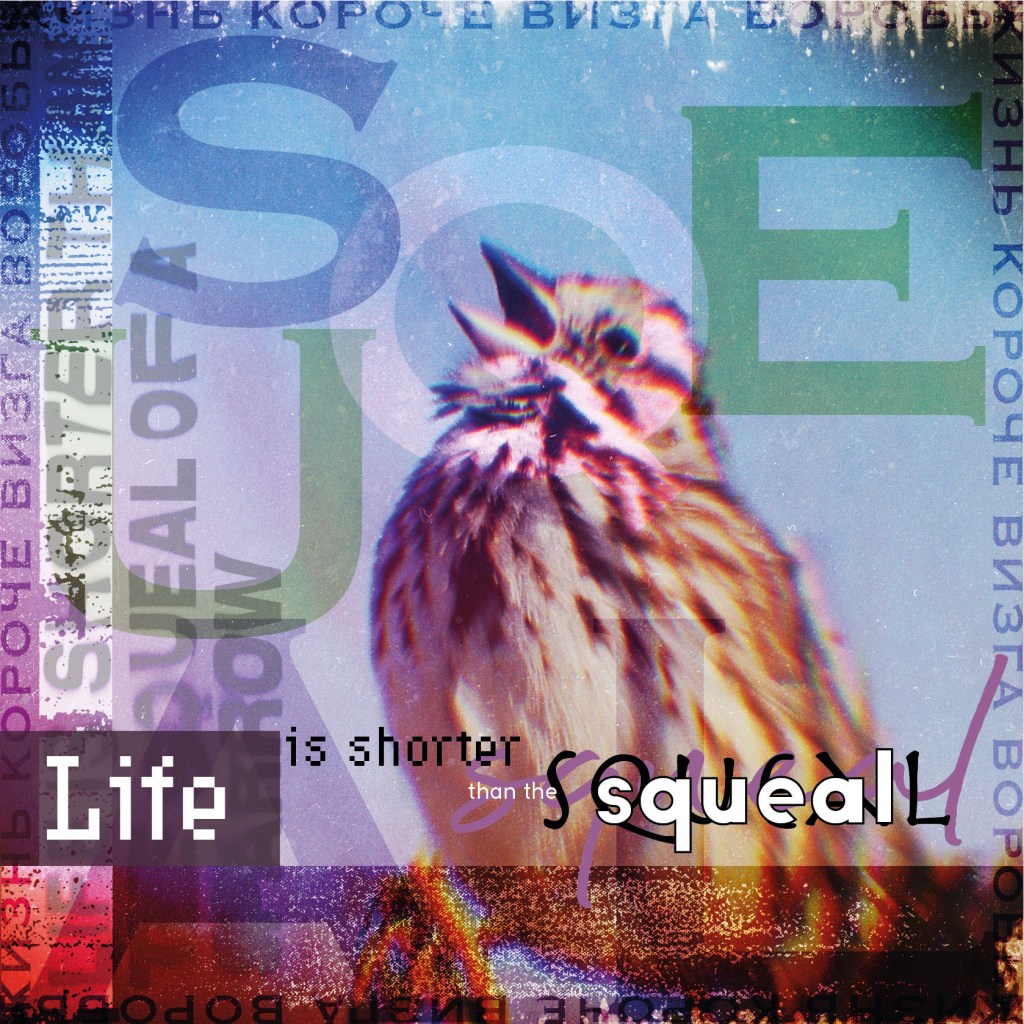
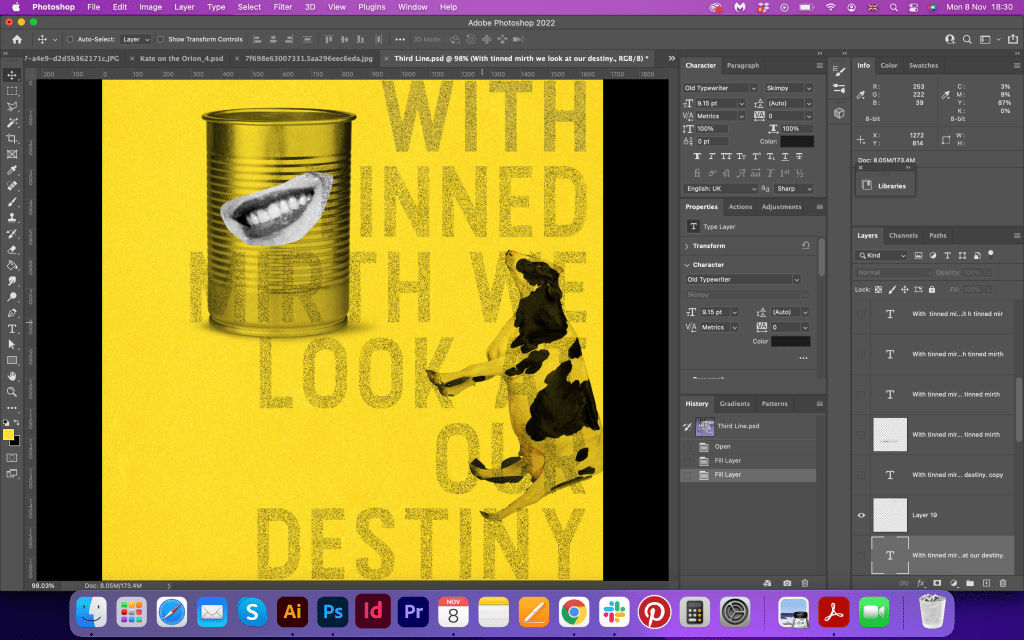
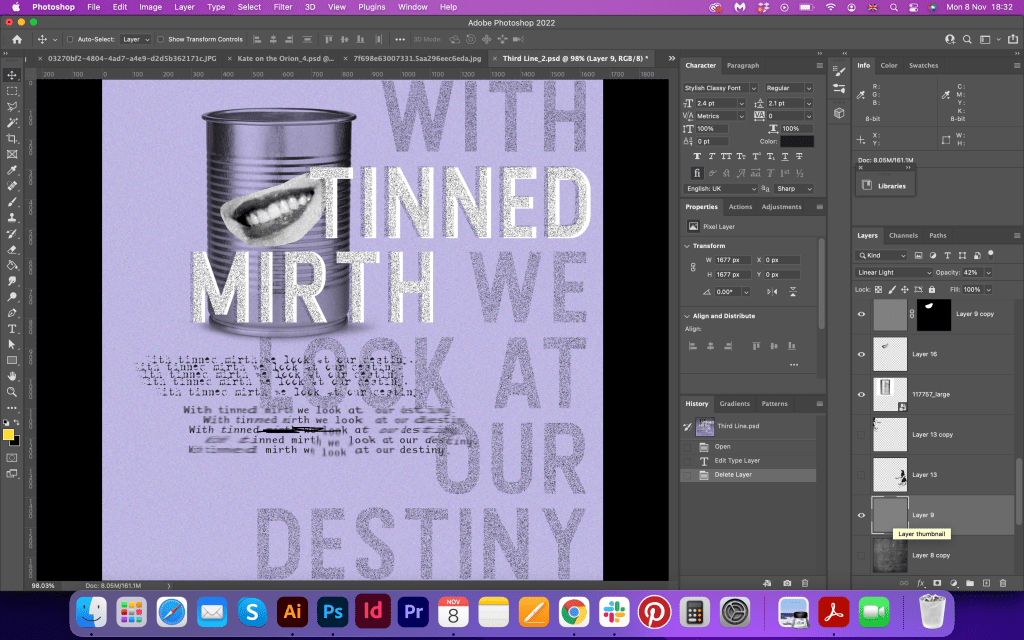
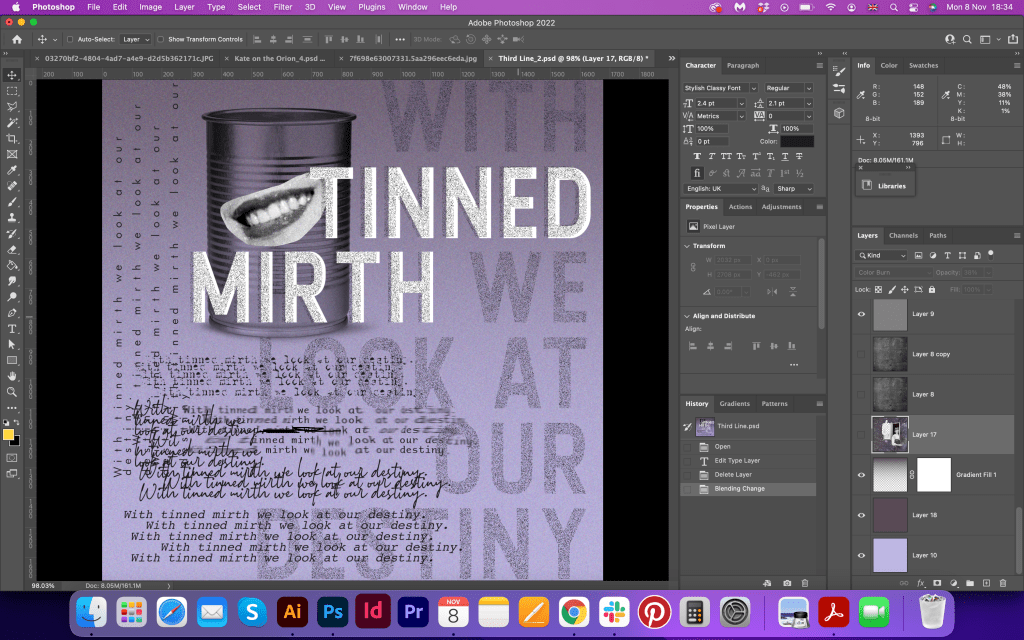
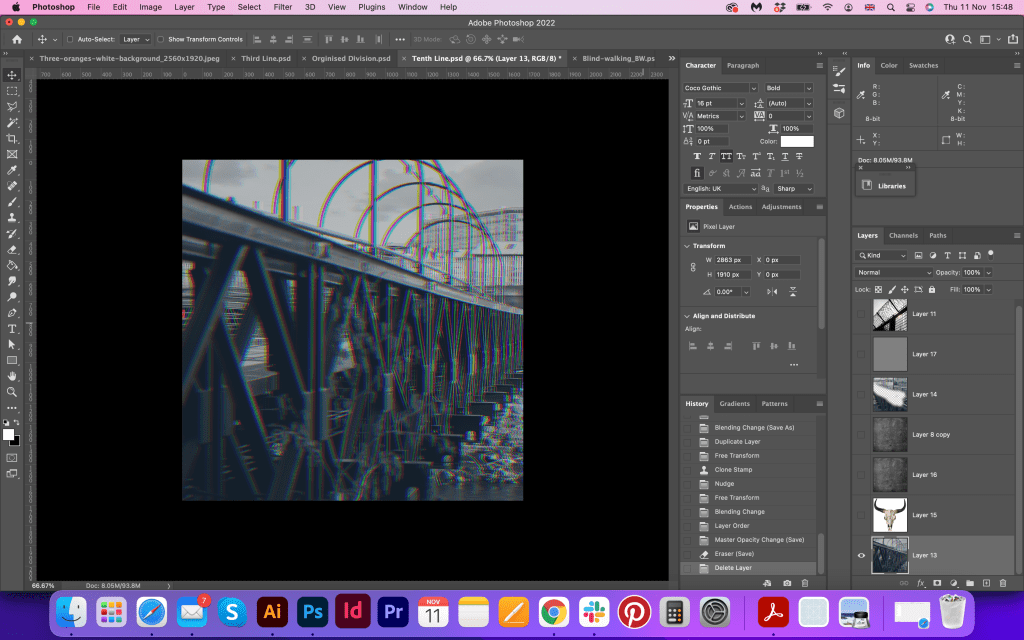
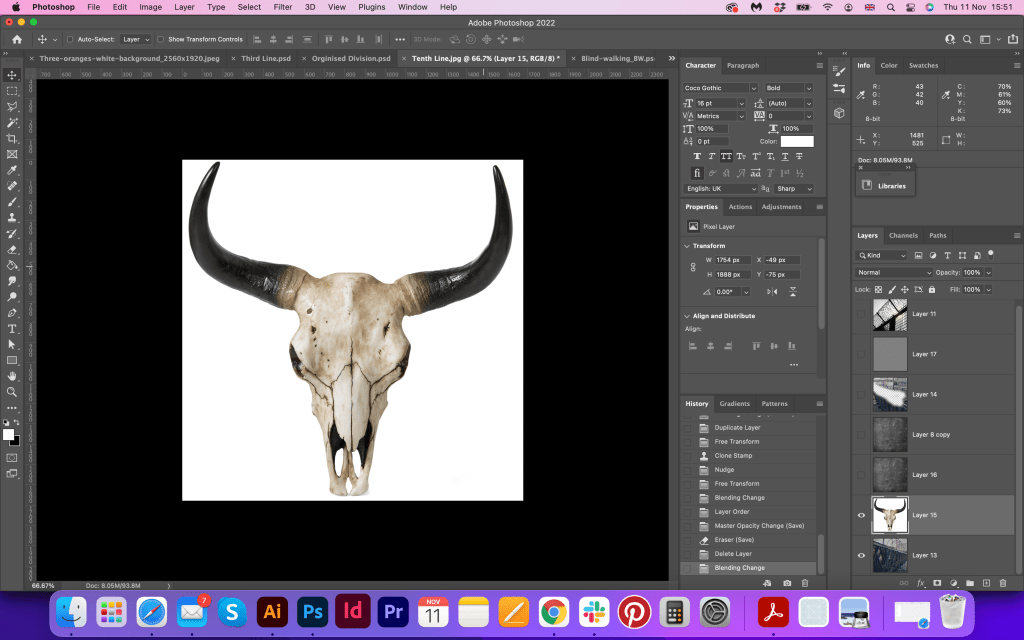
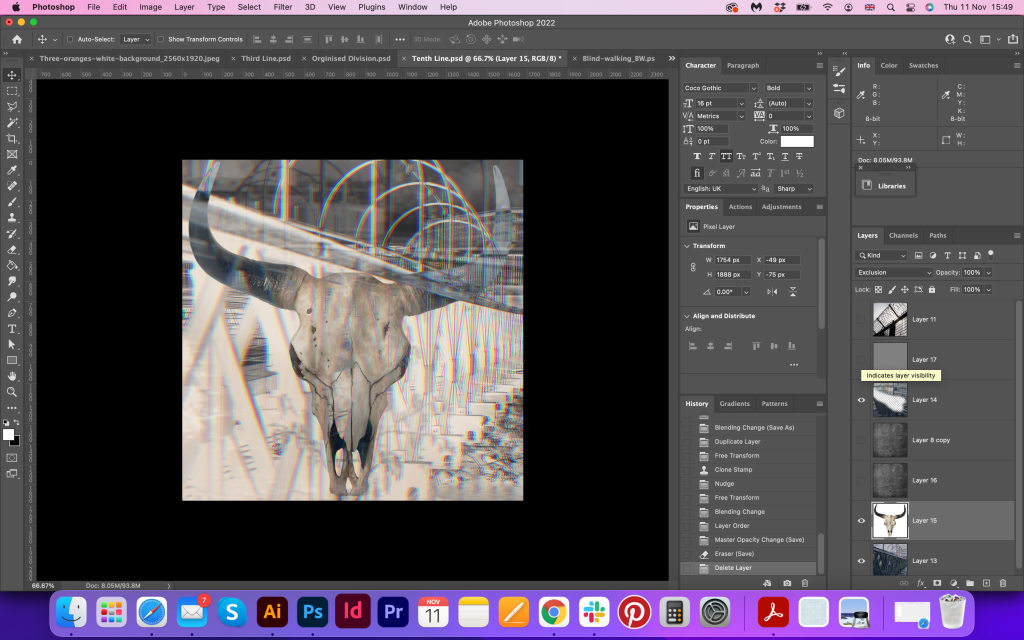
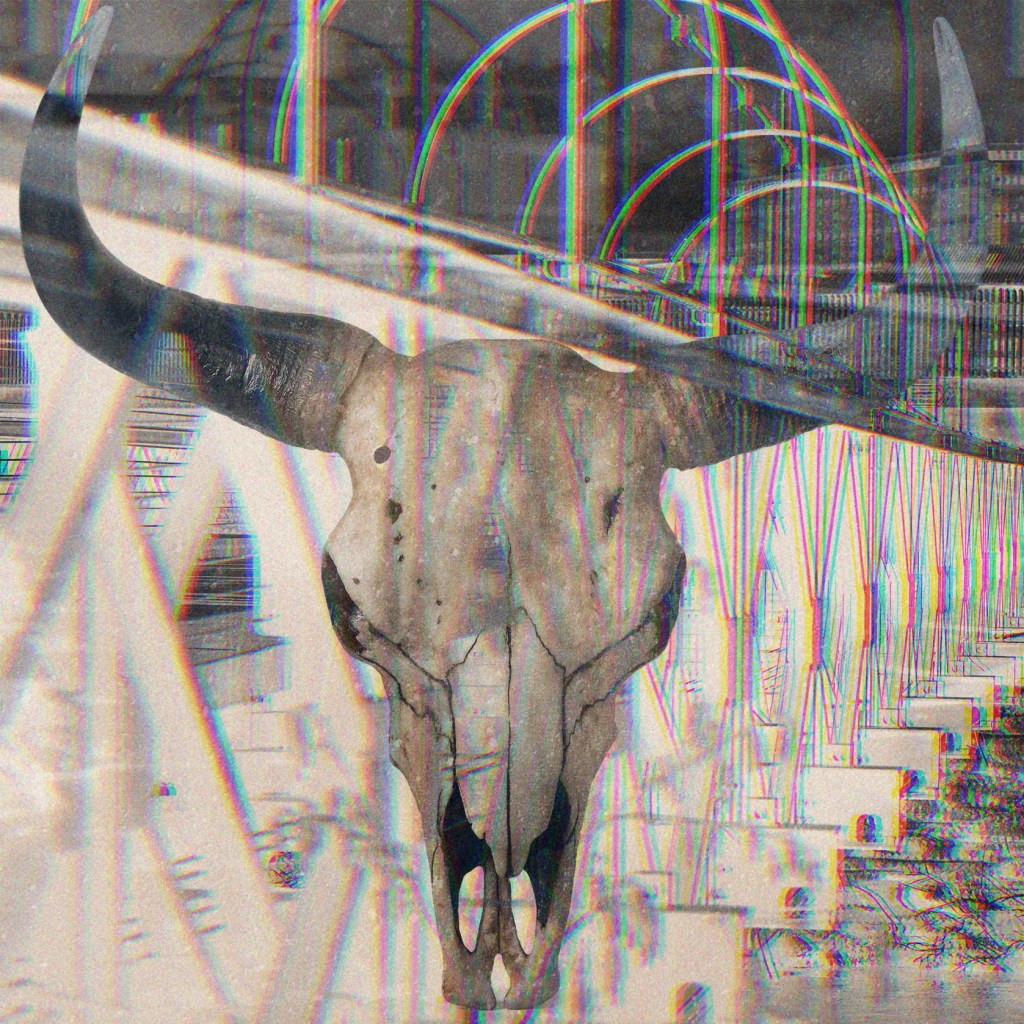
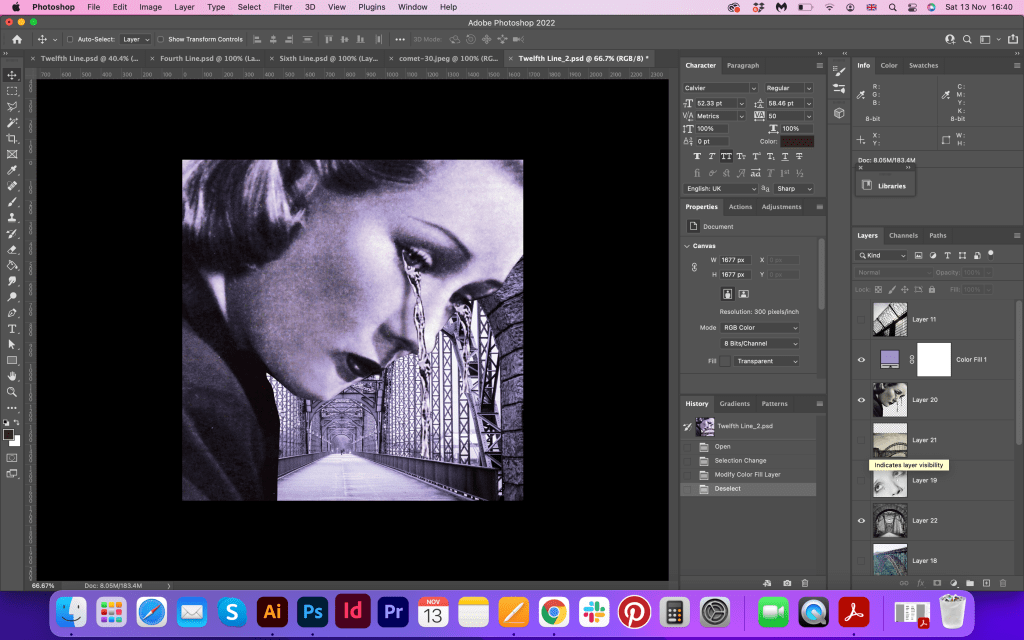
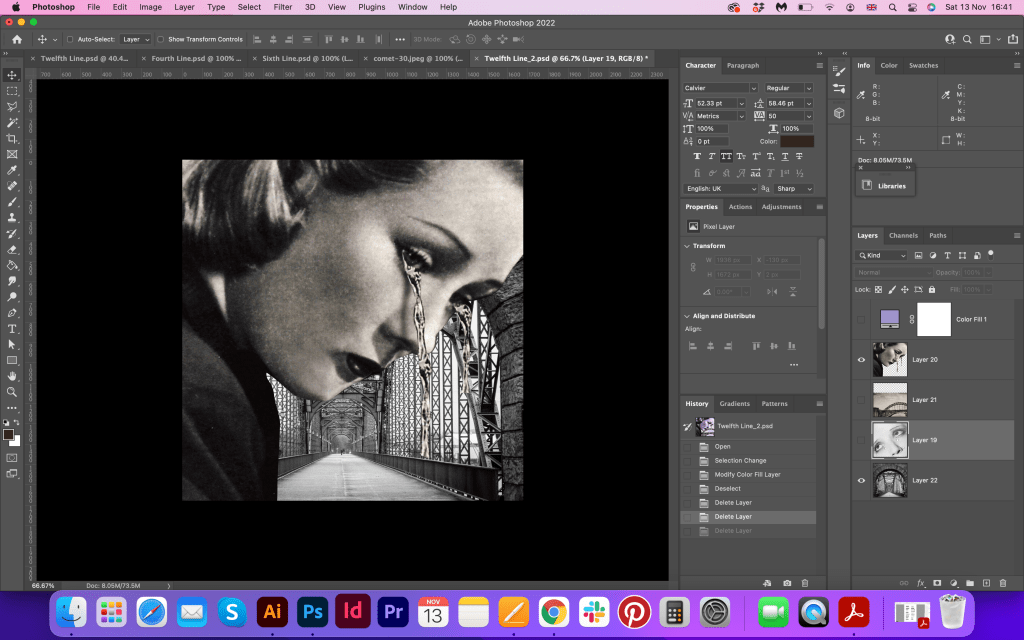
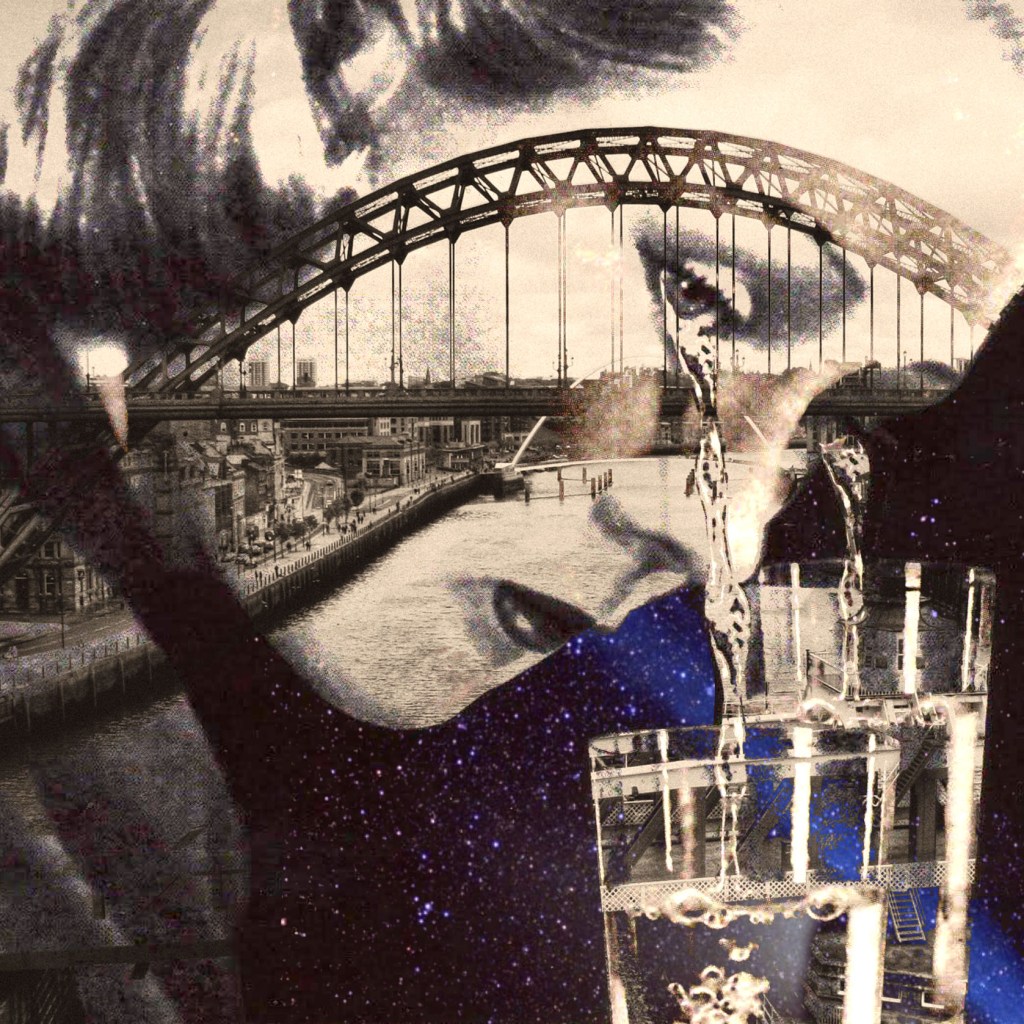
I placed the image of the girl in a balaclava with the experimental typography on top of it, which I created in Photoshop. For this image I got inspired by the rave culture, and its freedom. I think it gave good support for the introduction page and the main concept of the book I was going to achieve.

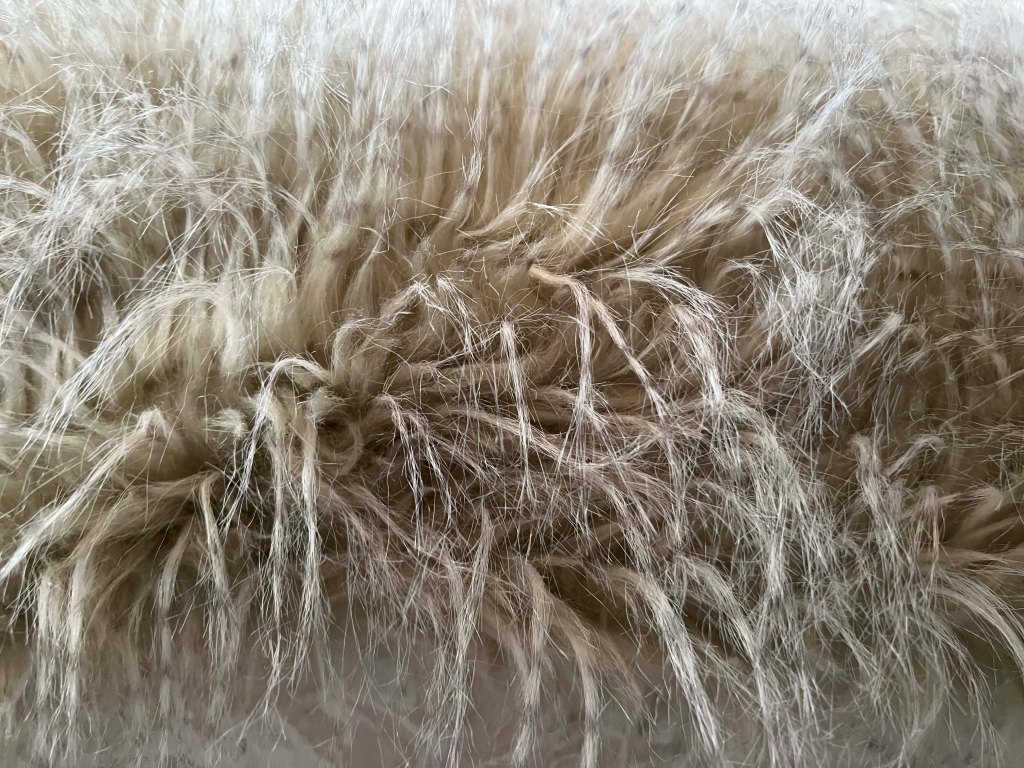
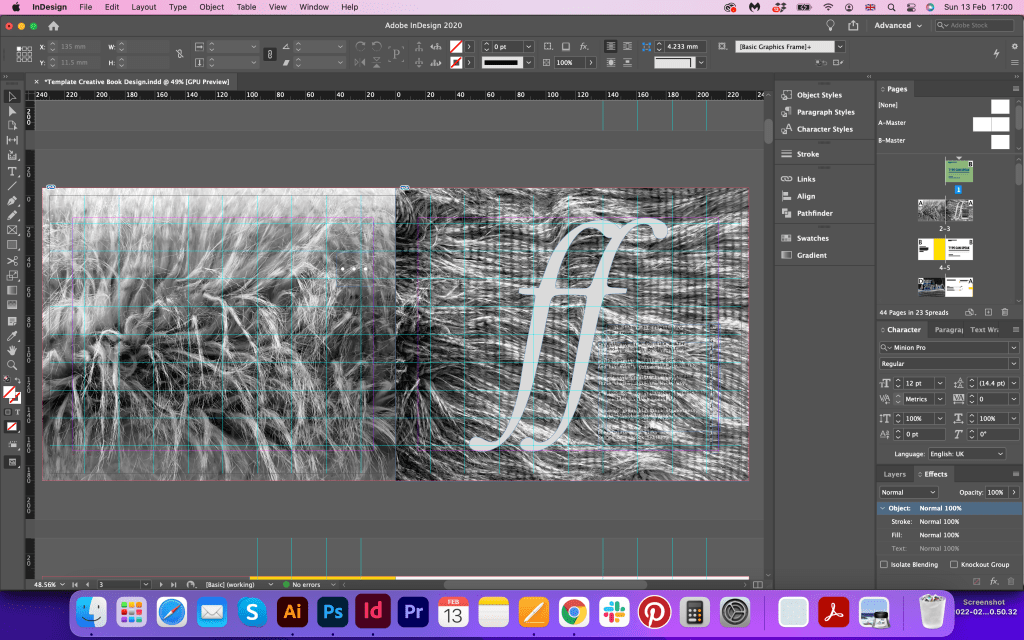
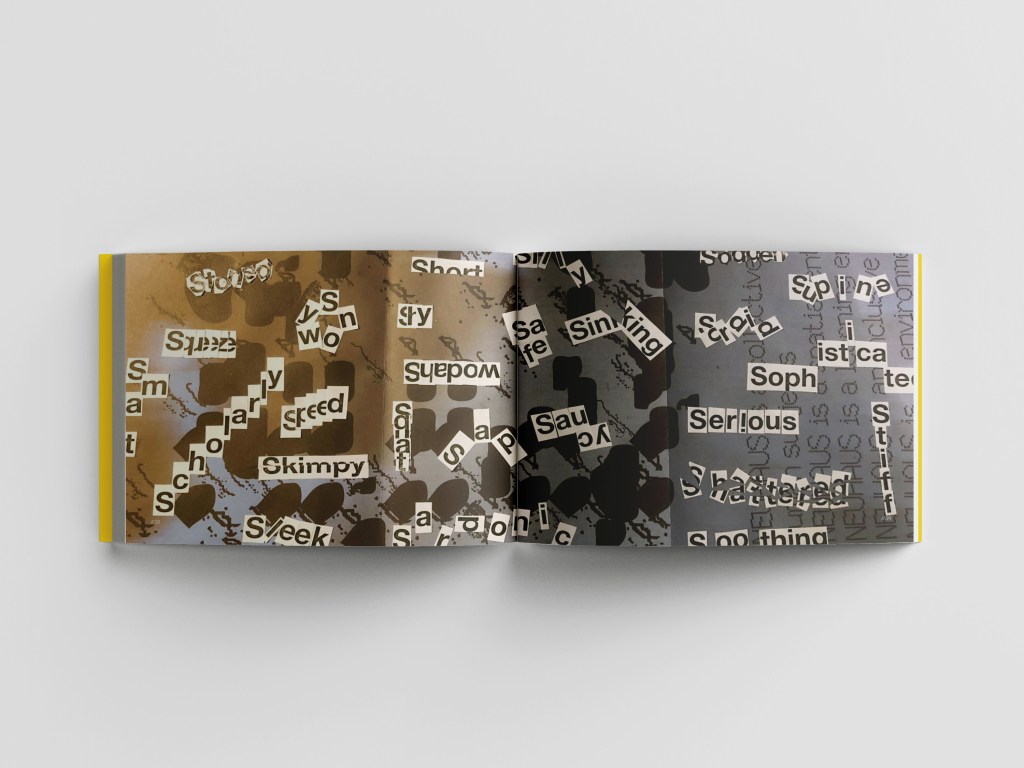
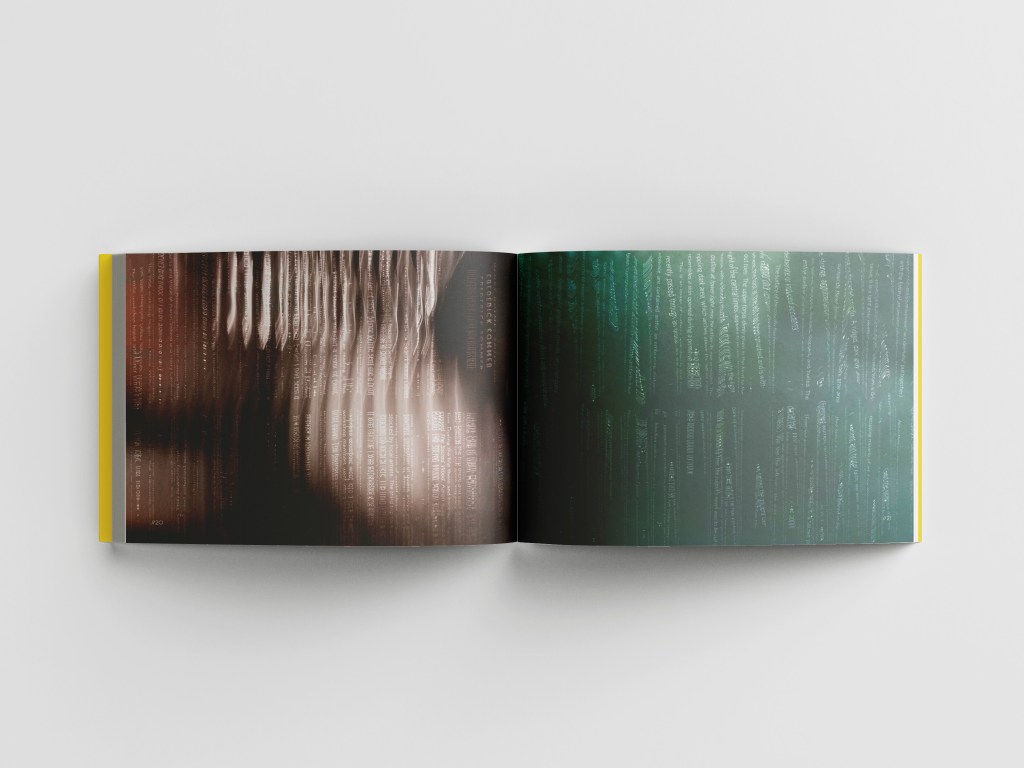
At the beginning of the book, I decided to place the fur texture full size. The reason why I did it, is as I wanted to demonstrate to the reader that this book will take them on the journey of unpredictable decisions and the book is full of volumetric designs. Also, that spread created a juxtaposition, as the heading of the book I was going to mention the typography. On the right side of the spread, I placed concrete poetry called’ A girl’s hair from the book The Map and the Clock, which is purposefully hard to read, I wanted it to disappear in that texture. I was hesitating about that decision, as I was not confident whether it works or not, but when I looked back on the whole picture together, I decided to keep that image, as it worked well with the design concept.

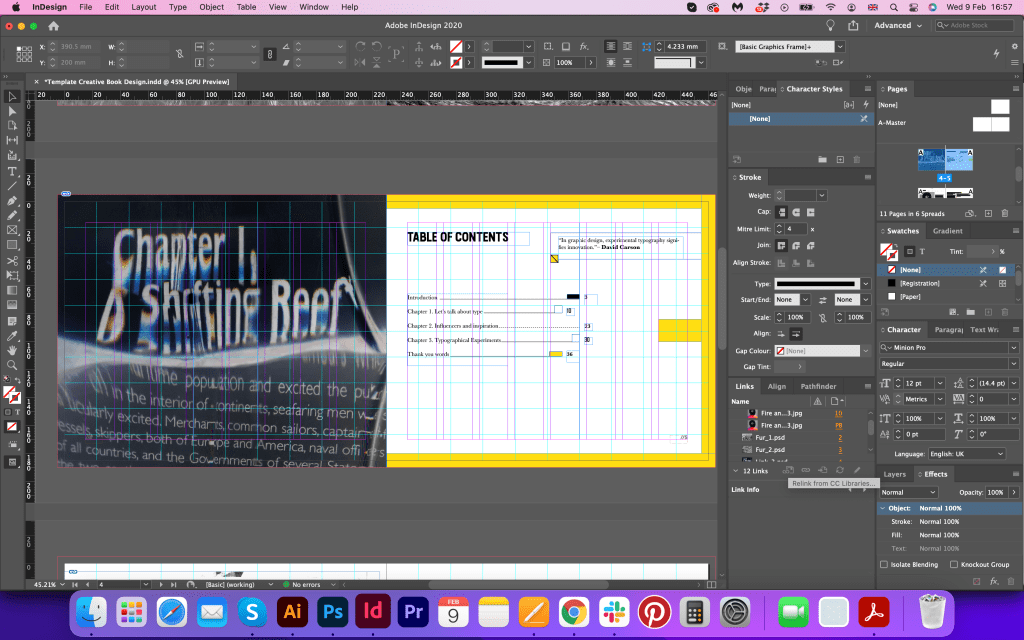
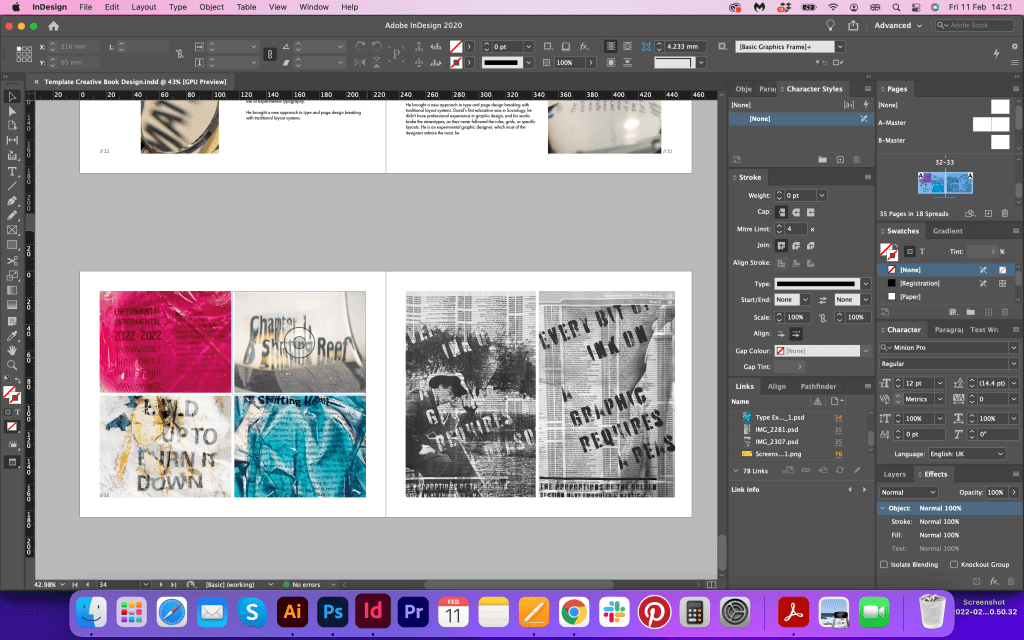
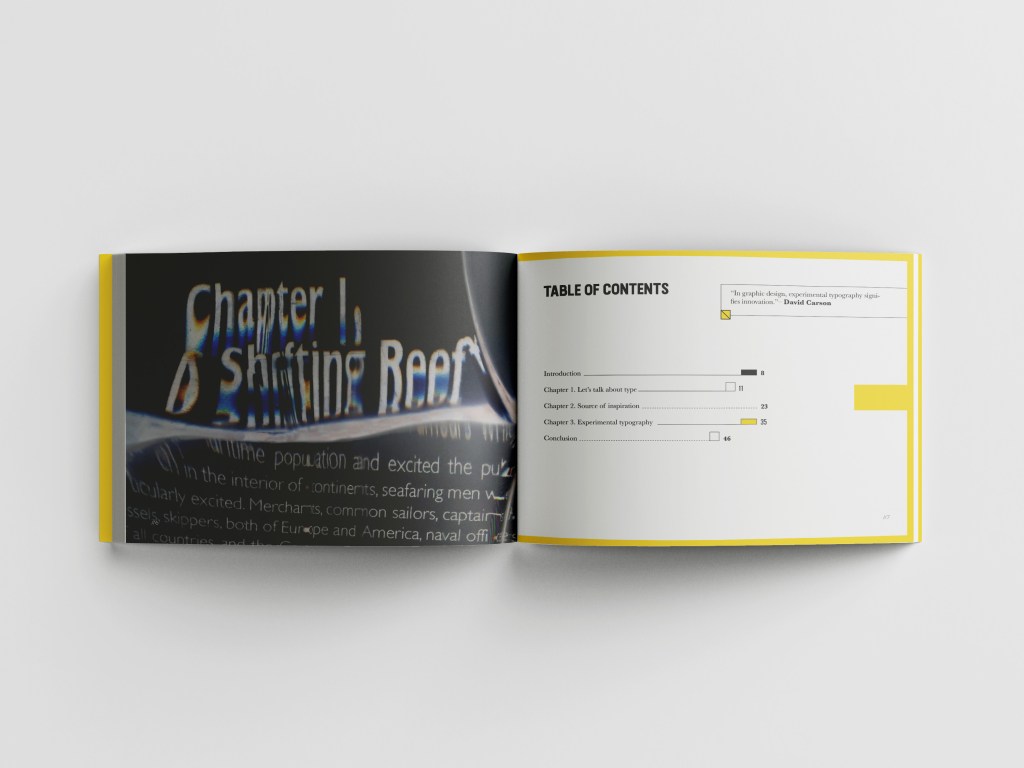
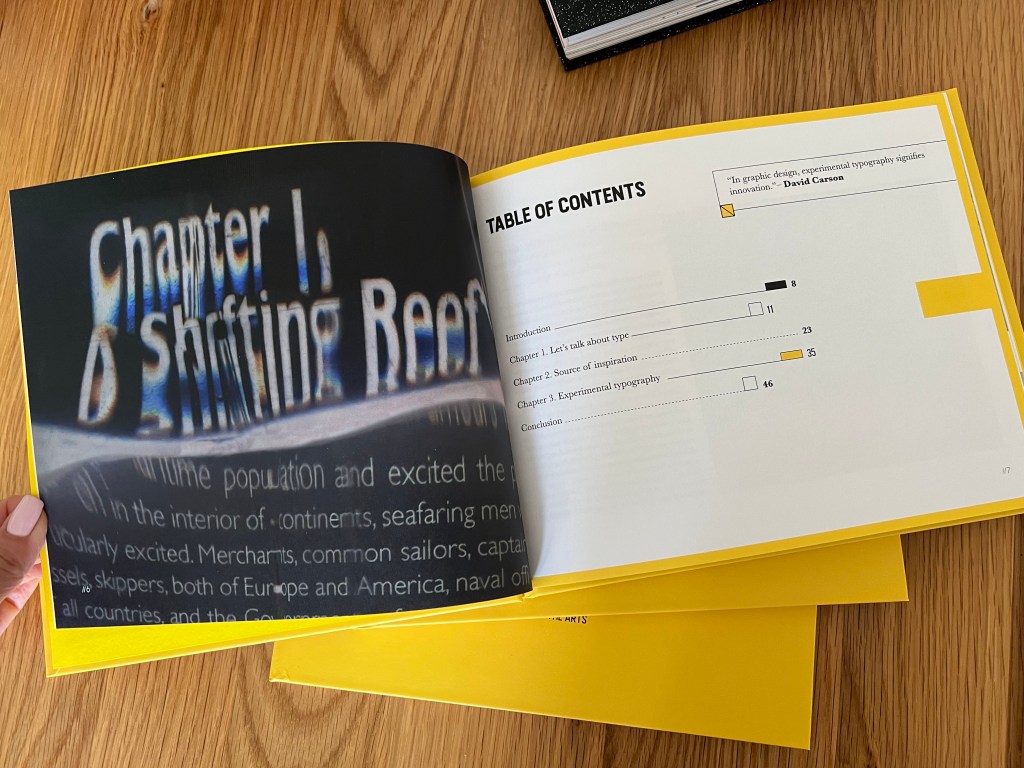
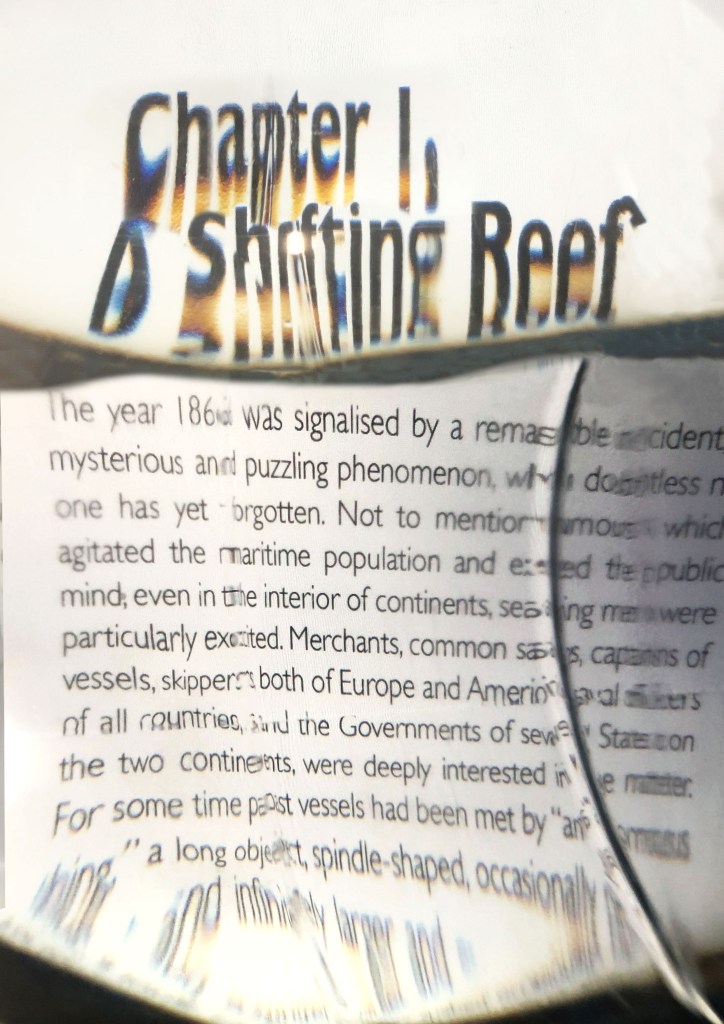
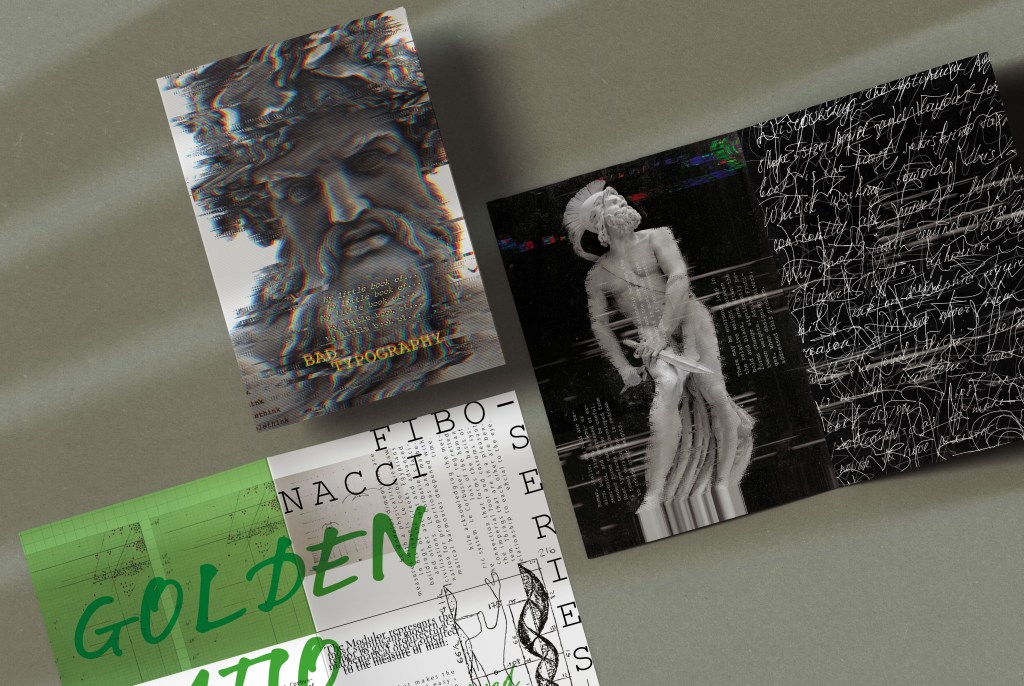
The idea was to create slightly different layouts for each spread, trying not to repeat them completely. I still needed to keep the same running theme, but for each page, I wanted to be individually looking. Like this Table of Contents spread, the only way looks spread, with the yellow frame around it, and different numbers. I knew that was risking to use three fonts, but I thought I should try it, as to how my experience with the Little Book of Bad typography shows, purposely different looking types and sentences can create that eye-catching look. Also, I created a proportional grid for the page, with little rectangular shapes, 10 from each side, as a golden ratio is still something I needed for this book, even though I was looking for the Fanzine style. On the left side of the contents page, I used the big image of distorted typography from the bottle of water experiment. I loved that contrast between pages, and I wanted to keep that black, yellow, and white pattern throughout the book.

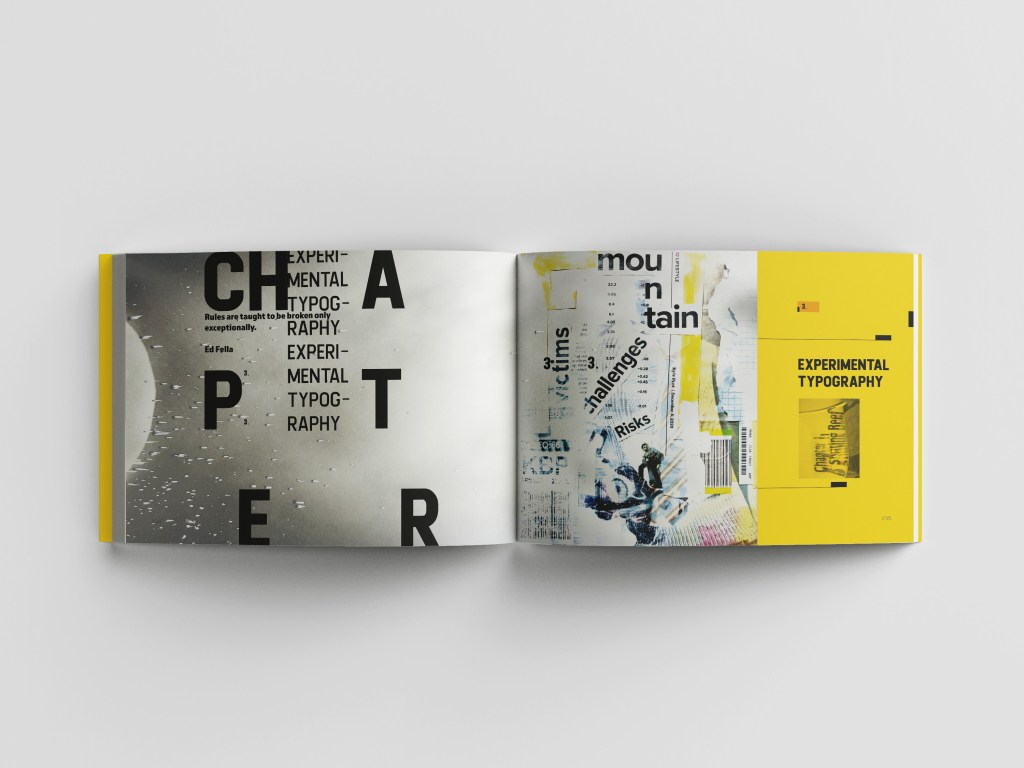
As I was going to use three chapters in this book, I thought I can repeat the spread with the breakdown image between each part. I was going to place some quotes from artists that inspire me, organised in the Fanzine style, and place different images related to the chapter. Earlier I created that experiment with the printer and word Motion, so I used it for this spread, as I was planning to place it for the full spread, but the colours were too heavy, so I used a small version of it, was quite pleased with the look of the spread. In the top I placed one of the first images I create4d related to typography Typographical Jigsaw in black colours.

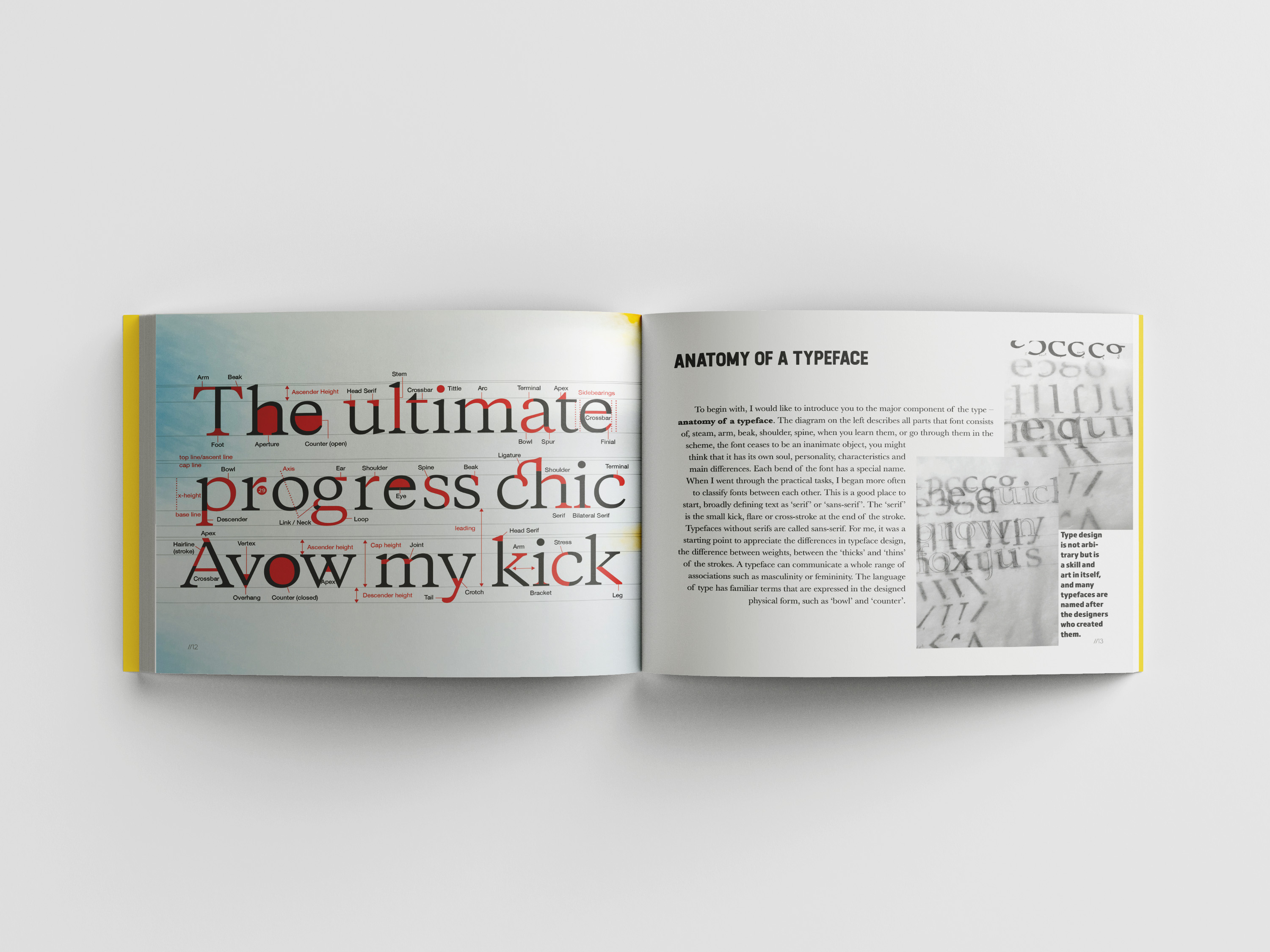
As I was going to recreate in this book the learning path about the typography, I decided to go back to the original sources, that to recreate again how it all started. It’s just from the personal level curious to see how I have grown as a graphic designer, and how important those little stages of learning that to discover something bigger. I included my first sketches of the typographical anatomy and for the next spread specimens from the biggest book, I have in my library. Collecting type specimens is a great example that a lot of passion for the work can create a historical meaning book. Anatomy of a typeface was the only one spread I have a slight doubt in terms of page layout, as it looks too different compared to others. I wanted to bring that freestyle across the whole page look, and drop from the top pictures. It looked a bit odd from the magazine or book layout point of view, but I decided to keep it, as the purpose of this book investigation of layout possibilities.

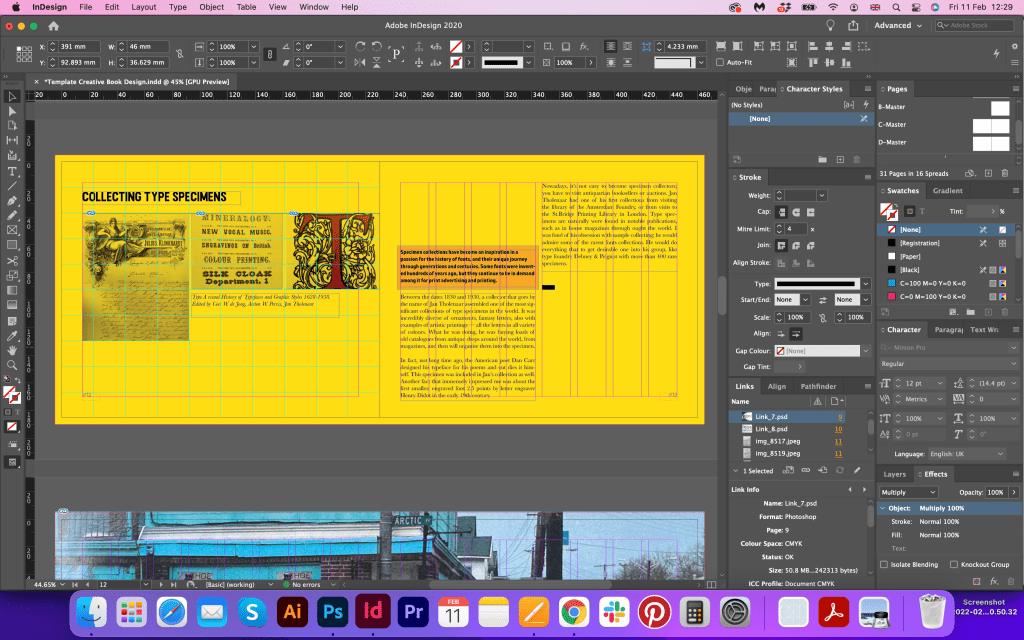
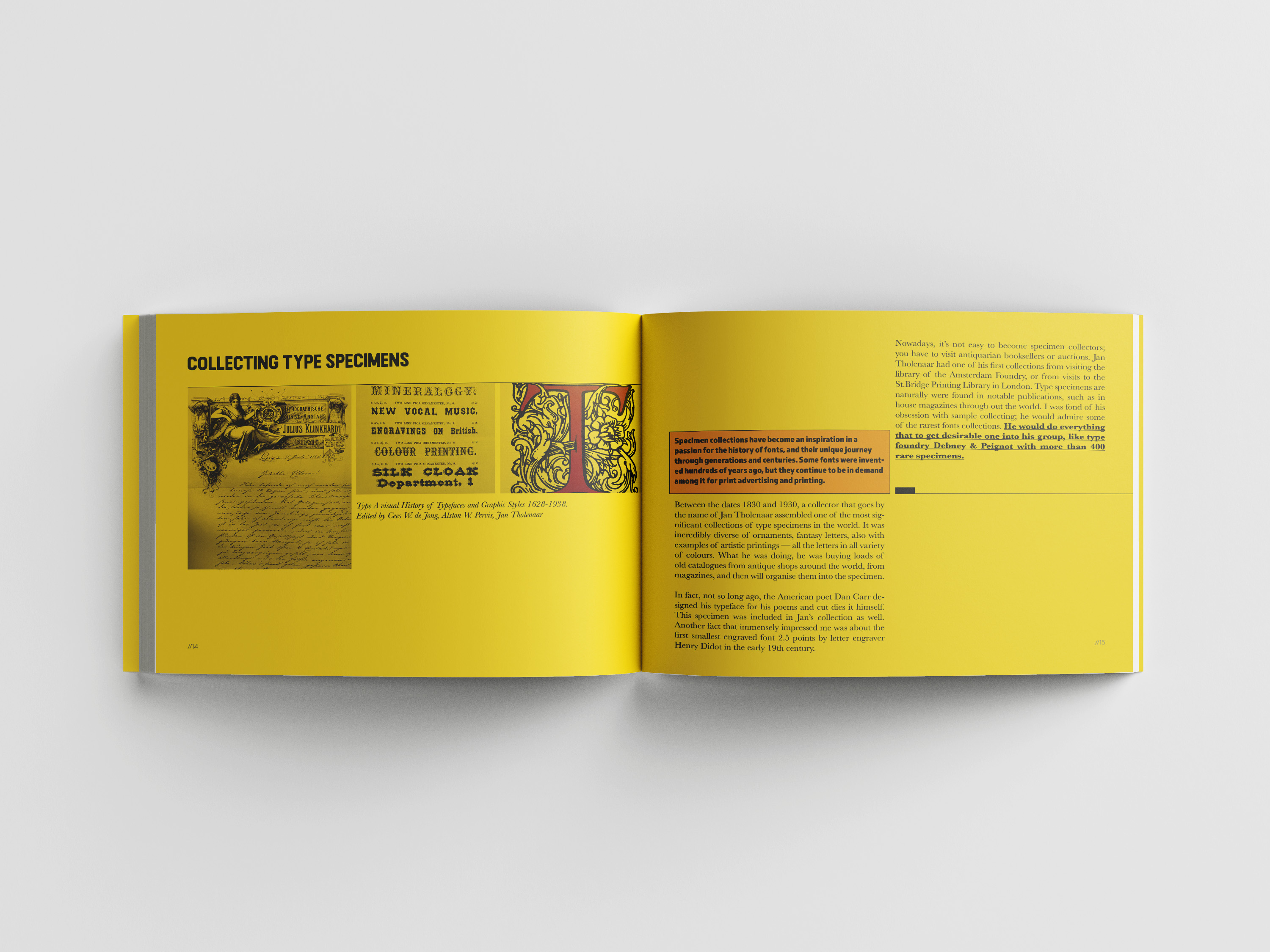
This spread I made yellow, it’s the only one that bright in the whole book, I liked how it works well with the breakdown pages for spreads, so I kept it too. Here I included my research on the specimen book by Jan Tholenaar, as I wanted to reflect on the foundation of what each designer should learn, the brief history of the specimen collections.

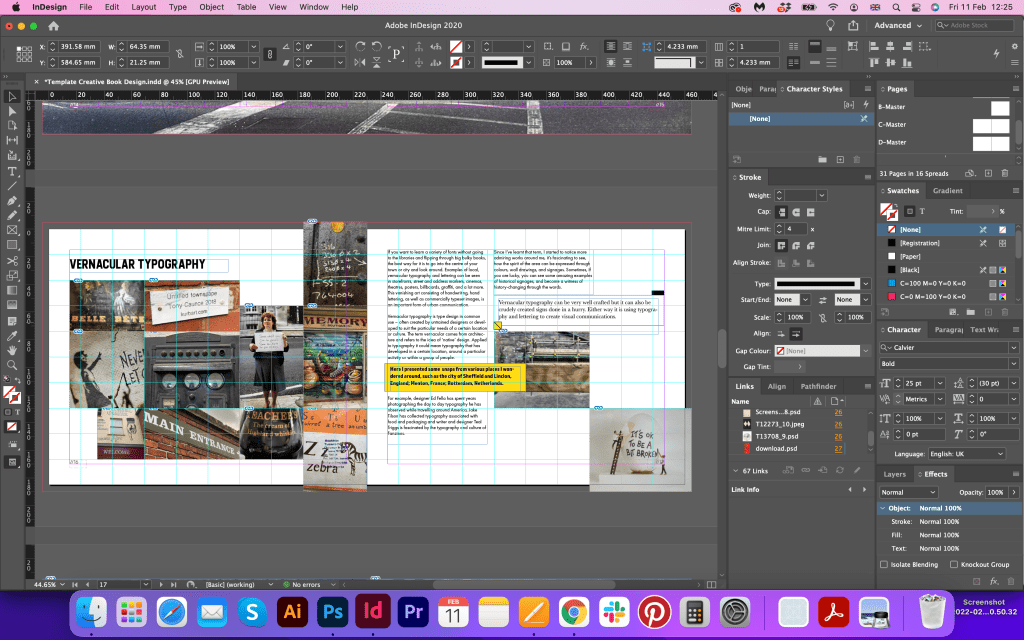
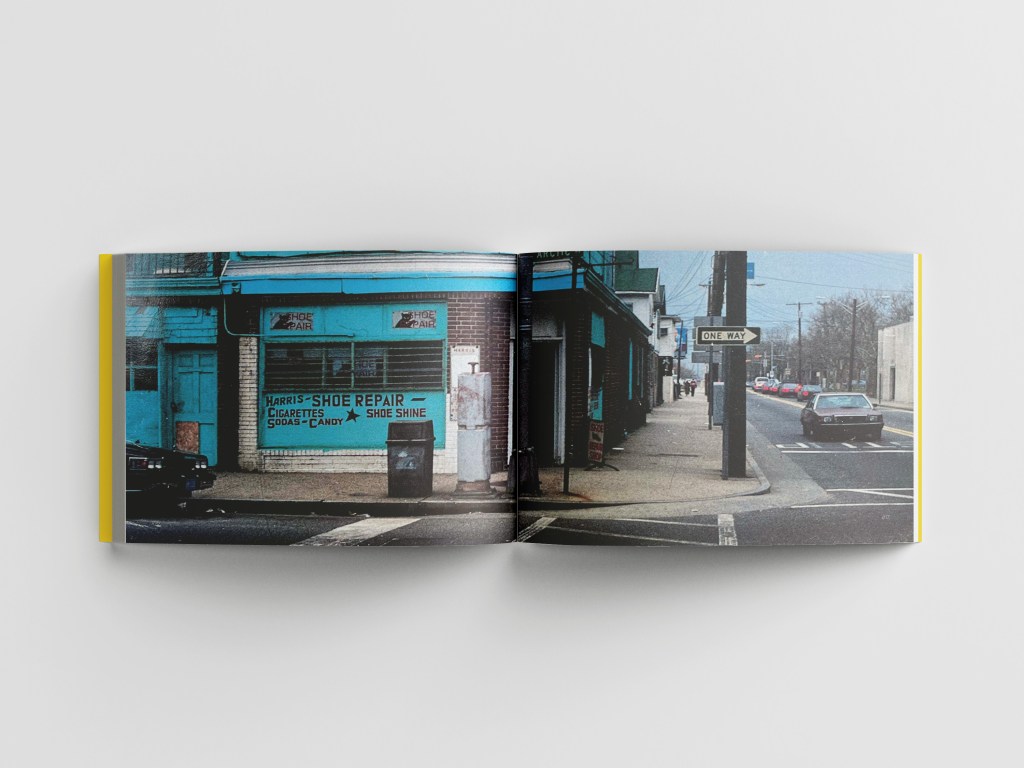
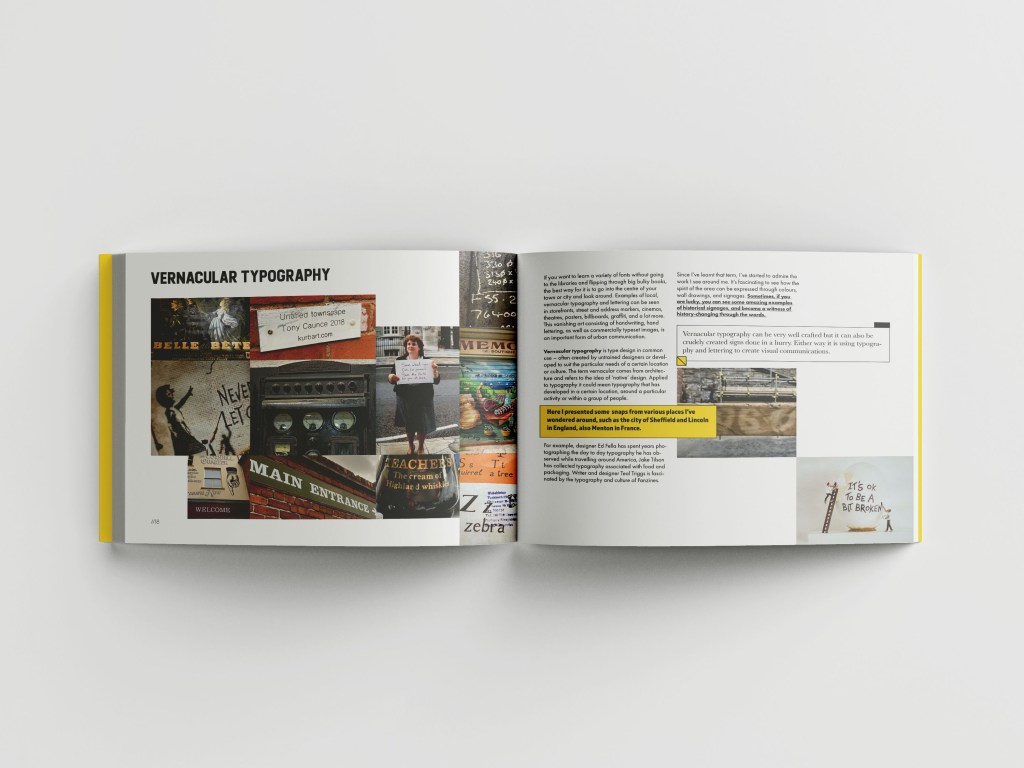
For the next spread, I remembered another important part of the typography learning, it was Vernacular typography from the Core Concepts Unit. At that time I did a quick research on the signage around me when I travelled to different countries, but this time I looked at some marks close to the area where I live. I created a collage from those images I collected, and added some new handwritten signs, that can be considered as a part of native signs. That is the reminder for myself as well, pay attention more to the signs around me, and note the difference between them, depending on the city I am walking around, or area.

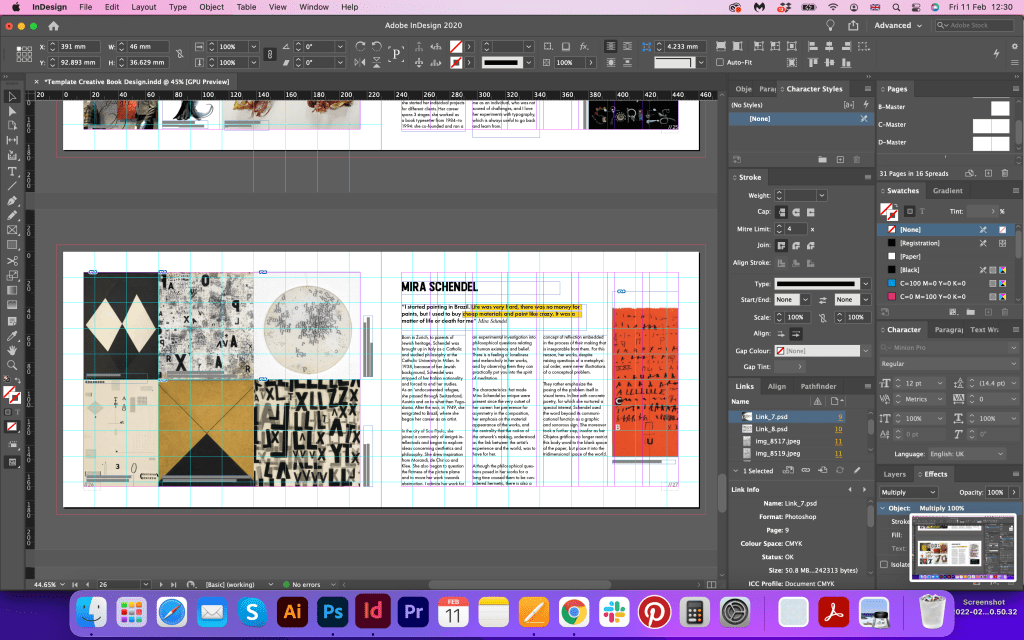
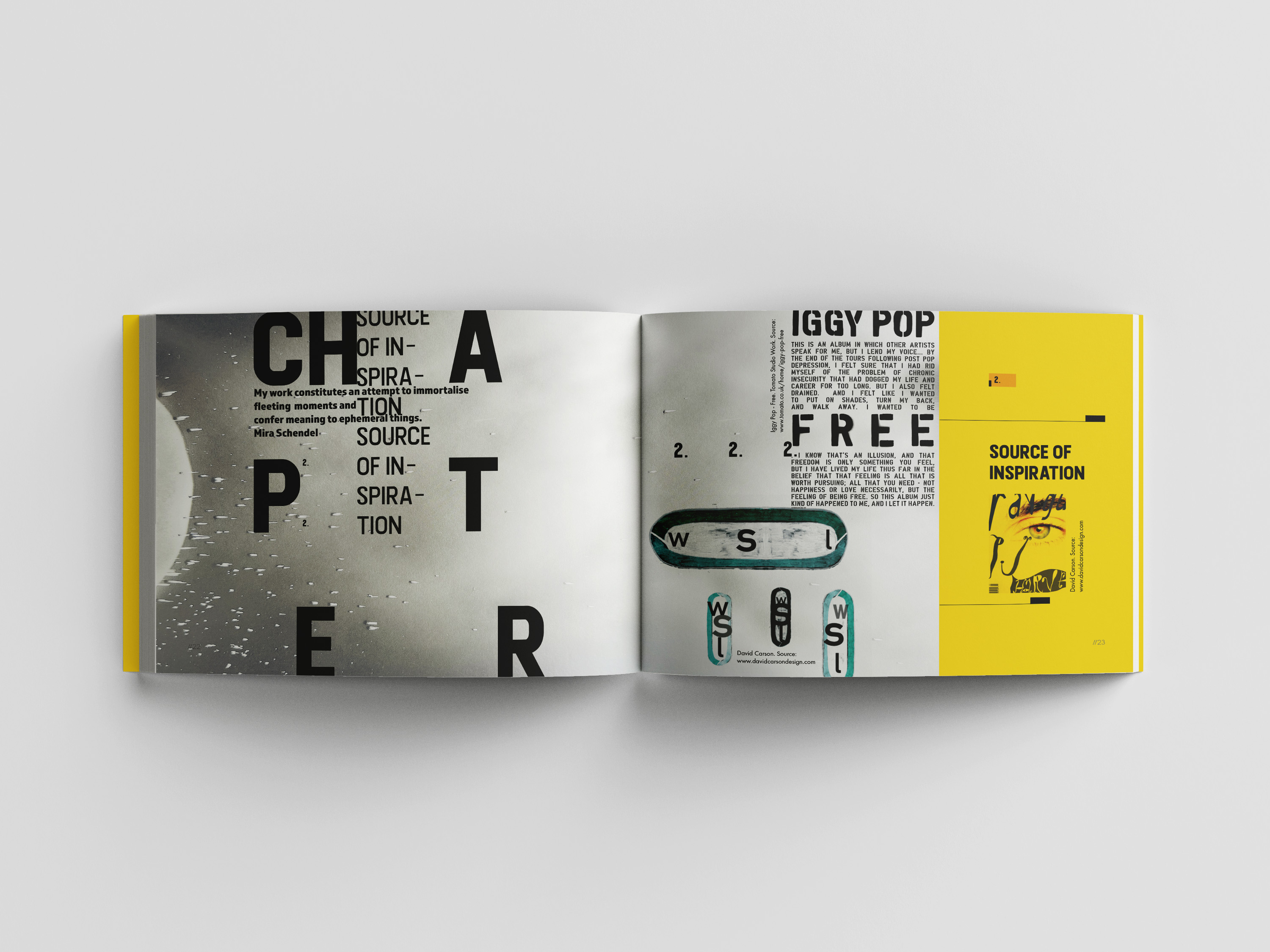
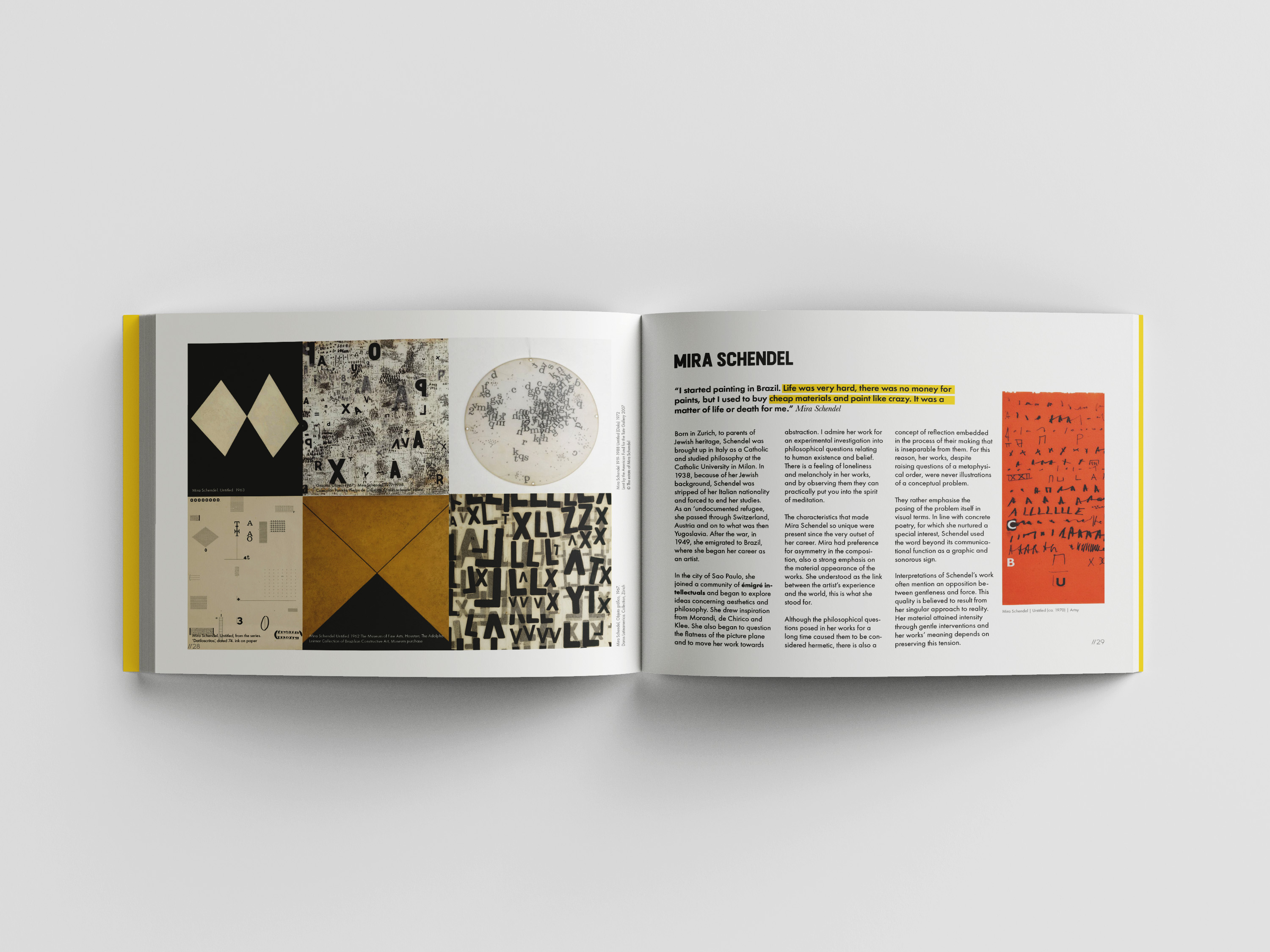
This breakdown image I created in a similar style as the first chapter, by adjusting images around, related to the subject I’m going to talk through. I added an inspirational quote by Mira Schendel, I couldn’t find lots of her quotes, I think she applied lots of philosophy and spiritual meaning into her works, also, they were different times, she is an artist who was born a hundred years ago, but her works still give a level to other modern artists two. I am quite happy with the template I created for those breakdown spreads, in Fanzine style, but still, letters are placed round l according to the grid.

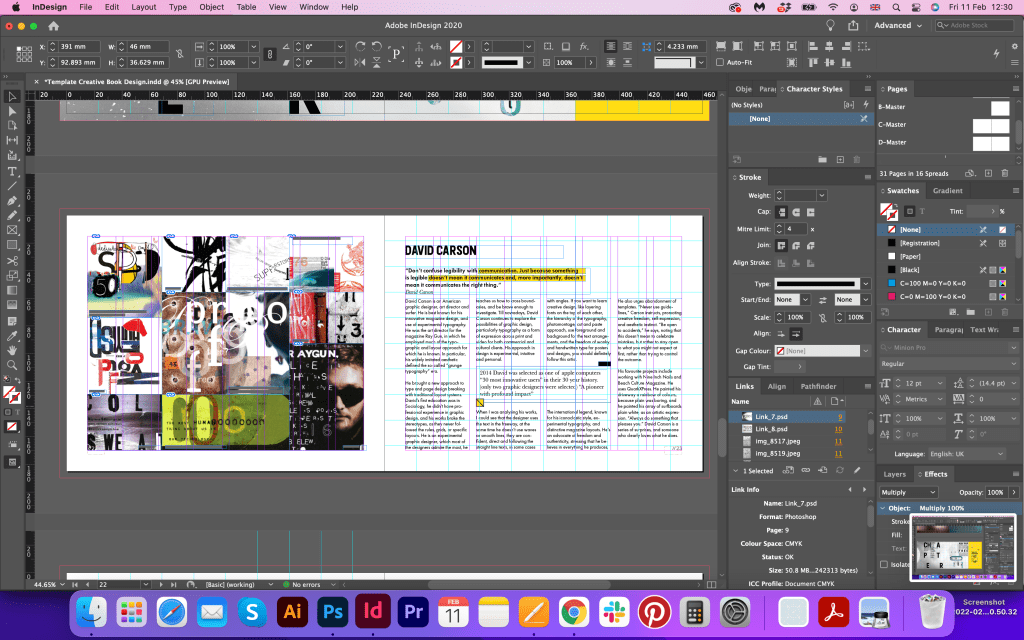
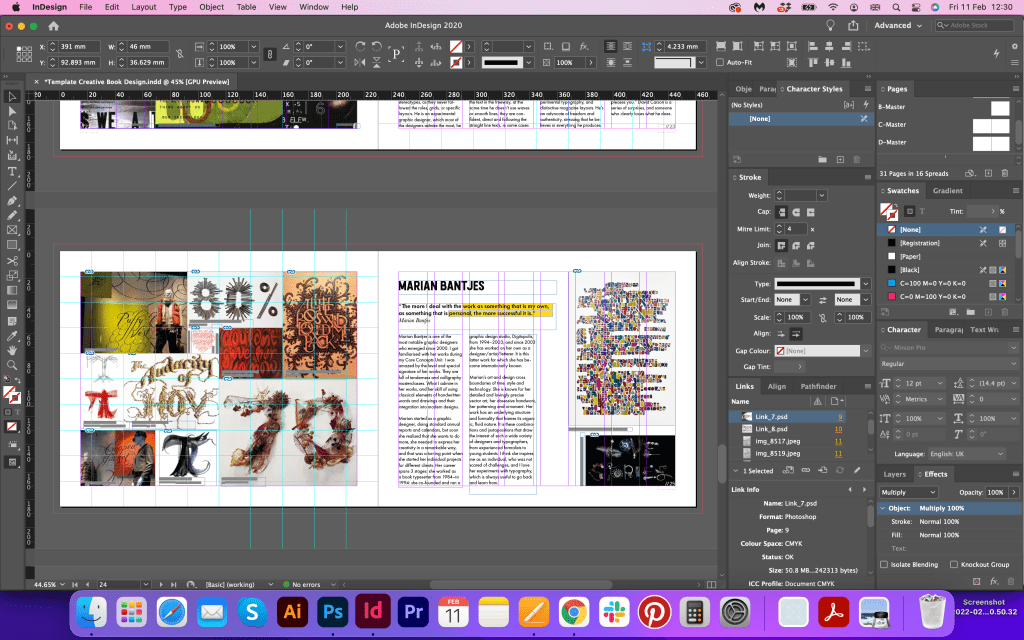
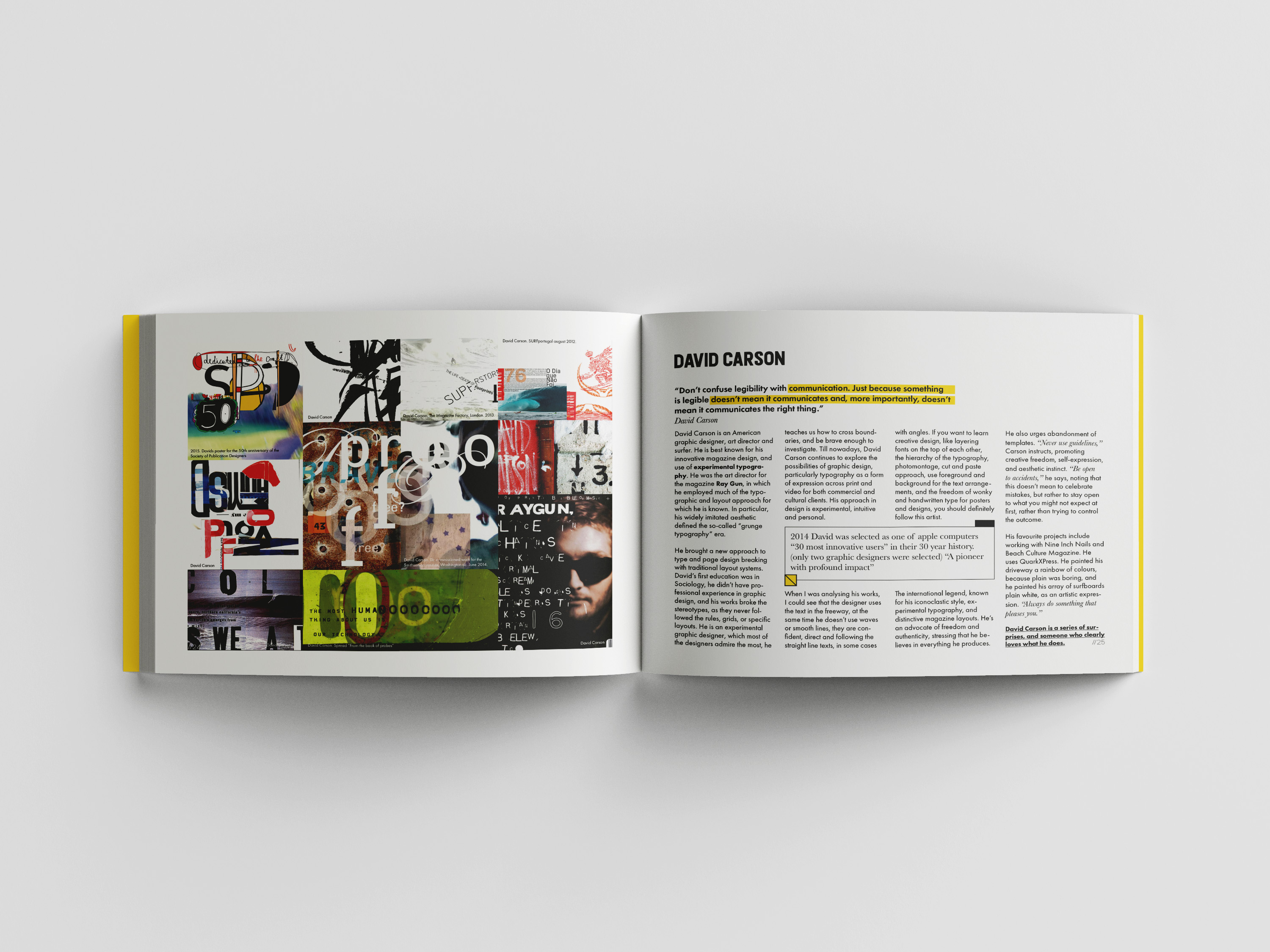
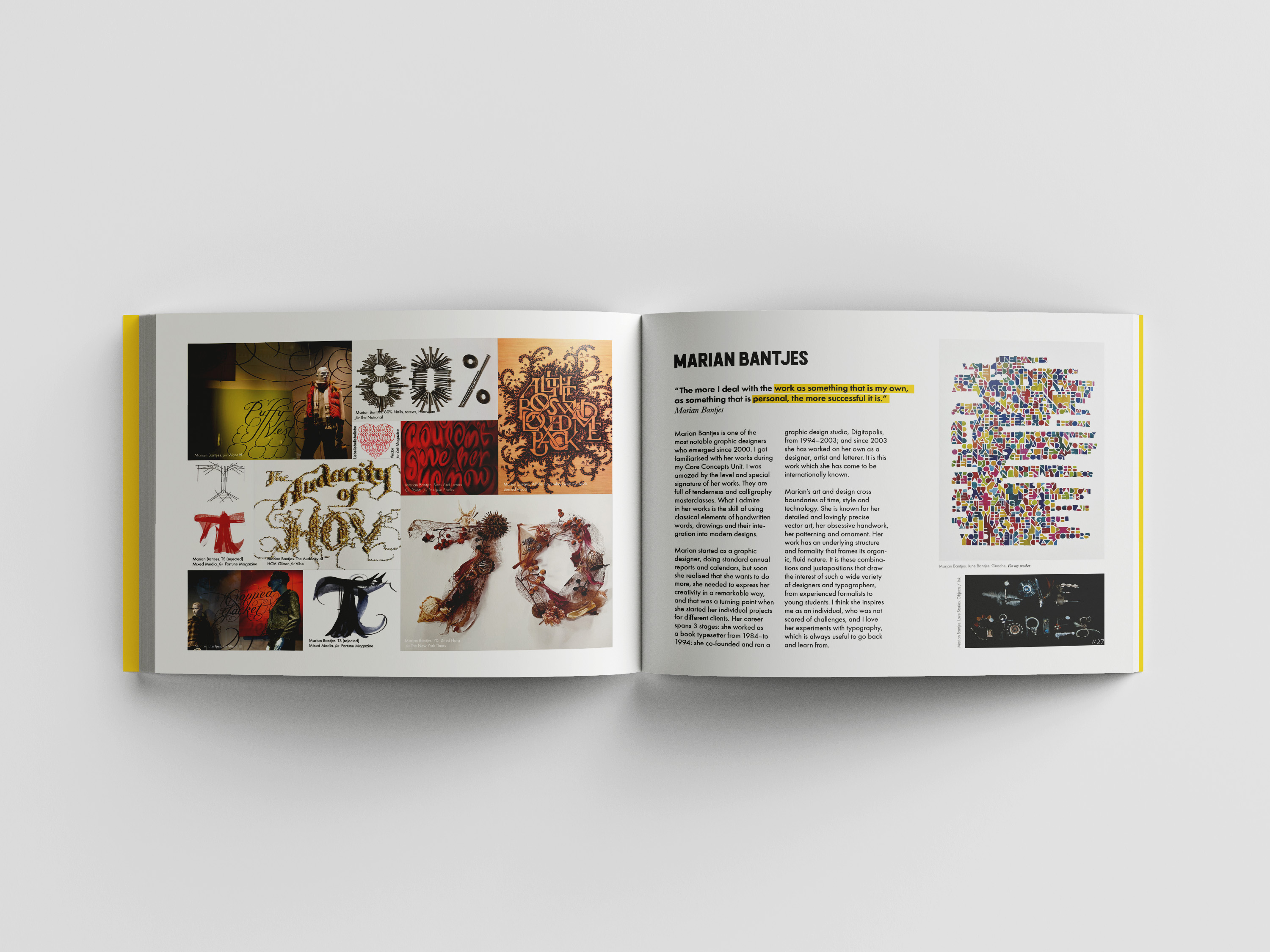
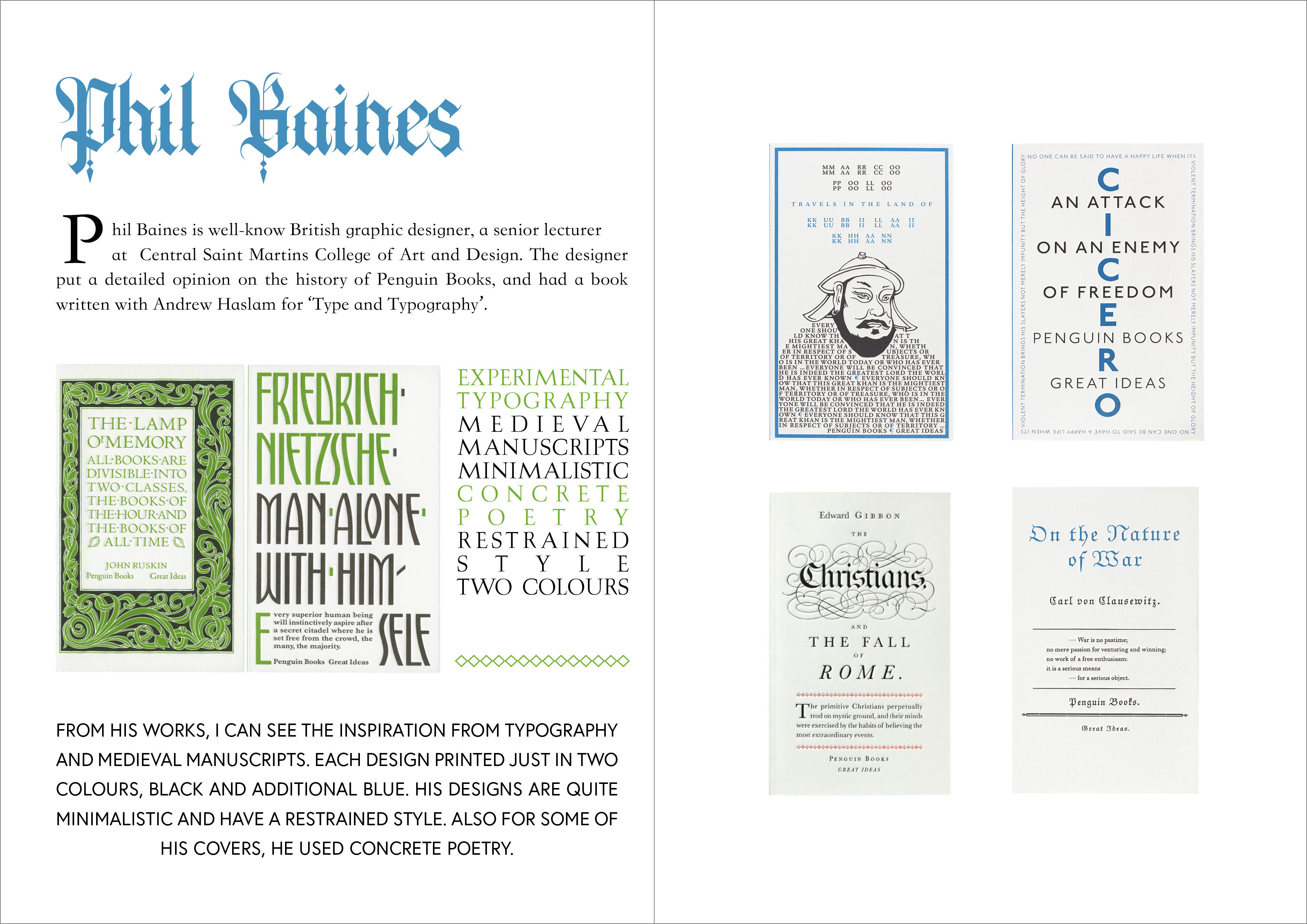
The next three spreads I designed with a similar template, on the left side the collage consist of the various designs of artists, and from the right, I placed short descriptions of each of them. I moved quotes around and changed the size of the columns, still according to the grid. I didn’t want to be repetitive, as the same grid collages can look quite boring, but playing around with them, and adjusting their sizes helped me to create a creative look for those spreads. I followed the short biography of such artists as David Carson, Marian Bantjes and Mira Schendel in those spreads, and also their inspirational quotes. Those styles that artists work on are completely different, but altogether they create a collaborative experience for me.

Also, I didn’t forget about the copyright and name of each work presented in the book, which was quite a job to do.

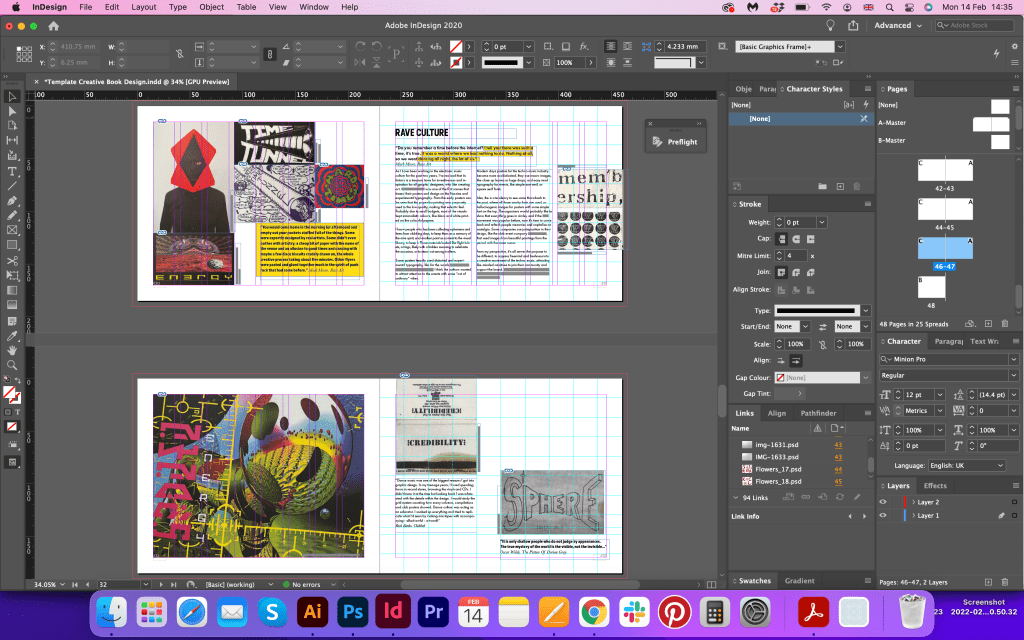
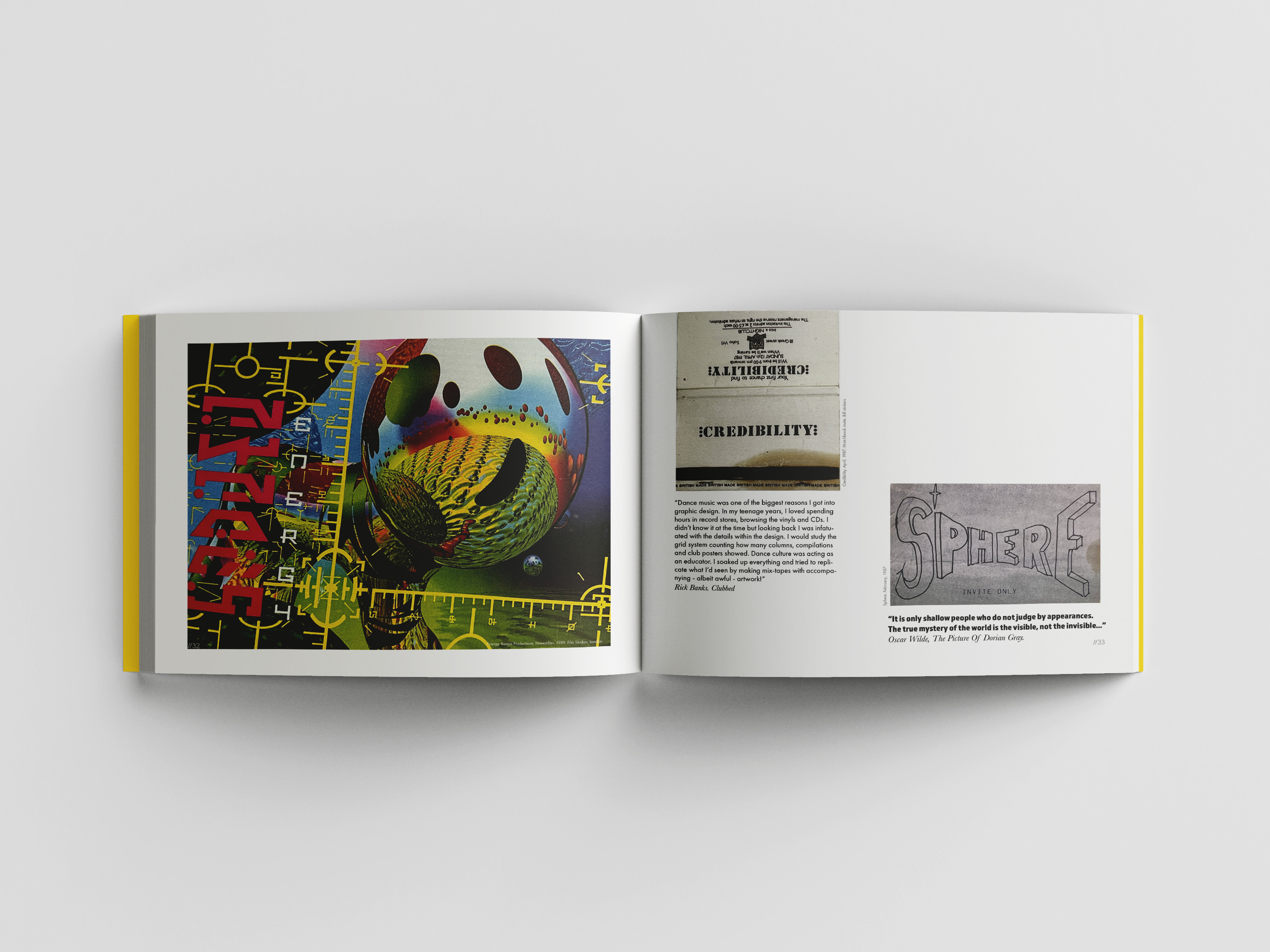
When I placed all those artists, I nearly forget about the electronic music movement I was going to include, good I had a flat plan. For some reason, I was planning to place it into the experimental typography, but then I realised this is the movement that inspires me. I wrote a big paragraph about it earlier. And here I just add in the page layout. I created another collage from works, I wanted that chaotically look layout for it, placed within the grid, with different sizes of posters and tickets. That is the scene that has been my major influence for the past few years, and I hope that it will keep evolving further in my graphic design career. Also, I added inspirational phrases into these spread, which can be related to the rave art industry, which is a bit judgmental, but there is something about it.

“It is only shallow people who do not judge by appearances. The true mystery of the world is the visible, not the invisible…” 

Oscar Wilde, The Picture Of Dorian Gray.

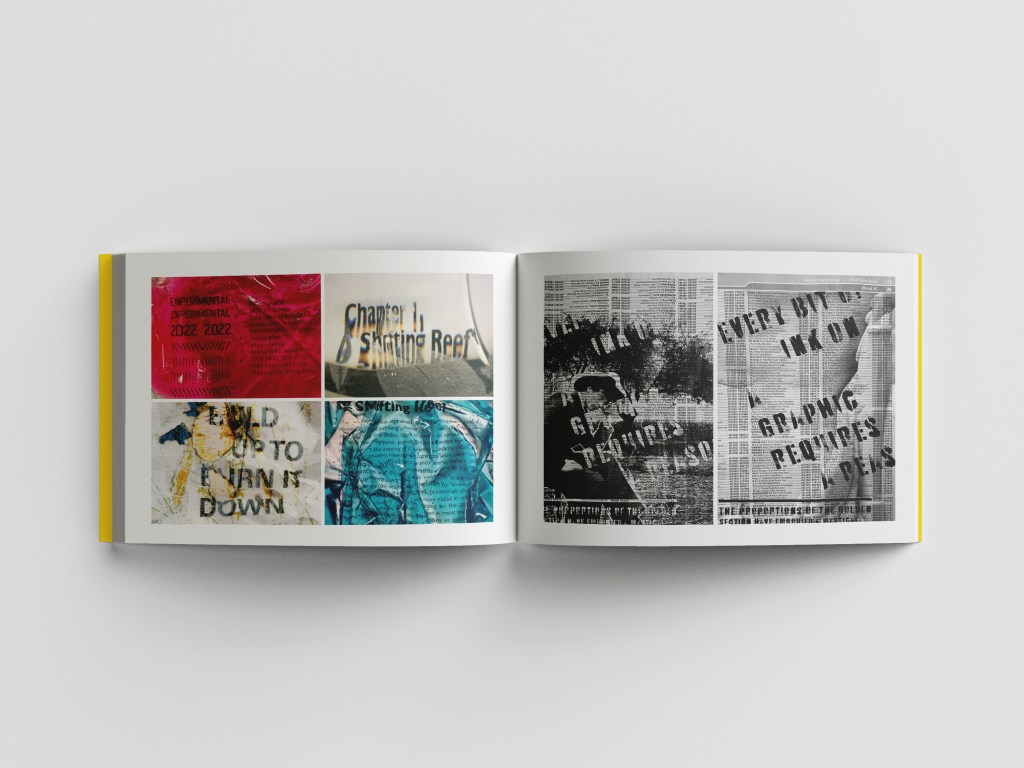
Finally, I’ve got to the part about experimental typography. As my experiments were in different formats and directions, I was thinking of how I can join them all together to create a mood of coherence. I organised those images according to their colour, and the next whole spread was used only for the images of typographical and printing experiments. I could potentially use some of the spreads I created from the fourth exercise where we used different texture printing, but I didn’t want to be repetitive, as I used quite a lot of those images, and already printed them. I filled those pages with new experiments, and some old images I designed ages ago. I loved the juxtaposition feel between them, and the creative look of each image, they are all different, but similar at the same time. And it’s good to see them together in the final work for this unit.

This book had already that distorted modern Fanzine look, but I thought what if I add my first sugar and flower experiments I’ve ever made. They looked amateur, but, at the same time, that is what made them look special. For this spread, I used new placing for images, but the font choice and elements around are all still the same. I showed it to my friends and family, and they said that is a really good one. It’s curious to see, how some older works can have a new life in the current projects.

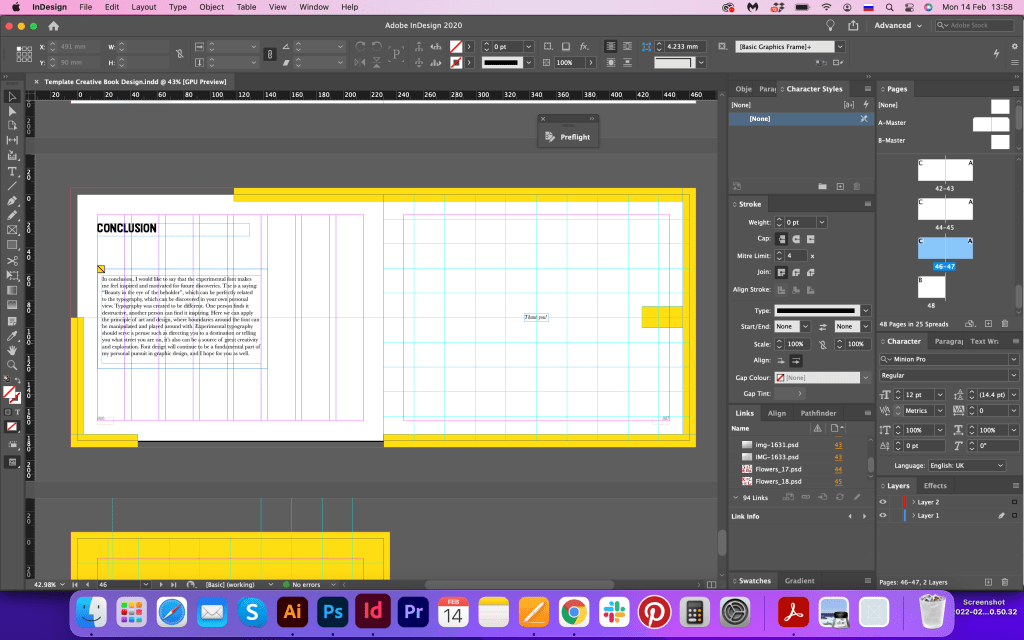
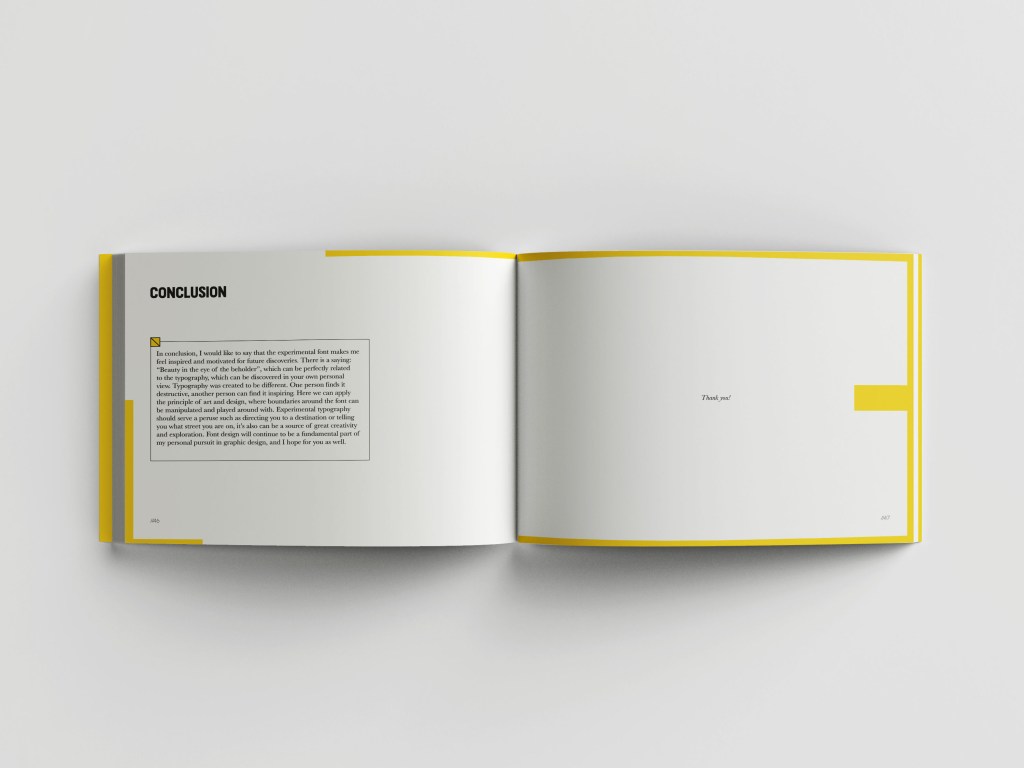
I was going to finish the book with the spread of flower fonts made out of petals, but then I showed the final book to my family and had a comment that I’m missing the conclusion. I couldn’t believe that I had nearly forgotten about the final words for the book. Otherwise, it could look like leaving the house without saying goodbye. So, I created a spread, which looked similar to the introduction spread, but with a slightly adjusted frame. Now the book finally had a missing part restored.

The full version of the book in pdf file can be viewed here

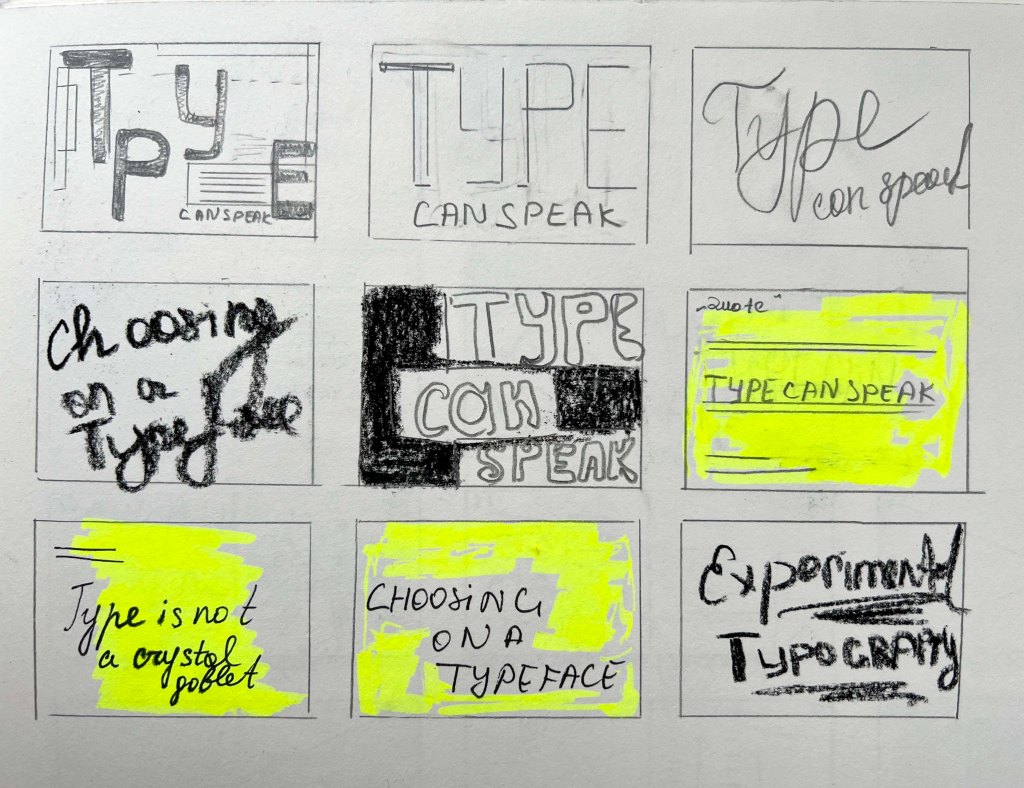
Cover sketches

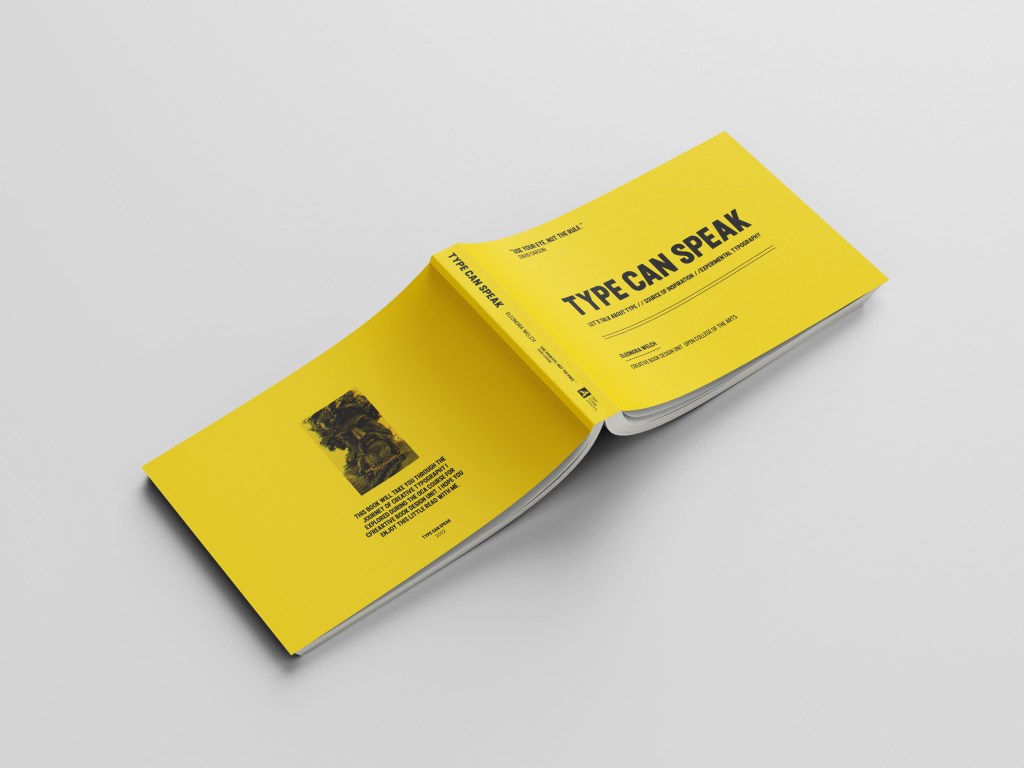
I had a few ideas about what a book cover can look like, I did a quick sketch, with different names for the cover and various writings. I decided to go for the bold looking cover, with the bright yellow background and confident bold font. I thought that it’s not very inventive cover, as it goes directly to the subject of the book, but at the same time it works well with the design concept of the book, so I decided to keep it.

Cover page mockup

Ready book mockups

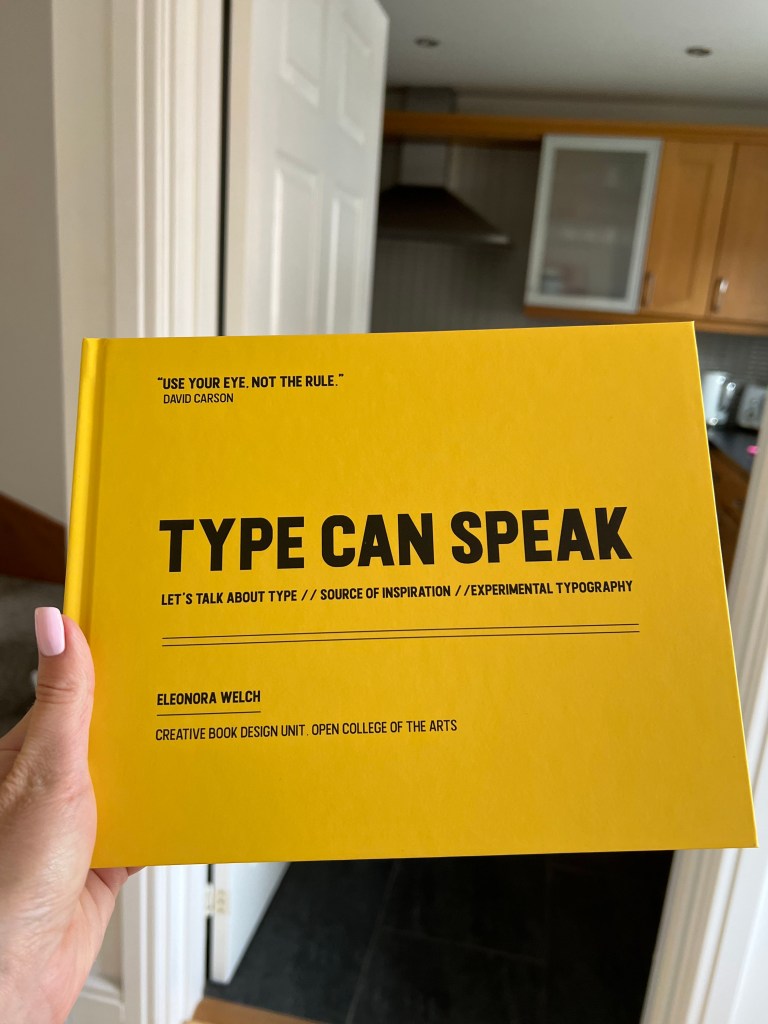
Printed book

For the printed version of the book, I went to the Mixam express print. I was nicely surprised with the quality of the print and the short terms it has been produced. Just within 10 working days, which is quite impressive for the book printing. I had a custom size of the book 230×185 mm, yellow hardcover with matt lamination, and for the endpaper I’ve chosen factory yellow colour as well, which looked bright and juicy. For the sheets I decided to go for the thicker pages, 170 gsm paper uncoated, as I loved that rough feel of the pages, good I had some samples of the paper, so I could decide what suits the best for the preferences of the book.

Conclusion

In conclusion, I would like to say that I really enjoyed this assignment. I’m pleased with how the book turned out in the result, and the direction that I took lived up to the expectations. In the beginning, I was super nervous as I felt a big responsibility, as that is quite important work to show at the end of the unit. I was thinking about what are my strongest points to reflect on, but at the same time what new I can learn during this book design. It’s good to see the progress, and usage of new approaches in design, but at the same time be able to apply the experience of the previous knowledge I gained through the whole course.

I found it quite challenging writing all the content for the book, as English is not my first language, but at the same time that is what I enjoy, being able to write and explain my thoughts. I can see some improvements compared to my first works, and it’s vital to have my own voice in graphic design, that to be able to express my personal thoughts. I wish I could do this book twice as bigger, and fit much more research and typography explorations, but due to the deadlines, I had to keep my head down to produce as informative as possible book.

It was quite important to learn the printing process for that book as well. As that is one of the vital parts of graphic design, do research for production, and search the market for the prices and time-frames for printing. I’m quite happy, that we had that kind of assignment at the end of the course, as I have additional experience in how to prepare book from the start to the end, it’s always good practice to become independent and be aware of all stages not only in design but in production as well. I’m still planning to upload the printed version, which will be ready at the end of this week.

I wrote that wording in the conclusion of the book itself, but here I would like to repeat it again. The is a saying: “Beauty in the eye of the beholder”, which can be perfectly related to the typography, which can be discovered in your own personal view. Typography was created to be different. One person finds it destructive, another person can find it inspiring. Here we can apply the principle of art and design, where boundaries around the font can be manipulated and played around with. Experimental typography should serve a peruse such as directing you to a destination or telling you what street you are on, it also can be a source of great creativity and exploration. Font design will continue to be a fundamental part of my personal pursuit in graphic design, and I hope it will make an impact on the people who will learn something new from this book as well.

Exercise 5: Reflective practice

This brief asked me to reflect upon the sorts of projects, exercises and assignments I have enjoyed most during this creative book design course. In order to do so, I need to go through my learning log and sketchbook to refresh the memory designs I produced during this studying year. When I looked at my works though for the In print exercise, I noticed a similar pattern that joined my works together, and I loved the fact that I could create some signature in my style. I’m fascinated by how much I learnt and what is the most important, the joy from the whole process as well. 

What I liked the most from this Unit is the opportunity to work both with digital layouts and experiments with hand-made, and work physically with the texture and papers. I discovered a new role, like a scientist in the field I’m familiar with. 

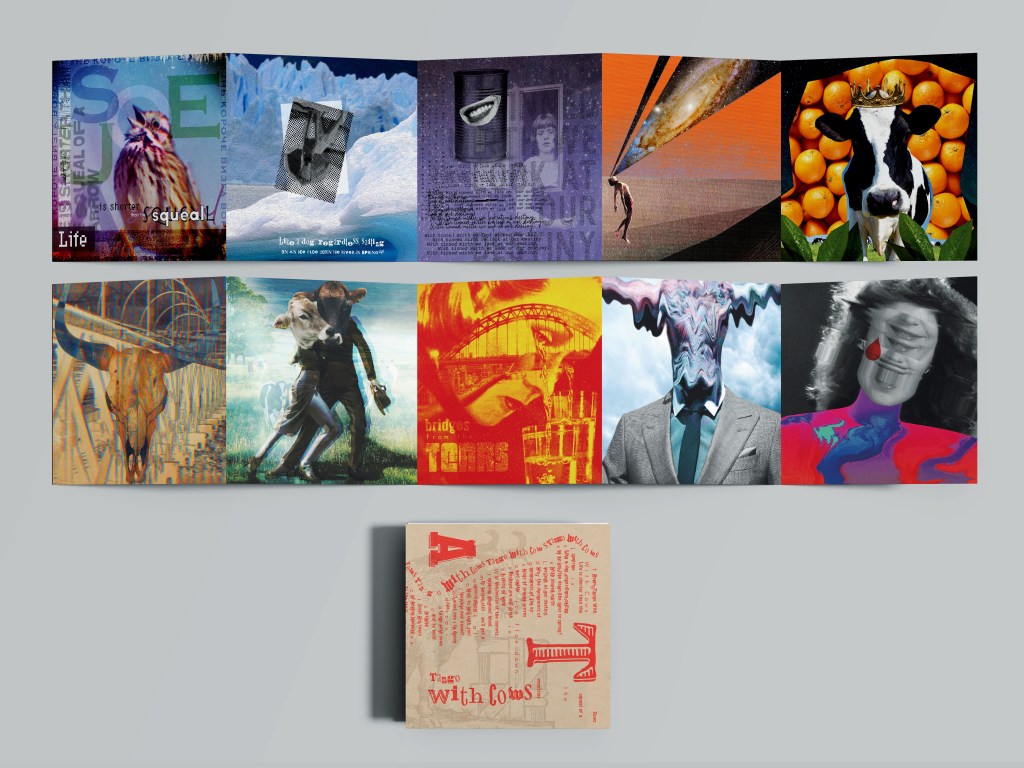
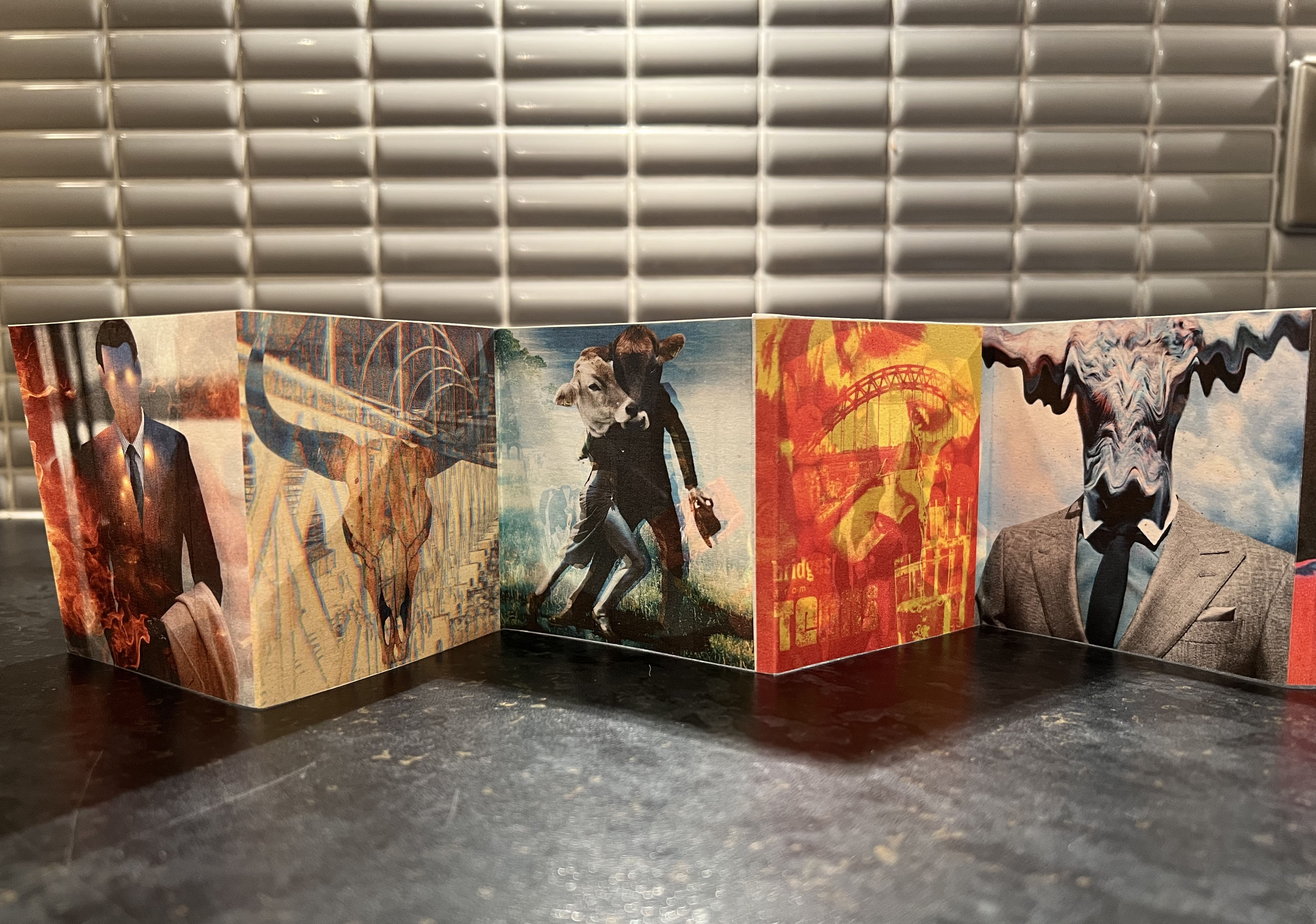
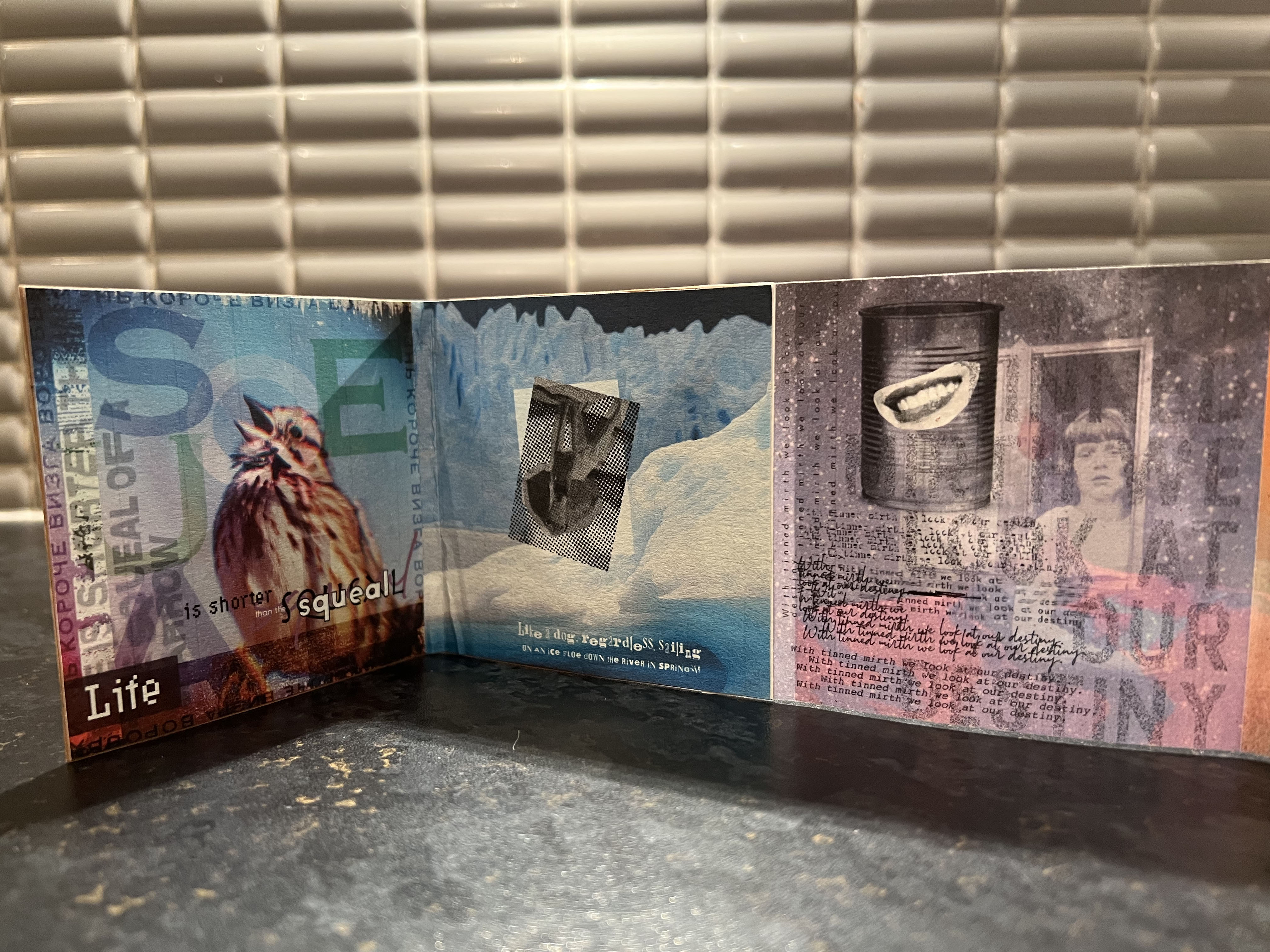
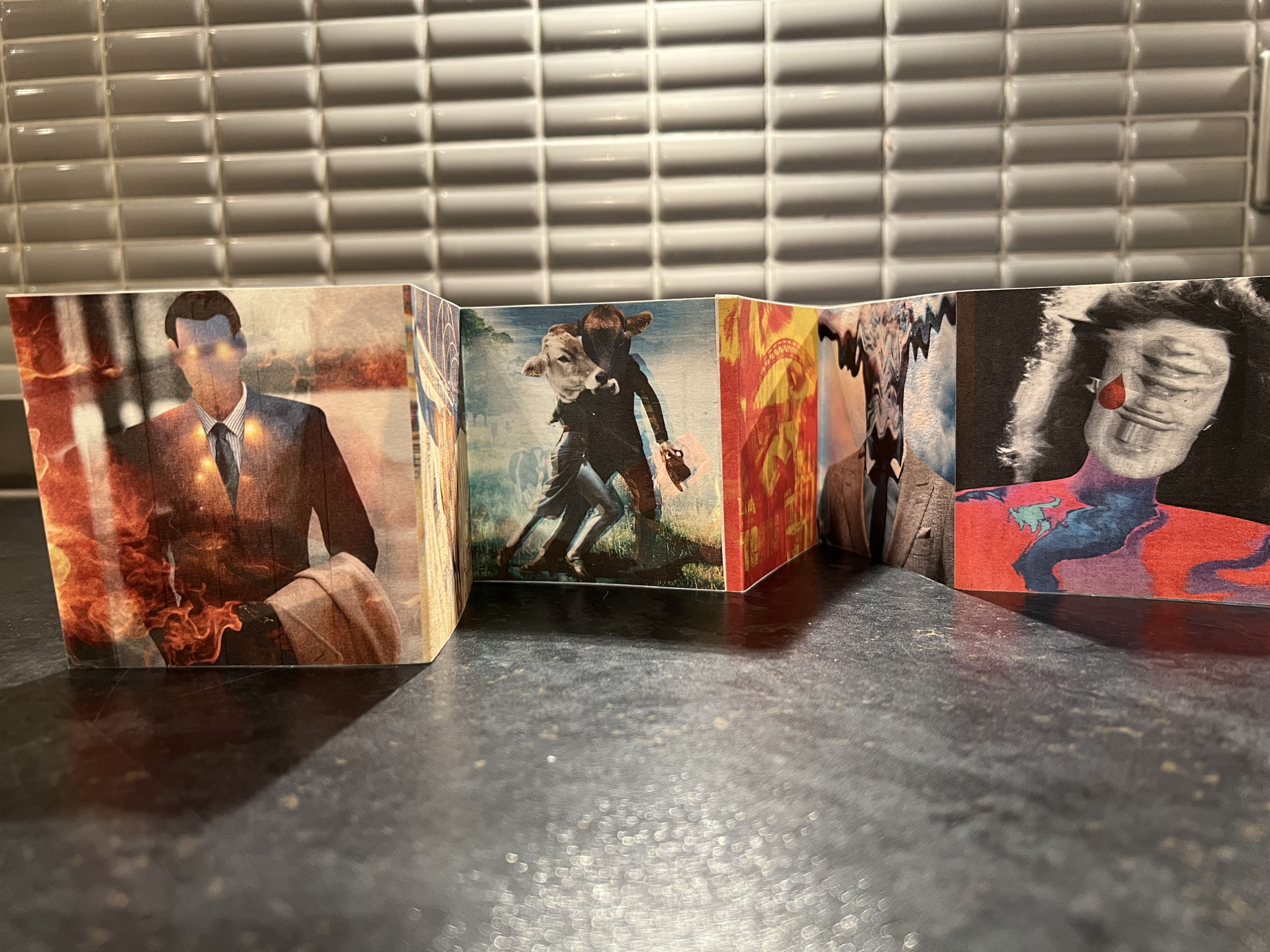
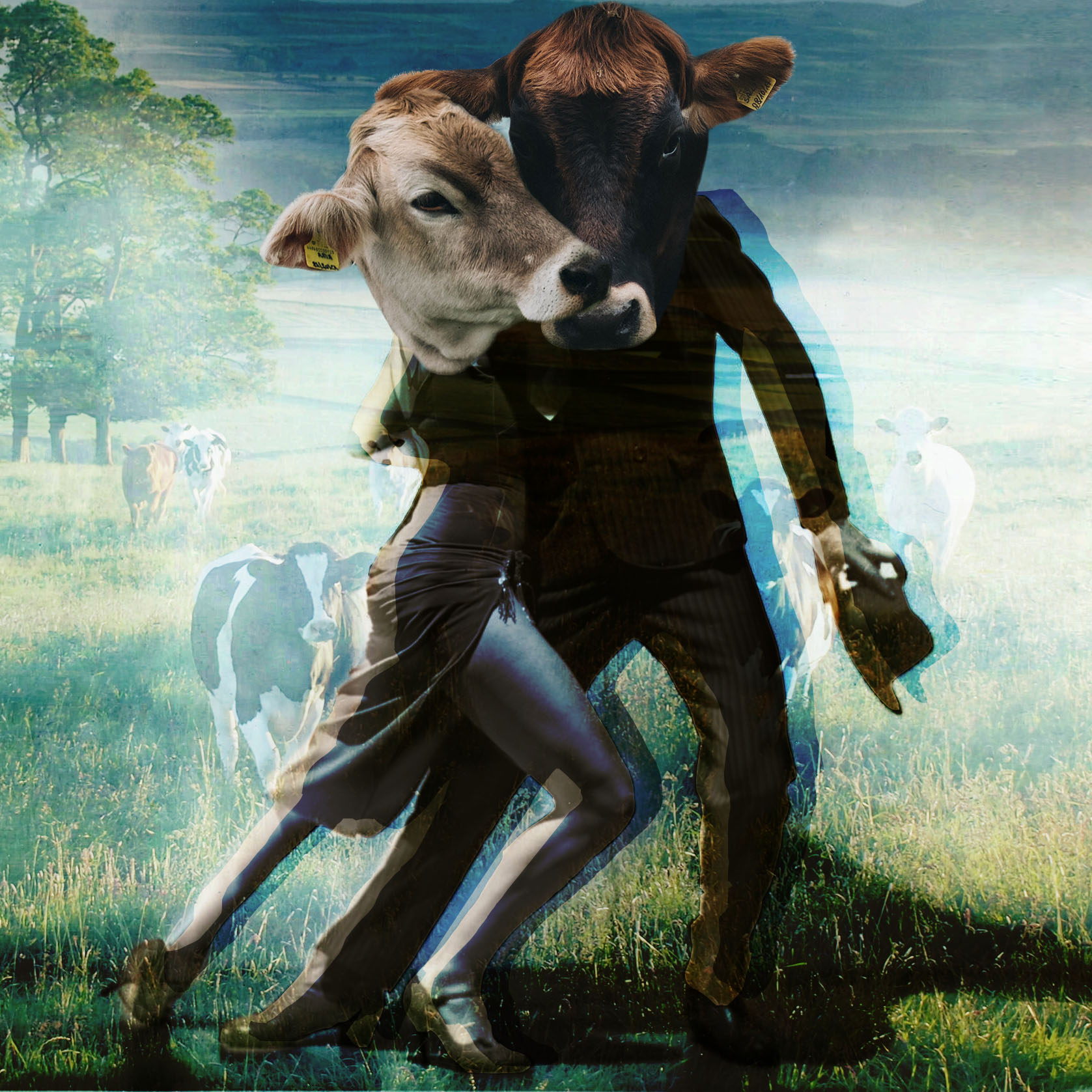
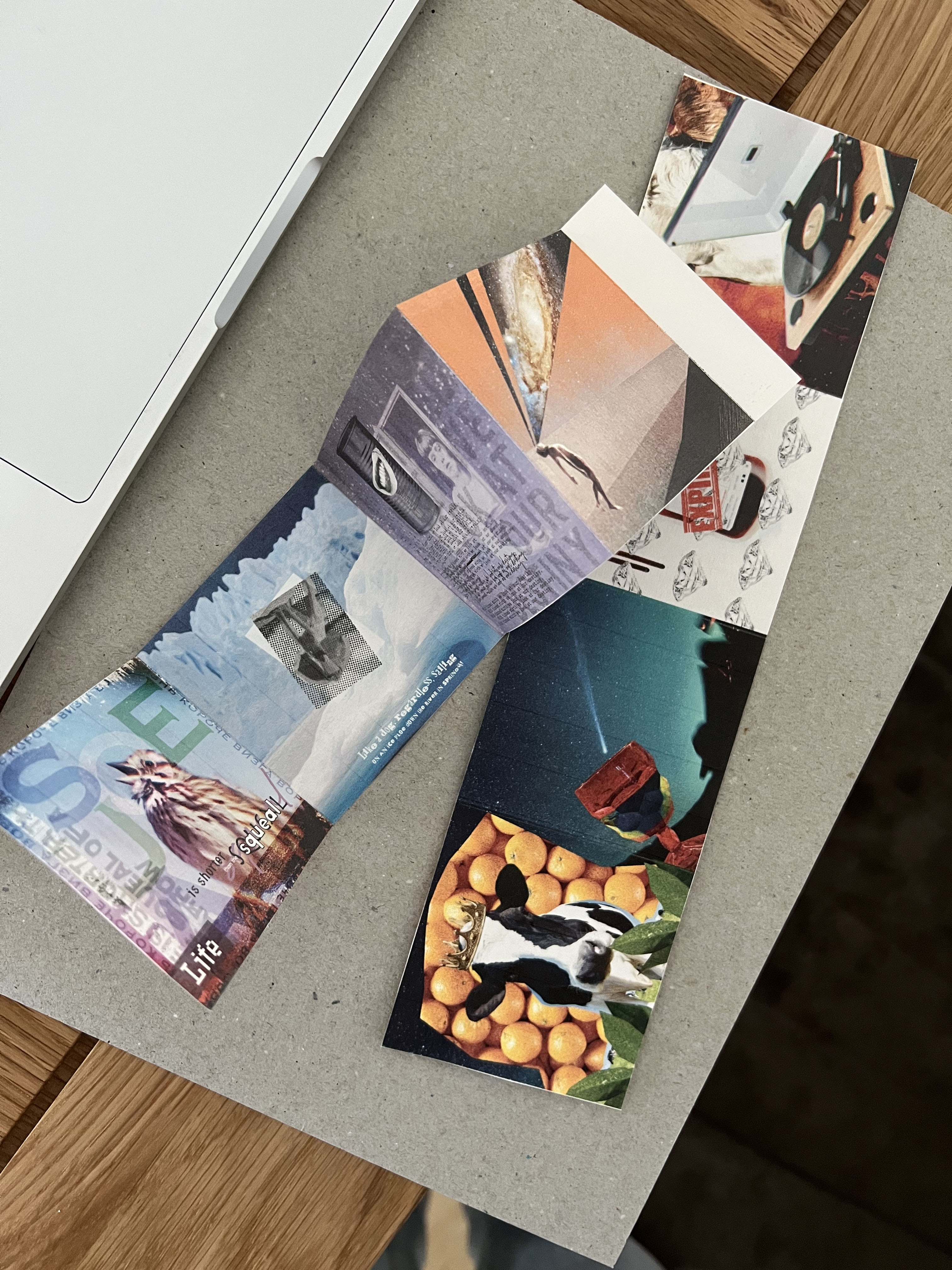
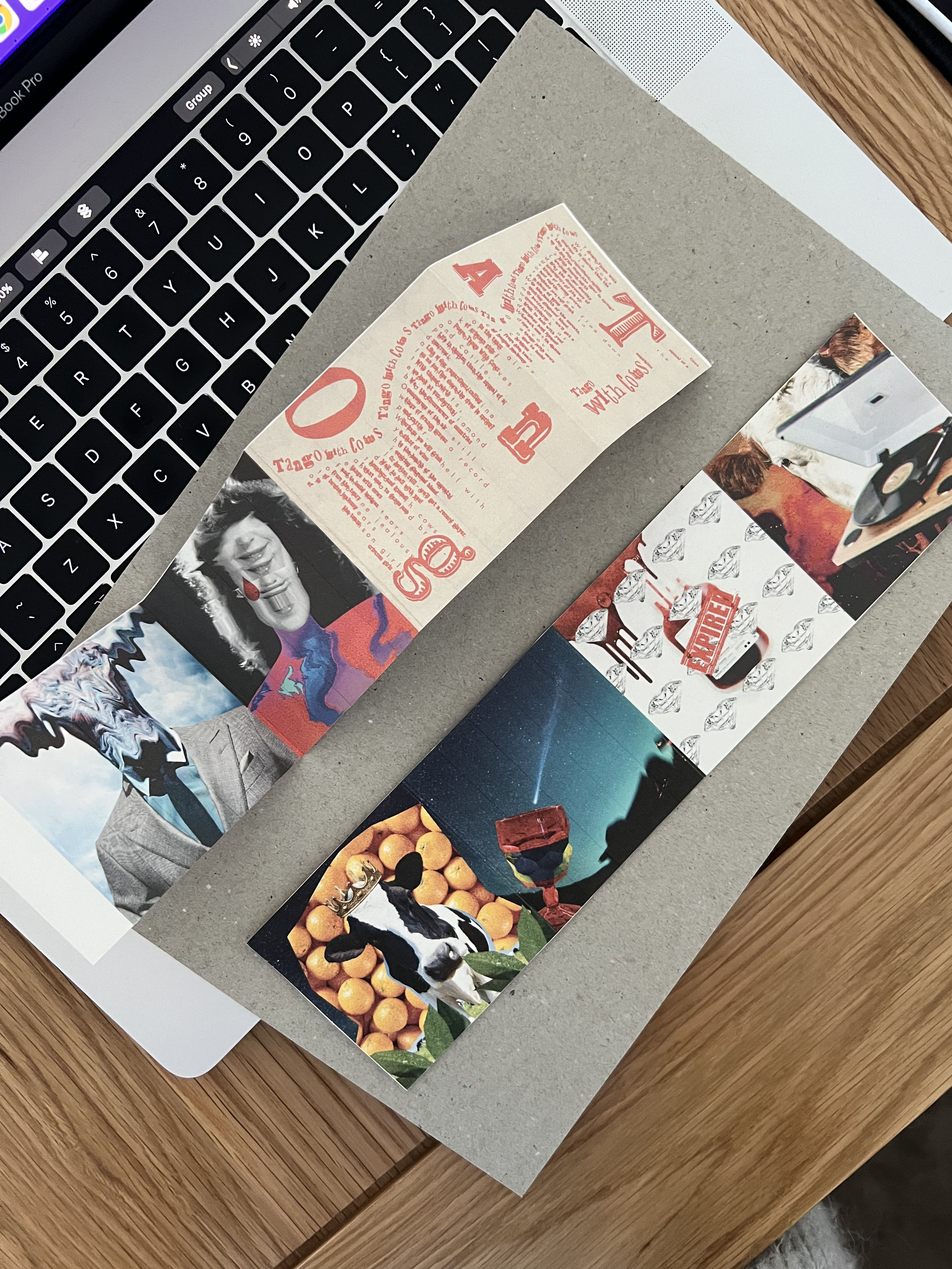
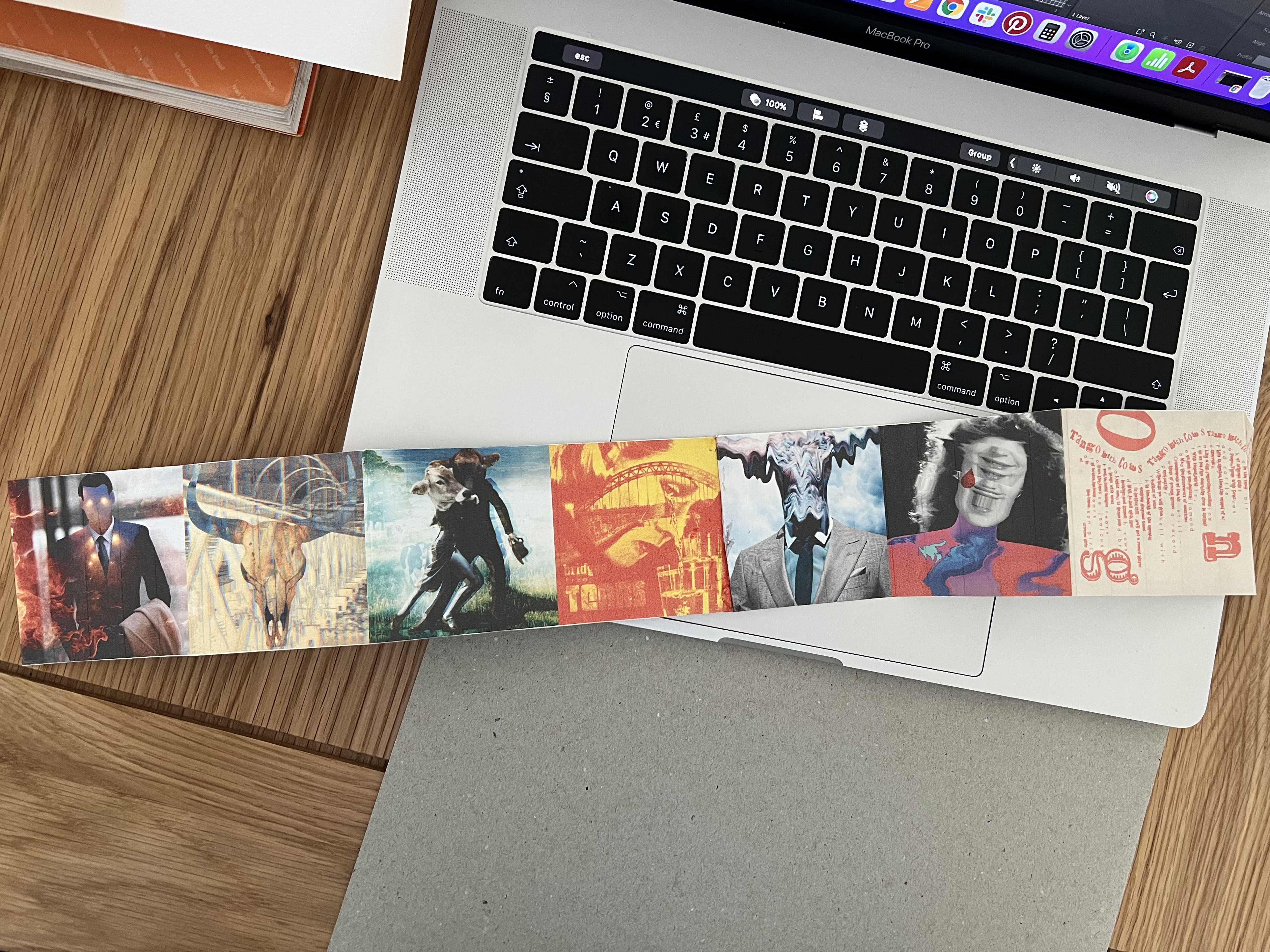
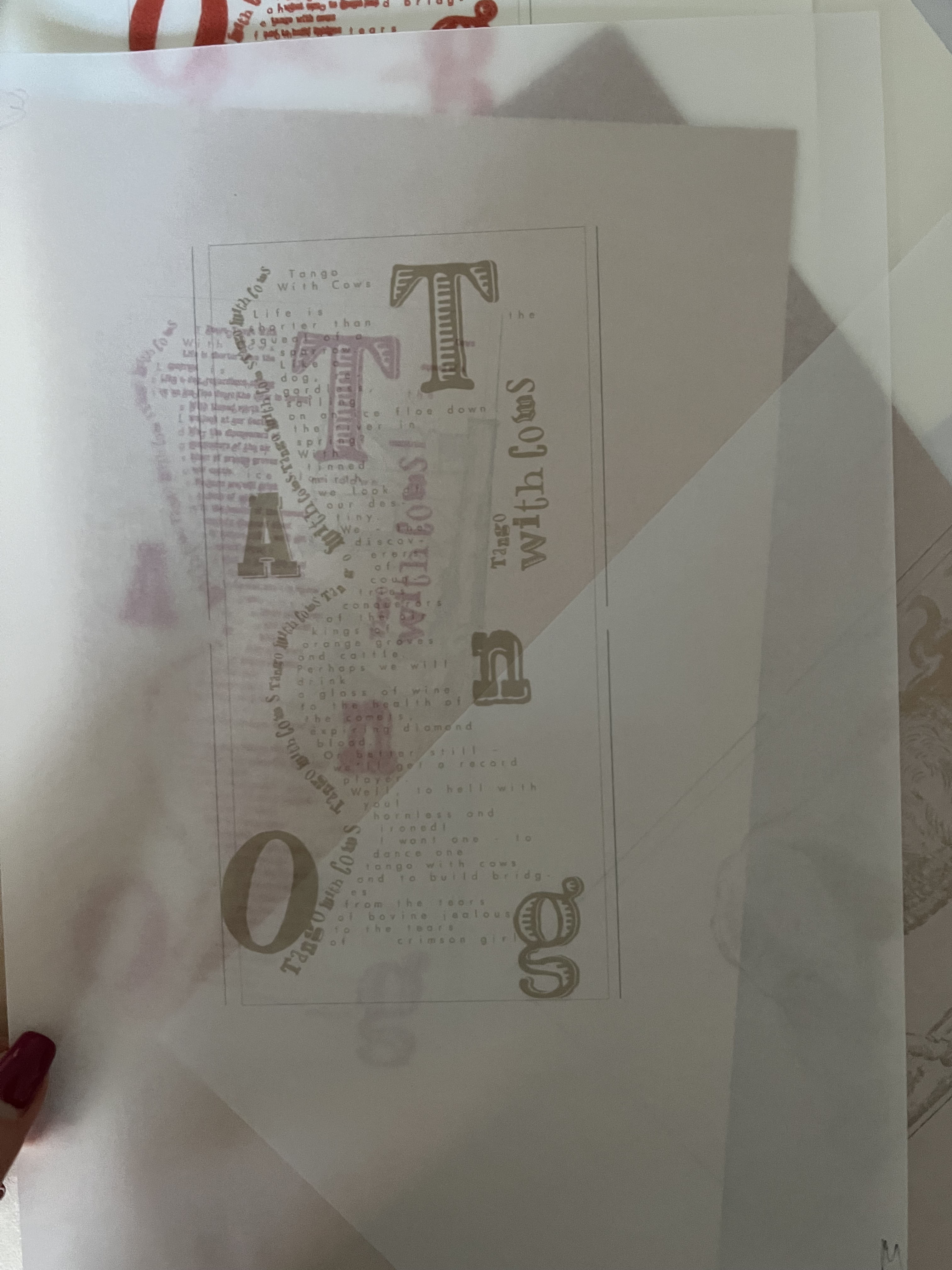
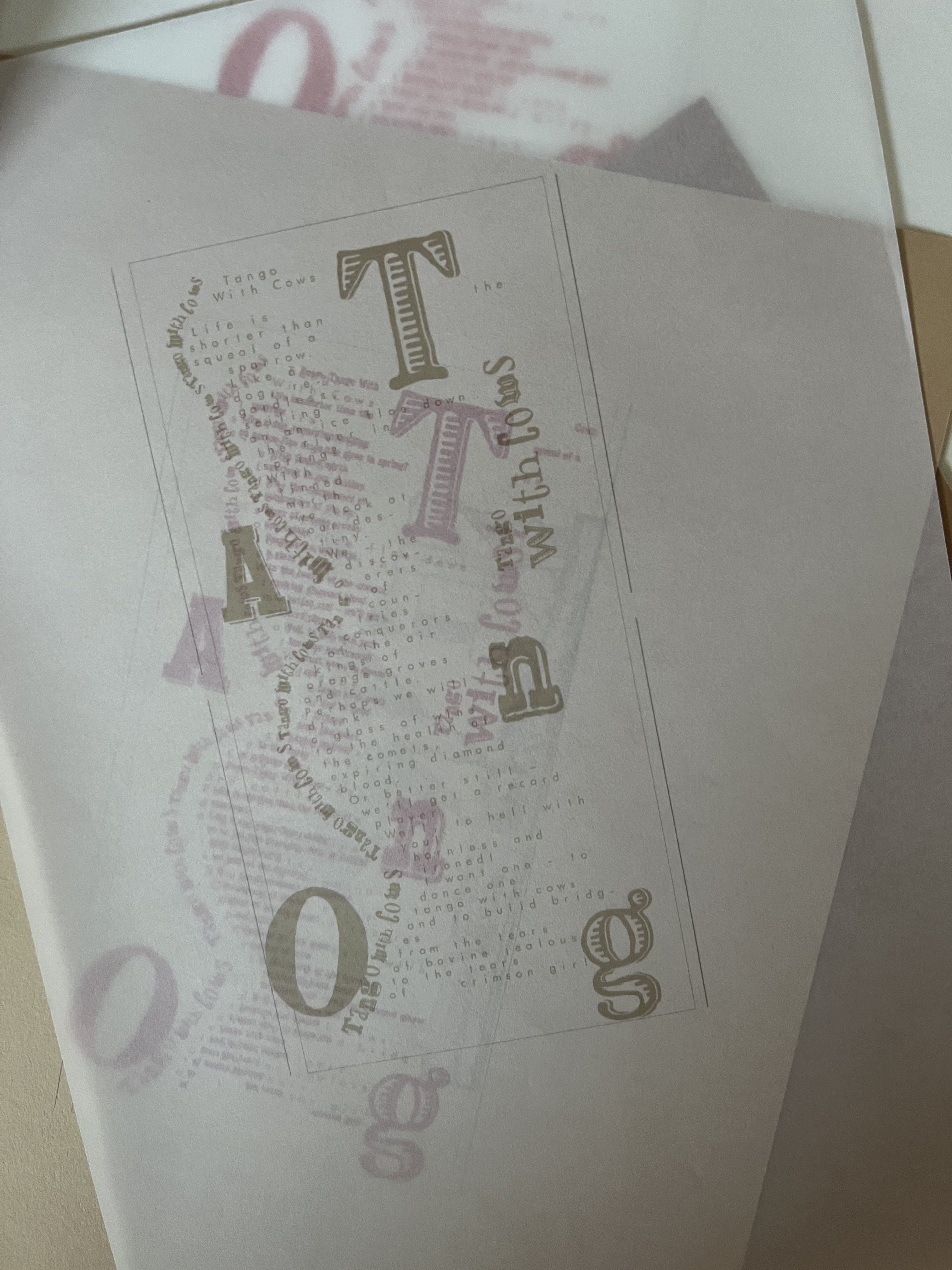
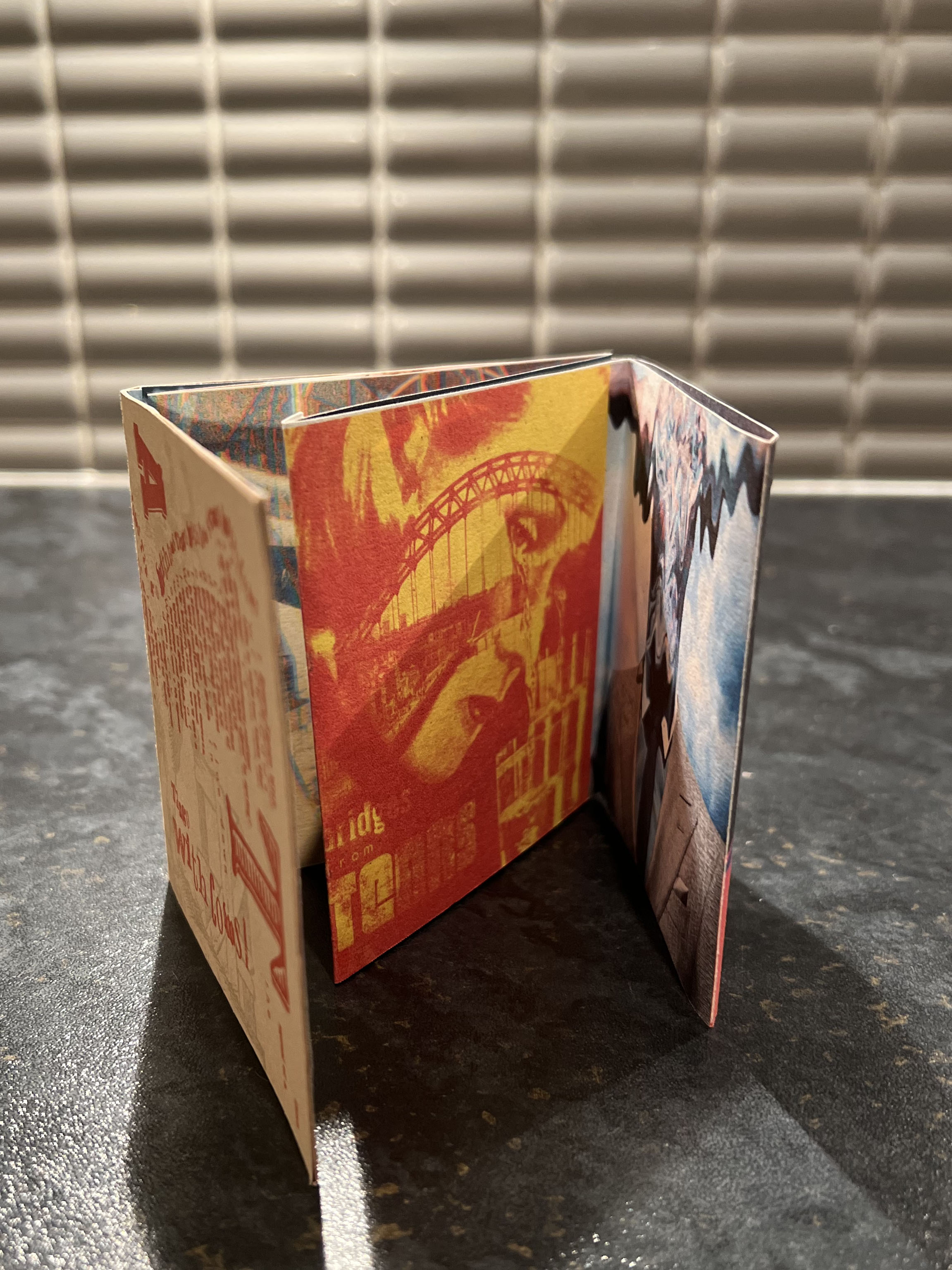
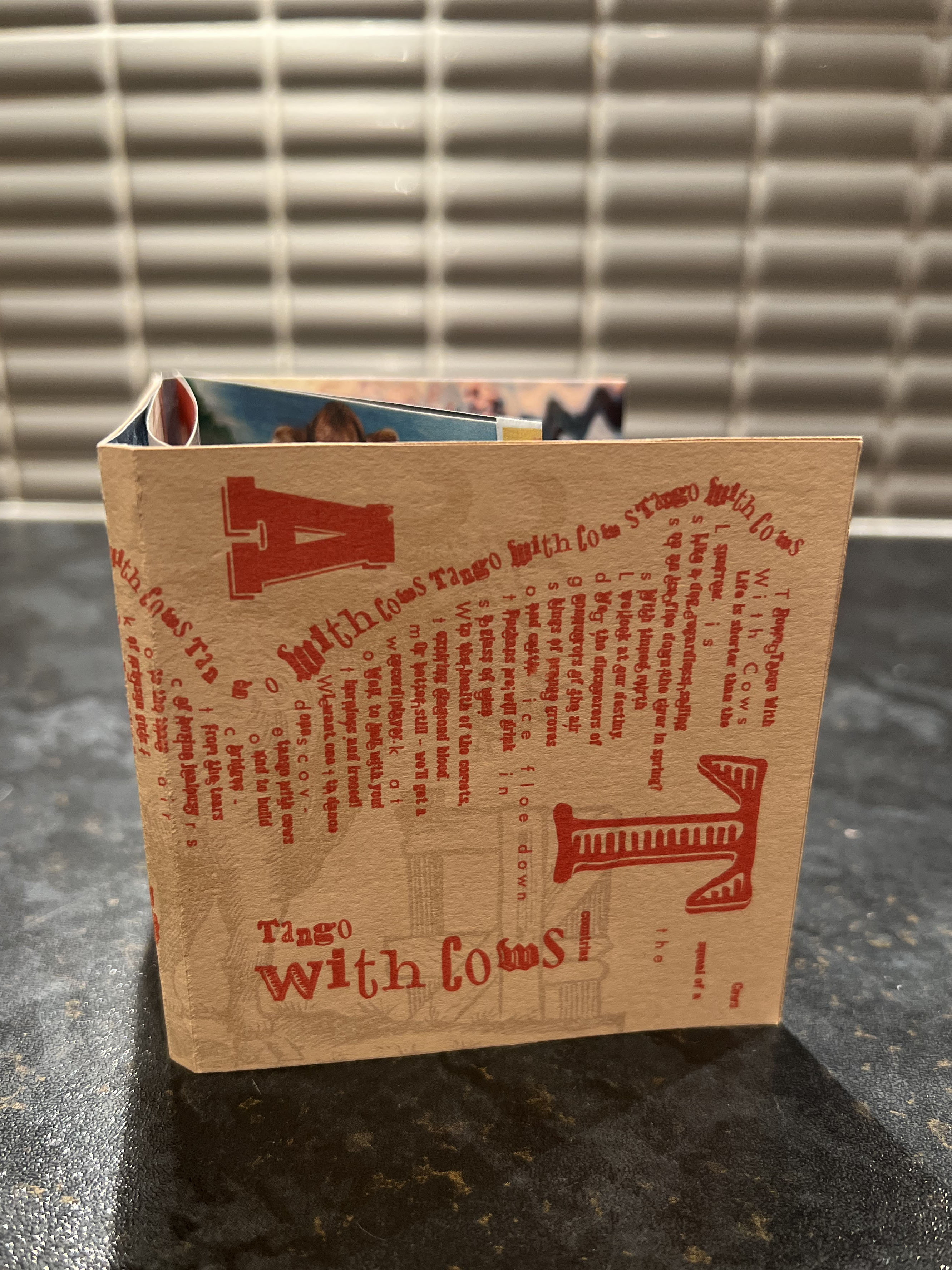
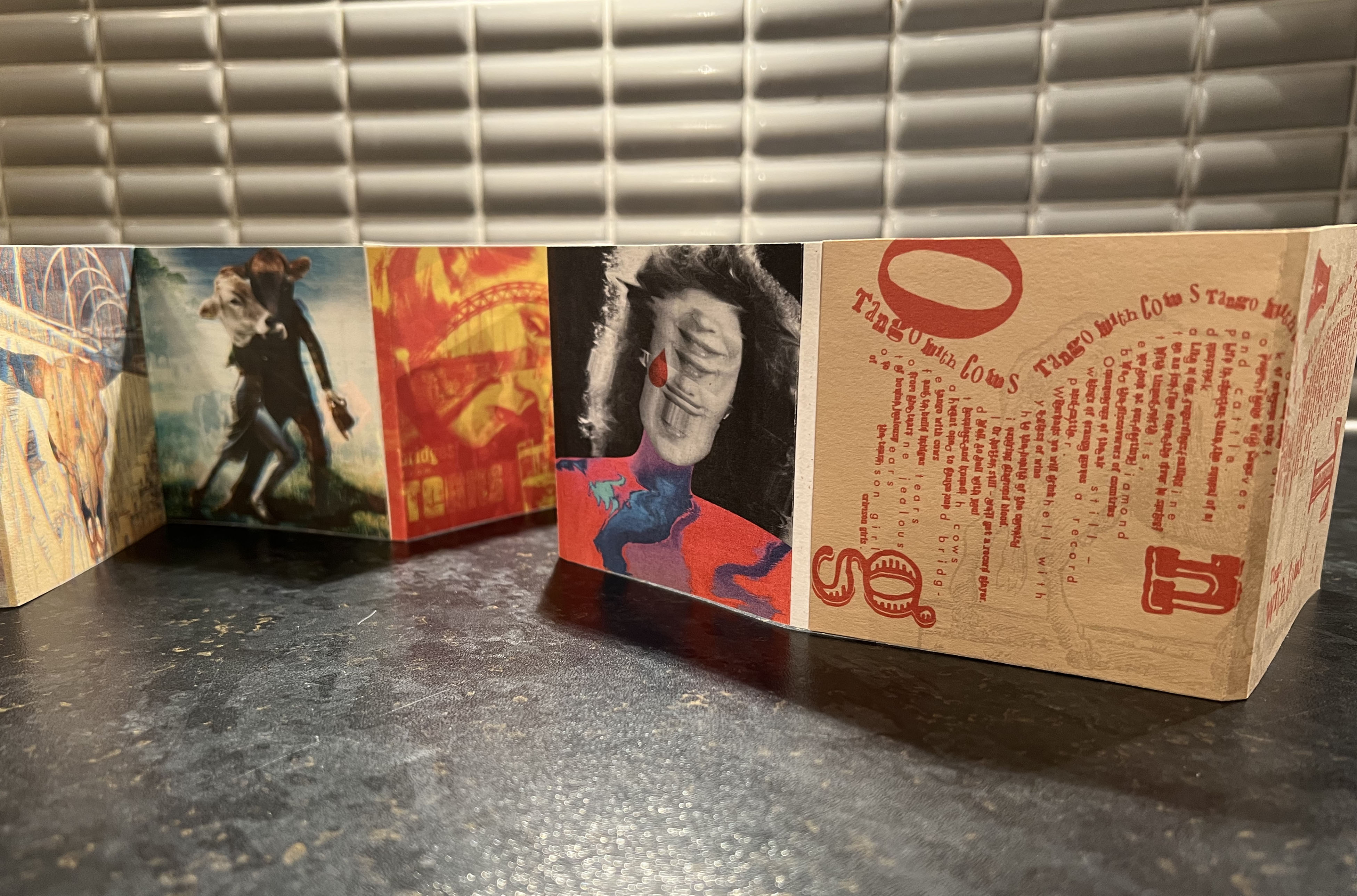
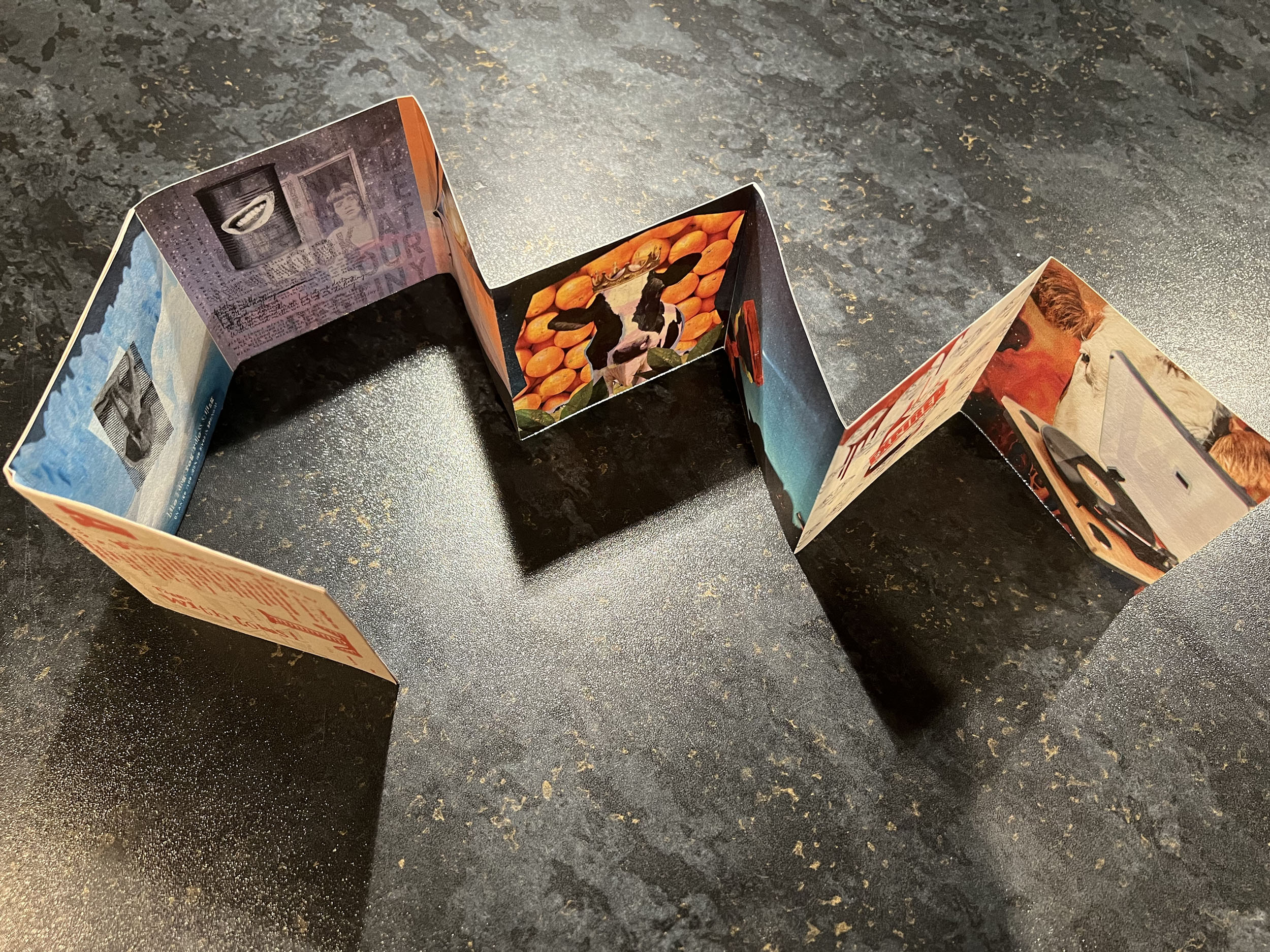
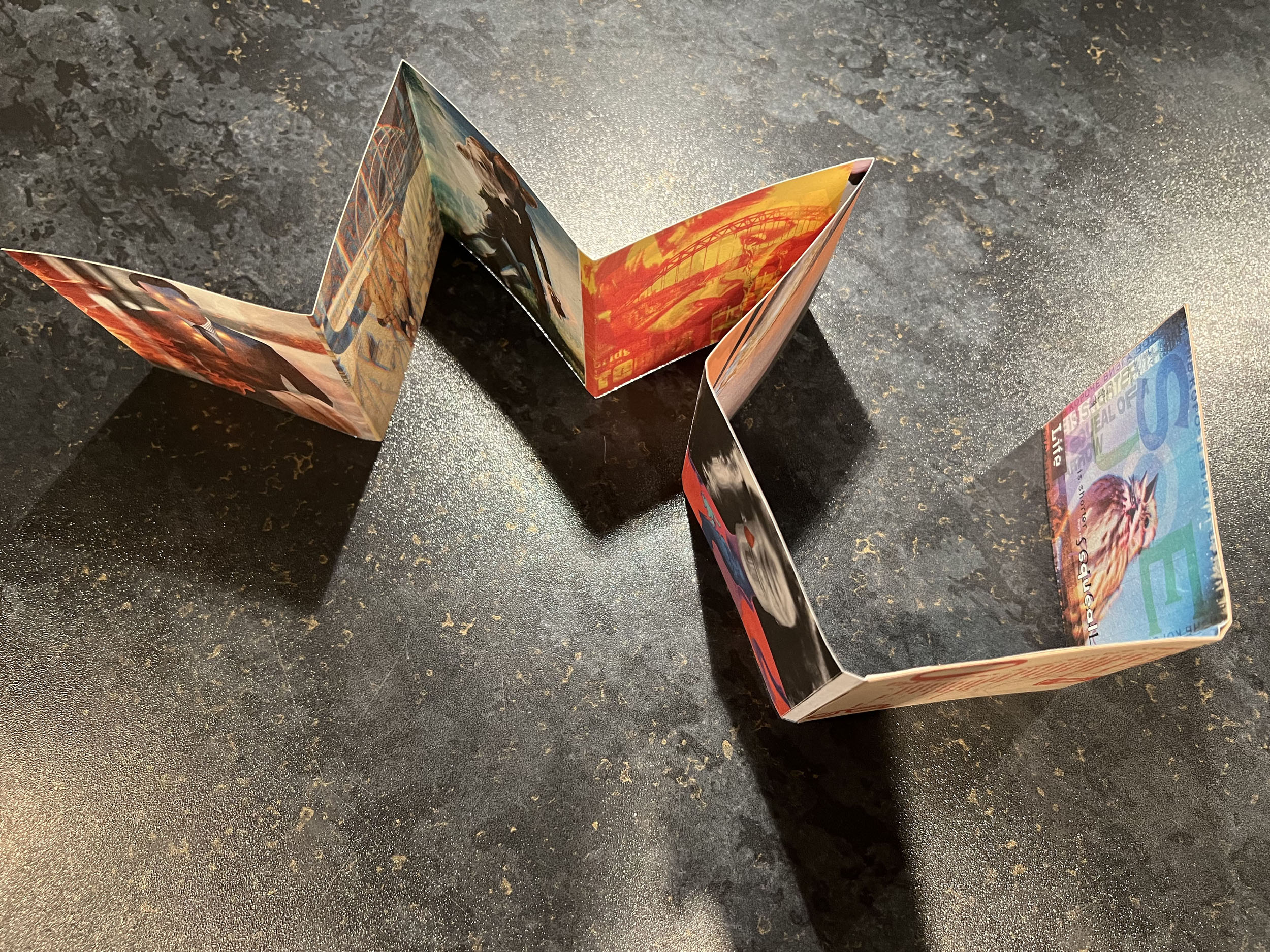
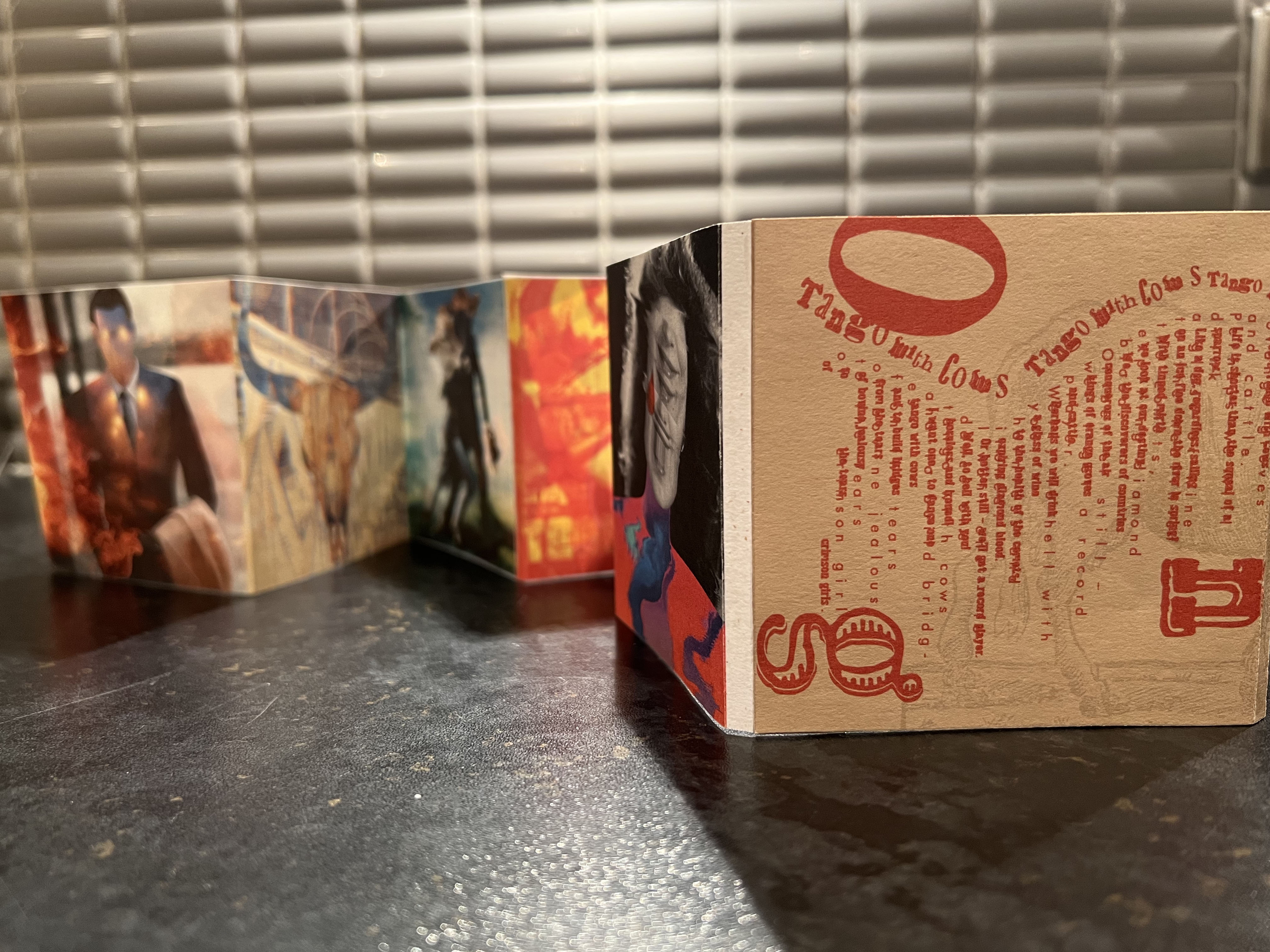
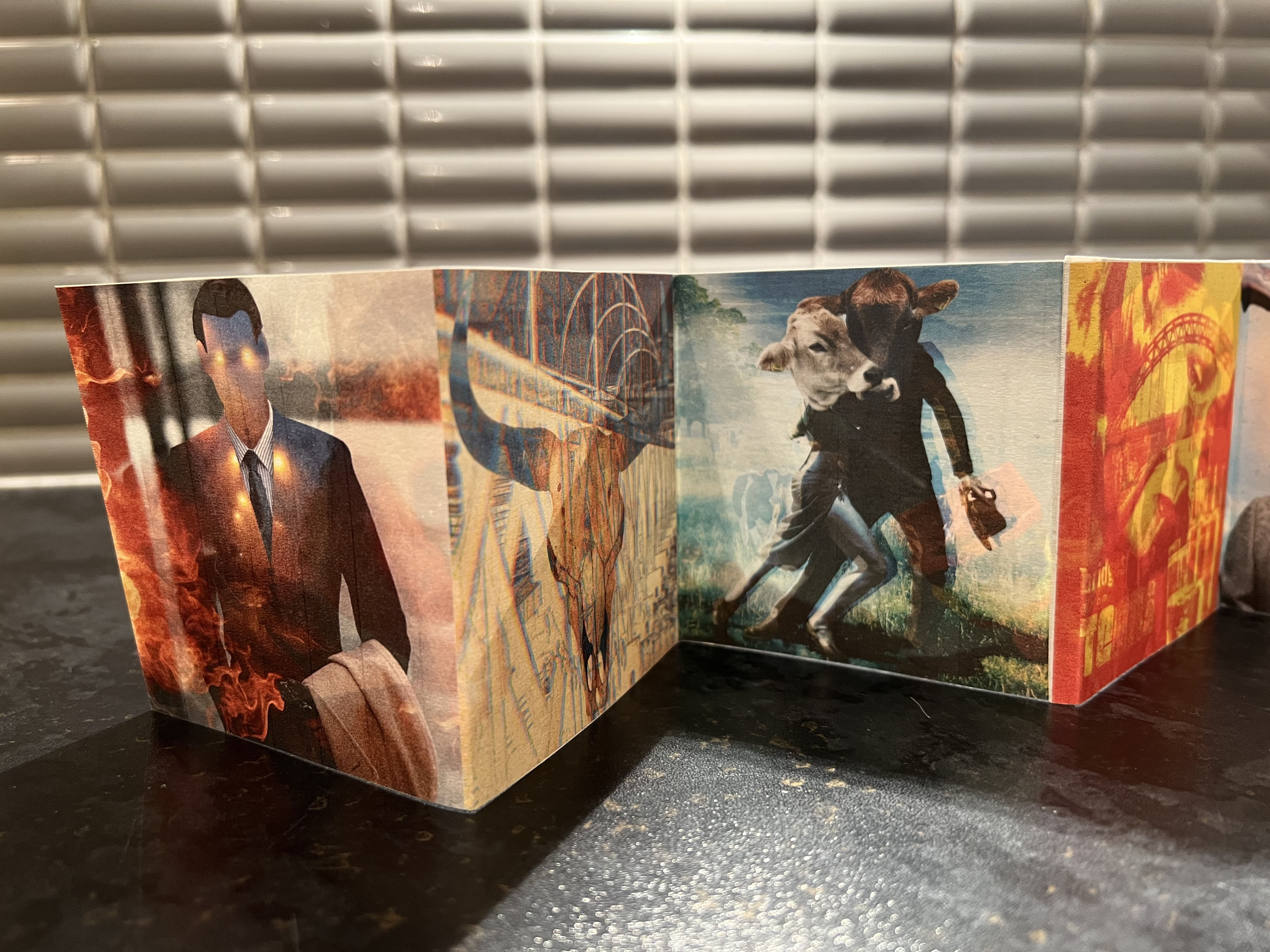
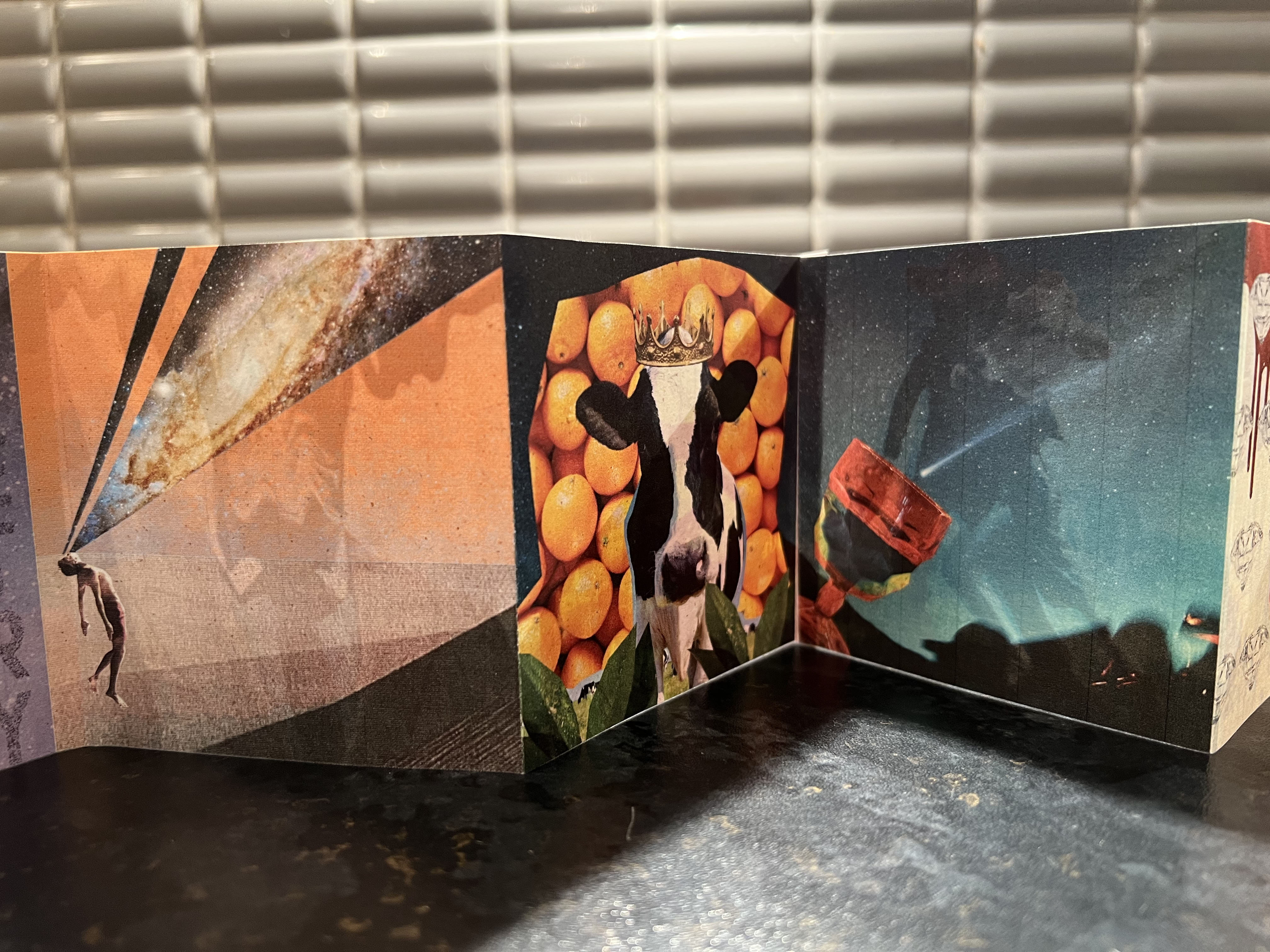
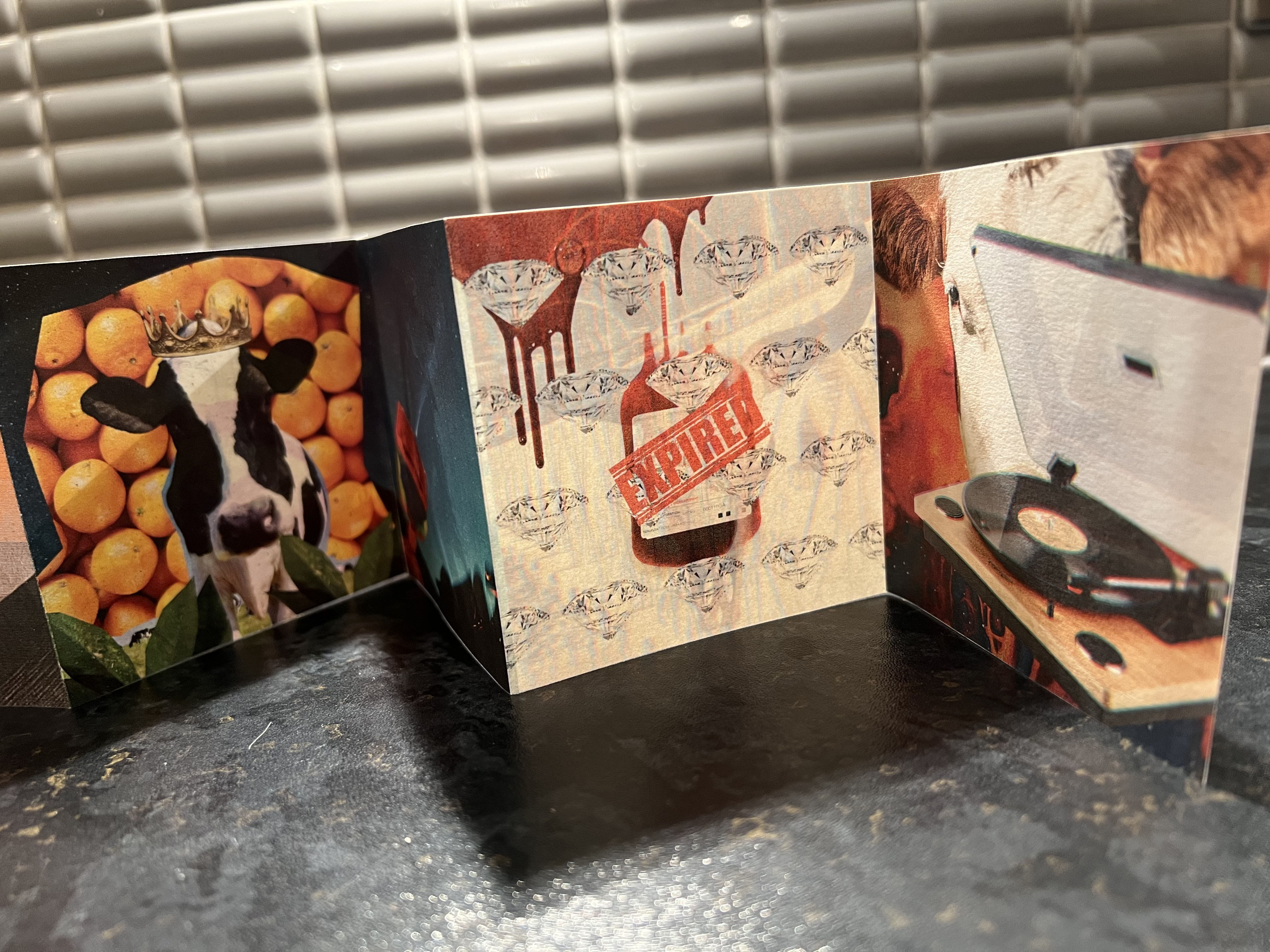
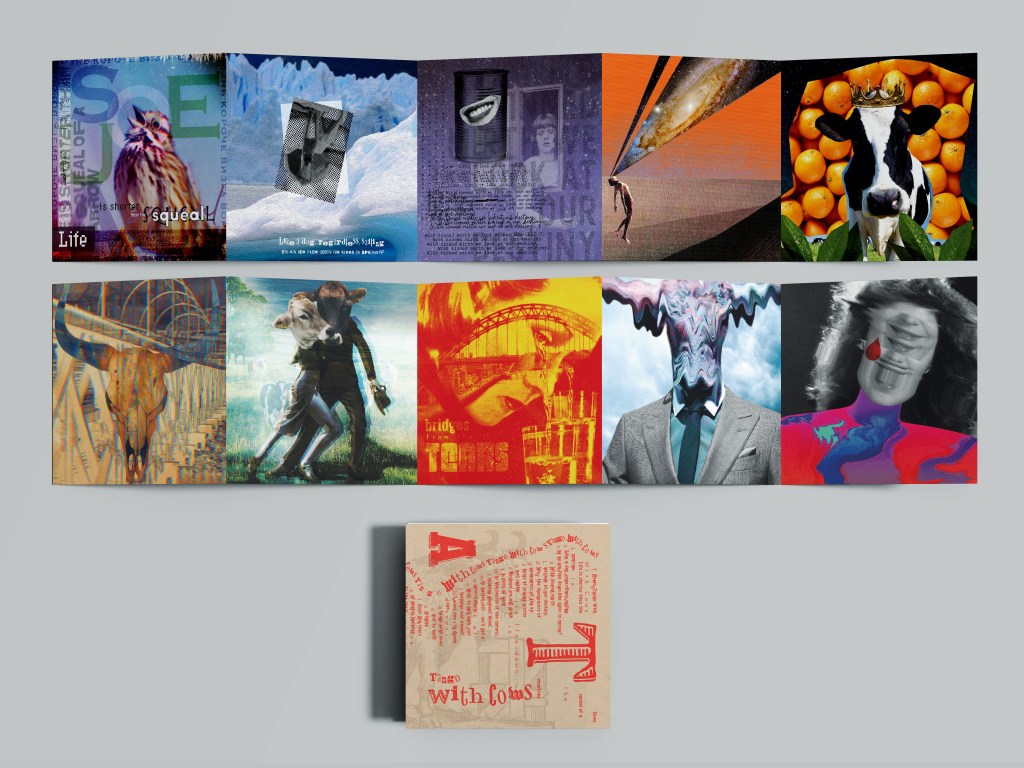
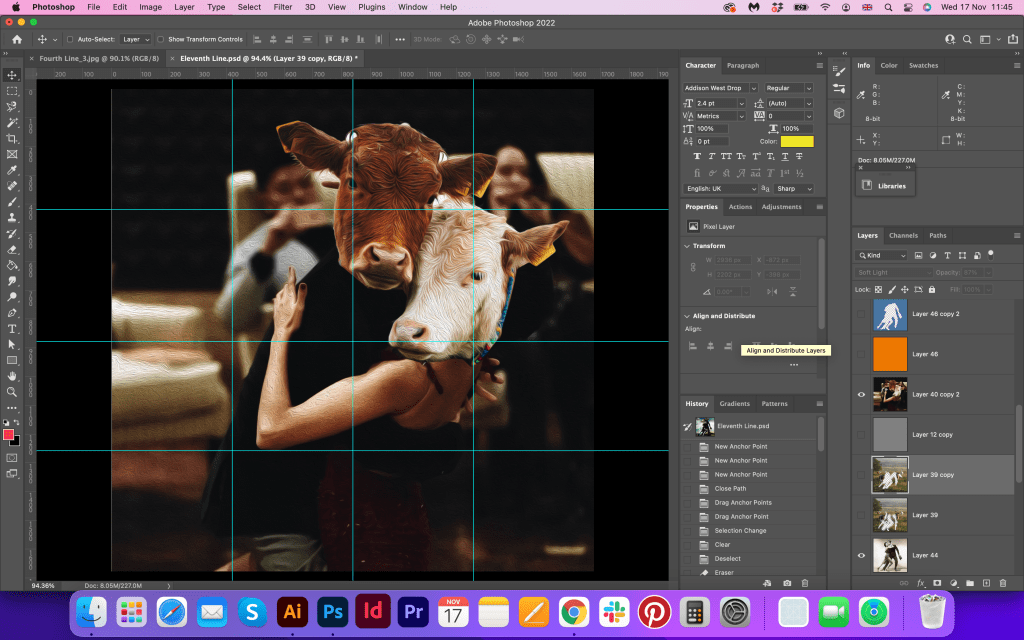
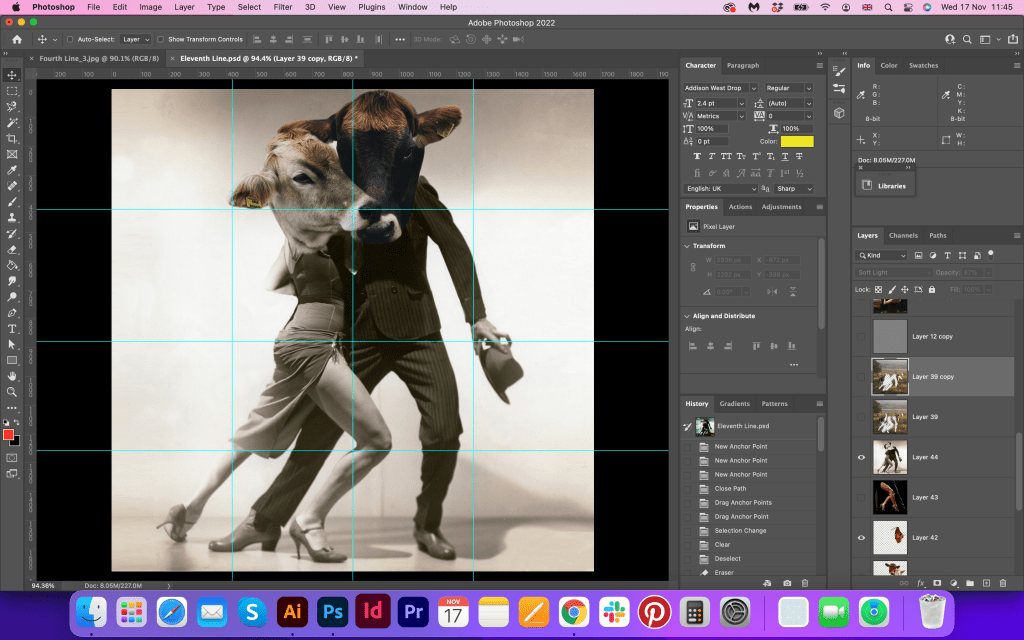
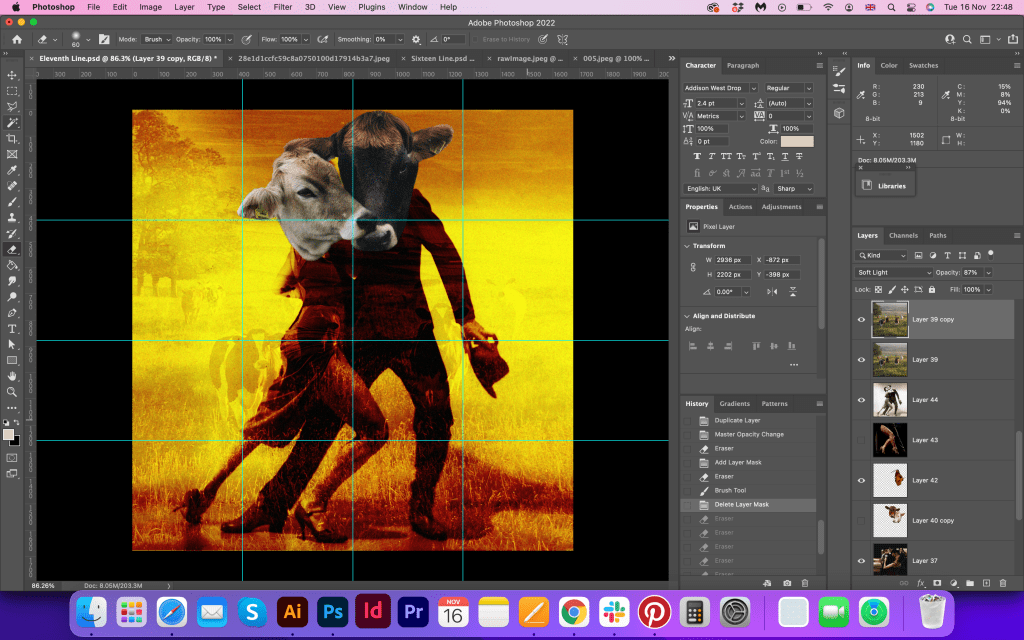
It’s hard to say what exercise or assignment was my favourite, but going from the experience of the Core Concept Unit, closer to the middle or to the end of the course, works are becoming progressively stronger, as they have collaborative experience from the previous knowledge and researches. I would say, that my favourite work was from the third part A little book of good/bad typography. Those works contain my personal taste and contrast of neatness and creativity. I loved the exercise Tango with Cows, where I explored concrete poetry and created sequences images based on the selection of papers from paper manufacturers.

Do you enjoy the creative freedom of working with your own text and images from scratch, or do you prefer working with text and images that are provided to you?

OCA

Here we learnt both ways of creating our own images from scratch, like the Altered Book assignment and designing visuals based on them, and working based on the brief where we had narrative or wording provided by the course. Before this Creative Book Design Unit, I was quite confident that I prefer to work based on a particular brief, a good example is a Tango with Cows, where I was concentrated on designs, and their creativity based on the wording. But, at the same time, exploring assignments from the third part A little book of good/bad typography, and assignment one My Zine taught me that creating my own content could be even more exciting and fascinating than I thought. Of course, it is more time-consuming, requires more research on what subject I need to concentrate on, but at the same time it’s a good learning process, and by doing that I’m investigating new areas of the creative content making process. What I liked the most about this Unit is the opportunity to work both with digital layouts and experiments with hand-made, and work physically with the texture and papers. I discovered a new role, like a scientist in the field I’m familiar with. 

Do you prefer working in a ‘hands-on’ way, physically manipulating paper and materials, or do you prefer working digitally, laying out the pages and page elements on-screen?

OCA

As I mentioned before, here we learnt how to get out of the comfort zone, get there and explore. Going from my experience, where I only had an opportunity to use digital materials, all my designs were based on images found online. But here I found new ways of creating personalised designs, by physically manipulating paper and materials, like Altered book assignments, or creating collages like for Exercise 3: Alternative publications. The good thing about it is I could see that those hand-made visuals had a good potential to be used in designs, however, I would possibly say that my strongest point is the digital design, as here I can manipulate images so much, create different textures and juxtaposition, and completely strip back the original image, so I would say it’s practically creating personal touch.

Which of the subjects covered in this unit have interested and engaged you?

OCA

Contextualisation: Researching designs and designers. This part of the unit is predominantly was oriented toward the expansion of the knowledge and learning the theoretical part of the design and art. I could see it through exercises such as My zine, Alternative Publications, Book Terminology and Book designers that they taught us to how to follow the path and experience of artists for the purpose of generating our personal thoughts. I loved the fact, that I did some research about Fibonacci Series, Golden Ration and Modulor theory. As for me, that is time spent with a great purpose, and I already see some positive impact from those studying on the level of my works. I think this is the knowledge that always stays within the career of a graphic designer for the future.

Typography: Principles and experimentation. In my opinion, typography is a fundamental part of graphic designers. I remember, from my experience, the type usually played a secondary role in designs. The rule was to make sure that the font is readable, and the headers are highlighted enough to grab attention, but overall the typography part is considered to be not valued enough amongst designers nowadays. However, in this unit, I learnt that typography can be an individual segment for exploration; as it keeps within itself a great spectrum of researches and experiments, such as handmade font, decorative typography, play with the shape and form of the font. Type can be used as a visual as well, or some posters purely based on typography and fonts. Going back to the previous unit of the Core Concepts I remember the whole assignment dedicated to font development, which was quite successful for me, and in this unit, I would like to pursue again some experiments, and design books based on typography exploration. itself a great spectrum of researches and experiments. Type can be used as a visual as well, or there are posters that are purely based on typography and fonts. Going back to the previous unit of the Core Concepts I remember the whole assignment dedicated to font development, which was quite successful for me, and in this unit, I would like to pursue again some analyses with typography experiments and discover new methods of generating typography visuals.

Colour: Colour management and working with images. In this unit I think we spent less time exploring colours and their properties, there were some exercises like Tango with Cows we explored the connection of the images to the narrative. At the same time, exercise with sequencing images was a good example of colour spread amongst the brochure, I saw how important was to keep colour coherence between those visuals. Also, explores on the Little Book of… gave me some ideas of colour decisions that to bring the message in connection of the text and colour spread, like a green brochure for the bad typography, and a red brochure for the good typography brochure. I think colour choice and creative visuals like collages and juxtaposition will always play important role in my designs.

Paper: Properties and qualities. I loved collecting paper samples from manufacturers companies and learning the individual qualities of each sheet. But I think with the rise of recycling and reuse awareness there were created new movements and era of recycled materials for printing. More and more companies every day go on the side of the digital versions, where all materials are provided in the online form. I would still try to push different textures and coloured papers for the purpose of creating unique designs, as we did with Paper Ephemera tasks, and Tango with Cows exercise where I used different pieces of paper in one brochure, but it’s difficult to say, whether all companies will be ready for additional costs in terms of providing high-quality papers for the simple printing. If it will be luxury brands, I would definitely pursue expensive pieces of paper, but if there will be simple brochures, the designers should go for the option with the most accessible option in terms of expenses.

Printing and bookbinding: Processes – traditional, digital. This is a technical part of graphic design, that is usually discussed with manufacturers and printers. The designer can always do proof print at home or in the office, but the final print is provided by printing houses. It’s good to learn about it and be aware of some specifications for the improvement of skills, but I can’t imagine it could be something I’m interested in.

My Zine

This assignment was an introduction to the Unit, where I explored a new area of creating collages and fanzines from the materials I collected, like magazines, brochures, etc. This exercise was quite a surprise for me, as I could see that collective work from physical prints and Photoshop can create a new product. I think this knowledge I could easily use in real practice and create unique materials according to the brief. Also, I found out for myself that creating the content could be quite an exciting part of the creative process, its obviously more time consuming, but the brochure is me as an individual, and it has some personal thoughts and examines.

Assignment 2: Form and function

These Robinson Crouse jackets were the very first book covers I ever designed. I enjoyed this part of the design process, I analysed lots of other book covers and went into the full history of this book design. However, I’m not sure whether that is the direction I would choose for the future. I think that book covers should be so individual and artistic, that to be able to place the product into the market to compete with other companies, it could be quite challenging for most designers, also it is very unique it creates a very specific niche market.

Part 2. Exercise 3: Book designers

This work on the research of different book designers was the most time-consuming. I treated it purely like the learning process and expanding the knowledge. I think, this exercise is all about contextualisation, and learning some experiences from the experts. This type of work could be a good basement for the final assignment, where we could choose the analysis of book designers.

Exercise 3: Experimental typography

This part of the unit was like a new chapter for the learning of experimental fonts. I’m glad that I could learn about it, as those creative ideas helped me to open boundaries. I wish I could experiment more with magnifying glass and stamps, as there is a very wide field for explorations.

My Little book of…

(Typography: Principles and experimentation) (Colour: Colour management and working with images)

Tango with Cows (Colour: Colour management and working with images) Paper: Properties and qualities (Printing and bookbinding: Processes – traditional, digital)

Exercise 4: Printing

In this brief I was asked to print images I created earlier in the course on the samples of papers I collected. Here I need to be spontaneous and experimental, without fear to make mistakes, to get to the point of the creative process. I will need to collect images in JPEG or TIFFs format in the high resolution 300 dpi. I need to create a simple flatplan with the way I want to layout those images, and later organise them in the 16 pages document.
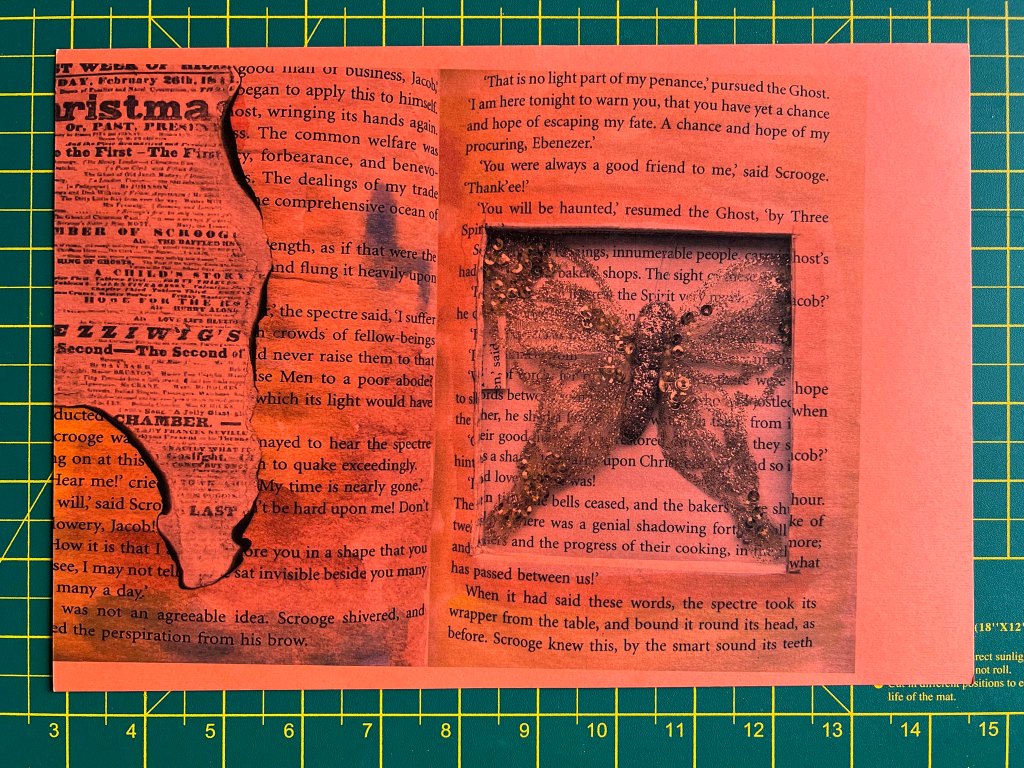
This is one of the final exercises at the end of the course, and another reminder to explore visual ideas and processes, by trying out and experimenting with the materials and ideas to discover new ways of working. I’m thinking of a couple of exercises and assignments to implement into this task. I went to the very beginning of the course and noticed a red thread between my first exercises and the last assignment of the Altered book. It’s quite curious to see the approach I developed for this unit and the similarities in the style and feel of the design. I’ve noticed the same direction images that I could join together to create something new out of them. Your Zine, Experimental typography, My little book of… and Altered Book, those visuals I was going to join together. I organised them all in the same folder in .jpg format, naming them according to the part they belong to.

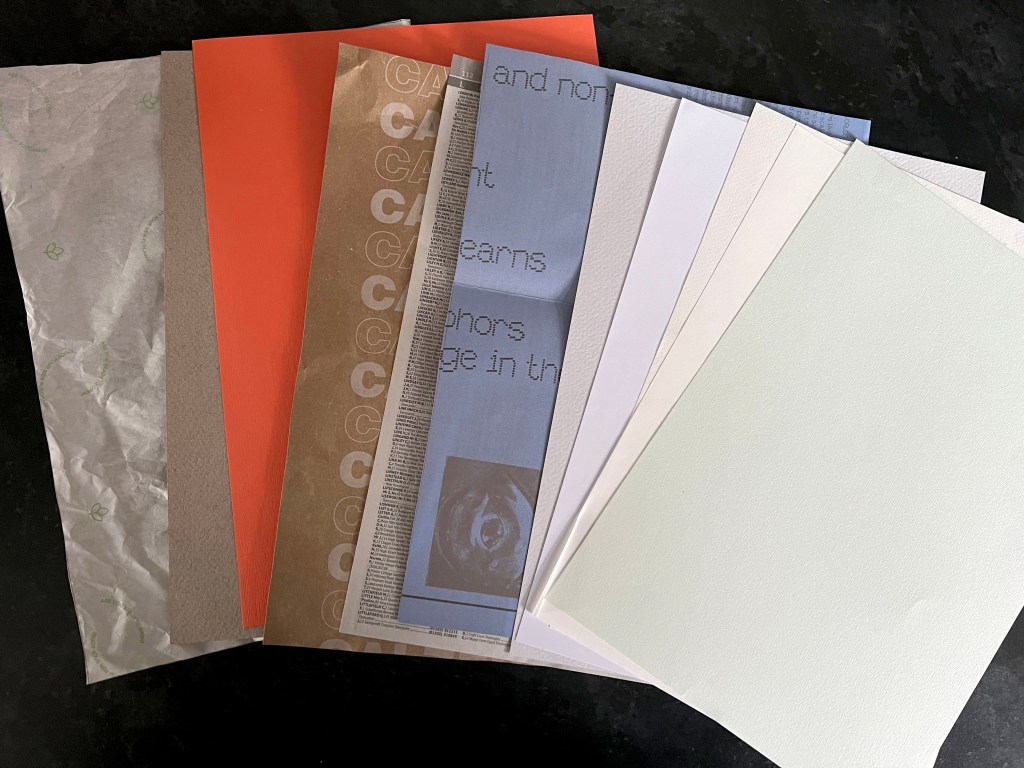
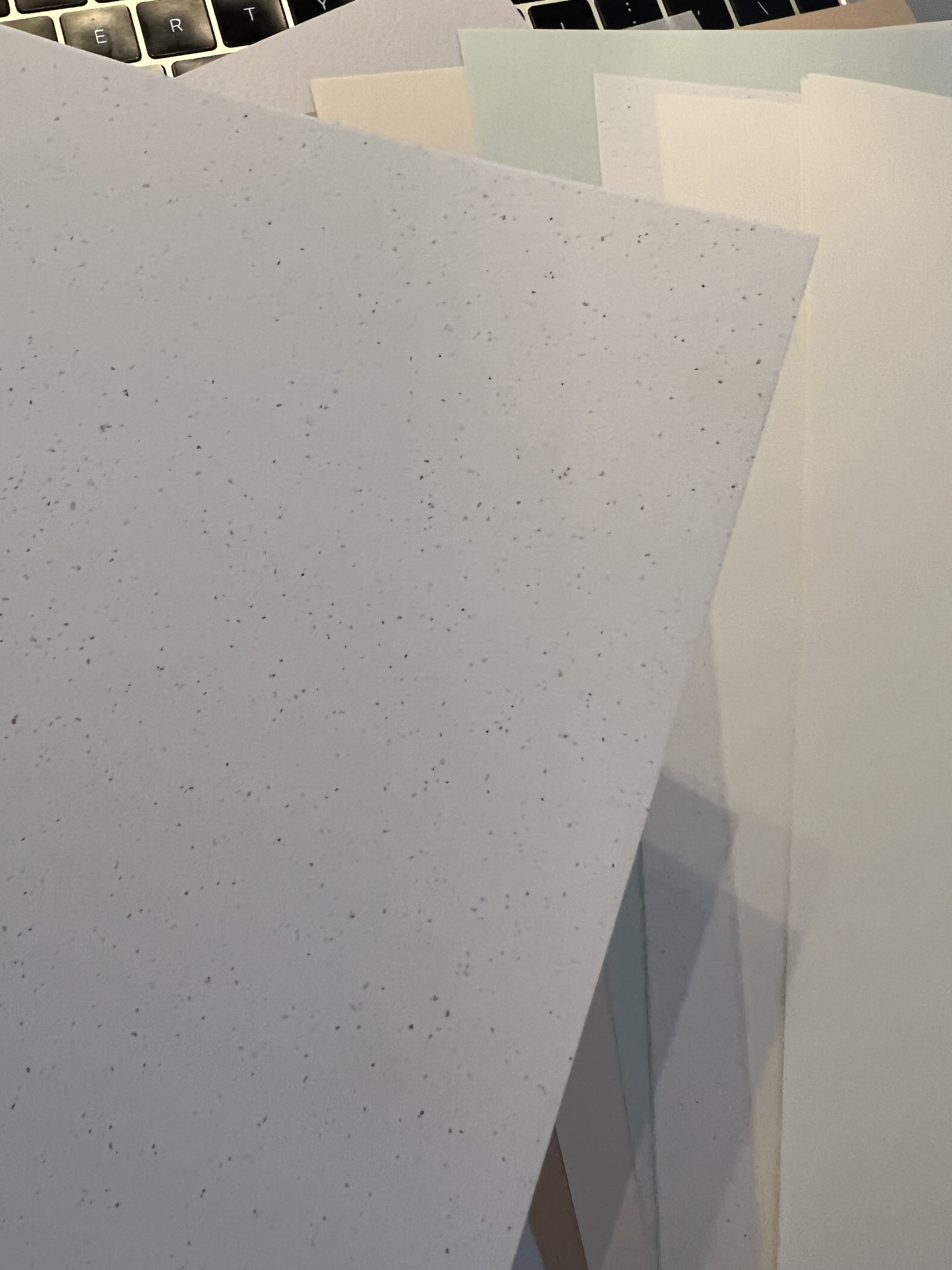
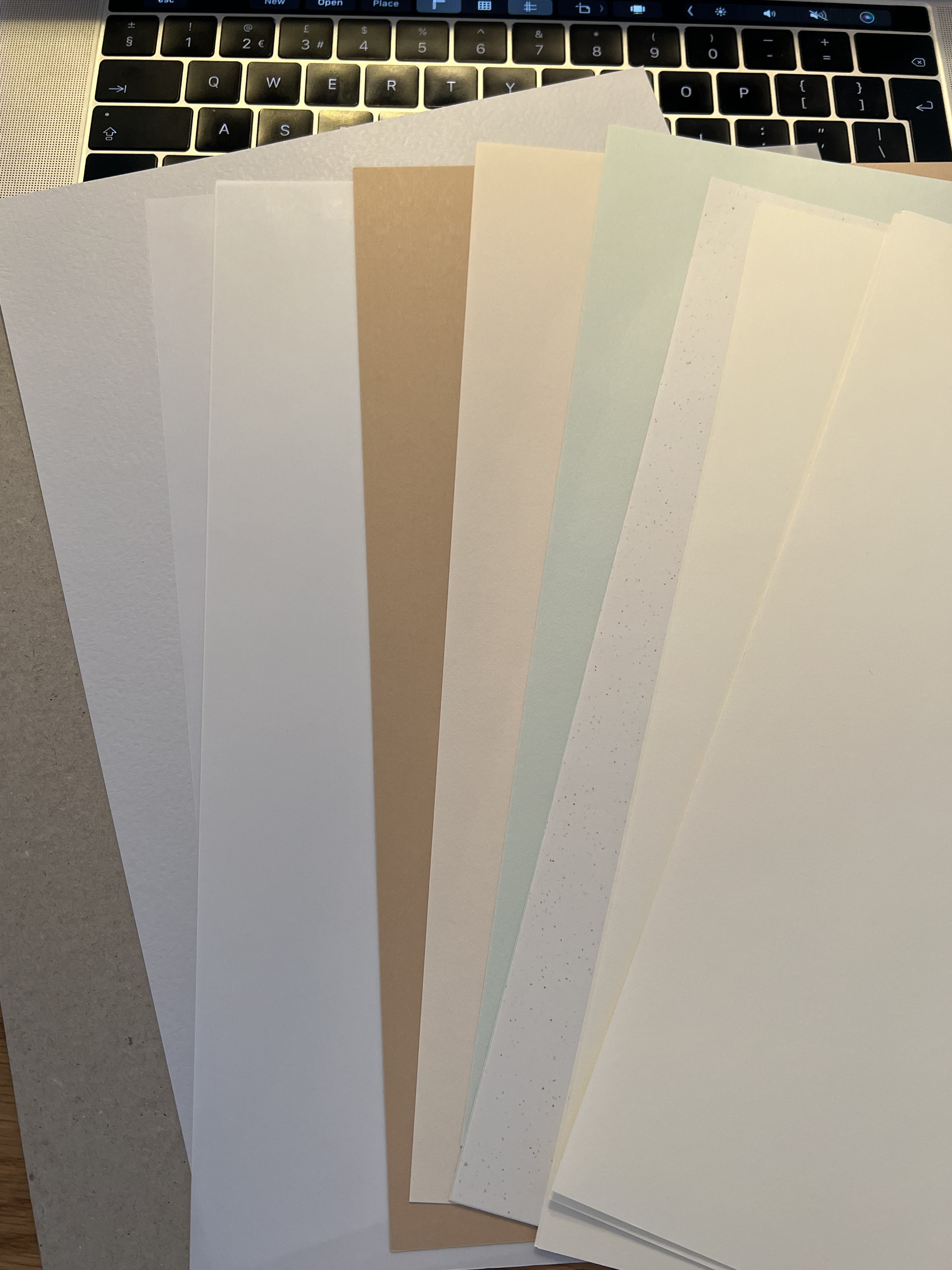
My home print is standard A4 format, so I’m thinking that my booklet is going to be A5 format, so one spread could be printed on one piece of paper. I looked for some papers I have left, as recently I printed so much at the pieces I ordered from various printing companies. I loved experiments I had on those papers, but never tried something different, like wrapping paper or newspaper type of paper, or ECO materials. I might try different papers for the same image. See how it goes. Here are some paper samples I collected.

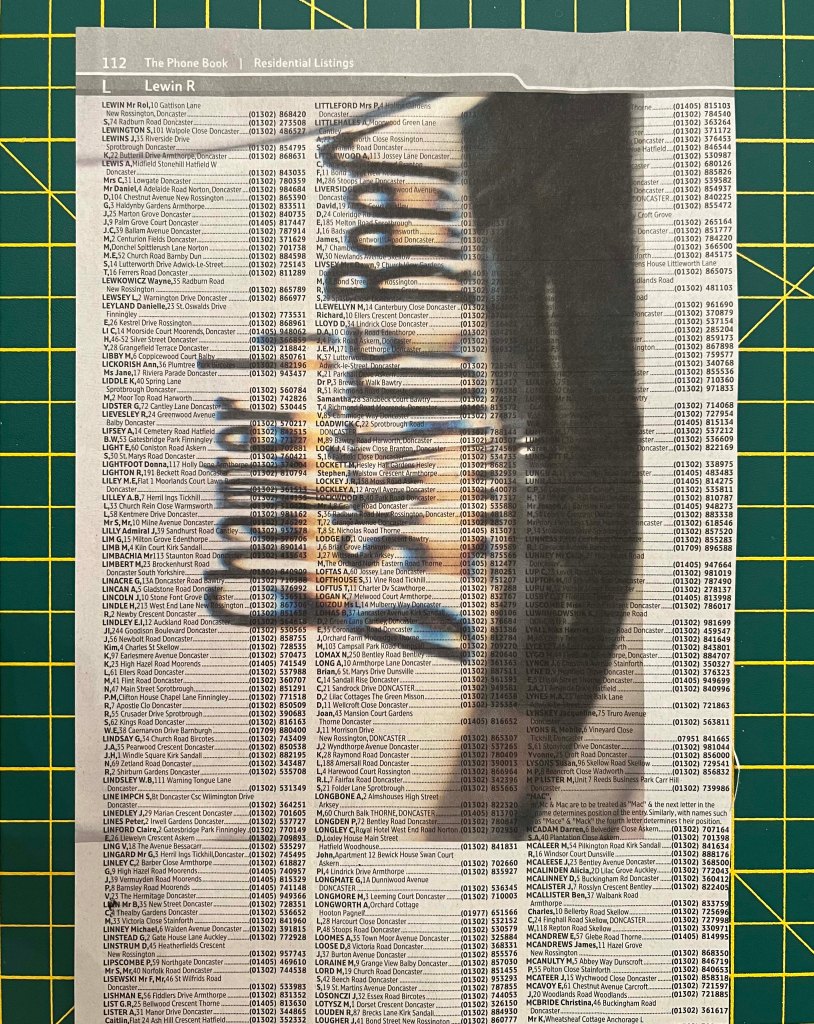
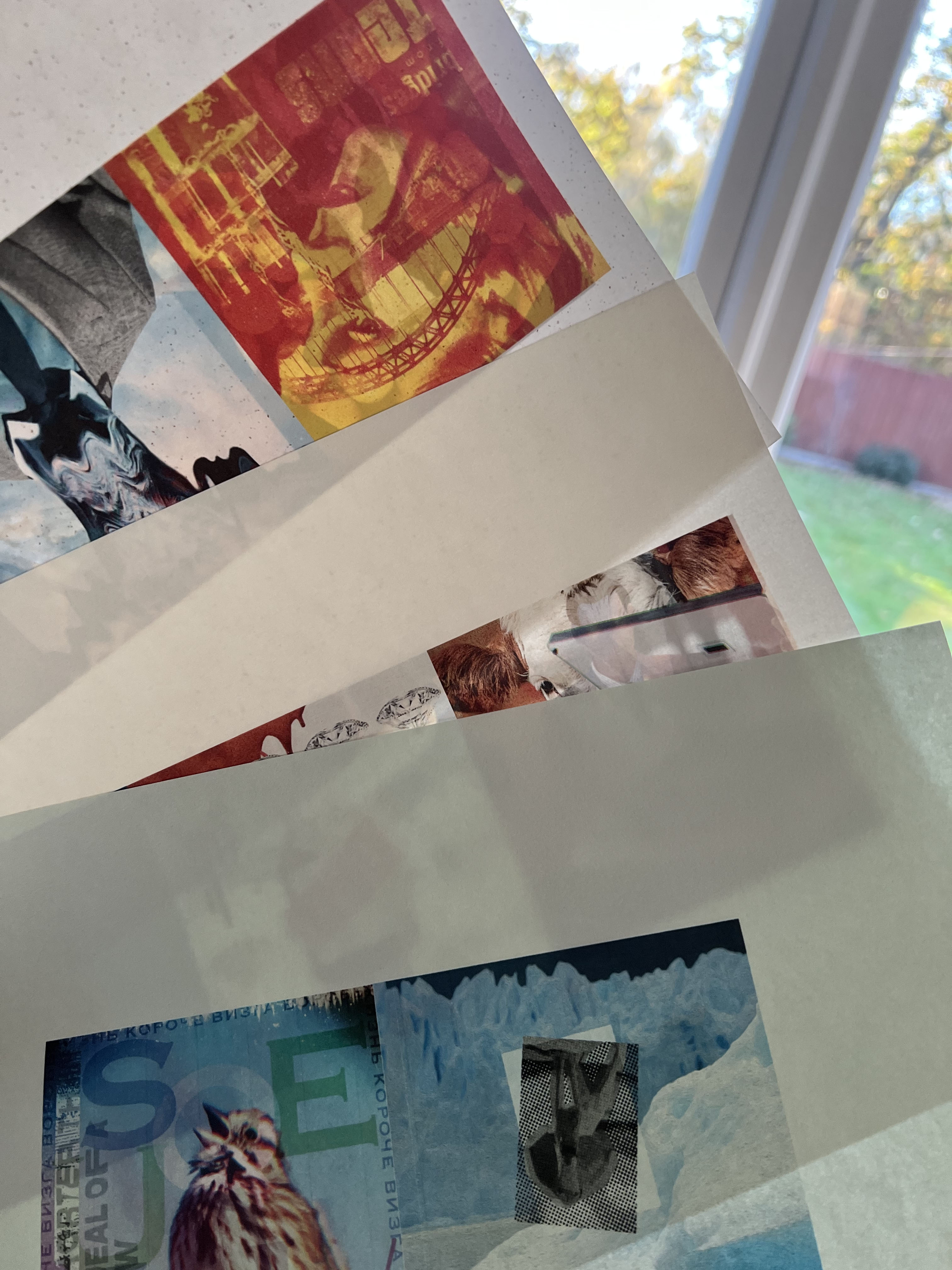
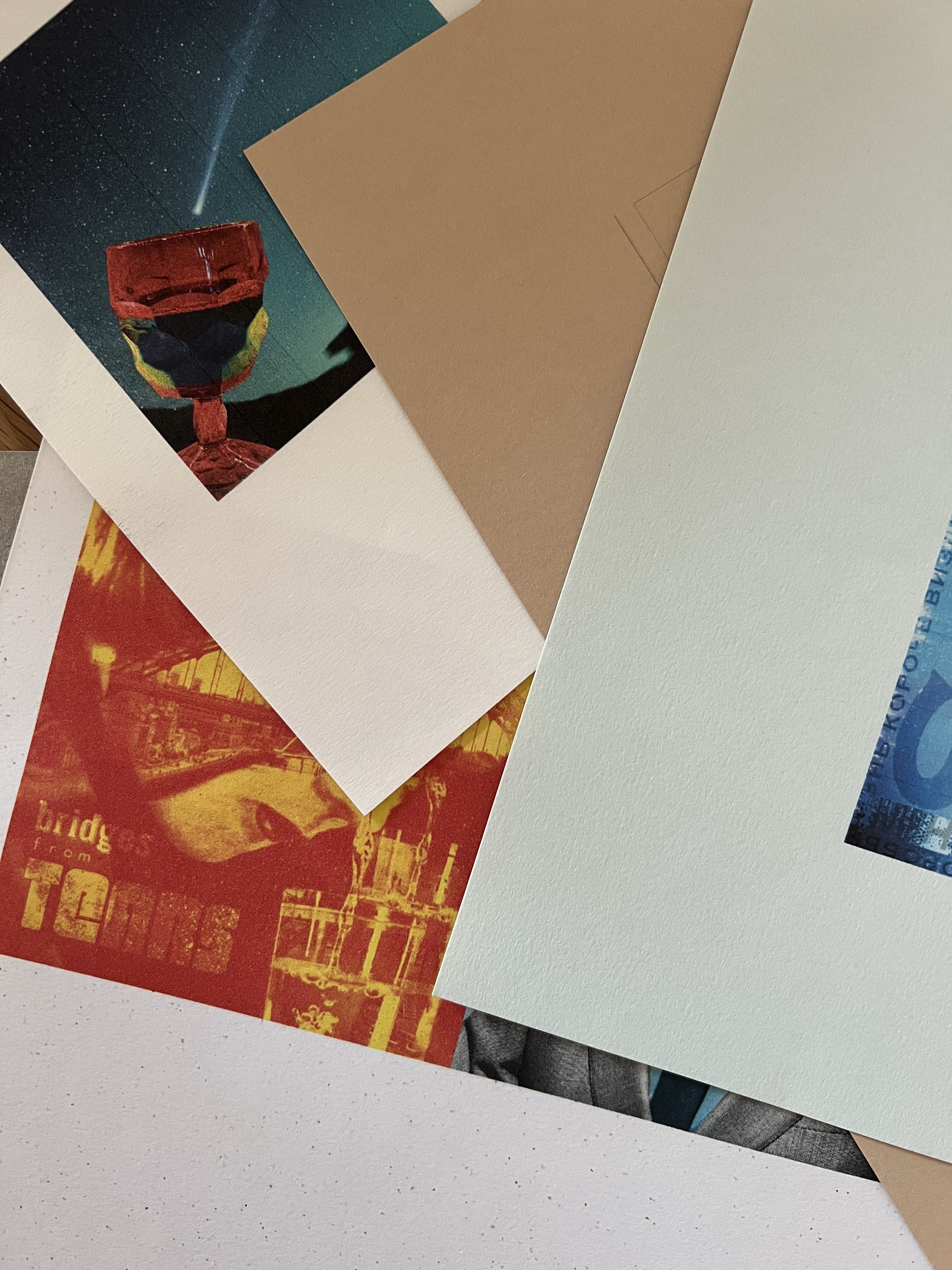
There I had wrapping paper from one of the parcels I ordered recently, some samples of recycled paper, colourful thick orange paper phonebook pages on the very thin transparent paper, violet paper from Exhibition Centre in Rotterdam, and some samples from paper manufacturer companies. Also, in addition, I bought some colourful paper for kids collages. They were not the best quality, as the paper was too thick and a bit glossy for the printer, but I was curious to see what designs will look like on them.

Design

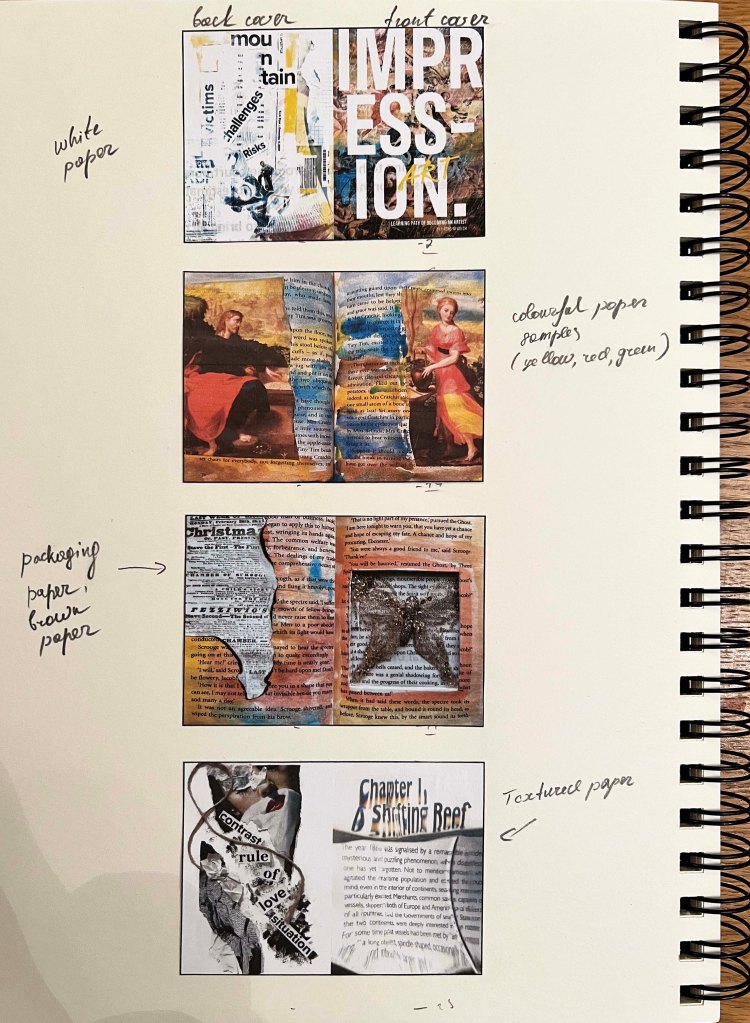
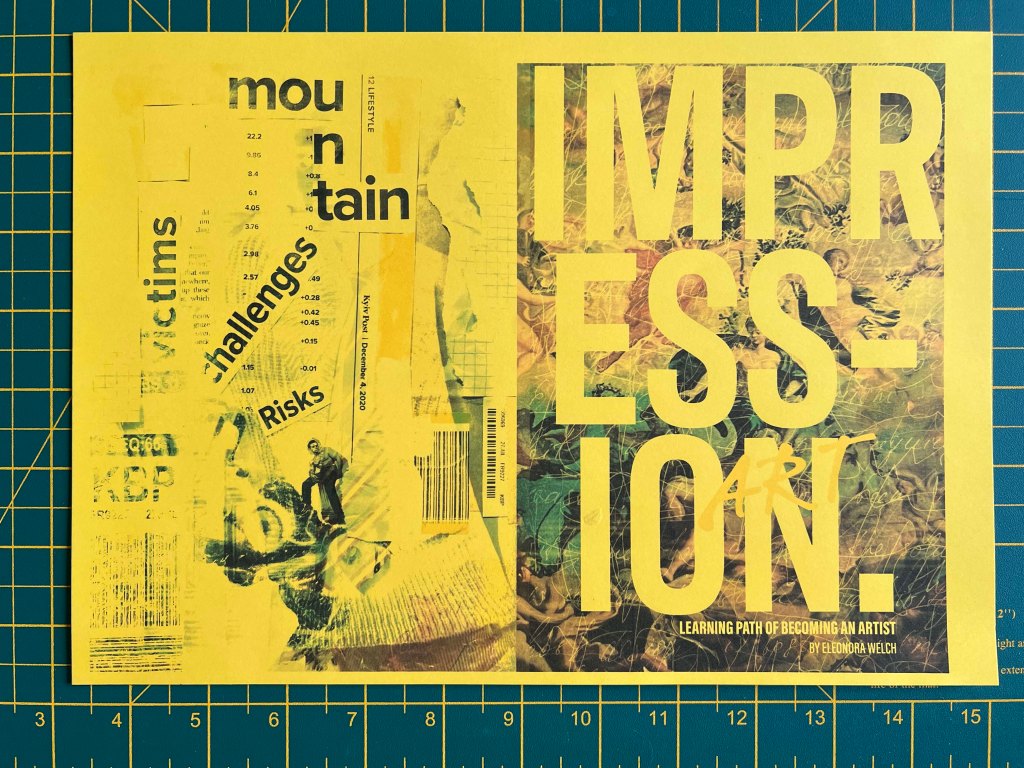
Below I placed the order that I chose for my artworks. I was coming from the idea of my learning process in the Creative Book Design Unit, where I’ve learnt the new direction of artists’ books, experimental typography and fanzines. This combination of art is personal to me, as they reflect new discoveries and observations that I determined during the course. Some of the works I included were hand-made, therefore I thought would be curious to see how they will look when printed at the different paper samples. I didn’t incorporate personalised wordings in the designs, just old messages that were developed according to the individual exercise, but for the front cover, I chose the name of the fanzine ‘Learning path of becoming an artist by Eleonora Welch’, to explain the selection of designs in this brochure. For the first cover, I placed big letters, that to make that page look like the front one, with san-serif letters Impression art I went for the fanzine look brochure and collected all artworks that matched each other visually. Some artworks like from altered books or experimental typography I didn’t see in a printed way, so I thought would be useful to play around with those images on different textured papers, I had some ideas about how to present them. I changed the layout slightly by adding some textures onto them and combining images from different exercises for creating a new one. Below are some of the sketches and full artworks I designed.

My goal was to be experimental, try some different pieces of paper for the same design. I was going to print one spread on the same piece of paper, but I didn’t think through how to create a booklet from them, therefore I had to improvise in the end, as each spread was different paper, and it was quite tricky to join them for the brochure look product. But I will try, as that is an appealing direction, to create a sample from different designs. Before I was aiming for the full coherence, but here I wanted a bit of miss-match, but with a taste.

Reflection on printed samples

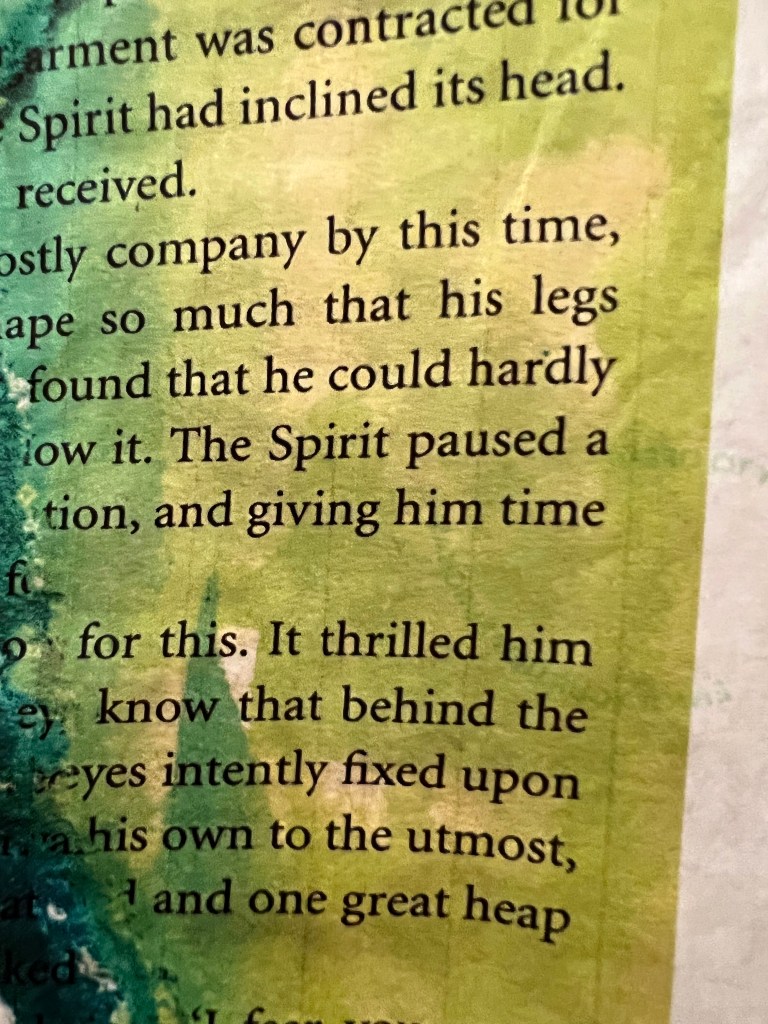
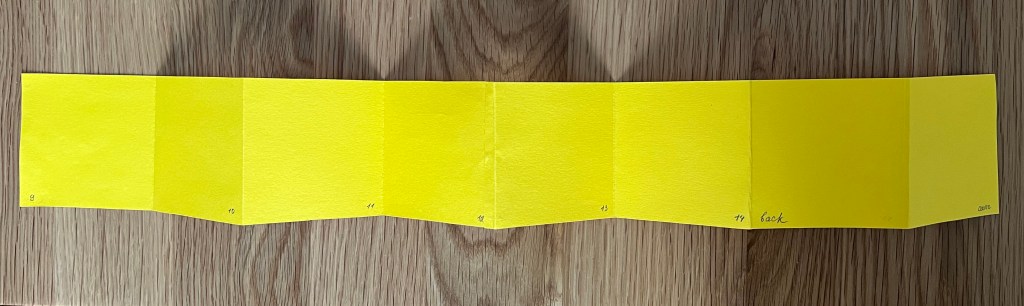
Coloured paper. The front cover page and back cover is printed on a yellow piece of paper. I liked that it was eye-catching and the design worked well on it. I used collages and multiple layers on that design, so they have some fanzine style and are not as straightforward to read, because of the colour of the paper. It looks like the printed failed, but that is the look I was aiming for.

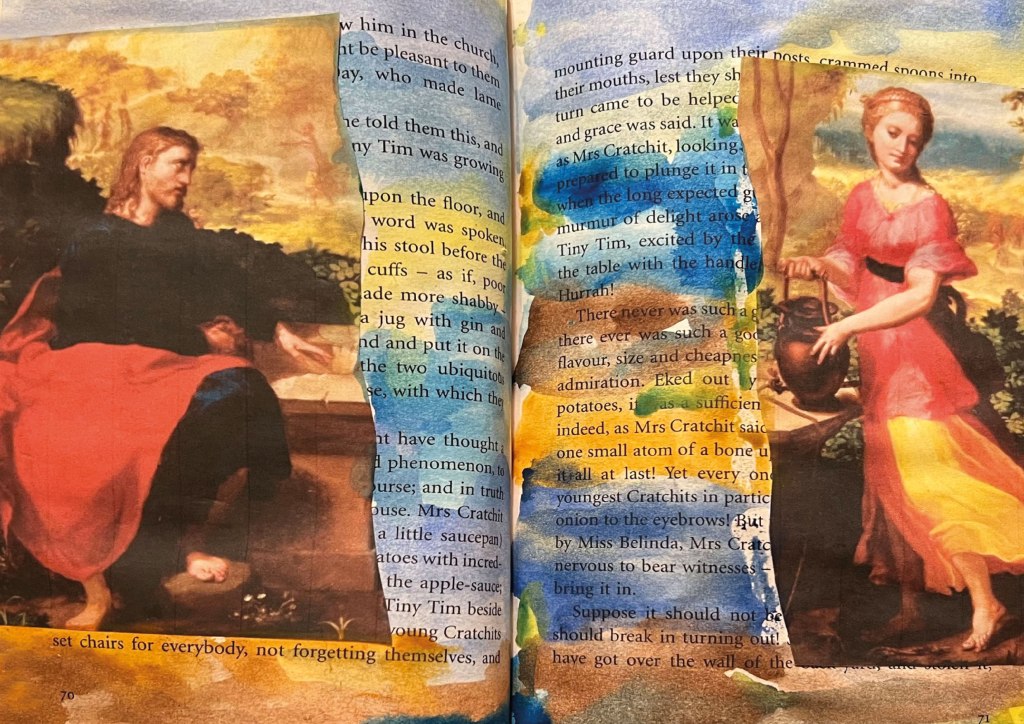
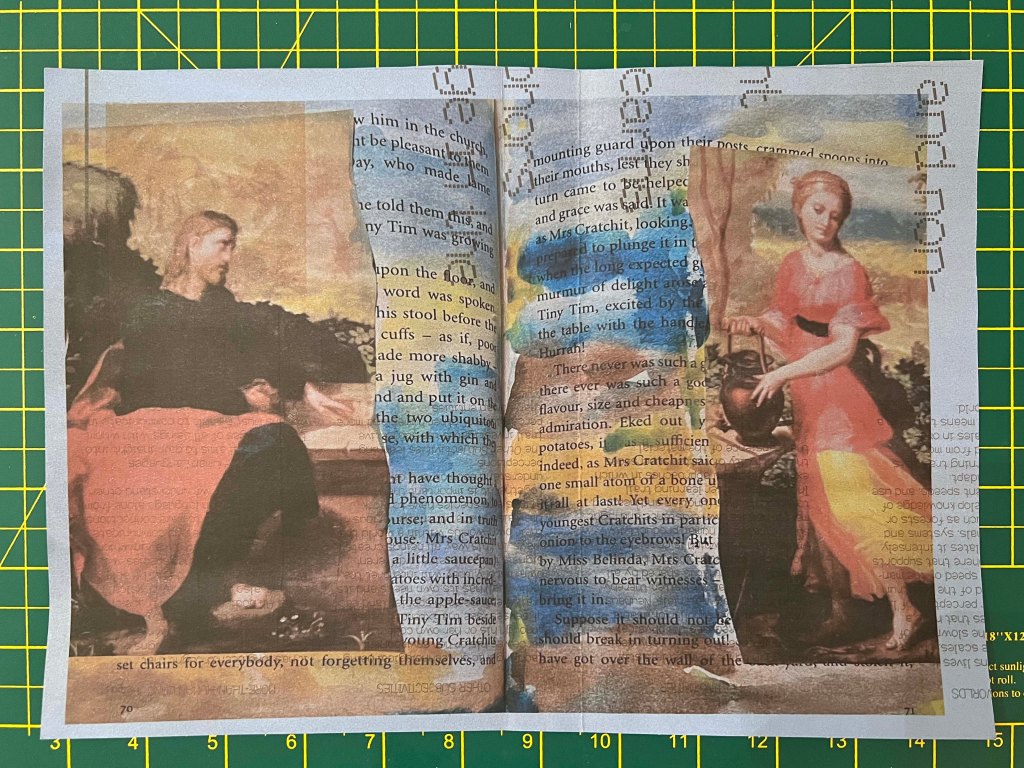
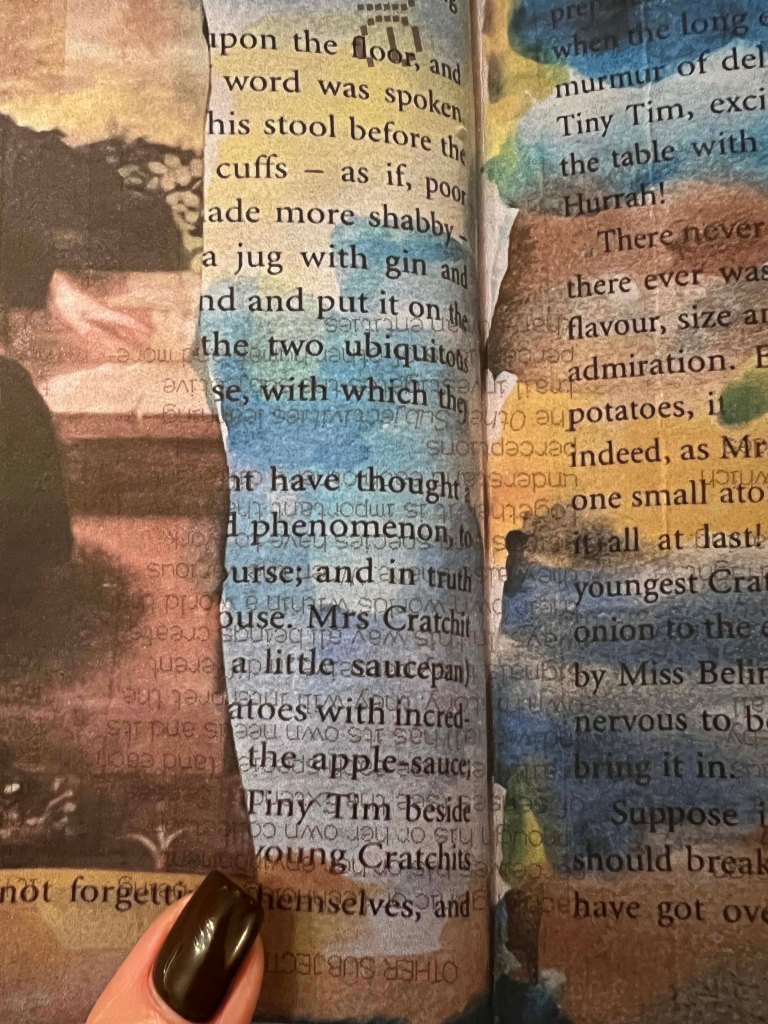
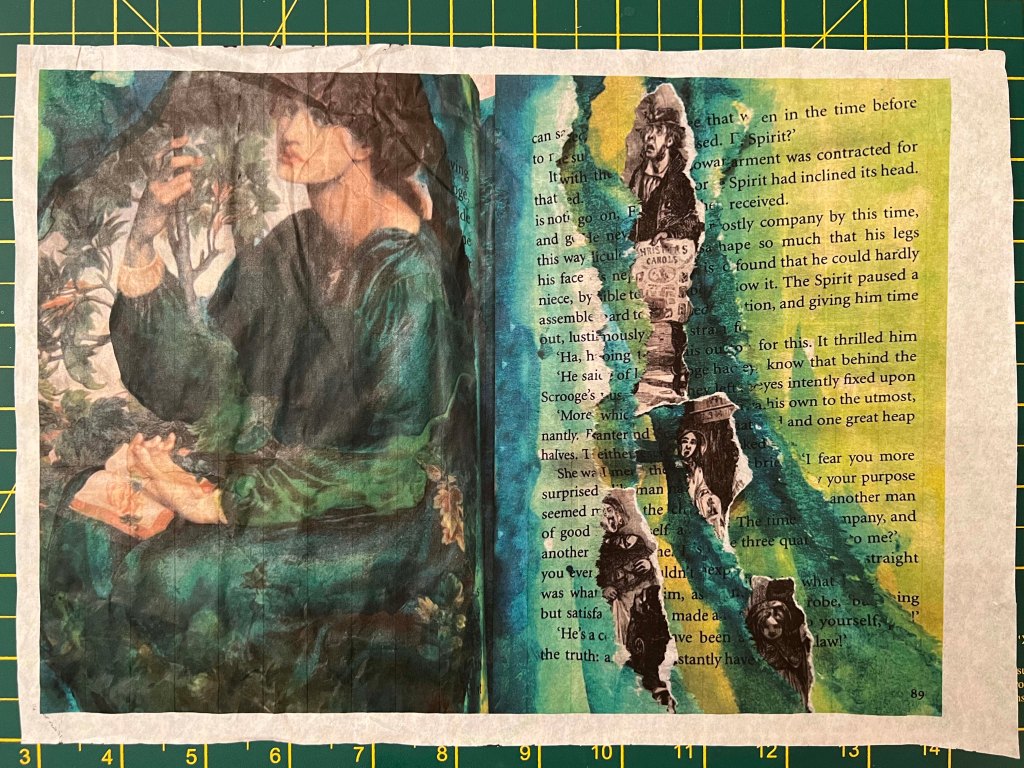
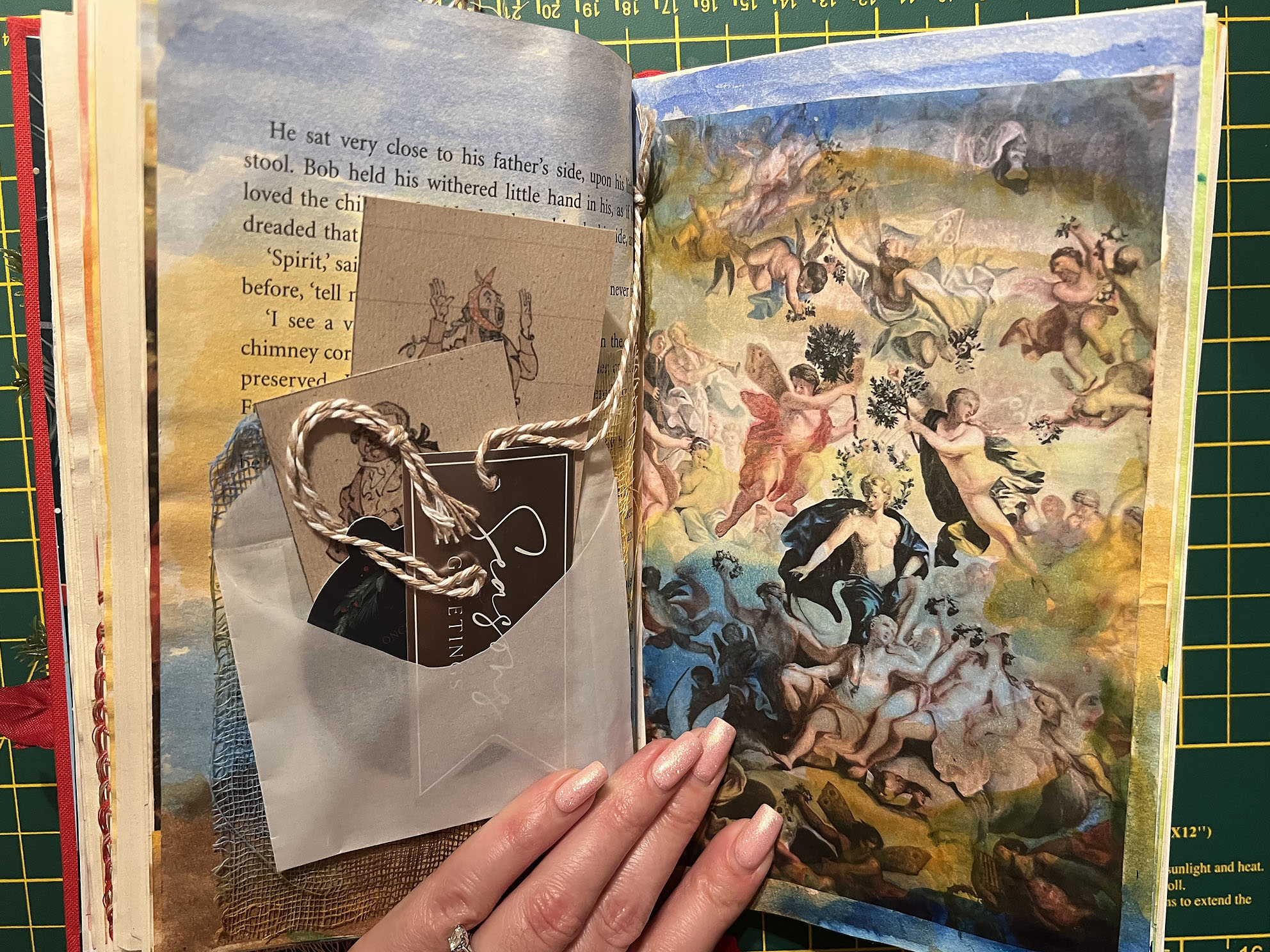
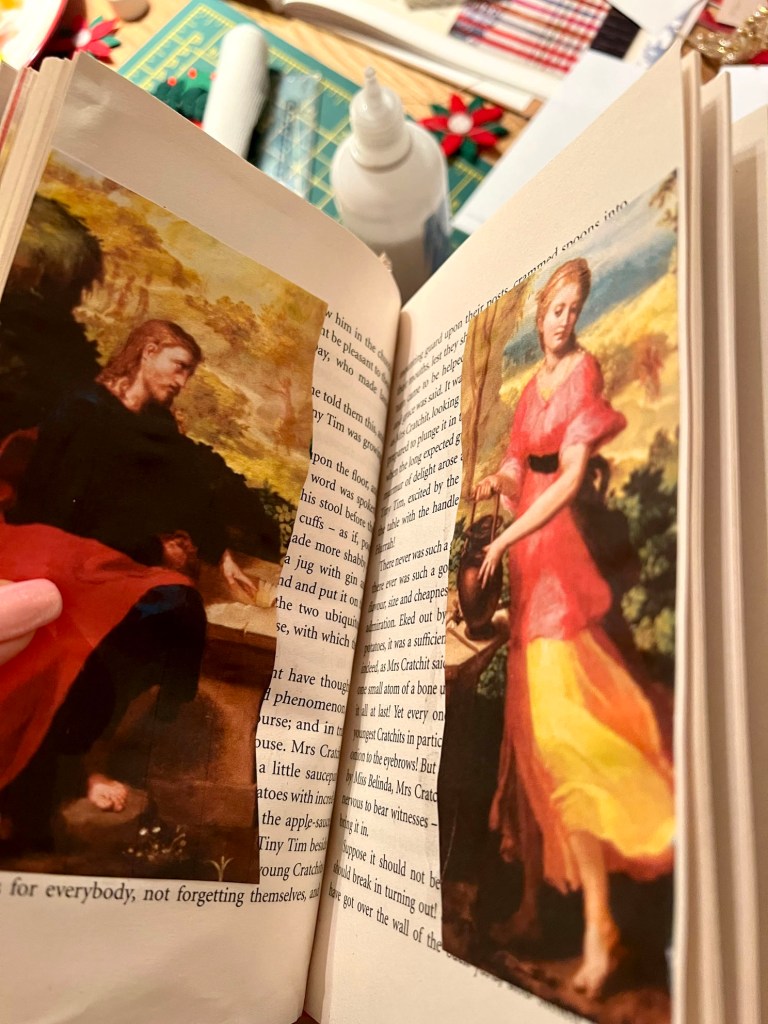
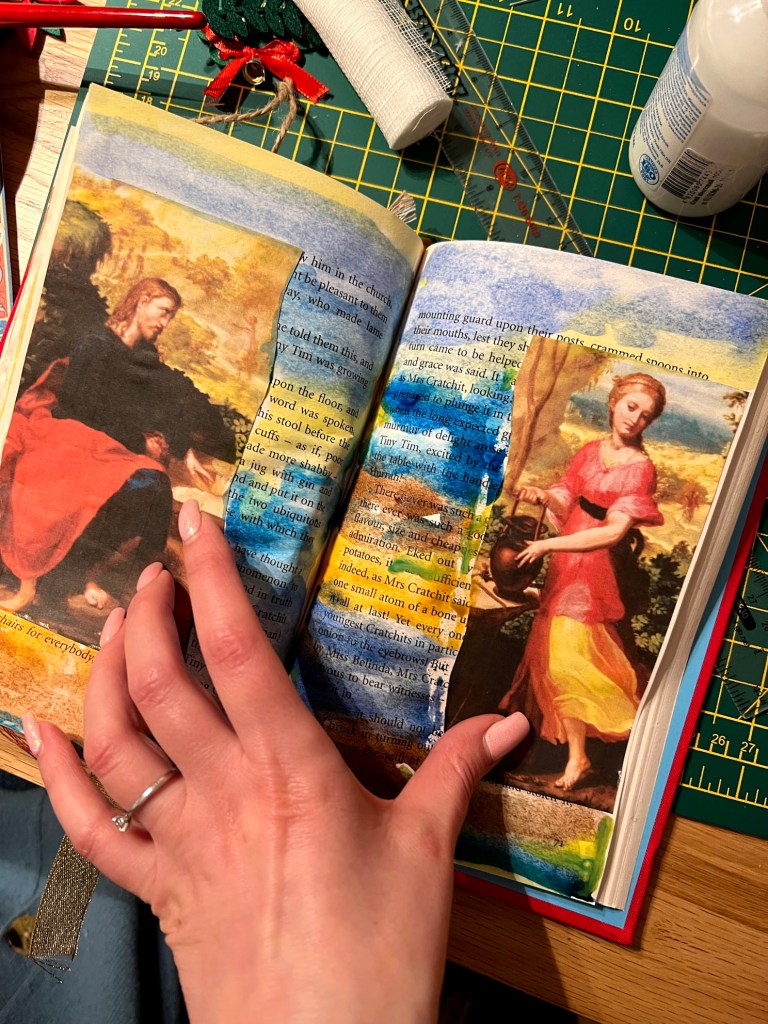
Violet paper from the exhibition centre map. Next spread I printed on the paper violet exhibition centre from Rotterdam. Paper had thin text around, so the printed image overlapped the existing text. I loved the effect, and the colour solution I received in the end. Those digital looking words created juxtaposition with the religious painting, and watercolour had some interesting transparencies on this paper. The paper itself is quite absorbing and have a nice rough feel. I liked the result, I think it was a good starting point. This is the main painting of the exercise, to see for unpredictable solutions.

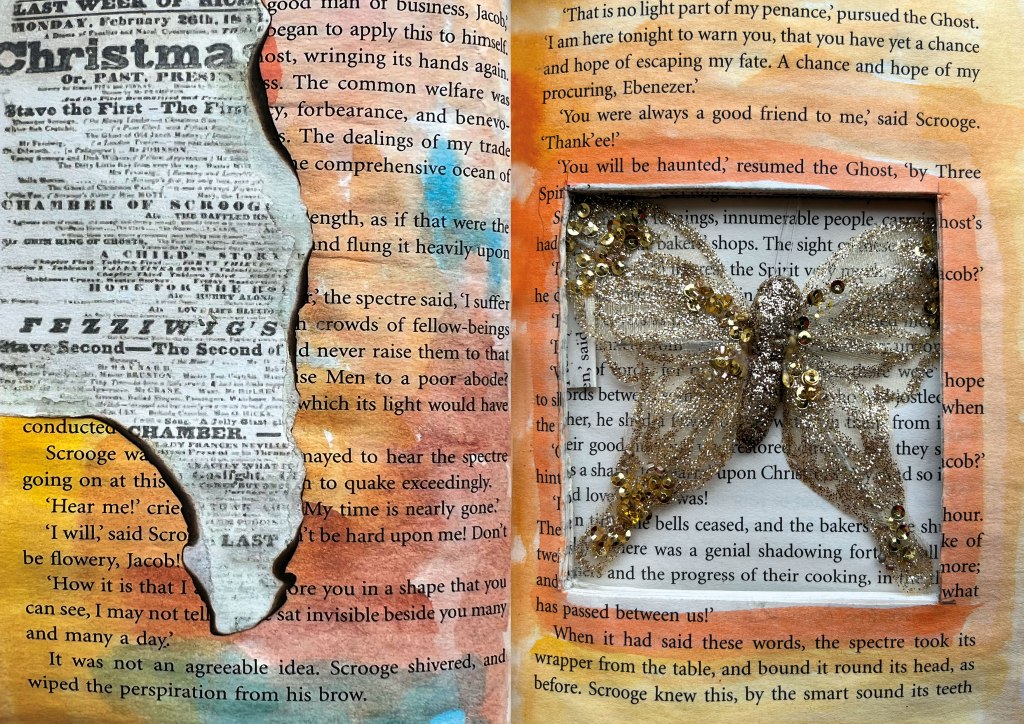
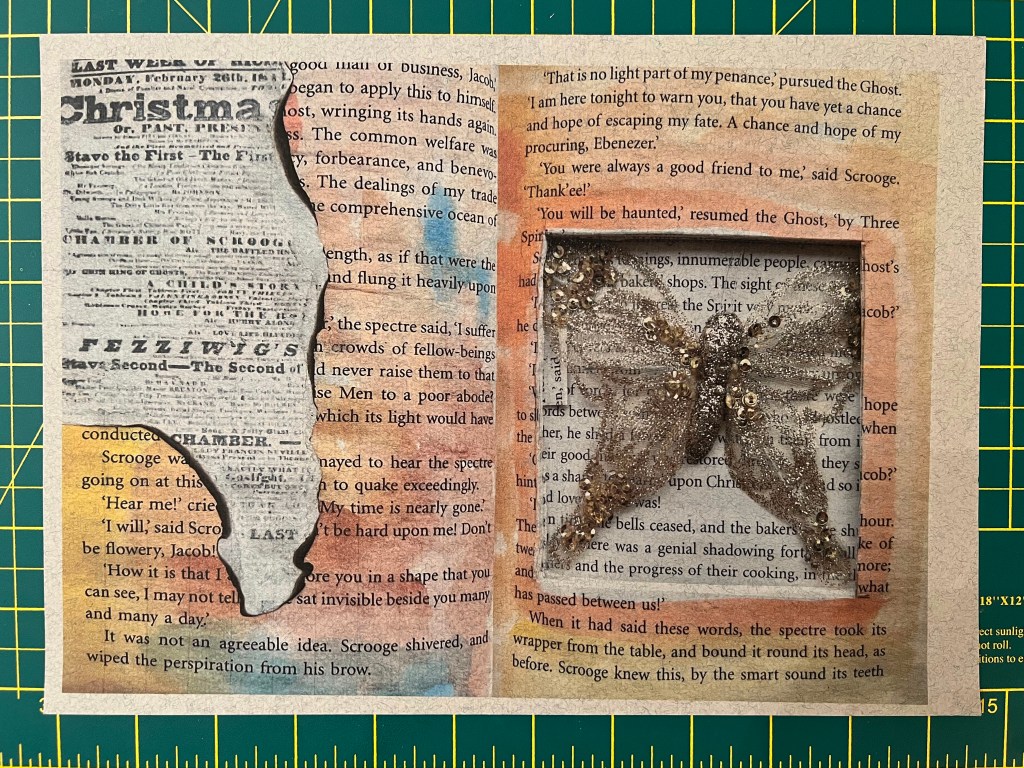
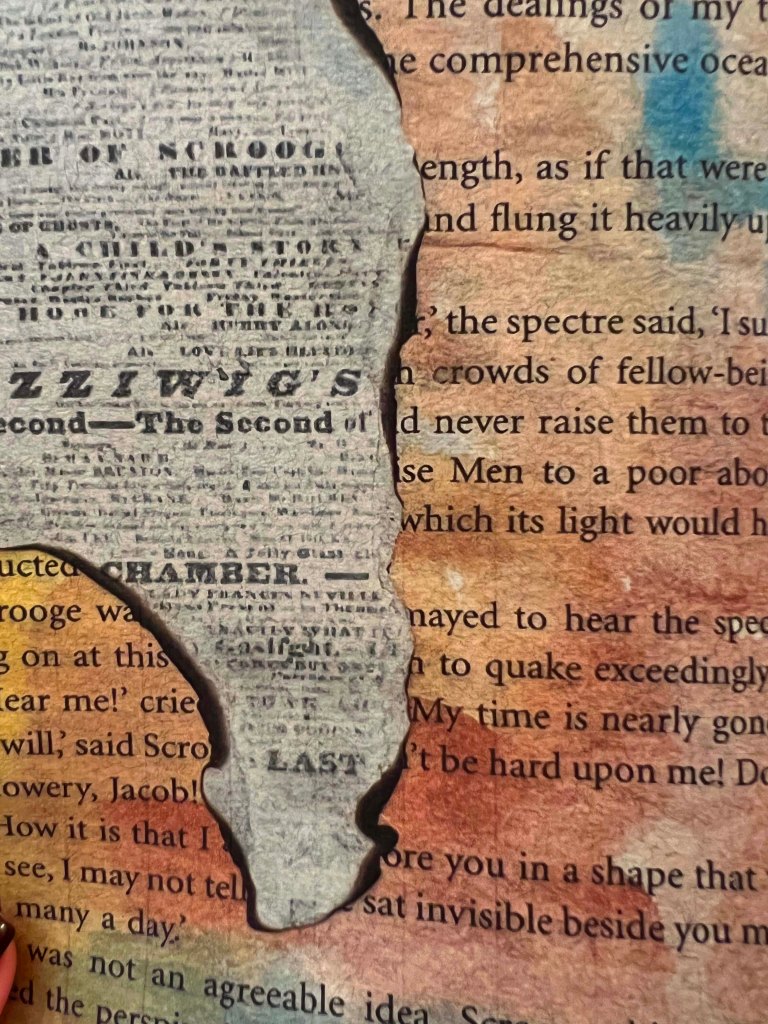
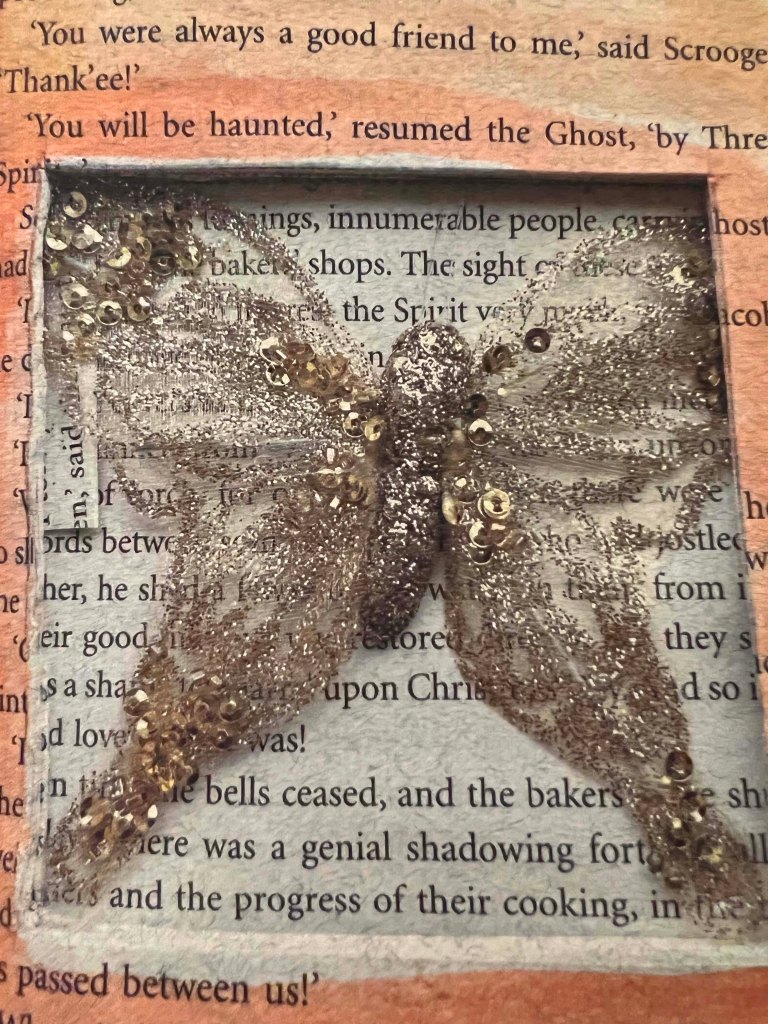
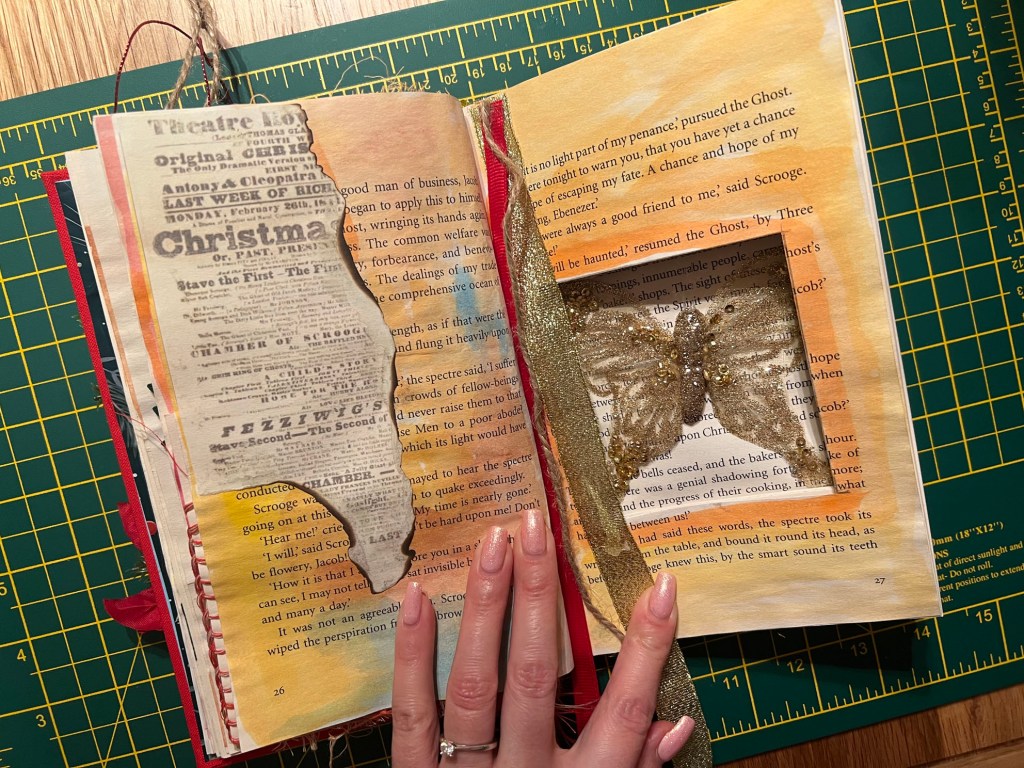
Craft paper. This paper sample I bought from one of the art shops in Kyiv, where they have all kinds of papers for craft and design. This dull-coloured paper brought a vintage feel into the design, also, it has lined texture, which surprisingly was surely printed though. I was astonished at how real the spread looked like I was looking at the actual book with the shadows and butterfly. I think the paper choice and the spread were quite harmonious together, and it was a good paper to work with.

Orange craft paper. This was an alternative paper print, and it didn’t work the way I expected it. That was similar to the previous piece of paper, with a stripy texture in it. But it absorbed all the colours, and even black contoured images are difficult to see. Not sure whether I’m going to use it for the brochure.

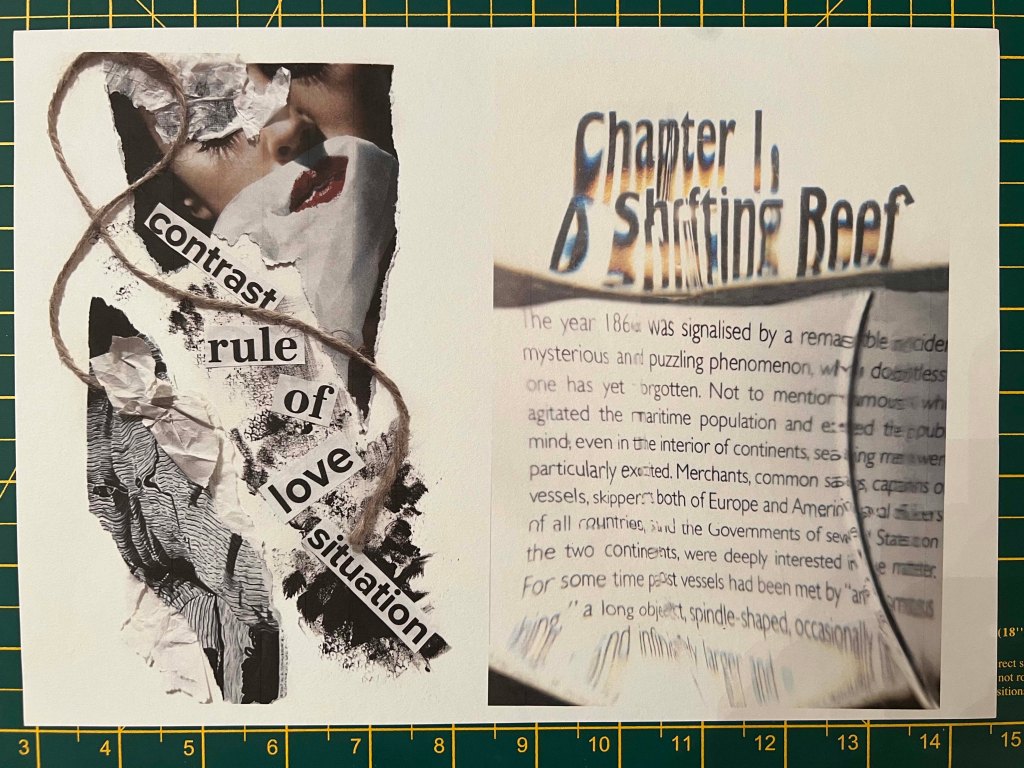
G.F Smith Radiant white paper. This spread I created from two different assignments as well, it was curious to see how they kind of work together and create communication between them. Here I chose textured paper from G.F Smith, it was a safe option to play, as the paper was designed especially for professional prints, but what I liked about it, was those little dents in the texture. The paper had a slightly grey shade, but it didn’t reflect the quality of the design.

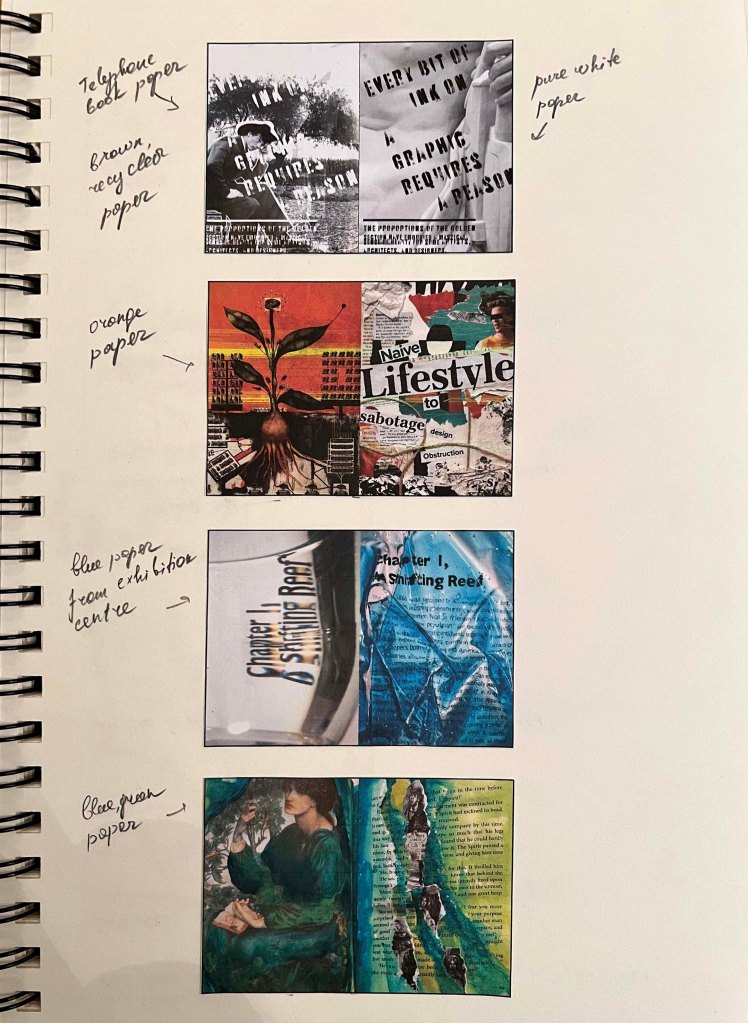
Telephone book newspaper type of paper. But here I went for some experiments with the print on the telephone book paper. I was surprised by the originality of the design. I think, it added some more impressive results, which made the spread look like a fanzine. The image started to have some depth and draws attention to detail. I’m impressed with this outcome, another proof, that experimenting with materials can bring some unpredictable results.

Brown kraft paper. Next spread on the recycling packaging I received my parcel in recently. I loved the result, highlighting the feel I was going for in that collage. The colours are slightly dull, but the vintage feel looked great. Definitely good for the brochure collection

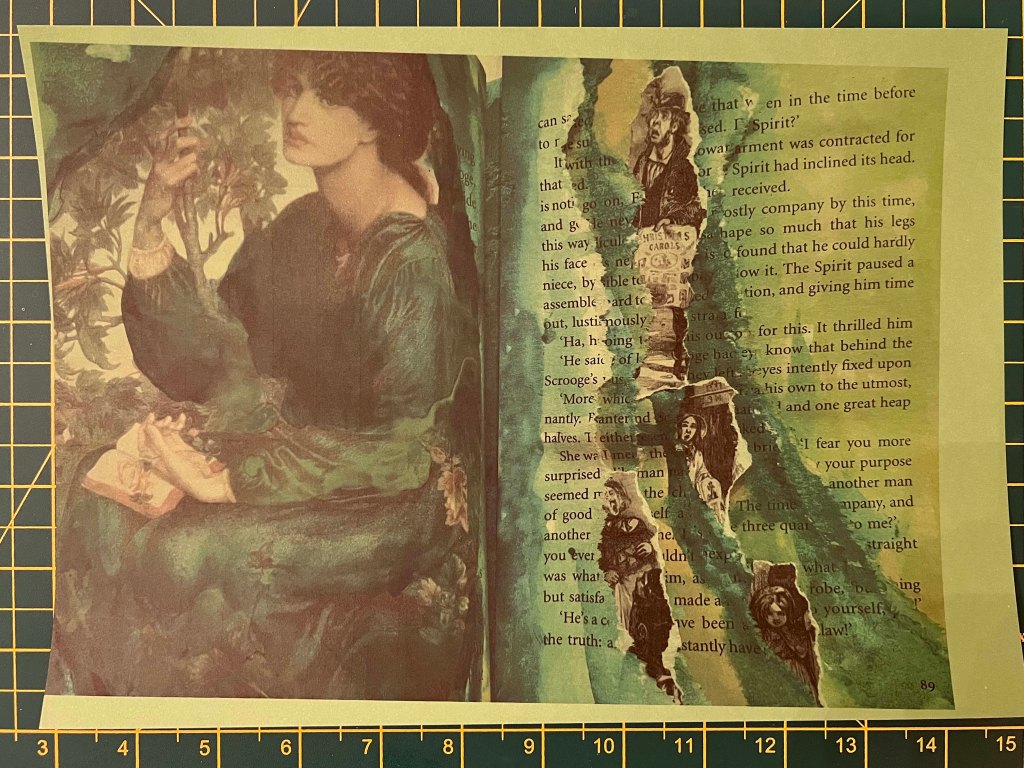
G . F Smith Powder Green. This sample from G.F Smith as well, pale green colour shade paper. The paper is a very nice feel on touch and good quality, what I like about them, for their rough texture, but the ink loves it, it makes colours slightly dull, and not as contrast as a white paper, but for the feel of the brochure, it looks the way I wanted it to look together.

This spread with experimented typography I printed on the different pieces of paper samples. One was with the phone book, which was great, and another was on the blue paper, matching to the blue shades of design. I think they looked fine, but blue paper again, probably too dark, and took all colours of the design. Not sure about this combination, will probably have to print it again.

Wrapping tissue paper. Last spread I decided to print on the wrapping tissue paper, one from the parcels as well. I was very nervous about the printer, as during the print it sounded like it was going to chew it, without the possibility to recover, however, I still got my print, with some amazing bright colours.

Coloured paper green. The green design on the green paper, the same outcome, doesn’t look as exciting as I thought it would do. At the moment, from the colourful samples, the yellow paper is my favourite for printing so far.

Conclusion

I really enjoyed this exercise, it was quite playful and packed with different experiments. I loved surprisingly bright and juicy designs that came out from the tracing paper, and nice colour shade on the brown/wrapping paper, something to remember for the future, as not only white smooth paper is suitable for printing, even unsightly from the first look paper can bring some special characteristics and mood into the design.

Exercise 3: On press

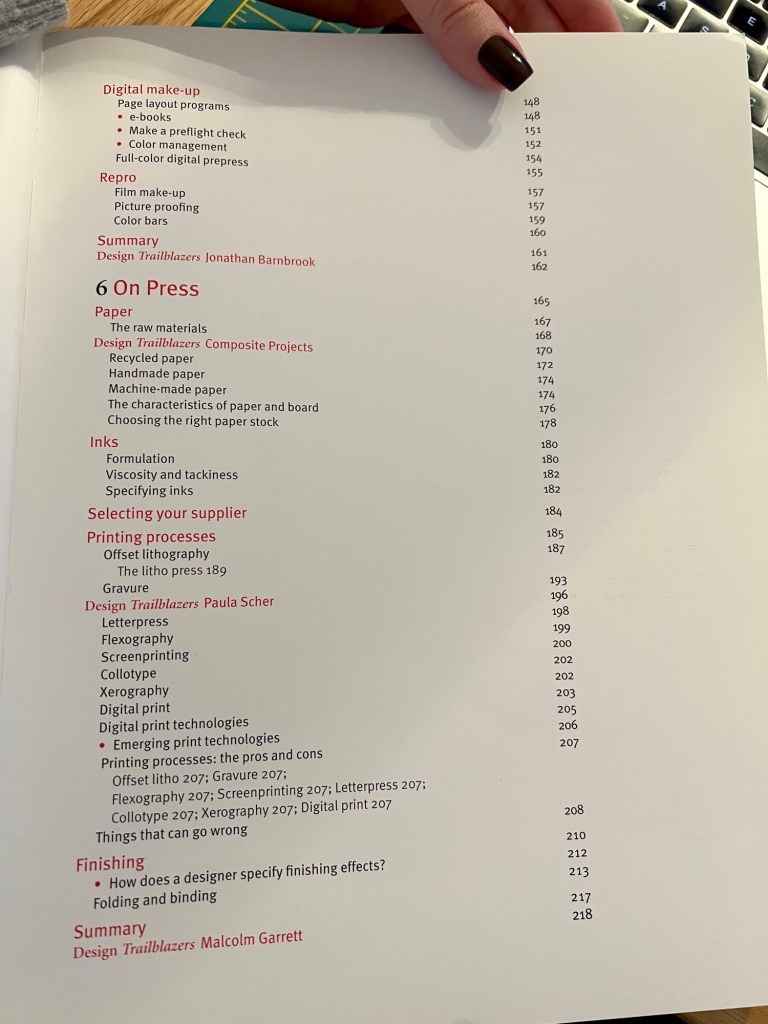
In this brief I was asked to read the fragment from Adrian Pipes’ Production for Graphic Designers, 5th Edition to overview the print process and decide which aspects of the print steps might feed my creative decision-making process. Also going into this subject will help me to understand the connections between artists and craftspersons sit within my work.

I was told that I can find the material in Pipes, A. (2009) Production for Graphic Designers, 5th Edition, London: Laurence King Publishing, as a source on the OCA student site, however, for some reason, I couldn’t locate it, so I thought will be useful to buy the printed copy from the internet, as I might need this book for the future references. This book is full of important information about decision-making and design processes, but at the moment I could concentrate on the particular Chapter Six – On Press that I needed.

The main idea of that book’s chapter is that graphic designer has the least control over the production part of the book. On press is the one part of the process that graphic designers are scared of. I know it from my experience, as sometimes the result of the printed material could bring some unexpected surprises. That is the final part of the book – printing, that designer is not taking part, therefore that to see the desired result as the end product, we, as artists have the power to decide what paper we are going to chose, the type of ink, printer, the format of the book, the hardcover or softcover, bookbinding. But in the end, someone else will collect it all together to provide us with a finished product. This chapter gives an insight into the process of choosing the right supplier, and suggests how to go about ensuring the best-quality job.

The budget is something to consider as well, books are probably the most expensive pieces amongst other printing materials, especially if the book is fully coloured and have some illustrations in it, as they are multipage, and have some complicated techniques to glue pages.

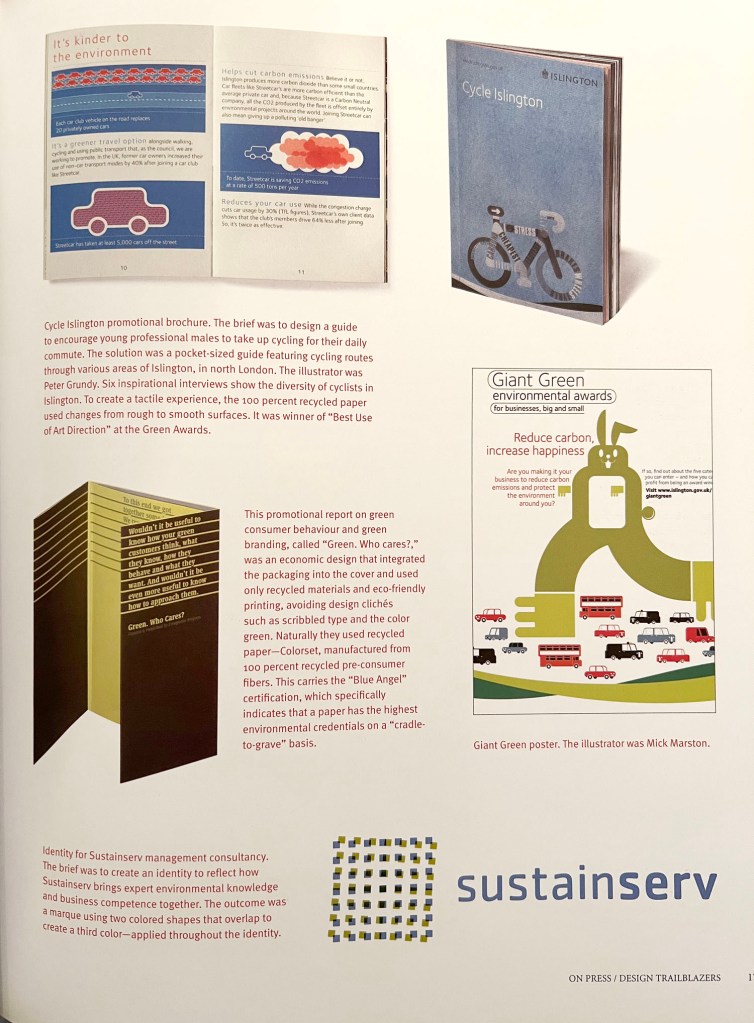
I’ve heard from the student group that https://mixam.co.uk/ is a digitally oriented company that I can deal with for printing a book. They take orders online and all information such as the quality of the paper, ink choice, the number of copies and terms are estimated already on their website. When I examined their website I found out that Mixam are passionate about the environment, so they use materials that have a minimal impact on the surroundings. Also, they print on environmentally certified and recycled papers and use superior quality vegetable-based inks. If I’m going to use sustainable materials I should consider the connection between the paper and the ink. Recycled papers tend to be more transparent and absorb the ink more, so, their colour is never pure white, they have little bits in them and look rustic. But if I want the book to purposely look vintage, the recycled paper is ideal for it.

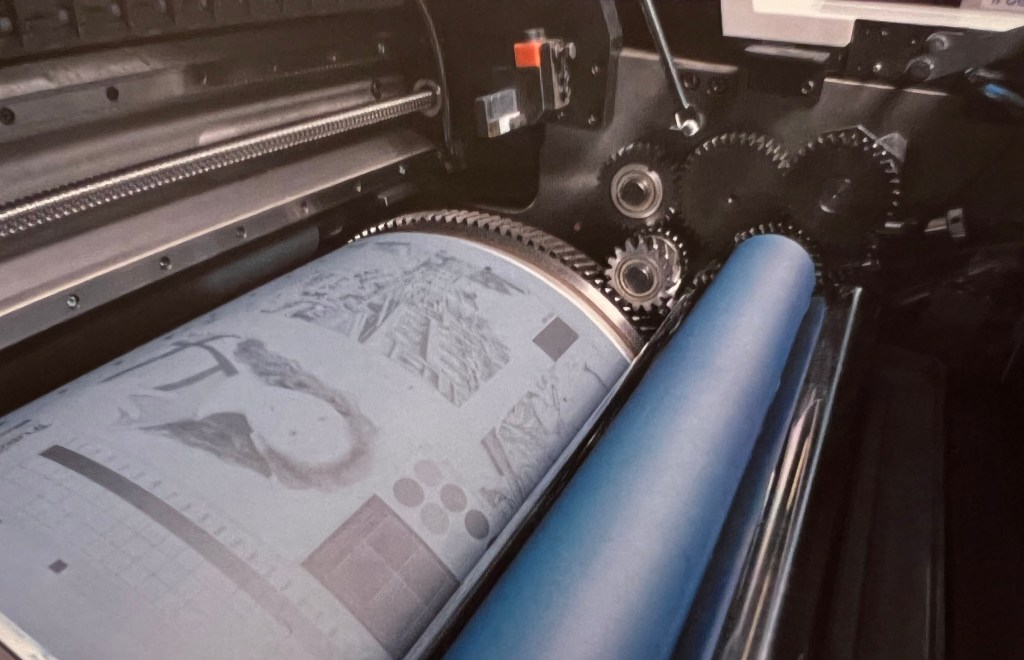
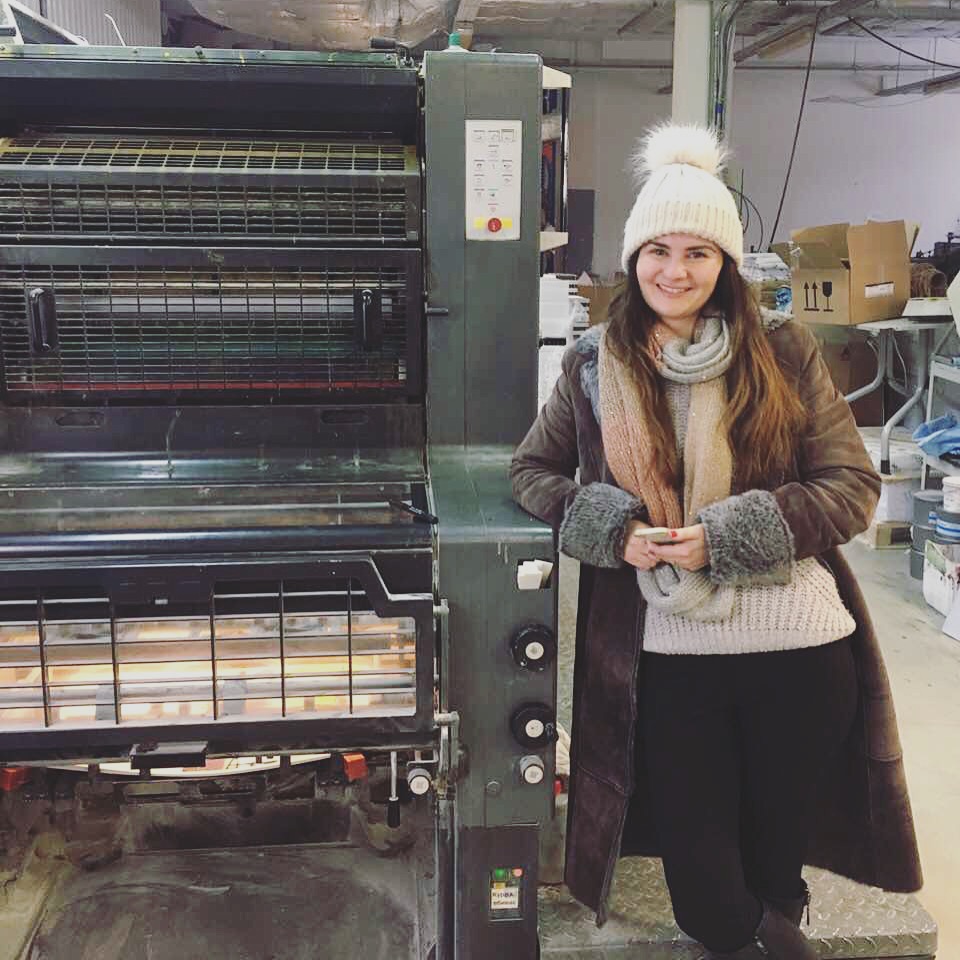
In a past, I had trips to the Printing Houses in Kyiv, when I worked on the preparation of magazines, catalogues and annual wall calendars. To be fair, I learnt from my own mistakes, as the amount of work and timeframes were quite stressful as well. I was shown what machinery’s they use to print those thousands of copies of pages and how quick they are flying through the mechanism. My responsibility was to make sure that colours look right and all fonts converted correctly into the printing copies. I worked as a commercial graphic designer when publishing and printing companies had their specialist, who had final checks before the printing. I always found their job quite intimidating, as those people had special attention to detail. On any book, the printer has pre-press work to do, scanning high-resolution images and preparing the plates for imposition prior to proofing. They were proofs ready for me before my arrival, and if I could see some samples are too pale, I asked to add some contrast. Also, I saw how books were bindings together, they didn’t look as colourful as my calendars and magazines, but they require lots of attention as well.

Consider which aspects of the print process might feed into your creative decision-making process. Where do the connections between artist and craftsperson sit within your work? Use your learning log to reflect on this.

Here are some points to consider before book design and printing:

  • Paper choice: High-qiality designs can be successfully printed on uncoated paper stock. There is rich range of papers available, I could see it from my researches on various paper samples. Handmade paper must be reserved for the prestigious jobsIf it will be hand-made, craft looking, artiststs’ book I’m going to chose recycled, vintage looking paper. If it will be professional print, that looks luxury and glossy, I will go for the pure white paper and professional printers. Depending on the content of the book and its look. These decisions I’m going to make when I will chose the direction of the book.
  • Type of printing: Depending on the quantity of samples there are offset lithography and print-on-demand types of printing. Most books today are printed using offset lithography. The emergence of digital print and print-on-demand has given creative designers much more control over the design and publishing process. As I don’t have access to the commercial printing due to the limited number of books I’m going to print, I can establish the type of lo-fi printing, as fanzines and artists’ books used for self-publishing. Here I can implement ‘do-it-yourself’ and handmade aesthetic.
  • Format: Books are charactiristicaly designed in three formats: portrait, landscape and square. A book can be liturally any format and size, but for practical, production, and aesthetic reasons, creful consideration is required to design a format that supports th reading experinece. In practical terms, the format that will be chosen of the book should reflect the contaner of the author’s ideas.
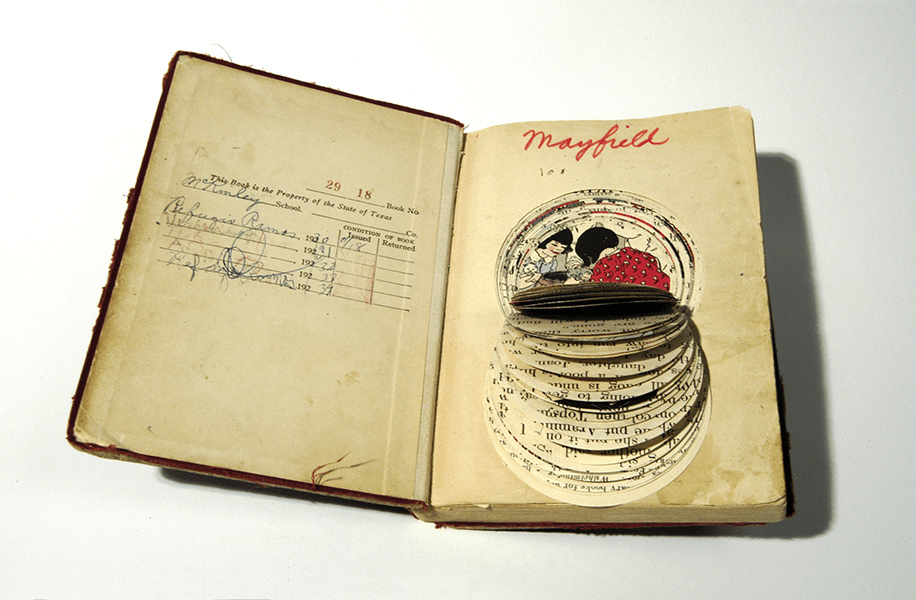
  • Finishes: Here I need to consider whether I would like embossing, die-cutting or lacquer on the cover of the book? Print finishers often have spesialised machinery for processes such a perforation, gilding, and folding printed sheets. For example, if I go with pop-ip book it will require construction by hand.
  • Binding: The binder deals with the “book block” — the collated printed pages. Binders usually offeres designers different binding techniques, depending on the boolkiness of the book and paper quality. As I’m managing the process myself, I will need to decide whether I want my book to be stitched, or stapled, and what kind of binding it will be hand-made or professional printing.

Conclusion

Graphic designers are both artists and craftspeople. During the course, we were learning how to be creative, look for sources of inspiration, and be experimental. In this exercise, I’ve learnt what I need to know about the craft of printing. The idea is when the production is learnt through we will be able to express our creativity. It is a very important part, to understand the stages of the print production process to prevent designers from technical errors. Something to remember, that every stage of the print production process will exert some influence on my design.

Exercise 2: Planning your workflow

However you plan to work in the production of your book, spend some time now planning your workflow, using the notes above as a guide.

Workflow phases

In this brief, I was asked to plan my workflow and consider the number of days or weeks I will need to spend that to complete the fifth assignment book design. Here I need to organise each step according to the five phases, making sure that I allow myself not only to be creative but structural as well. If we are looking at the roles of preparing books for printing, I as a designer will take multiple roles as a project manager, writer, editor, picture researcher, designer, production manager and publisher.

At the same time, this particular unit is all about balance, I’ve noticed how easy here to get carried away with only planning, or how the creative part can take most of the time, and it’s easy to forget about one or another, the organisational part and the structure. That is something I need as well, to have some organisational skills, let the creativity flow and be a good planner.

I looked at the calendar, and approximately I have a deadline of approximately four weeks to complete this final part, which is a quite short time. However, as I’m committed to this course, I have a full-time job to concentrate on it and be fully involved in it.

I have friends printers who can possibly help me with this project to print. Below I described how long each phase of this assignment will take and my thoughts about it.

Phase 1: Scoping

I think, for the overall project itself I will need approximately two weeks. I should consider working with the printing companies, as they could be overloaded with workflow after the Christmas time backlog, therefore just in case I have a backup plan of printing it myself. My home printer can do A4 format, so the book I can possibly print will be around A5 format unless I found some fast print companies. My experience with working on the previous part Collating and binding helped me to understand timeframes and the structure for the project from start, where I ordered sheets of paper, sketching of future design, to the production of design, and then actual printing.

I’m going to use a sketchbook and a full brief analysis as guidance for describing the plan of the project, also things like keywords and mind maps will be quite useful here. Working on the project of the altered book gave me some ideas on how the process can look, it inspired me for creating some more alternatives for artists’ books, as the field for creation is quite broad. In regards to what kind of methods I will be using in this project, I’m thinking of combining digital and hand-made methods for the final book. I believe, using alternative methods of design help to open new perspectives. I had quite unpredictable and interesting outcomes, which makes the final product unique and exclusive.

Also, I need to consider the content of the book, and what direction of the story I will choose. For inspiration I’m going to search for some artists, using Smithsonian Library, and some more sources I’ve discovered recently. I might include in it some quotes, similar way I used for the My little book/good and bad typography. Quotes from the influencers help to focus on the particular subject and develop the idea with the special characteristics.

Phase 2: Creating content

I’m hoping, I will need just about two to four days for creating the content after I generated some ideas. I’m going to start the assignment on the 31st of January, leading to the submission of the final work on the 14th of February. For this assignment, I can try to write my content, as I did for Assignment 3. I’ve collected some magazines recently, and material about book creating, so I can do collages or scanning for my project. Also, as an idea on the side of my sketchbook, I can do watercolour illustrations and drawings. I found it a very good way for converting all images into CMYK format and high-resolution 300dpi, which should be good enough for printing.

This Creative Book Design Unit has been my favourite part so far, as I discovered new directions in design, and I found it quite creative. I will think of using concrete poetry and altered books as a basement for creating my book, also, the collection of books I’ve been buying during the course can be very helpful for this conclusive assignment.

Phase 3: Design

This part of the design process includes page set-up, such as the numbering of pages and planning the order and amount of pages. The next stage is a page layout, which I’m going to do in my sketchbook as well. I’m going to do thumbnails, they should not be detailed, just a brief positioning of the columns on the image should be enough for the understanding of the structure. After that, I’m going to choose a typeface. I can always follow the guidance of the Notes on Book Design by Derek Birdsall, with the best-provided material for the typography choiceBut for the final book, I will look at the finest way of arranging the text according to the image elements. From my first assignment, I remember the rule that paragraphs shouldn’t be too long, otherwise, they are difficult to follow, and remember about gaps between the sentences, avoiding “rivers” between words, because the rule is – if that is the book of good typography, the text should look professional and neat unless it was done purposely artistic and creative. Overall, I think it will take me about one week for this process. Up to the 6th of February my deadline, as I need at least one extra week for the production part and conclusion.

Phase 4: Pre-production

Before the final printing of the book, I will need to do proofs first. Check the book for errors, make sure that I’m satisfied with colours and check the numbering of pages. I’ve heard the recent story that it can be cases of confusion with the numbering of the page or missing some pages from the final book release, which I can’t effort due to the tight terms of the book production. Also, from my experience, I had trips to the printing companies and for the colour correction of the magazine. It’s useful to have calibrated screen, but a digital copy will always have a difference compared to the printing sample, as depending on the thickness of the pages, the quality of paper, or type of inks the result can have an impact on the final piece. Even home print can provide some orientation on the colours and what the final book will look like. I can do drafting print first, make a mockup and only after that send the work for pre-production.

Phase 5: Printing and production

To finalise the whole assignment I need time to print some copies of the book. I think at the initial scoping stage I need to decide which services I’m going to use, and the company I’m going to deal with, making sure I have sufficient time for the successful outcome of the project. I’m going to research for the local printers, hopefully, they will be able to complete the order within a week. Also, I will follow the guidance of the printers, making sure I’m covering their requirements as well. Start from the 7th to the 11th of February.
Conclusion

This workflow plan helped me to build some valuable points and determine deadlines and important stages for the book production. I don’t have extra weeks for errors or adjustments if something goes wrong, so I hope this planning will be a good guide to keep myself organised and structural. Also, I have three exercises to complete, which ideally should be done by the 24th of January. I hope that complete concentration on assignments will help me to move quicker and have some good results at the end of this course.

Research task 1: Book Fairs

Research the book fairs online and explore the wide range of books by independent publishers, to gain a better understanding of the variety of books and publishing possibilities.

Offprint London

Offprint is a platform supporting independent and experimental publishers in art, architecture, design, humanities and visual cultures. Produced by LUMA since 2015, Offprint is activated under different formats and various locations (London, Paris, Milano and Arles).

According to my researches, there have been few events in London, one in 2015, also, in 2016 and another in 2019. This year the event was held in Paris in November 2021: A walking tour of independent publishers hosted in art bookstores, studios and galleries.

In 2019 in collaboration with Tate Modern, Offprint hosted publishers from 17 different countries. The event takes place in Tate Modern’s Turbine Hall to coincide with Photo London.

Earlier, in 2015, the London fair included books, zines, vinyls, posters, prints, websites, magazines, and blogs from over 140 participants in the fields of contemporary art, graphic design, literature, poetry, philosophy, and experimental music.

Offprint showcases an alliance between printed strategies and digital cultures within the art world, presenting concrete examples of the contemporary dissemination of artistic practices.

Art book Fair London

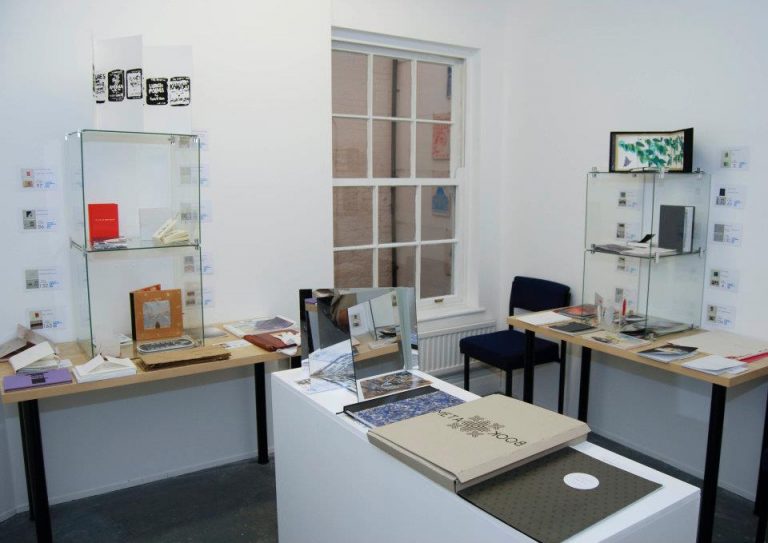
Free and open to the public, the London Art Book Fair presents the best in international arts publishing, showcasing artists’ books, catalogues, zines, rare publications and brand new releases.

The event was held in the Whitechapel Gallery for its seventh consecutive year, with over 90 independent publishers and presses exhibited.

Small Publishers Fair

The Small Publishers Fair is the annual gathering of small press publishers, writers, artists, poets and book designers. This year the event took place online. About 58 publishers from across the UK and Europe were represented together with a specially compiled booklist and a feature on lockdown books.

Each year Small Publishers Fair brings together some 65 publishers, or some 200 artists, designers, illustrators, poets, printmakers and writers who make books. Here are the people who make the Fair happen each year.

International Contemporary Artists’ Book Fair

The International Contemporary Artrists’ Book Fair held in Leeds is the longest-running artists’ book fair outside of London. It celebrated its 20th anniversary in March 2017. Throughout its history, the Fair has attracted national and international participants and welcomed thousands of visitors from across the UK. Since 2014 it has been held at The Tetley and co-curated with PAGES, the organisation run by AWP co-founder Dr Chris Taylor.

The Sheffield International Artists’ Book Prize

Sheffield International Artist’s Book Prize is organized by Bank Street Arts, an independent arts centre and charity, using public funding by Arts Council England and sponsored by the Open College of Arts. In its fourth edition, the Prize is free to enter and all books submitted will be featured in a 8-week exhibition, as well as online and print catalogues. The Prize’s goal is to promote book artists, and as such it encourages artists from all over to world to enter.

To encourage submissions, all books submitted were shown in the inaugural exhibition and the policy was established of the Prize being free to enter. The first Sheffield Artist’s Book Prize in 2008 attracted nearly 50 entries from all over the world and several hundred people cast votes for their favourite book.

Dublin Art Book Fair

Temple Bar Gallery + Studios presents Dublin Art Book Fair 2021: Manual (DABF21), the eleventh edition of Ireland’s only art book fair, sponsored by Henry J Lyons. Taking place both online and on-site, the gallery in the heart of Dublin’s Cultural Quarter transforms into a centre for art and artist books.

Dublin Art Book Fair champions artists and creative, small and independent publishers, Irish and international, with books on art, design, visual culture, philosophy, architecture, select fiction and poetry.

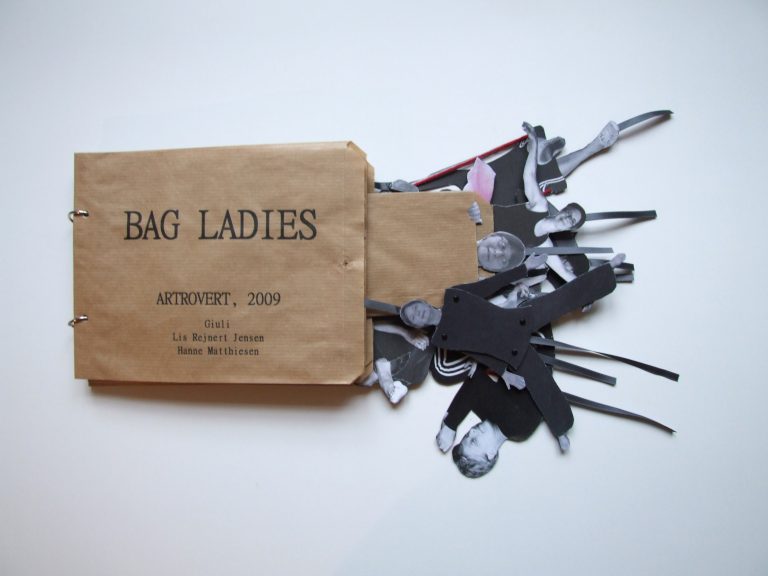
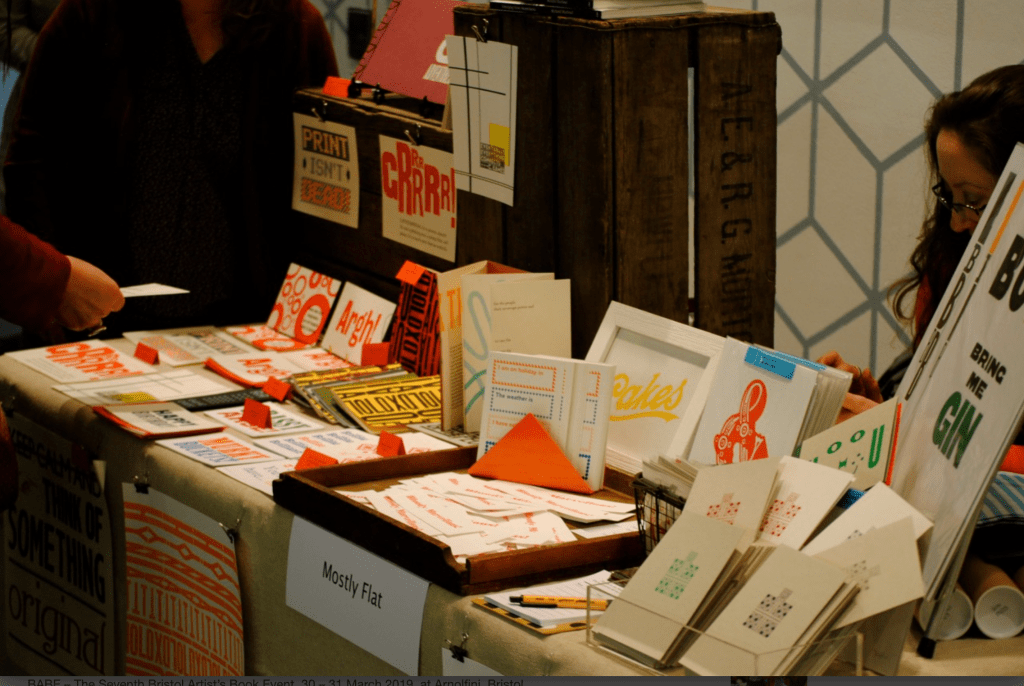
BABE Bristol Artists’ Book Event

The first Bristol Artist’s Book Event (BABE) was organised by Sarah Bodman and Tom Sowden in collaboration with Peter Begen and Snoozie Claiden at Arnolfini in 2007. It has since grown into an international event showcasing artists’ books to the public over a Spring weekend every two years. Since its first outing, BABE has established a great reputation as a relaxed and friendly event to meet and talk to book artists about their work and buy works of art.

The next edition of BABE will take place over the weekend of 23rd and 24th April 2022 at Bower Ashton Studios, UWE Bristol, BS3 2JT.

We’ll have some artist-led workshops and printmaking demos. There will be a free walk around tours with curators/experts, readings, poetry pop-ups. We will have free talks, show & tells and some special guests from the Nordic / Scandinavian regions for you to meet. World Book Night exhibition will be on show in the library, and Linda Parr will be showing the entire Postcards for Perec original artworks in their albums.

Exercise 1: What is your role?

Working with the outlined publishing models, identify the various roles you (and potentially others) will be undertaking for assignment five. For example, you’re likely to be writing your own content, designing your book, editing and reviewing it. You may also be involved in the production, printing and distribution process. Consider each aspect of the book assignment and briefly list what roles you think you’ll be doing, and what these roles entail. Also, make notes of the roles of others who might be involved in your assignment and what their contribution is.

Where do books begin?

Previously in my graphic design experience, I’ve dealt with magazine design with the list of hotels to stay for travel destinations. Obviously, it’s different to book publishing, as those magazines served the purpose of promotion, but the concept is quite similar. I remember that originally there were multiple people involved in the process.

1 the customer of the project (hotel chains) → 2 the content writer → 3 editors → 4 marketing managers → 5 graphic designers → 6 printing company → 7 distributions and retails in the face of the travel company.

As far as I understand, here for my final assignment, I’m going to play multiple roles, and I believe that is going to be a good experience for me, as I can test different roles, apart from being just a graphic designer of the project. Most likely I will need the help of the printing company, depending on the design of the book, as if it’s going to be an artists book I can do it myself. Here I would like to analyse each role individually, following recommendations by Andrew Hasslam’s Book Design.

Generally, there are four simple models of book creation. The first, the traditional model, places the author at the beginning, but there are some alternatives, where publisher, editor, or designer placed at the start of the book chain.

1 Writer → 2 Publisher → 3 Editor → 4 Designer → 5 Production → 6 Printer → 7 Distribution → 8 Retail

1 Publisher → 2 Writer → 3 Editor → 4 Designer → 5 Production → 6 Printer → 7 Distribution → 8 Retail

1 Editor → 2 Publisher → 3 Writer → 4 Designer → 5 Production → 6 Printer → 7 Distribution → 8 Retail

1 Designer → 2 Writer → 3 Publisher → 4 Editor → 5 Production → 6 Printer → 7 Distribution → 8 Retail

The traditional model of a book’s creation places the author at the start of the production chain. For example, the author has an idea for a book and begins to write text hoping that eventually the finished work will be accepted by a publisher and become a printed book.

I think, for my book assignment most of the roles will be played by myself, but at the same time the customer of the project I can consider an Art College representative, and probably extra people who will be involved in printing. The Art College will judge how successful the final design will be and whether all points have been met, however, the whole process of book design and production will be managed by me. The model of a book’s development is often referred to by publishers as a “critical path”. Now I need to consider carefully what kind of key stages I will have to complete.

  • Author / Writer of the content will be me. The ideas should come from myself according to the brief that will be provided by College. The overall project should be thought through, including a review of the subject and physical characteristics of my book and its cover;
  • Publisher. I won’t need extra people to get involved, like agents or agancies, as the project is held by myself;
  • Editor. I will be edditing my works myself, check it for errors and imperfections, correcting them and going back to the final checkups.
  • Designer / Illustrator / Photographer that will be me as well. I will need to think through the sketches, decide on the format of the book and create a rough plan of actual design. If book will include illustrations they should be painted by me as well, or I can look for some royalty free images at library like Bridgman photography. I can take pictures for the book myself, that will help to create unique style, or I can adjust images in Photoshop, to make them look original, depending what design I’m going to chose, realistic one or abstract;
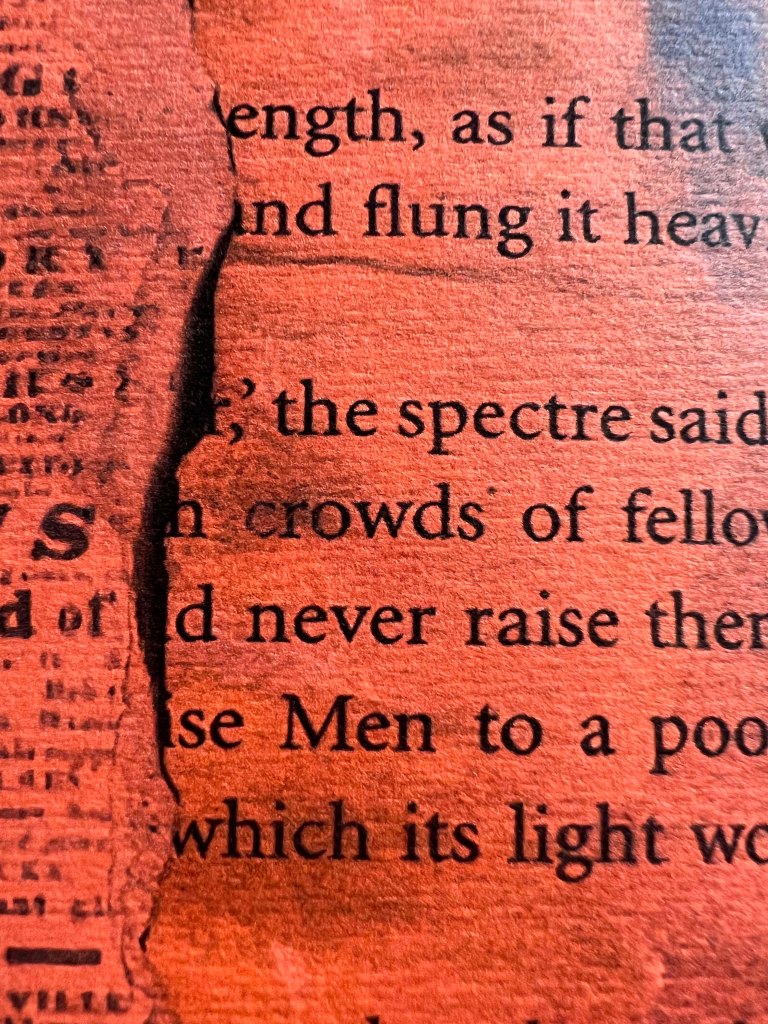
  • Production will be decided when the brief will be read. If there are multiple pages book which should look like professional print, than I will need to go for the printing companies and explain them the requerements. If the book should look hand-made like, and have some room for inperfections, than I can do it myself;
  • Printer same a as publisher, will be considered later, depending if I’m going to use my home gadgets and printer or printing comapny;
  • Distribution this will be my role as well. I might will need to distribute books to the friends and family, or send some copies to the Art College. Also, I can contact to one of those Book fairs, look for upcoming events, and consider whether my books can take part in it;
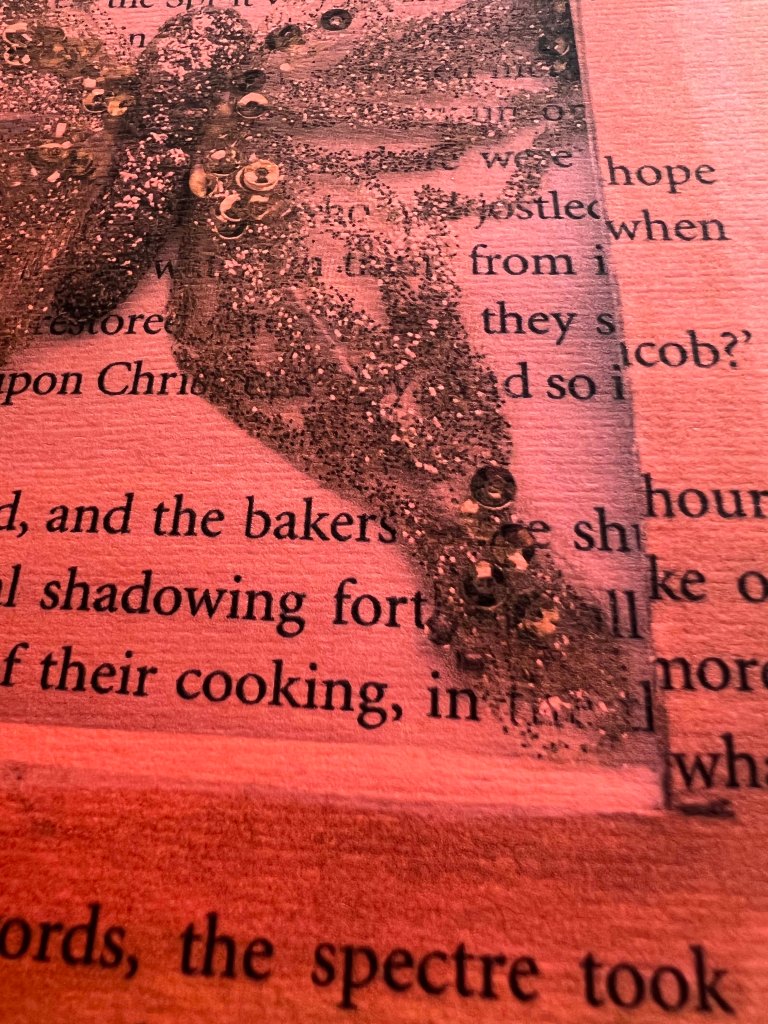
  • Retail most likely my books will be non-comercial projects, I can contact voluntary organisations, and give them away for free to some of the organisations that interested in exhibit or sale artists’ books for charity.

Assignment 4: Altered book

Using a found book, significantly alter the appearance of the pages to create a new volume that is personal to you. This can be any kind of book that is of interest to you. For example, a fiction book, a non-fiction book, a picture book or a photo book.

Approach the found book in a very physical way, manipulating the pages and paper inventively. If you need to, stitch or glue a number of pages together to reduce the ground you need to cover. Decide what to remove from the book, and what to add. Use the found book as a source of ideas and inspiration – the existing text may inspire illustrative, conceptual images, collages or typography as images. Embed, overlay and integrate your work into the existing pages using whatever materials, media and processes you feel necessary. This may be digital, hand-rendered, photographic, textile, or a combination of all these and more.

Think about the relationship between the content and the form, the design (text and images), and the materials you use, such as papers. Perhaps you are creating a new sequence within the book?

Change the book from its original form into a different form, altering the appearance and/or meaning. Apply an inventive, intuitive response to materials and how these can be exploited within the context of the altered book.

Refer to your contextual research into artists and designers in the unit so far. Use elements of your research as inspiration and to inform your book-altering practice.

Primary research

This is a very exciting assignment to come up with at the end of Part 4. I’ve never been so curious and intrigued before, as that is going to be a test skill for me as well. Mainly this assignment is based on handmade skills, and the ability to adjust the existing materials into something new. Also how we can plan the process well in advance, as there won’t be a way to go back and change the concept as we do in digital exercises. I was expecting this type of assignment to approach at this stage of the course. Earlier in this Creative Book Unit, we explored artists’ books, that are made as a masterpiece individually without connecting to the particular story of the book, they hold historical, cultural, or environmental messages within them, when altered books based on similar principles in terms of design and decorating, but the design is based on the context of the book.
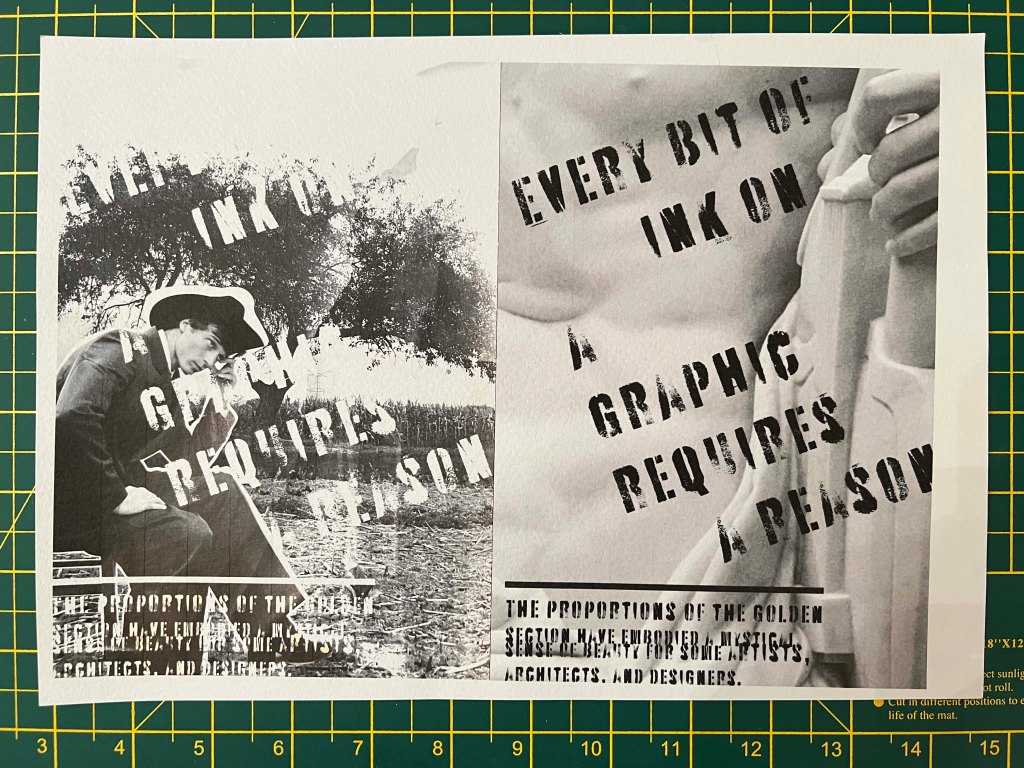
An altered book is a form of mixed media artwork that changes a book from its original form into a different matter, altering its appearance and meaning. If an altered book artist takes a book, whether it’s new or old, it can be modified in various ways, such as cutting, tearing or folding, or embedding objects.

I found this collection of unique altered books, with beautiful designs within them, and some amazing ideas. They are all done in one sample and classed as collectable items. I loved the variety of different manipulations that can be applied with the altered book, and how various and diverse the altered book art can be.

Altered books are impossible to read, but they are an amazing addition to the library if the reader is familiar with the story already. I was excited to see what the market holds as examples for the altered books. Some of them are amazing masterpieces of art. I think those artists are just incredible at carving, obviously, with great imagination and artistic skills. I’m not expecting myself to learn how to create a 3D book straight away, but can definitely bring some creativity and charm into the altered book.

Actually, creating 3D shaped book calls book excavation, which is a sculptural work of art made by transforming various types of old books using precise cuts with a scalpel or knife, carving pages one by one until an astonishing new composition reveals itself. This almost surgical focus of dissecting books results in a wholly new object infused with a graphical history that evolves as the artist exposes each layer of the book while cutting around interesting images or text. Finished book excavations often appear as cross-sections of the book, carved to create an alternate universe previously hidden between the covers.

Brief

Collecting those ideas as an inspiration board gave me some directions on what I was going to create in my altered book. I made a quick brief for the book I was going to work with and placed some keywords and a mind-map for the chosen book.

Choosing a book

It didn’t take me long to choose the theme and what kind of book it is going to be. As I started this assignment at the end of the 2021 year, my heart was on the A Christmas Carol book by Charles Dickens as a symbol of festive season celebrations. That is the perfect time for the Christmas spirit and I was surrounded by Christmassy attributes and a feeling of merriness and joy, would be great to transform it in the altered book design. I’ve discovered the A Christmas Carol film only recently, for some reason the story was not as popular in Eastern Europe. I’ve heard about it, but have never read the book, so I bought it two years ago to learn the story and the ecranisation of the story in the film gave me a better understanding of it.

I love the concept of the book, Dickens inspired the main aspects of Christmas, including family gatherings, seasonal food and drink, dancing, games and a festive generosity of spirit. Also, Dickens put a “Carol philosophy” of charity and altruism into this story.

During the Christmas tree decoration, I was looking for some attributes I can borrow to implement into the altered book. I wanted to make a Christmas wreath shape for the book, and create a new object from it. I’ve noticed similarities between altered books, sculptures, artist’s books and scrapbooks, they are all quite merged together, but still, have individual features where the difference can be seen.

I had a book of A Christmas Carol on the softcover, but I’ve read recommendations that the book should be with the hardcover, as it is better for adjusting, and it keeps the shape firmly. Because of that, I ordered a version by Penguin Publications in the festive red cover with some gold designs around it. I didn’t know where to start altering the book, as I was worried that I can just destroy the book without the possibility of going back like we do working in the software, so it took me a while to be brave enough for some first cuttings at the book. I thought it will be a big deal for me to cut pages or paint on the pages, as in my head the book has always been a sacral object. But I thought I will let the creativity flow and will do my best to create a new piece of art with it.

Sketches

I had so many ideas about how I can redesign the book, so I decided to create a quick sketch with a brief map of various manipulations that can be applied in an altered book.

  • To start with, I was going to cut a window in the first pages and place an object or picture inside of it. I didn’t want to cut it too deep, as I wanted to design about 8 to 12 spreads. Maximum 6 pages deep a window. The window cutting was like a symbol of entering into the story, the book is open for the reader, and holds the mystery in it.
  • Also, I was going to use lots of Christmas tags and images around it, pine tree branches, most likely artificial, bows and ribbons. I wanted to bring that feeling of the book to explore, the illustrations on those tags were going to be from the story, rather than them to be just on the page, to bring a bit of tackle and explore feel to it.
  • Multiple bookmarks from red and golden ribbons.
  • In addition, I was going to try burning the edges of the paper techniques and sticking to the page fabric or gauze. I wanted to try to distort the book as much as possible, applying the principle of the book being through a lot of alteration, I was curious how much it can handle and compare it to the professional altered books market, as some of those books are quite valuable, as all made individually, based on people’s imagination and creativity.
  • Another technique I was going to use is sewing some pages and leaving some stitches around the edge of the book.
  • For one of the spreads, I wanted to glue a sequence inside, and use old images from the book story.
  • But the main point was going to be around watercolour and its natural characteristics of bending and distorting the paper. I didn’t know what feel the book will have, I wanted it to be artistic and playful, so I was excited to tackle it.

I had a trip to the local garden centre where I could buy some Christmas attributes. I bought golden butterflies, a pack of tags, wrapping paper, bunches of artificial flowers and pine trees. I was going to use them as 3D objects for the cover, and some designs to place inside of the window. In addition, I printed some images I found from Bridgeman Library with A Christmas Carol theme, they were made as illustration parts to the first books, some sketches from various artists. I thought will be a great idea to keep that vintage feel in the book. I didn’t want to overuse commercial cards, as they would be too obvious materials to work with, but just in case I kept them on the side.

Designs

I prepared all materials I was going to work with, a set of knives and blades, which were not sharp enough to be fair, so I had to cut those pages in stages, a big set of Saint-Petersburg watercolours and some Kolinsky paintbrushes. I cut an image of Marley’s ghost and stuck it inside of the window. That image looked spooky, was curious to see how that closed eyes face looked through the window cut. For the colour palette, I was going to use green colour with some brown shades, as I was going to implement some images of trees, forests and leaves around it.

The idea was to glue for the pages torn edges prints and go with some watercolour over the top of it, I liked the texture it was giving to the page. That was a good starting point for the book, it helped me to have a feel for the rest of the design. I could see that some more work needed to be done for it, but I was hoping that pages can go progressively better with some more experiments.

For the second spread, I wanted to use a table napkin to experiment with the watercolour. I quite liked the pattern it had on the sides, so I thought I will keep that as a little frame to go around the page, and apply torn edges as well. In the middle of the process, I got distracted so I forgot to take a picture of just a watercoloured napkin, it was very wet as well, and the poor little book was getting soaking wet, so I assumed I would need to decrease the amount of water that was being used on the book. The next day I ordered a hot glue gun to stick some Christmas elements from a craft shop, so I could glue heavier objects inside. I created a sequence of the images from the Christmas story, stuck a reindeer and a pack of pages I cut from inside of the book. I loved that feeling of the bulkiness of the page, with some pieces that the reader can interact with.
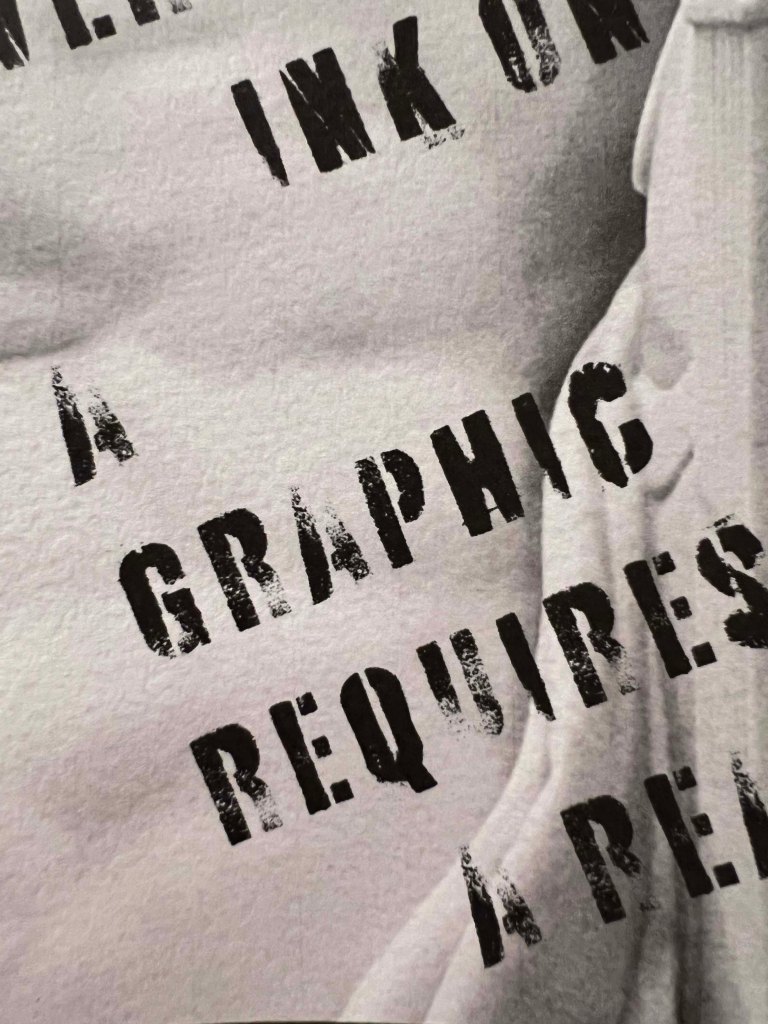
This spread I designed straight after the front pastedown. Collage type design, with red watercolour and a little cut in the corner, that to feel it with tags. I think that red spread looked a bit like blood, something was creepy about it, so I thought some cute stickers will equal the mood. Not sure how it worked, but the main point is that I still have the same mood in the book, as the story itself filled with mystery, spirits and another reality.

At some point, my table looked like a complete mess, but it was not a reason to tidy, I thought that means that I’m into something creative. I brought some red and cream coloured threads to stitch some pages, obviously, I have torn them before, as I quite liked that effect I was getting. Also, I had a pack of thin gauze that I was going to paint and glue on the top of the pages. In the corner of torn edges I stuck Scrooge and the Ghost of Christmas Yet to Come, and the image was matching to the red watercolour around it.

I think that was a moment when I started to be a bit clear with the designs and the direction I was going. At the end of the day, the number of objects I was using didn’t serve the purpose I was aiming for, and clearly, that more minimalistic design with a beautiful golden butterfly looked quite fresh and clean. I added burned ages piece of paper in the corner, and a couple of ribbons and felt like the design was completed.

I thought as the Christmas Carol holds a religious theme, I could use some prints of the old paintings, like Michelangelo Anselmi. Christ and the Woman of Samaria. I had that image from my visits to Burghley House. Just matching watercolours around did a great theme as well.
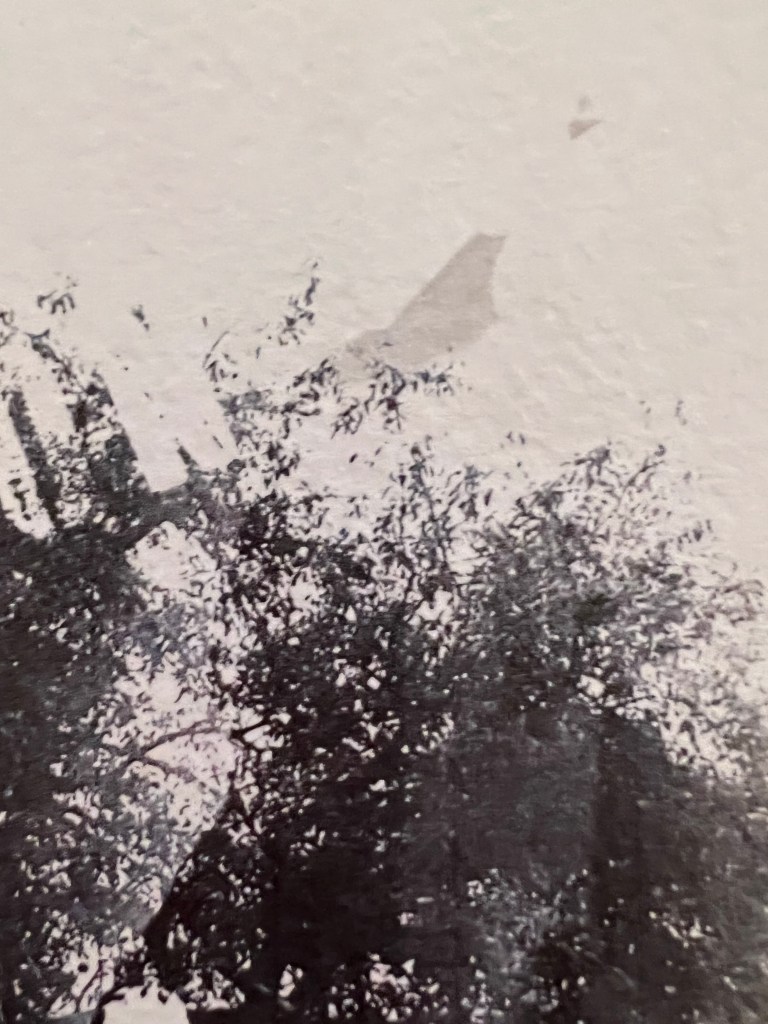
For this spread, I went for a similar path, that to support the previous theme with the painting of Heaven, as well, the Burghley House collection. I stuck it to the page with some watercolours around it, made a little envelope out of tracing paper, made colour shades on the gauze, and filled the page with some tags and images from the A Christmas Carol book. I could see how the experiment with different textures started to show the result, it’s interesting, unusual and creative, and that is a quite nice tactile experience, to have so many different textures at one spread.

I was so excited about how the book looked in combination with the art, so I decided to go with the last image I had in my head, from Rossetti’s painting. I chose The Day Dream art in the green tone, one of my last paintings I wanted to finish with the green colour, as they are traditional colour shades, of red and green, torn edges of the page and hide inside sketch from The Christmas Carol (engraving) illustration. That created juxtaposition I was looking for and supported the theme of the book. I realised that the whole book was made in that approach, I found something that was visually appealing, it was closer to the end of my research, and I wouldn’t be the mind of creating more of those textures throughout the whole book perhaps, I needed to go through all that experiments to discover something special.

I would probably finish my designs on the previous image, however, I had so many pages left, that probably happened because I didn’t divide pages evenly, so I thought would be a shame not to use a big bunch of last pages, so I decided to go for the last idea I had, with a Christmas tree, with some watercolours and illustration by John Leech (1892). I still had a few pages left, so I just glued them together, and that was me done.

For the front and back pastedown, I used wrapping paper with a red and green Christmas theme, and for the cover, I keep something special, which was artificial pieces of pine tree and red berries. I decided to keep the cover in red, as it was the perfect colour choice for the story, I just made it look like a door Christmas wreath in traditional colours.

Reflection

I think I can call this assignment one of my favourites in regards of work with handmade materials. It was the first time when I went from the begging to the end strictly by working with handmade objects. That was a discovery for me that handy work can bring so much joy and satisfaction. Before that task, I was quite confident that I’m a digital kind of designer, and software is the best way to express my creativity, however, this assignment helped me to discover something new, helped me to open some fresh skills, and showed that I’m I can push even more. I could see that this assignment was a collective task from our earliest exercises like Alternative Publications, Your Zine, Artists’ Books, etc., and I’m pleased to see how the experience can be transformed into discoveries. I believe I could meet the brief, as I did my hardest with the number of materials and media I was working on. I have to admit I didn’t go far from the A Christmas Carol theme, probably slightly moved it closer to the middle of the book, first pages were a start, and I relied pretty much on the story, but closer to the end I could figure out the religious theme in it, and the use of art for this story. I hope I could meet the standards with this work, and I am ready to enrol for the upcoming assessment.

Exercise 4: Collating and binding

Reflect, evaluate and rework

Having printed your images from the previous exercise, take the opportunity to view all of the pages, reflect on them and evaluate before moving on to the next step of collating and binding the pages together. Which pages are successful? Which pages have not turned out as well as you had hoped? Are there any visual surprises, or happy accidents? Given the experimental and open-ended nature of this exercise, the answers may be quite subjective, but it is important you reflect on these and other questions, to sharpen your self-critical awareness and assessment of your own progress.

Evaluating my work

The first image was a starting point of the whole book. At this point I was still thinking on the concept, and that’s why the image is full of wording and text, as I was planning to make each page with the sentences from the poem, but later I excluded that idea and kept each montage free from overload. I kept the wording in this poster still, as it looked quite good together with the rest effects that I added around the picture. I like the colours in it, it helped me to set up the direction of the colour palette for the brochure, as I wanted it to be colourful but with a slightly transparent and grainy effect on them. And little cute sparrow represented well the action of the squeal.

This is the image that I had to go back that to redesign slightly. I was not sure whether the big brown bulky fonts in combination with script font looks good with the rest of designs, as it was too dominating in the image, and I didn’t apply that principle anywhere elese. But the position of the dog upside down on the snowy background worked quite well. I loved that oil painting effect on the top of it, and the dog has quite an unusual dots effect, so the image can be still recognisable after careful exploring. I liked the colour combination in it, and it worked very well with the first page.
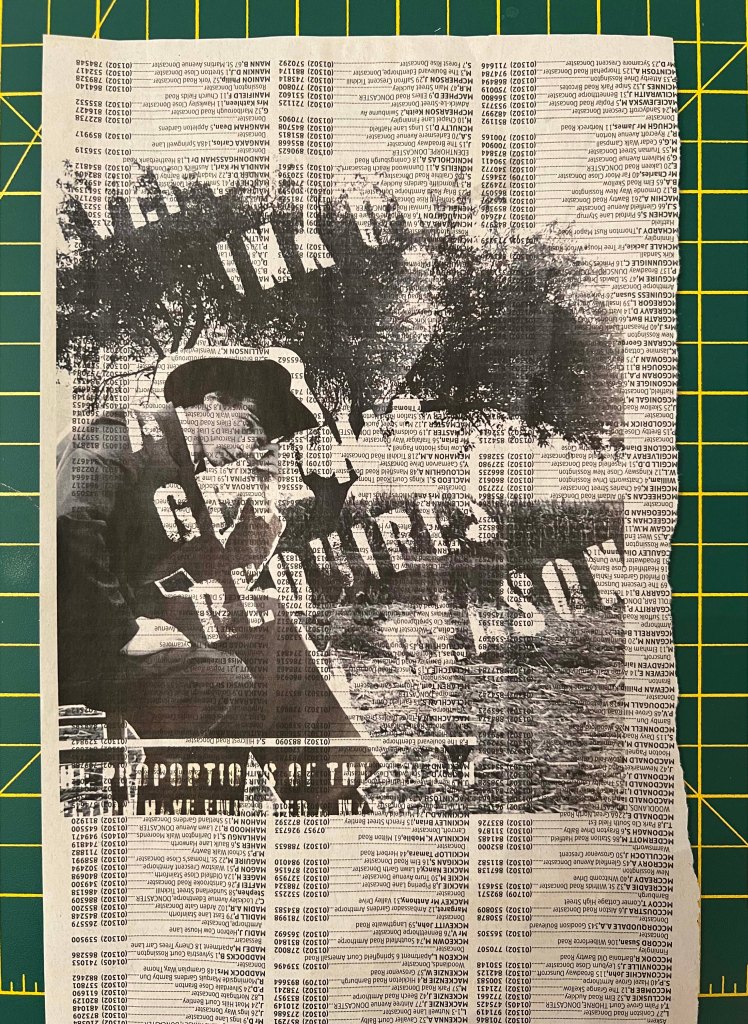
This is one of my favourite collage in this book. I put lots of hard work and efforts into that text positioning and fonts combinations to make it look harmonious. I liked how those first three images merged into a similar theme, and on top of that, this particular photomontage was generously filled with different layers of stars and grain effect. The smile on the tin can looks curious, and the girl like a ghost image looking far ahead gives an eerie mood, with some oddness. The hue in this image is cold violet, and it reminds of some kind of dreamy mood and night star sky. Even though other pages didn’t have as much wording, I think, due to its transparency it worked quite well and was not as heavy going that to keep up with the rest of the style.

At this point, I started to walk away from the design style brochure. I chose geometric angles in it, and a very little image of the human in the corner,– conqueror of the air. I was returning to this image a few times, trying to adjust it according to the colour palette the best way I could, I changed the colours many times as well, however, I still managed to come up with something as coherent as possible with the difference of the composition top effects. The reason why I kept it, as it had that levitating spirit, it was light, filled with emotion of discovery the Universe.

For the kings of orange groves and health of the comets I created same background theme, and I’m quite satisfied with this duo. I decided to create a joint image, where the sky is continuing from one picture to another. Originally I had different effects in it, with blue sky and lighter colours, but I didn’t feel it looked right, so after some consideration, I came up with this night sky solution. The cow with crown amongst the oranges looks out of place, but that is the purpose of the poem, to surprise the reader, and visually I recreated it in the same way. Fewer layers and effects in it, but still looks consistent with the booklet.

I like this page for its simplicity and matching the trend of the booklet. Here I discovered that minimum details can provide required effect. As I tried to use the part of the different planet with it, and a picture of the moon and with the comet, all together it created the overloading outcome, so I stripped it back and got what I was needed. It’s clean and clear and looks like the wine glass catching the falling star to make a wish, additional meaning to the health of the comets line.

Here I have matching colours with the blood splatters and the red glass of red wine. I like when there is a colour circulation in composition and painting, as the reader can follow the pattern of joining images from one to another. Here the red glass and red blood created similar purpose. This is the only one page where I used a grid of objects in the line, and the realistic picture of the blood creating creepiness and oddnes as well. I didn’t use as many filtures here, and kep it clean, but on a print it did look great together with the rest of the images, despite to the white background and diamonds grid.
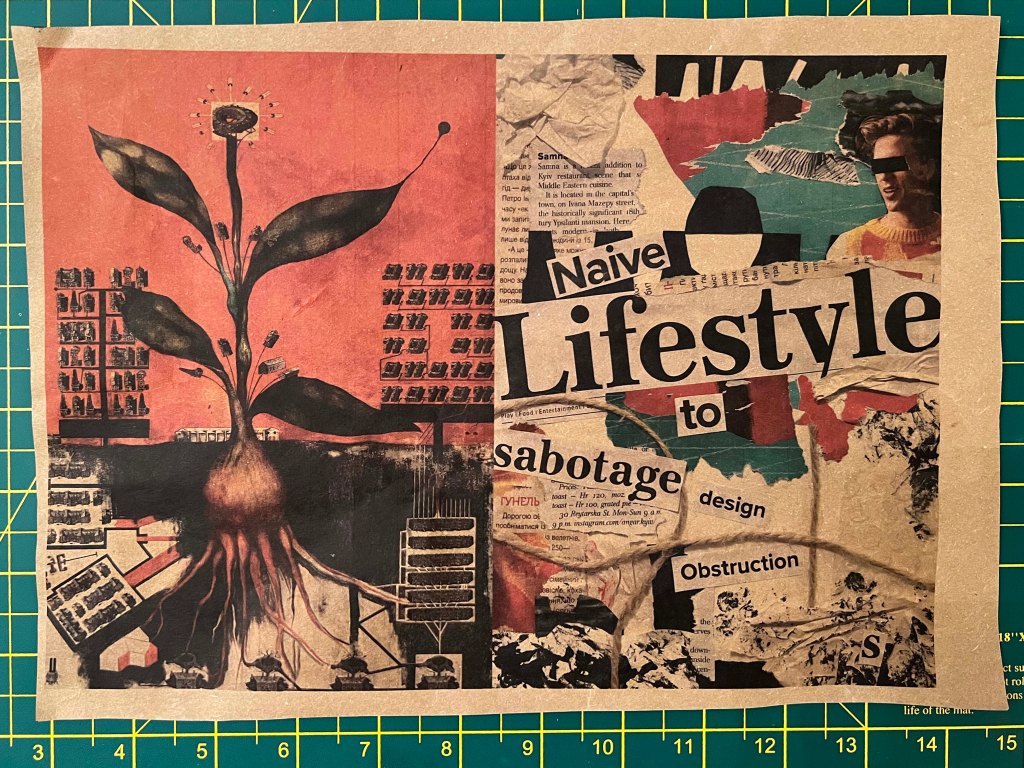
This photomontage is straight to the point too, record player with the abstract background. I used the head of the cow just to create juxtaposition. Back image consist from contrasting colours splatters, which are matching to the next image, I moved sightly to the warmer hues, red, orange and brown, as around this part I could see words assosated with red shades such as as blood, wine, hell.

This photomontage was straightforward for me. I think my previous collages helped me to establish the feel and mannerism of the poem expression. The mood is dystopian, and that image is a good representation of the line. I like that kind of collages, when they are not overwhelmed and not too complicated, but have some mysterious atmosphere. So it was good and right to the point, and I’m pleased with the outcome.

For this photomonrage I used the picture of the Sheffiel Bridge I had in my folders. With a bull skull with some opacity effects on the top, it created translucent filter with some fluorescental colours. That how it works sometime with Photoshop, just do some trials and see for the interesting results. The collage looked slightly different to the previous works, but here I had a brochure of experiments, as the idea was to make it look appealing and unusual. I like that collage, and it was good colourcombination with the image of the man.

This is the central image of the poetry, as that is the name of the poem. I tried to be considerable with this image and be as much as responsive to the theme and mood I established through the brochure. Colourwise it reminds me of the old painting of traditional countryside with grazing cows. It took me a while to come up with this idea, but I’m glad I could push it enough that to see this result. The image has depth, interesting shadows, originality and eclectic vibe. I even left the numbers on the cows years, as a symbol being a cattle.

This one is probably the one of the collages that was the hardest for me to do, probably closer to the end of the book I just became exhausted from generating ideas. I found this picture of the woman with tears, and I thought would be great to implement a photo of the bridge in there, with some transparencies and merging together. I tried few colour variations, but in some reason that was the best colour solution. Probably one of the redest and brightest images in this sequence set, but I loved how it looked individually. It has a bit of funzine style, and vintage photomontage feel, which I always aimed to learn, so that’s why I kept it. Maybe an odd one but still looks great.

This image I created as a pair to the last picture of a crimson girl. I think they are working great together, and have similarities in approach and style. Liquify effect was handy for that cow’s head, it made it look serious and dominant. Perfect explanation of bovine jealousy.

The last image is one of my favourites as well. It was inspired by the juxtaposition of modern artist Tyler Spangler and collage artist John Stezaker. I like experiments with distortion and replacing parts of the body, that creates an interesting effect that goes beyond the imagination. That woman has a smile and a big tear, which looks like the opposite meaning. The distortion effects worked quite well in this exercise, and I’m pleased that the approach can potentially represent a new generation of art.

Printed version

By the time when I finished the last pages, I received by post my pieces of paper from G. F. Smith. I ordered different textures and colours of A4 design papers, which I was going to use at home printing. Firstly, I did a test on the smaller size, as the sequence is quite long I couldn’t do it as big I wanted to, so I ended up instead of 142×142 mm with only an 88×88 mm size brochure. It was smaller than I planned, but the images were still readable, and it was easier for me to stick it around, but for professional printing I would go with the firstly planned size.

Here I selected beautifully textured papers, vellum white, powder green, weizen with some dots in it, mainly 135 gr, so I could print them indoor. When I did those prints I’ve noticed that the quality, hue and saturation of the print changed depending on the colour of the paper. That was a good experiment to learn, as different colours of paper reflect the printing colours in different ways. For the spine of the book, I created a thicker paper template, that to stick into it front and back cover and first few pages. It was a bit of hand-made work for me to print and glue pages together, as I was printing it on my own, I couldn’t create that factory look as I usually have when I use printing companies series, from the other hand this version of hand-made brochure its own charms.

For the final part, I needed to stick and fold the brochure together, which was a challenge as well. I didn’t expect it to be so thick, so even with my 5 mm spine I could barely fit all the pages inside, what I should have done, is to make cover pages from all sides 5 mm bigger too, but that’s for the future. If the print was made somewhere else, like at the printers, I would make sure that marks are ticked, and the brochure made to perfection.
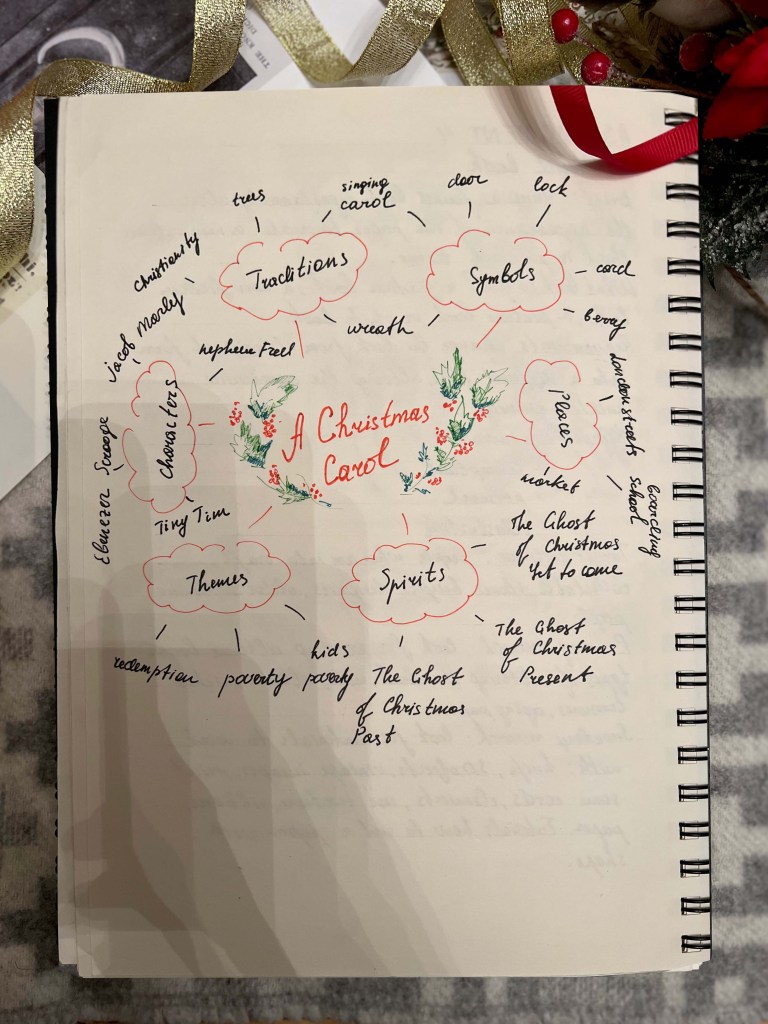
I was so pleased with my little printed version, it turned out smaller than I wanted it to be, however, the resolution of the collage would allow me to make it as big as I want, ideally, I would say 142×142 mm, but this mini version could be good for the pocket and handy to give away. I think the offset paper I used for this brochure gave a nice texture feeling for the images.

Live version

Conclusion

This exercise was genuinely a great experience for me. I must admit it was quite a challenge, and I didn’t know what is the formula that to complete all the parts of the brief, how to make it right, what is the best solution for the style of the brochure. I still think that I could improve it, make the book itself neater, be more coherent in photomontages, do not overcomplicate it, think about varieties of the bookbinding because in theory I just come up with one printed version, where could be much more. Creative book design is quite broad, however, I’m proud of my little work, and I think that was a new learning experience for me. I enjoyed exploring each line of the poetry and thinking about possible designs I could come up with. I believe that particular part teaches us how to be brave in our creativity, be experimental and never give up, even if the task looks quite complex. And I hope that I could achieve a good result in it.

Exercise 3: Sequencing images

Create a series of images which will build a narrative sequence over about 16 pages.

Use keywords from the poem as a starting point. Work with images you have created before, developing and changing their contents, or use fresh new ideas and imagery related to the poem. Remind yourself of the creative design process.

Explore the sequential narrative over the folds. Produce a folding document (2 sided) with the images you have created. Try one of the folding systems discussed in part two of the course, Form and Function: Paper folding.

Introduction

In this exercise, I must follow the Tango with Cows – Vasily Kamensky poem that to create a narrative by using keywords and sentences from it. The purpose of this brief is to interpret important for me images and extend their meaning. I think the whole sense of this fourth part, was to open the borders and explore new approaches in graphic design. I assume my detailed researches from the previous exercise of the meaning of the poem and explaining the story for myself should help me to produce some designs by using collages with cut and paste objects, or using Photoshop Software for juxtaposing. Also, I could potentially use my learning log for creating a sequence of images for the mind map. In this case, I assume, we are free to choose our own path for the final destination, which is the unique narrative visual of concrete poetry. Here I will try to be as experimental as possible, that to join all materials together, such as photography, paintings, drawings, film footage and many others more.

The visual narrative has always been the way of transferring the part of the story. The story may be told using still photography, illustration, or video, and can be enhanced with graphics, music, voice and other audio. There can be two ways of interpretations of the story, in chronological order, for example, how the personality has been transforming with the time, the beginning, middle part, and the end. Or, it could be a less predictable way, of performing abstract images, exploring the ways of printing and writing.

I collected some images from the Notes on Book Design by Derek Birdsall, there are photographs that represent a sequence of images, or in some way tell the narrative story in a logical or abstract way. For example, the first two images of Maugham books tell the narrative in sequence from the book covers. They were shown on the Penguin stand in a particular order as all those book covers have parted from the next book. I liked how those images joined together, they are mysterious and dramatic and tell the brief story of the book from the cover.

The Living Treasures of Japan, Wildwood House 19873 book shows a unique Japanese distinction for craftsmen and women, and the way how textured paper, photography and illustration are combined together is a prime example that the narrative story can be told visually, without words needed. Also, I attached Francis Bacon book of small portraits with triptychs spreads to have a visual example of experiments in art in sequences.

I paid attention to these gate-folds as they are useful when design deals with exceptionally wide pictures or in our case with the sequence of images. It’s quite unusual to see that extended pages in the big books unless the book is designed in multiple folds in purpose. These are the examples that the story could be told by paintings in triptych, where the reader follows the path from left to the right, and the number of pages can be bigger. That could be a useful idea for my design construction with 16 pages.

What is remarkable about those sequences collections presented by Derek Birdsall in Notes on Book Design, all books have the narrative in them, whether they are photography art, poster or history books. The story can be placed for the reader through so many sources, like in the case of art visually in the illustrations, designs and paintings.

Analysing the brief

Below I did some conclusive notes about the narrative and its variations. In the case of Tango and Cows, it sounds like a fictional narrative, as it describes an imaginary world, mainly just abstractive thoughts, filled with emotions and drama. I identified the keywords that should be presented in my sequence. I was going to highlight the keywords from the narrative and use them for designing idea around it, I wanted the design to evolve around each quote. Those sentences from the poetry sounded like a loud speech from an opinionated poetriest, and designs should be confident and inspirational. Also, I planned to use photos and collages but justify and arrange them in such a way, that the final image would be read through the philosophy, dark mood and mystery. I thought that my previous experiences working with fanzines, collages and juxtaposition will be a great starting point, and they will help me to reflect new meanings in these poetry lines.

After I specified the leading points of the narrative, I proceeded to do sketches. For the front and back cover, or the first and last page of the booklet, I was going to use the adjusted design from the previous exercise of concrete poetry. As the design was going to be square, I need to amend the template slightly to match the size. The rest images I sketched straight away in the square format, which helped me to see approximate proportions and images arrangements in the sequence. Those sketches were a very helpful starting point for designs, as from the beginning I was overwhelmed with the amount of information I need to process and arrange fourteen visuals in one solid piece. For example, the first line is associated with the sparrow with an open mouth (alert, call of nature), the second image is a dog on the ice floe, someone lost and helpless. Tinned mirth from the original text had as well knot, but I was going to use a smile like a Cheshire cat but on the can. For the discoveries of new worlds, I was going to use the map or something like Columb first discovery of America. But later I changed that idea into discoveries of the Universe, as that is predominantly what are scientists concentrating on in XXI century). And so on, I think most of the sketches are self-explanatory. I split up the poem roughly into 14 lines and quotes and organised them according to the order. On the sketches, my images looked quite cartoony, but I knew what Photoshop tools I will be using to make them look artistic. I was going to apply some technics that to mark the design in a distinct manner.

For some inspiration in designs and laying out the images, I went through the book Pioneers of Modern Graphic Design: A Complete History by Jeremy Aynsley. I was keen on the experimental designs that emerged out from social questions and modern culture. The main feature was the simplicity and clearness of graphic design, but at the same time mysterious energy that dadaist and futurist artworks were filled with back in that time. As I mentioned before, my main points for designs were collages (cutting and pasting objects, work with different textures, filters), juxtaposition (merging some extraordinaire images together, merging the scenes, like space and cows) and fanzine style (brave and provocative).

Below are collective examples of early movement from Italian Futurism, De Stijl, which was a Dutch avant-garde movement based around the same name magazine. The first few movements by looking at it were based on geometric patterns. Also, I was thinking I can borrow some ideas from Alexander Rodchenko’s works, which stands out for their vigour and dynamism. The rest collages are quite abstract. I loved the transparent filters on them, text that goes over the top, some liquify effects and colour variations on the layers. The fourth and fifth advertisement recalls photomontages of elegant women, designs are quite simplistic and clear, but with some grace in them. I’ve noticed that retro images give some mystery and oddness to the collages and create a special mood. Also, for my designs I was going to adapt free-style graphics, a combination of visual eclecticism and technical experiments, that was characteristical for pop, subversion and alternative culture.

Folding

I was thinking about the brochure fold from the start. There is various type of fold available for the brochure which includes tri-fold, z-fold, half-fold, parallel fold & more. As that is a sequence that consists of 16 pages including the front and back cover, I was going for the accordion-type of folding, with the idea that all pages will fold inside of the two pieces of paper, so in the result, the design will have a front and back cover and all pages hidden inside. Mocking the template helped me to see pages organisation. I planned to try a few options for printing, as I have only an A4 format printer, I would have to stick some of the pages together, for the cover I was going to try a few options, use a cupboard, so the brochure will have a hardcover, and use just textured pieces of paper, I collected specially for this exercise.

Designs

After the long process of searching and analysing major aspects of this exercise, I proceeded to the actual designs. I think my aim was not just to make designs, but create a concept from them, where I could combine all my experiences from the earlier exercises. Because the task was quite complex, it has concrete poetry, collage, fanzine, juztoposition, dadaist and modernsit culture influence, all of that created a great task, that I was going to complete. I made sure that I covered all points of the brief. I created a quick scheme in Adobe Illustrator that was based on 16 pages, and later I was going to fill it with images, following the narrative of the poem.

Life is shorter than the squeal of a sparrow.

For the first line, I went for the self-explanatory image of the sparrow with the open beak. That is really what is the first coming into the head when you think about it. I found an interesting filter in Adobe Photoshop, which creates an effect of an old lens with some distortion in it and bend the image from the centre. After that, I filled the layer with some grunge and sand-like effects on the top, and around organised text in Russian and used some fonts variation in it. My inspiration for this image was David Carlson; he used various layers and odd texts in his works. As the poem is very quirky and abstract, I tried my best for the first image to make it look less ordinary. That first image gave me a boost for the rest of the designs, I loved how colourful the image looked, I wanted to keep that trend, but at the same time, I needed more filters and distortion for my images. I kept it as a good starting point and proceeded to the rest.

Like a dog, regardless, sailing
on an ice floe down the river in spring?

That was an interesting one, as I did two variations in it. I wanted to use more fonts and white background here, and have alternating sets in the brochure, like one image full coloured, another one on the white background, but later I lose that idea and had to go back to the design that to make a colourful image, as grey one with that bulky text didn’t work with the rest of the brochure. I kept the dog upside down, and used some dots filter on it, for the background I used an oil painting filter with the dynamic image of the ice and water. Also, colourwise the image was close to the sparrow one, and it had something artisticabout it, so I was fine with it. For the wording in the bottom I used AltaCalifornia type, which looked quite well in this page.

With tinned mirth
we look at our destiny.

Here I was going to experiment with the colour and make the page yellow, but later the concept of the Universe and star sky came into my head, so I started to implement it into the rest designs as well. Here was the first one that turned out quite well. I was coming from the later line about the health of the comets and I wanted it to appear through the theme of the brochure, and I think this extra layer into idea generation helped me to keep the dreamy mood and add a special signature into design. I added the woman’s smile from the retro picture, placed it on the top of the tin can, and next to it I placed the girl that looked like into the distance. Around I added lots of text in different typography, which is coming from the concrete poetry. I think that was my favourite so far, as it had hypnotised energy, the design had some depth and multiple layers, but the colours were still vibrant and appealing.
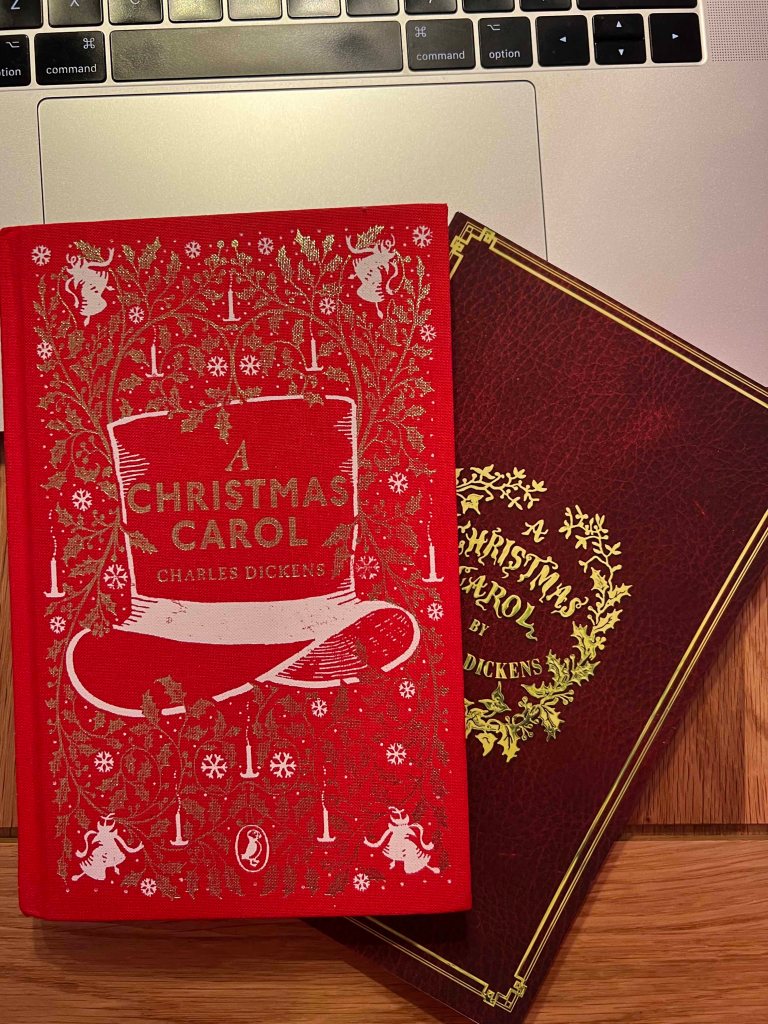
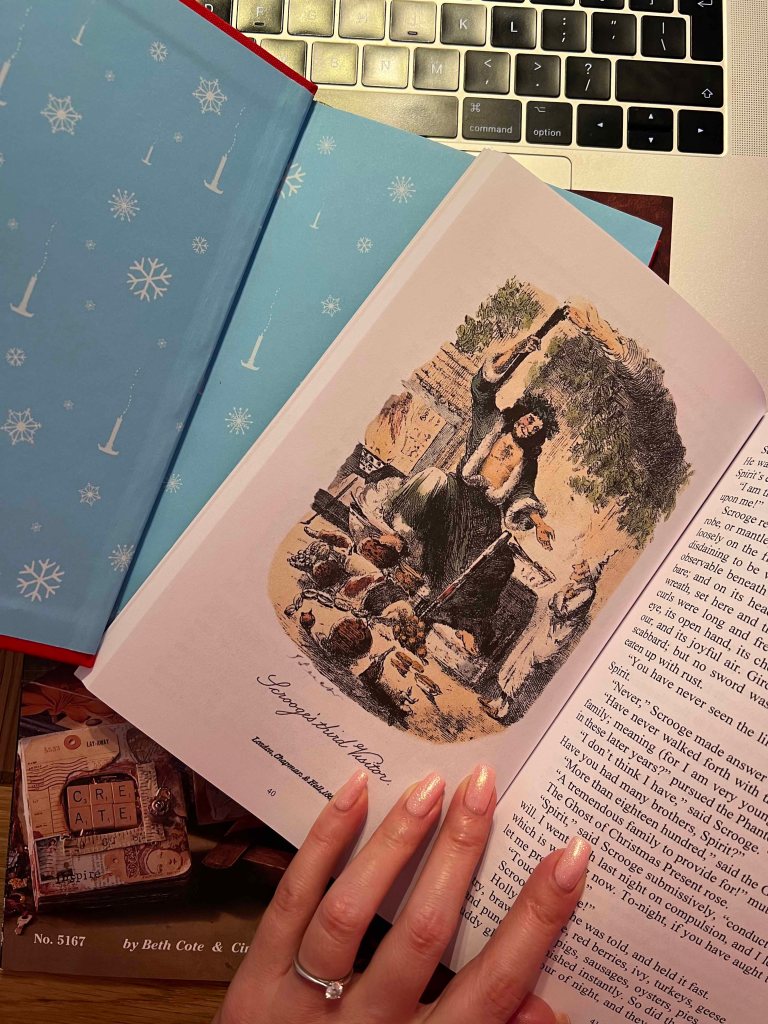
We – the discoverers of countries
conquerors of the air

In this design, I went a bit far from the original idea in my sketches. As I mentioned before, I was going to implement the sky theme here, so I thought why not try to show the man who discovers the Universe, which in my understanding helps to open a vision for the individuals too, we are conquerors of the space in some way. I tried different colour variations, but in the end left the image without text, as I thought the brochure could be overloaded with typography, so I went for the option less is better and left the image clean and with more free space around.

kings of orange groves
and cattle.

In this collage, I was going to use similar technics as in the first image, lense effect and colourful background but for some reason, it didn’t work in the way I planned. The blue colour and orange with filter were too bright and didn’t interact with the rest of the brochure I wanted it to. I added night sky in it, which helped to see the coherence with the rest of the images, changed oranges for the background with more natural ones. I thought that the visual of a cow in the crown is quite a comedian and funny, also being surrounded by oranges and citruses tree leaves is quite surreal in real life. Later the cow will appear more in my collages, as the key figure of the poem.

Perhaps we will drink
a glass of wine

to the health of the comets,

At this point, I realised that I have so many pages to work ahead, and I should not forget that all images should have coherence in them. It’s easy to get carried away and have different styles in one brochure when there are so many ideas and experiments that can be implemented into the design. I wanted to have one united piece of art with some variations in them, but at the same time be the whole. That was one of that cases when I had to go back to the image and redesign it, as the idea with the moon and piece of Mars planet was not too appealing compared to the rest of the images. So I decided to share the background with the sky image from the orange groves line. The picture of glass was from my mum’s sideboard, and that is the first visual that comes to mind when I think about rising the glass for the comets. That collage is probably one of the simplest I made here, but I was pleased with how well it worked with the previous image and similar colours palette with the rest designs.

expiring diamond blood.

Actually, this one was quite straightforward. As I had that visualisation in my sketches, I’ve literally could transfer it into the Photoshop layout. I didn’t overload it with filters and transparencies, but the blood added some creepiness to the image, and crimson colours worked well with the red glass from the previous page.

Or better still – we’ll get a record player.

For obvious reasons with this line, I went for the record player integrated within the collage. I tried some dancing couple on the back, but as to me that was missing some maturity, so I went for the abstract crimson background with some stars in it, and the head of the cow hidden behind. I didn’t overcomplicate this image, it doesn’t have as many layers as some of my previous pages, but the image combination still works well for the concept.

Well, to hell with you!

That is one of my favourite images, as it has all moods and emotions I wanted to show in this brochure. I discovered that juxtaposition collage approach over a year ago when abstract portraits became very popular amongst the music industry and creative art. I learnt different techniques through Photoshop tutorials, and I’m pleased that it helped me in this exercise, as I could use my skills in practice. That collage is quite easy to make, but it has so much depth and feelings into it, that I could call it one of the main characters in the brochure. Also, I changed the direction of the sequence slightly, and the rest of the images were evolving around this design.

hornless and ironed!

Here I was a bit stuck with the image choice. If I could do fewer pages I would probably have taken away this visual. But as I had to have fourteen collages at least, I had to push myself, that to invent some visuals for this line, which was quite tricky. I used the picture of my own from Sheffield bridge, and the image of the skull from the internet, added some filters in Photoshop, and here is the extra image, I was pleased that it worked well with the previous image, and kind of made sense for the poem.
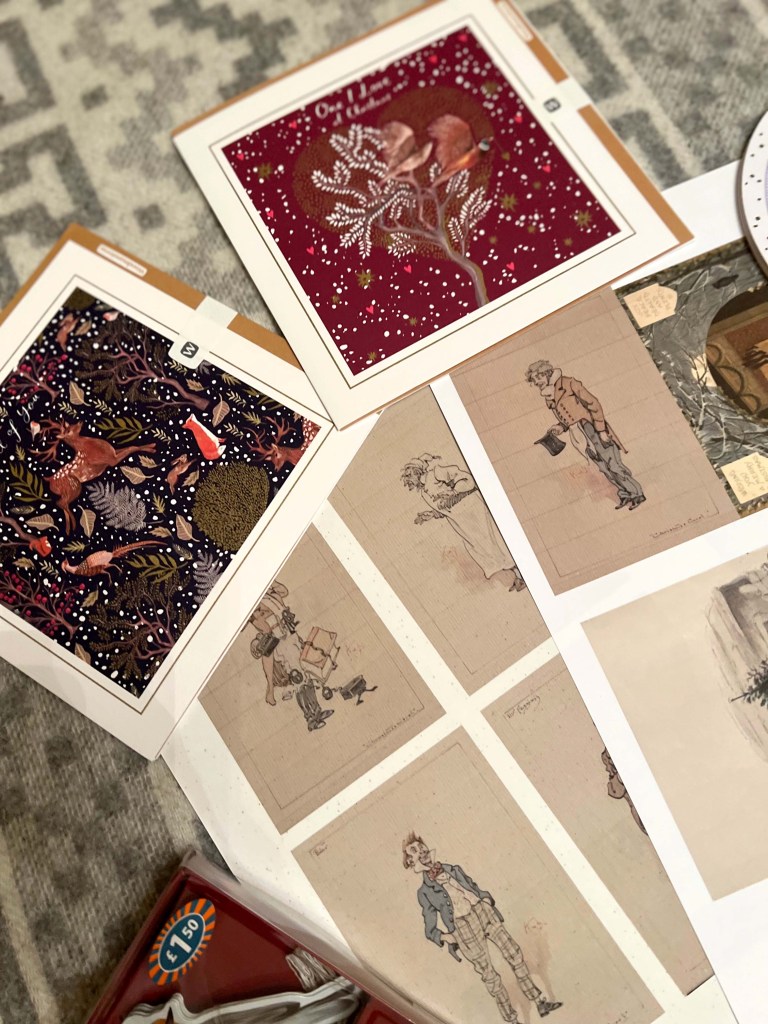
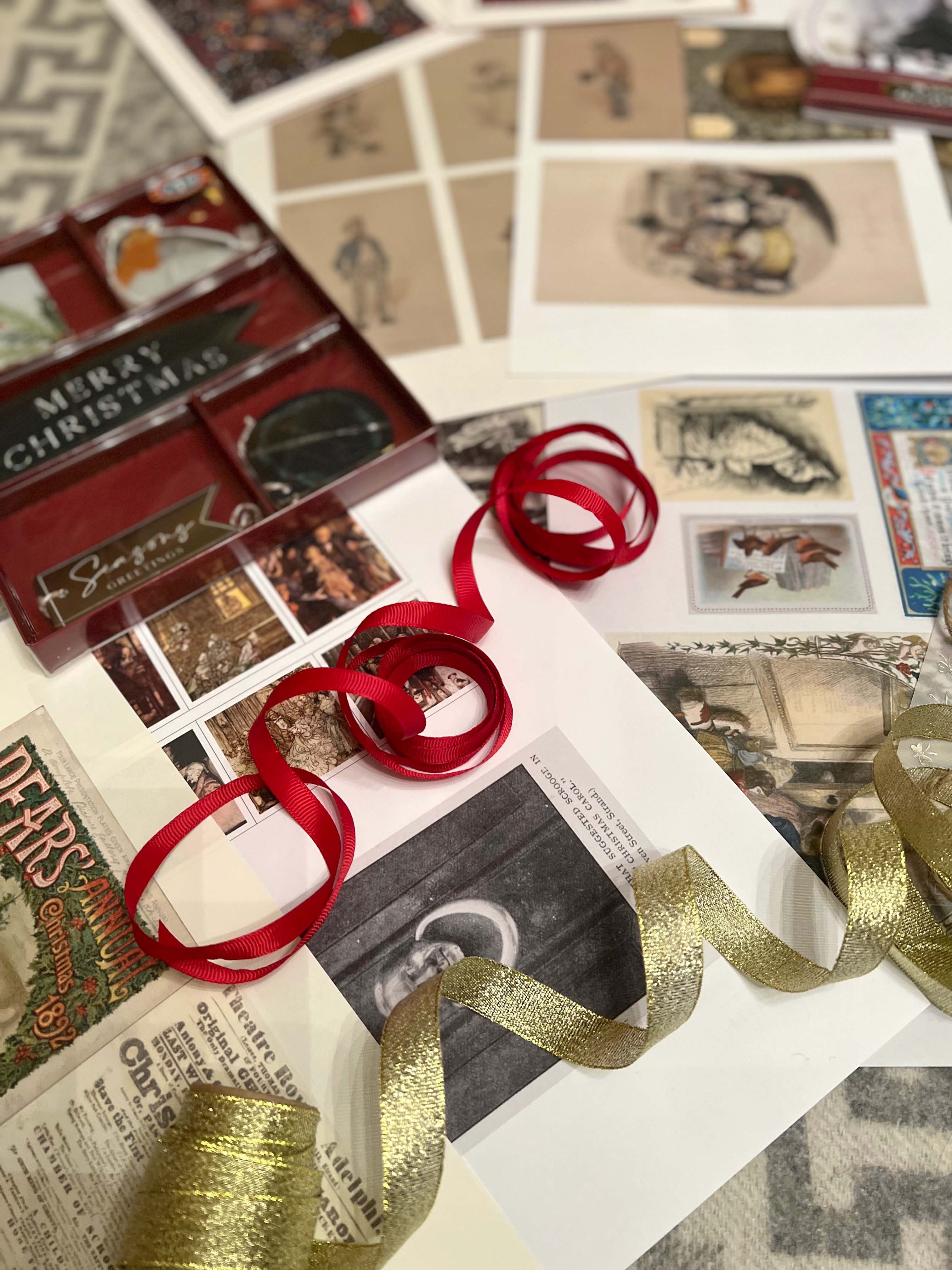
I want one – to dance one
tango with cows

To be fair, that was almost the last visual I designed, because it was such a crucial part of the poem, I wanted to make sure it will have the collective style from the whole brochure. It was not the easiest one for me, as I could not find the cow that wouldn’t look so sad, also, I was hesitating between using cow hooves or heads in the dance, what a dilemma…However, I came up with the solution I visualised from the start, a dancing couple with cow heads. I loved the mood and colours of that collage, I think it summed up the whole idea of the sequence and collage that I had in here and matches well to the mood of the poetry.

and to build bridges
from the tears

In this image, I was going to keep a similar colour palette as I had from the beginning, violet and blue shades, as there are tears and cold shades of the bridge, but I didn’t like how this particular visual looked in these colours, so I couldn’t do anything else but change the colour grade completely. I was fascinated by how vital the colour choice can be for the picture, as that juicy red and yellow colours changed the design completely, but at the same time, it stands out so much compared to the rest of the images. I knew it was different, but I was hoping it will work with some orange bits I had in the brochure, but the visual itself looked great, despite its oddness colourwise. In the corner, I added text in a few fonts, which made it looks like a poster.

of bovine jealousy

This image I created to the pair of the last image from crimson girls. These four images of a man in a suit, crimson girls and dancing cows sort of share similarities in artistic style. These designs are based on vintage pictures by adding a visual psychedelic touch. When the two universes blend, they create a series of portraits covered by graphic and colourful elements, hypnotic and surreal compositions.

to the tears
of crimson girls.

For the last image I went for a creative vision of the girl who smiles; she doesn’t have eyes, as they disappeared in distortion, but there is still a tear on her right cheek. Here can be seen the formalist relationship between images as they are removed from their original context. The last two images work together as a tandem. They helped me to finalise the mood in the brochure and understand that how vital coherence and mood creation is in design.

All designs together

Reflection

This exercise was an amazing experience for me, I have never created multiple pages brochure with that amount of creative images in one collection before, and I’ve learnt that imagination and creativity can always go beyond the level. I found that how vital to follow a similar pattern and coherence for the brochure, also discovered that design can be represented through a set of sequences, not as a usual book, but closer to the artist book way. I love how an image can speak to the reader with no words and behind all, that abstract and imaginative collages represent the message of the author. At the same time, I met the challenge here of missing the pure similarity in style for the visuals, as I wanted to keep the reproduction of the collages on a high creative level, some images look less complicated and more straightforward compared to others. I still had to go back to some of them that to adjust the style and keep the manner in design as coherent as possible. I hope I met the brief, and that brochure could gain interest among the potential audience.