
Using a found book, significantly alter the appearance of the pages to create a new volume that is personal to you. This can be any kind of book that is of interest to you. For example, a fiction book, a non-fiction book, a picture book or a photo book.
Approach the found book in a very physical way, manipulating the pages and paper inventively. If you need to, stitch or glue a number of pages together to reduce the ground you need to cover. Decide what to remove from the book, and what to add. Use the found book as a source of ideas and inspiration – the existing text may inspire illustrative, conceptual images, collages or typography as images. Embed, overlay and integrate your work into the existing pages using whatever materials, media and processes you feel necessary. This may be digital, hand-rendered, photographic, textile, or a combination of all these and more.
Think about the relationship between the content and the form, the design (text and images), and the materials you use, such as papers. Perhaps you are creating a new sequence within the book?
Change the book from its original form into a different form, altering the appearance and/or meaning. Apply an inventive, intuitive response to materials and how these can be exploited within the context of the altered book.
Refer to your contextual research into artists and designers in the unit so far. Use elements of your research as inspiration and to inform your book-altering practice.
Primary research
This is a very exciting assignment to come up with at the end of Part 4. I’ve never been so curious and intrigued before, as that is going to be a test skill for me as well. Mainly this assignment is based on handmade skills, and the ability to adjust the existing materials into something new. Also how we can plan the process well in advance, as there won’t be a way to go back and change the concept as we do in digital exercises. I was expecting this type of assignment to approach at this stage of the course. Earlier in this Creative Book Unit, we explored artists’ books, that are made as a masterpiece individually without connecting to the particular story of the book, they hold historical, cultural, or environmental messages within them, when altered books based on similar principles in terms of design and decorating, but the design is based on the context of the book.
An altered book is a form of mixed media artwork that changes a book from its original form into a different matter, altering its appearance and meaning. If an altered book artist takes a book, whether it’s new or old, it can be modified in various ways, such as cutting, tearing or folding, or embedding objects.
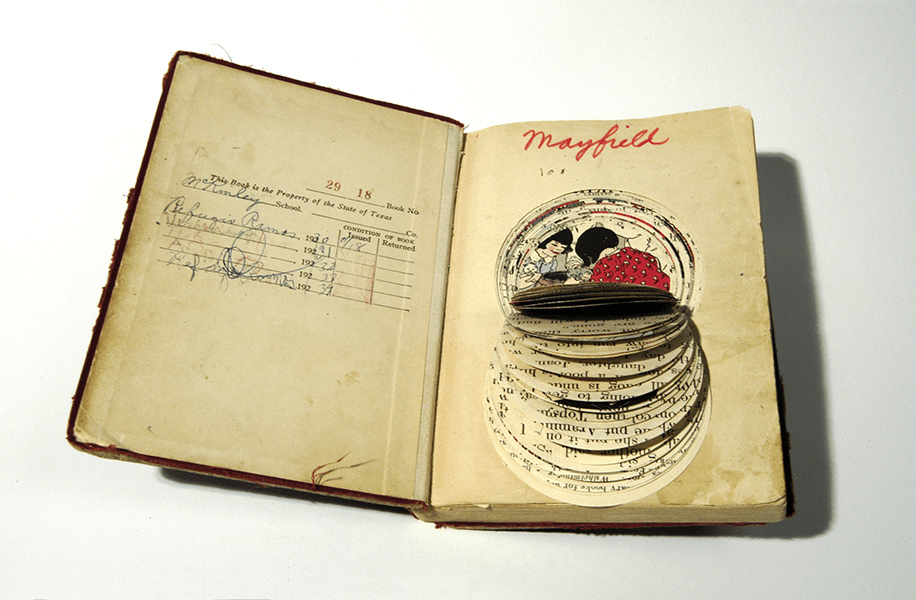
I found this collection of unique altered books, with beautiful designs within them, and some amazing ideas. They are all done in one sample and classed as collectable items. I loved the variety of different manipulations that can be applied with the altered book, and how various and diverse the altered book art can be.

https://www.bellevuearts.org/exhibitions/past/the-book-borrowers
https://www.bellevuearts.org/exhibitions/past/the-book-borrowers

https://23sandy.com/products/later-a-myth-was-developed-by-james-allen-sold
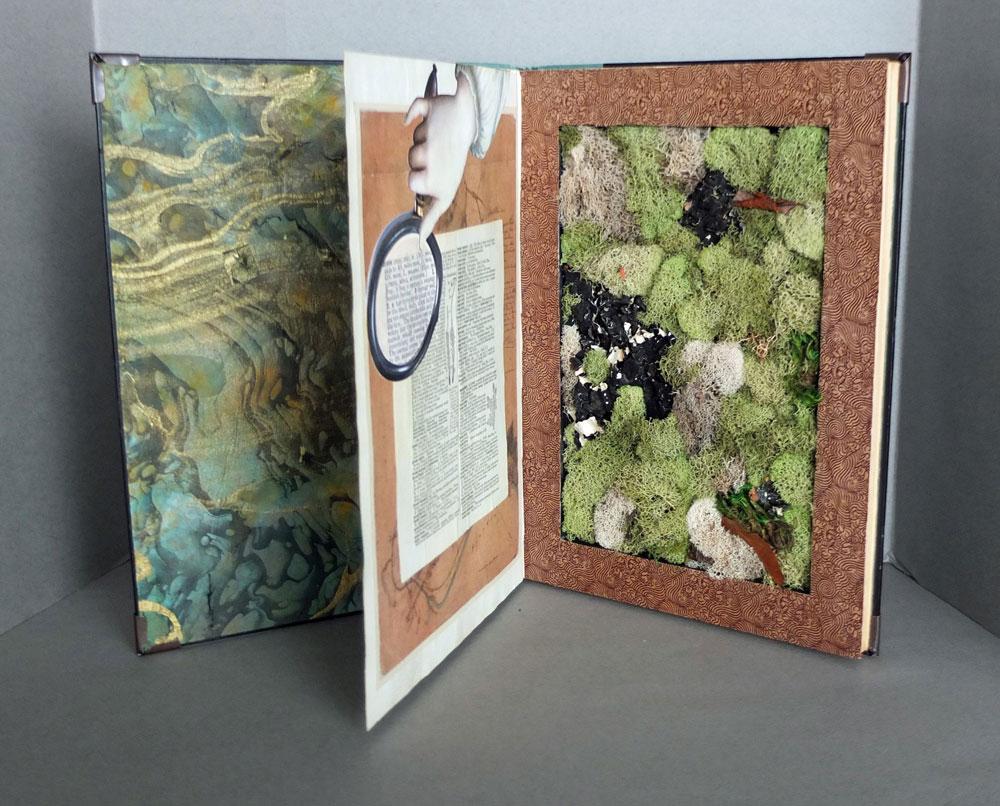
A Book of Mosses, Lynn Skordal, 2017
https://23sandy.com/products/a-book-of-mosses-by-lynn-skordal-sold

of Two Worlds.
for Aleppo
Linda Welch, 2017
https://23sandy.com/products/of-two-worlds-by-linda-welch-sold
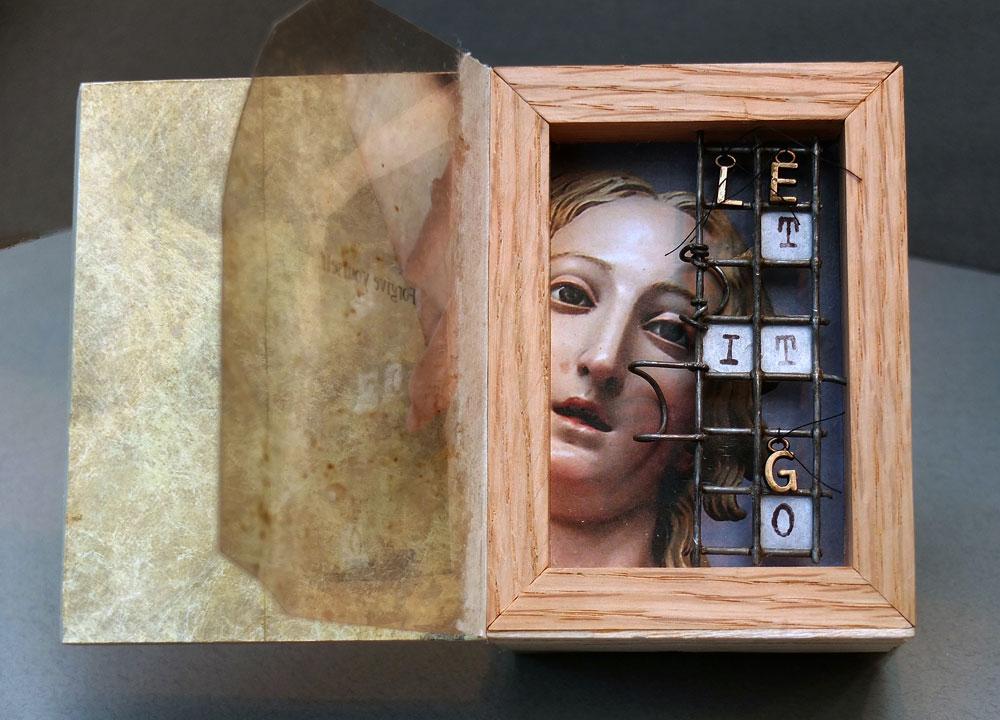
letting go. Lynn Skordal, 2014
https://23sandy.com/products/letting-go-by-lynn-skordal-sold
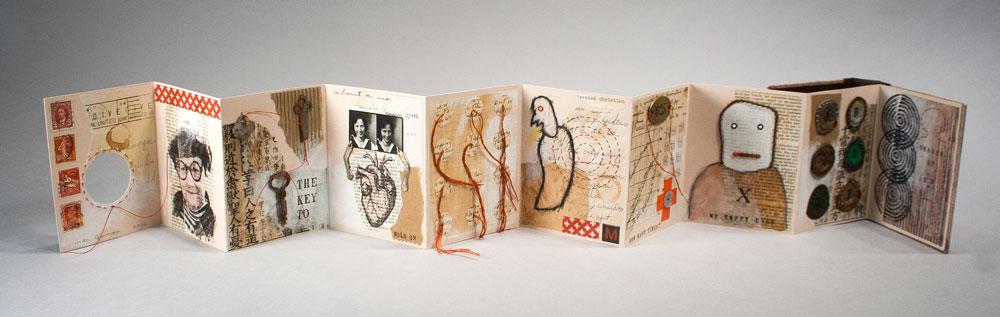
https://23sandy.com/products/almost-empty-by-mar-goman-sold
Altered books are impossible to read, but they are an amazing addition to the library if the reader is familiar with the story already. I was excited to see what the market holds as examples for the altered books. Some of them are amazing masterpieces of art. I think those artists are just incredible at carving, obviously, with great imagination and artistic skills. I’m not expecting myself to learn how to create a 3D book straight away, but can definitely bring some creativity and charm into the altered book.
Actually, creating 3D shaped book calls book excavation, which is a sculptural work of art made by transforming various types of old books using precise cuts with a scalpel or knife, carving pages one by one until an astonishing new composition reveals itself. This almost surgical focus of dissecting books results in a wholly new object infused with a graphical history that evolves as the artist exposes each layer of the book while cutting around interesting images or text. Finished book excavations often appear as cross-sections of the book, carved to create an alternate universe previously hidden between the covers.
Brief
Collecting those ideas as an inspiration board gave me some directions on what I was going to create in my altered book. I made a quick brief for the book I was going to work with and placed some keywords and a mind-map for the chosen book.

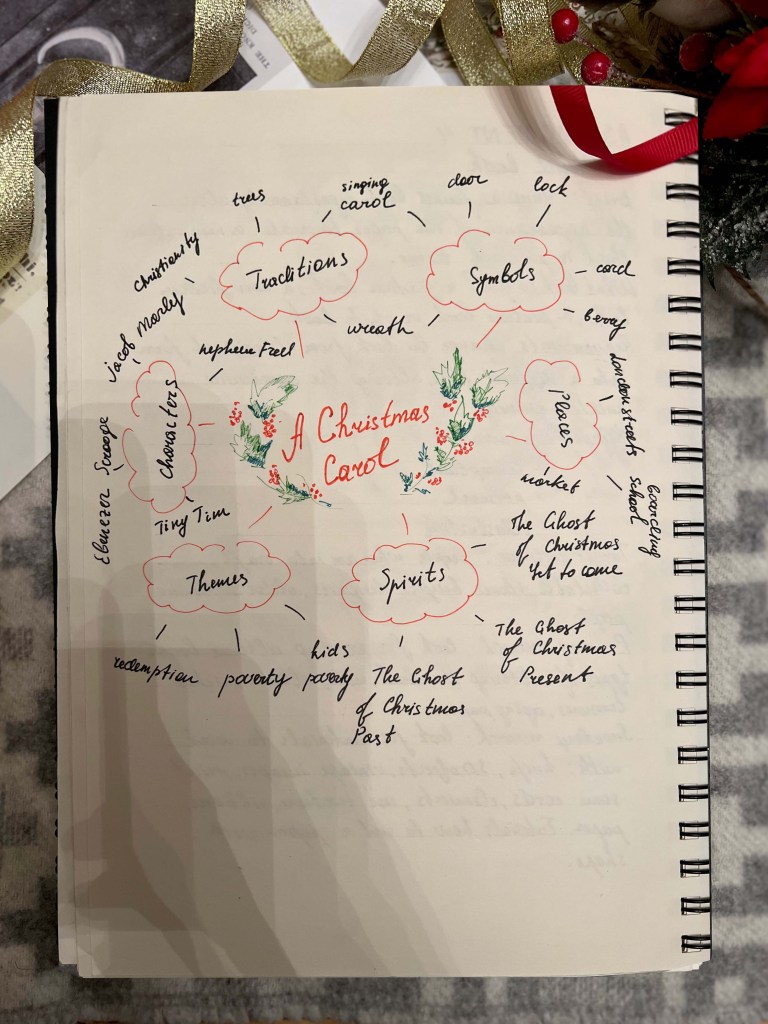
Choosing a book
It didn’t take me long to choose the theme and what kind of book it is going to be. As I started this assignment at the end of the 2021 year, my heart was on the A Christmas Carol book by Charles Dickens as a symbol of festive season celebrations. That is the perfect time for the Christmas spirit and I was surrounded by Christmassy attributes and a feeling of merriness and joy, would be great to transform it in the altered book design. I’ve discovered the A Christmas Carol film only recently, for some reason the story was not as popular in Eastern Europe. I’ve heard about it, but have never read the book, so I bought it two years ago to learn the story and the ecranisation of the story in the film gave me a better understanding of it.
I love the concept of the book, Dickens inspired the main aspects of Christmas, including family gatherings, seasonal food and drink, dancing, games and a festive generosity of spirit. Also, Dickens put a “Carol philosophy” of charity and altruism into this story.
During the Christmas tree decoration, I was looking for some attributes I can borrow to implement into the altered book. I wanted to make a Christmas wreath shape for the book, and create a new object from it. I’ve noticed similarities between altered books, sculptures, artist’s books and scrapbooks, they are all quite merged together, but still, have individual features where the difference can be seen.
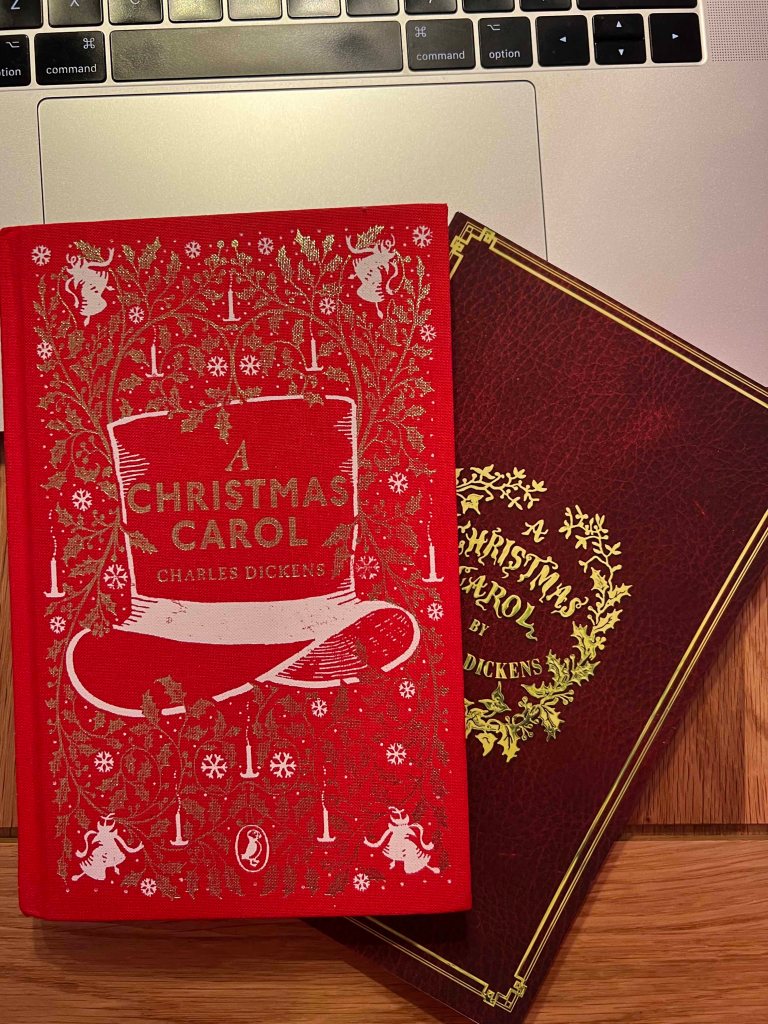
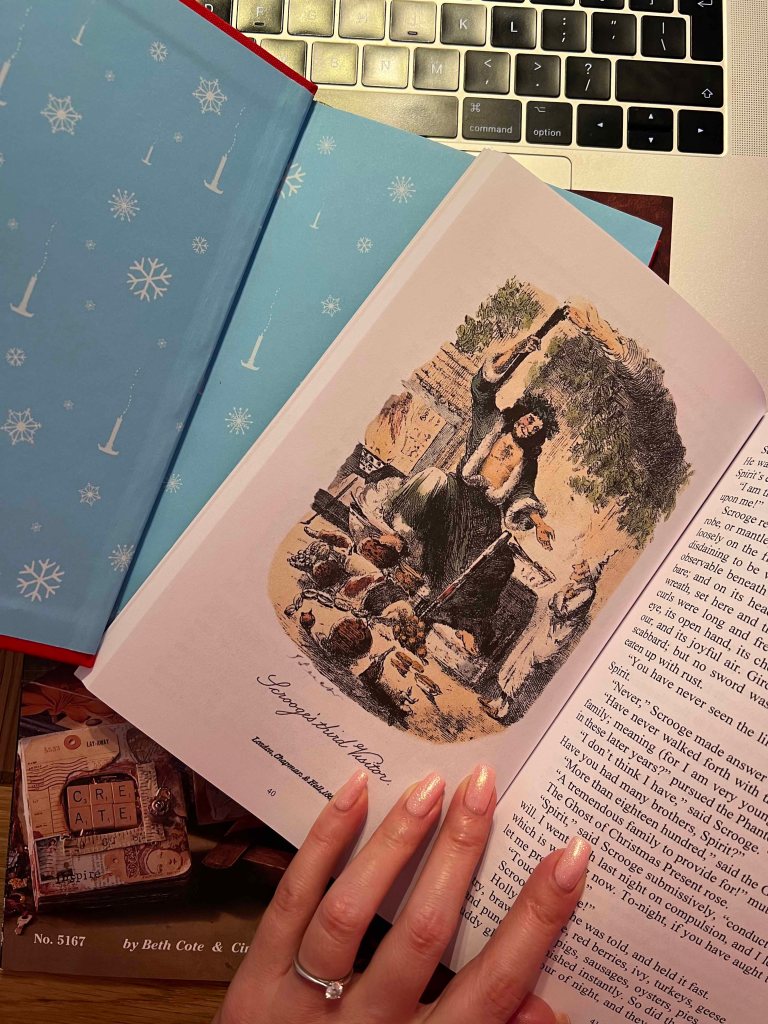
I had a book of A Christmas Carol on the softcover, but I’ve read recommendations that the book should be with the hardcover, as it is better for adjusting, and it keeps the shape firmly. Because of that, I ordered a version by Penguin Publications in the festive red cover with some gold designs around it. I didn’t know where to start altering the book, as I was worried that I can just destroy the book without the possibility of going back like we do working in the software, so it took me a while to be brave enough for some first cuttings at the book. I thought it will be a big deal for me to cut pages or paint on the pages, as in my head the book has always been a sacral object. But I thought I will let the creativity flow and will do my best to create a new piece of art with it.
Sketches
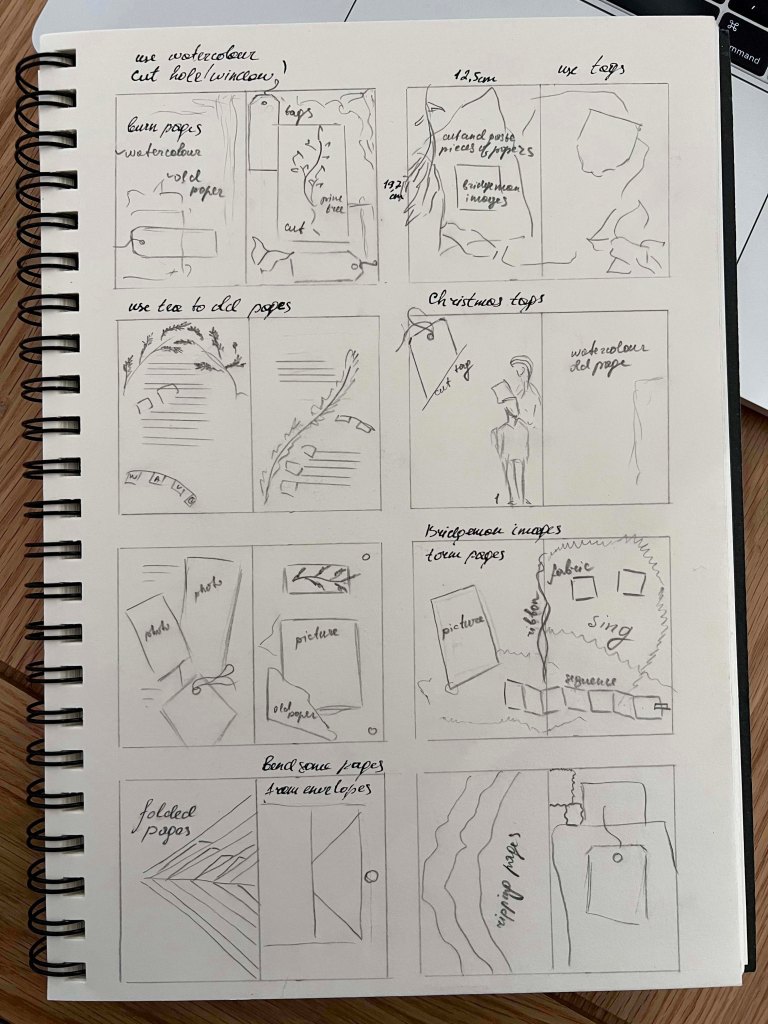
I had so many ideas about how I can redesign the book, so I decided to create a quick sketch with a brief map of various manipulations that can be applied in an altered book.
- To start with, I was going to cut a window in the first pages and place an object or picture inside of it. I didn’t want to cut it too deep, as I wanted to design about 8 to 12 spreads. Maximum 6 pages deep a window. The window cutting was like a symbol of entering into the story, the book is open for the reader, and holds the mystery in it.
- Also, I was going to use lots of Christmas tags and images around it, pine tree branches, most likely artificial, bows and ribbons. I wanted to bring that feeling of the book to explore, the illustrations on those tags were going to be from the story, rather than them to be just on the page, to bring a bit of tackle and explore feel to it.
- Multiple bookmarks from red and golden ribbons.
- In addition, I was going to try burning the edges of the paper techniques and sticking to the page fabric or gauze. I wanted to try to distort the book as much as possible, applying the principle of the book being through a lot of alteration, I was curious how much it can handle and compare it to the professional altered books market, as some of those books are quite valuable, as all made individually, based on people’s imagination and creativity.
- Another technique I was going to use is sewing some pages and leaving some stitches around the edge of the book.
- For one of the spreads, I wanted to glue a sequence inside, and use old images from the book story.
- But the main point was going to be around watercolour and its natural characteristics of bending and distorting the paper. I didn’t know what feel the book will have, I wanted it to be artistic and playful, so I was excited to tackle it.
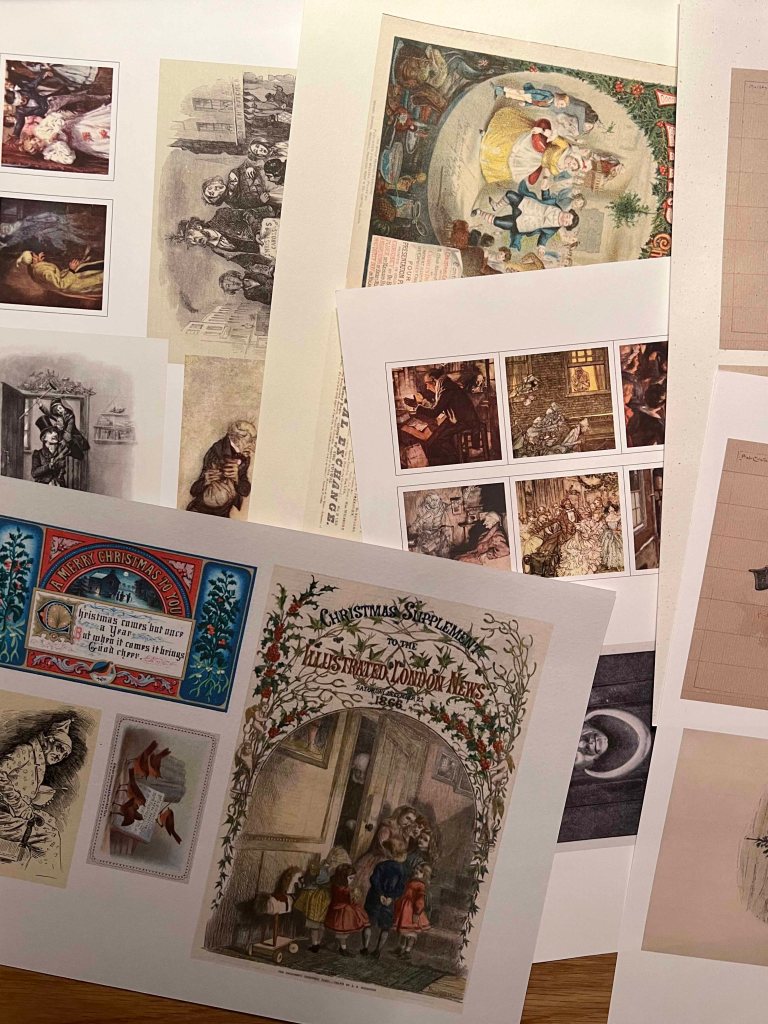
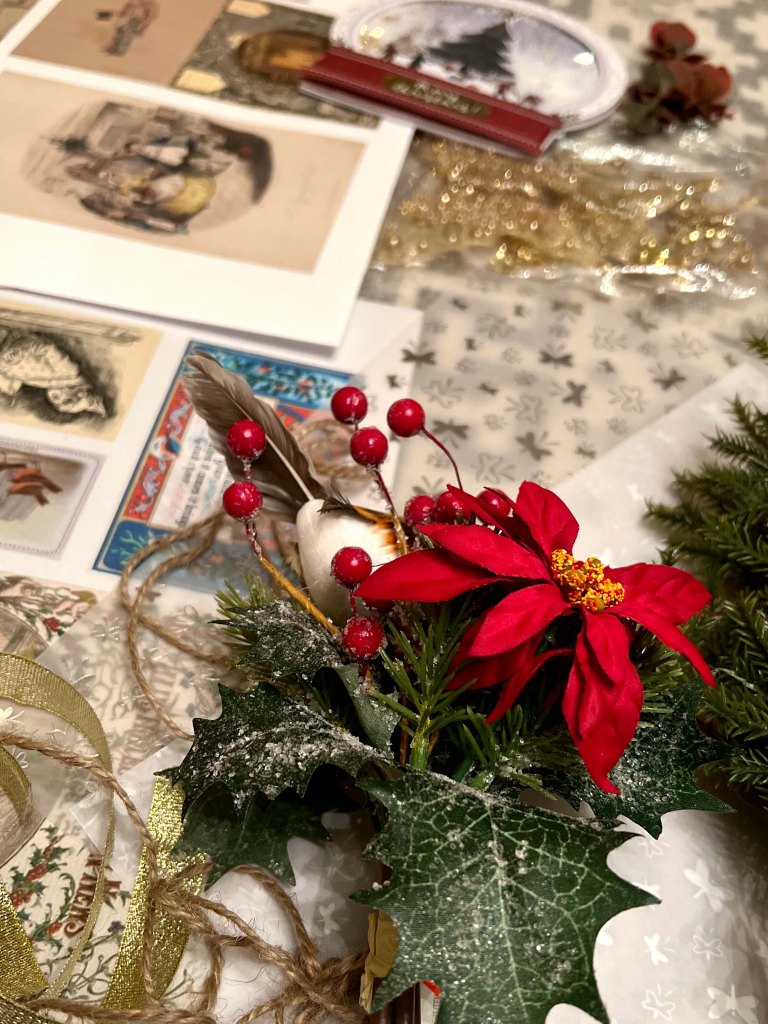
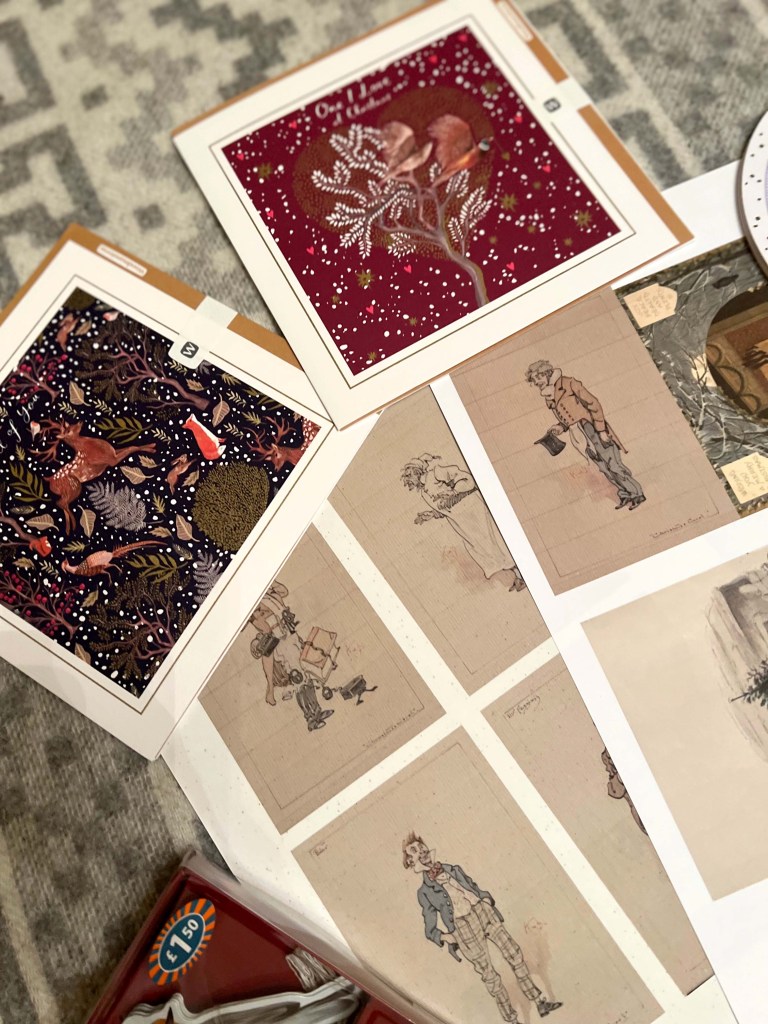
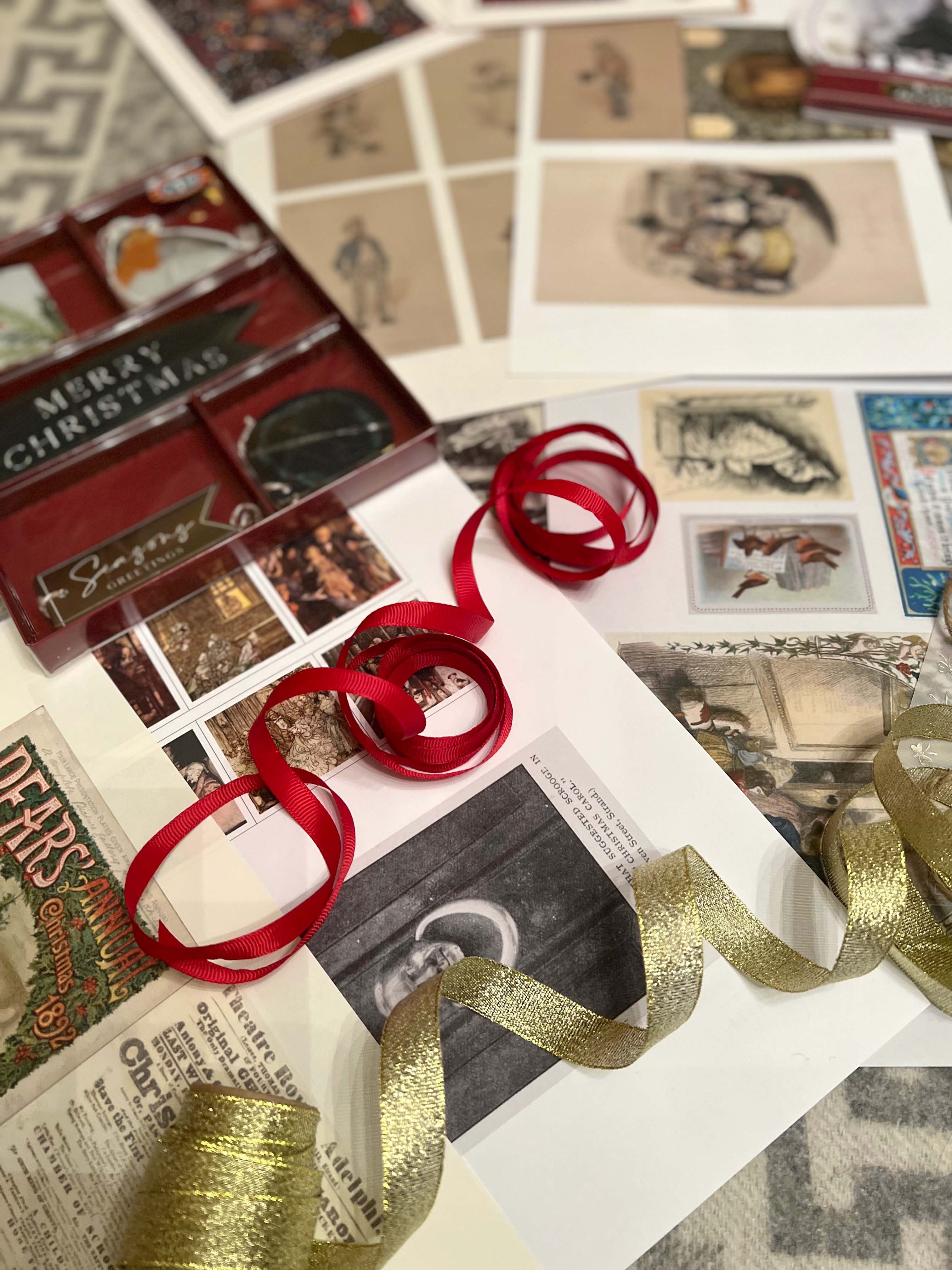
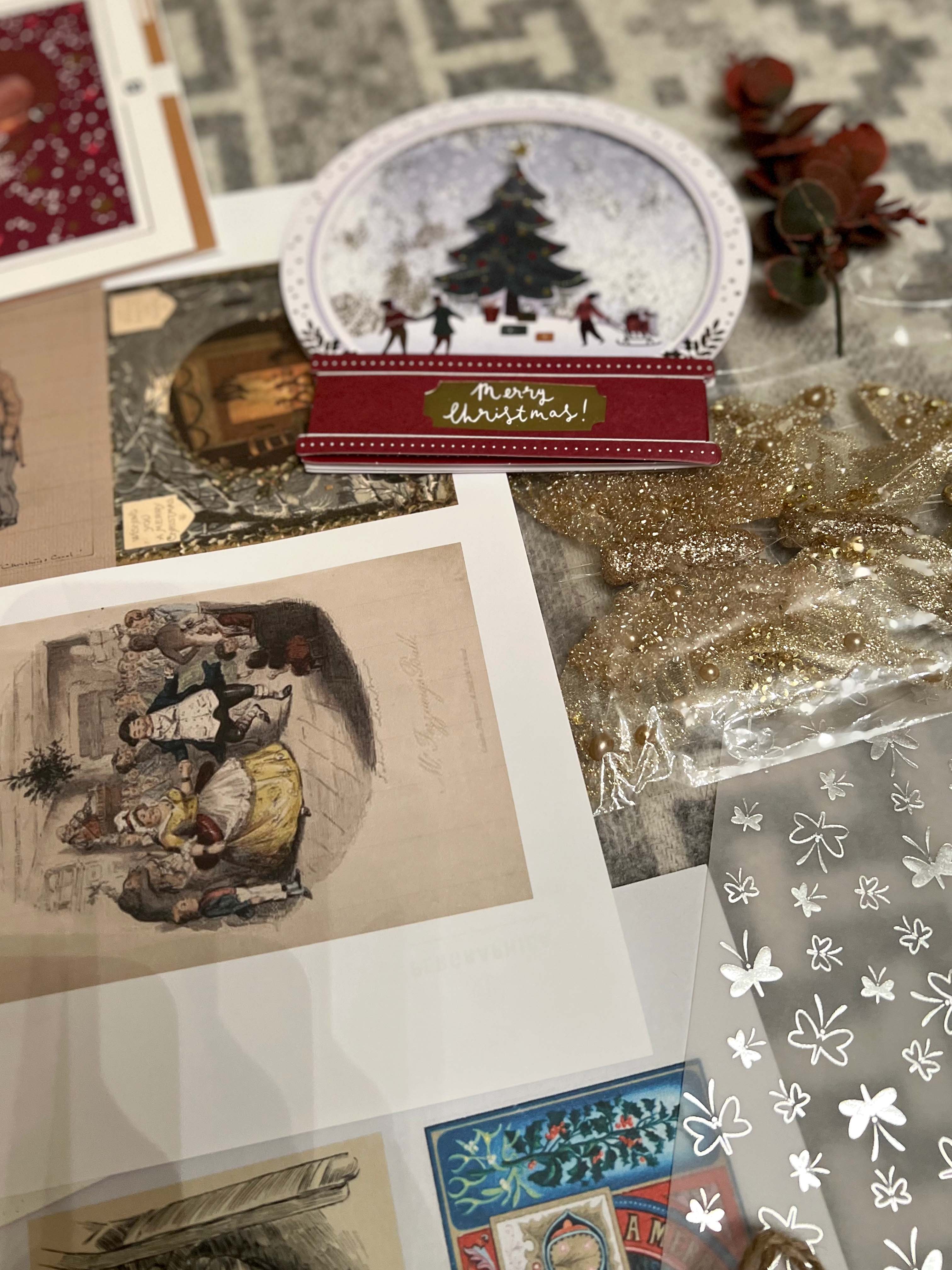
I had a trip to the local garden centre where I could buy some Christmas attributes. I bought golden butterflies, a pack of tags, wrapping paper, bunches of artificial flowers and pine trees. I was going to use them as 3D objects for the cover, and some designs to place inside of the window. In addition, I printed some images I found from Bridgeman Library with A Christmas Carol theme, they were made as illustration parts to the first books, some sketches from various artists. I thought will be a great idea to keep that vintage feel in the book. I didn’t want to overuse commercial cards, as they would be too obvious materials to work with, but just in case I kept them on the side.
Designs
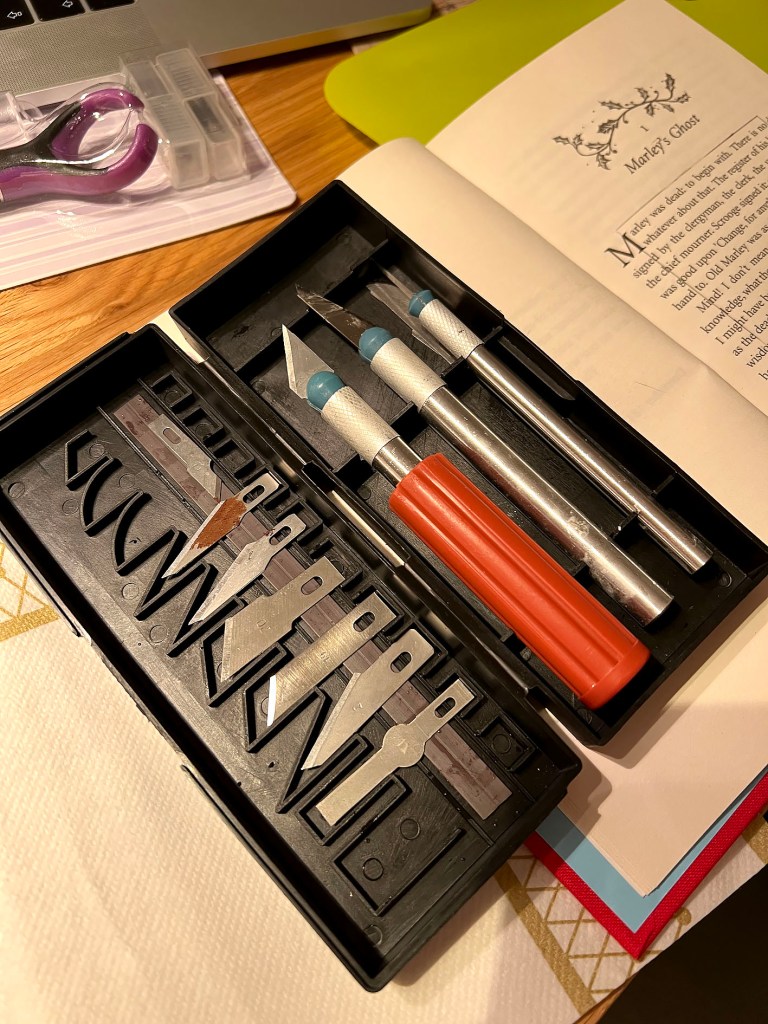
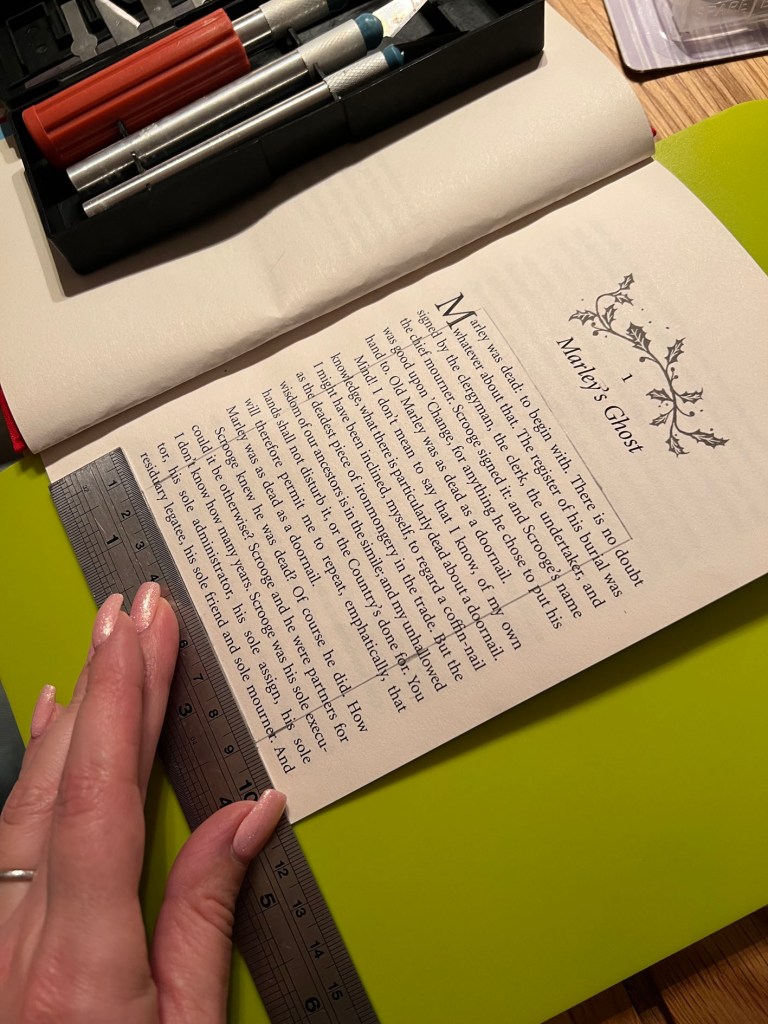
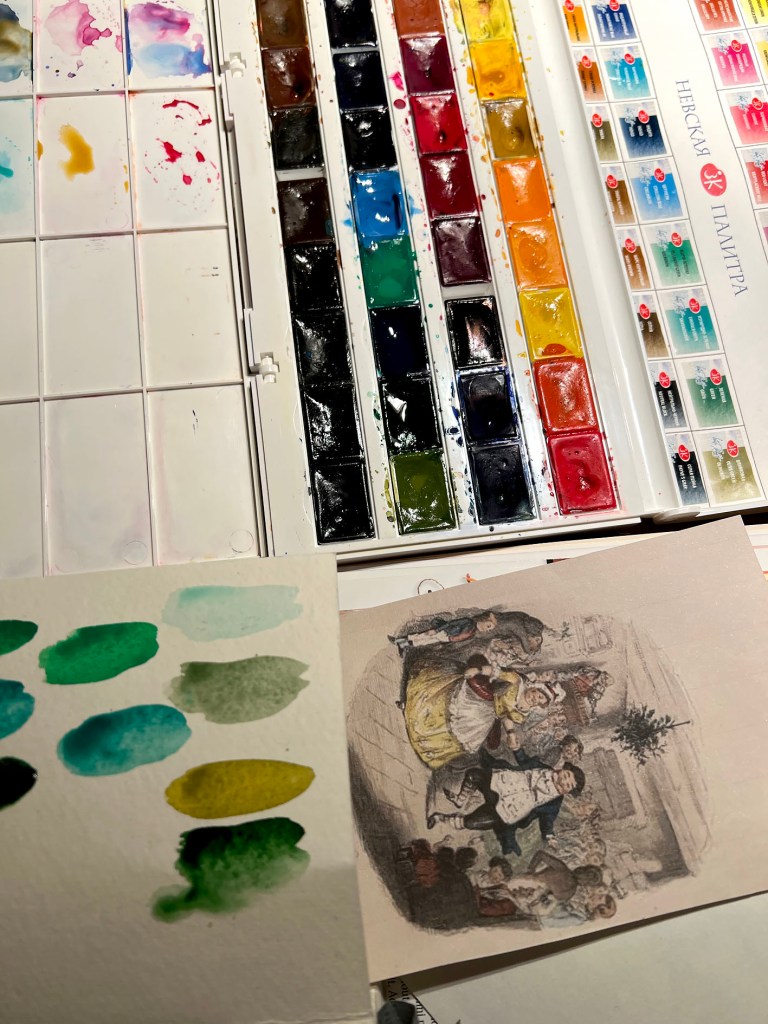
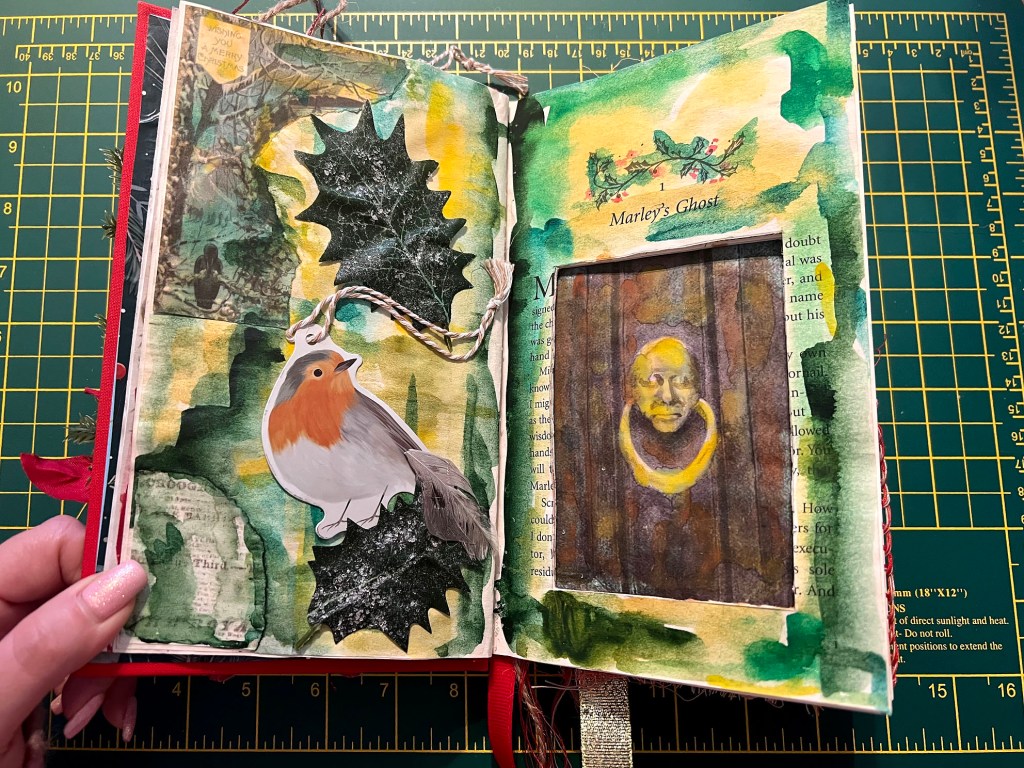
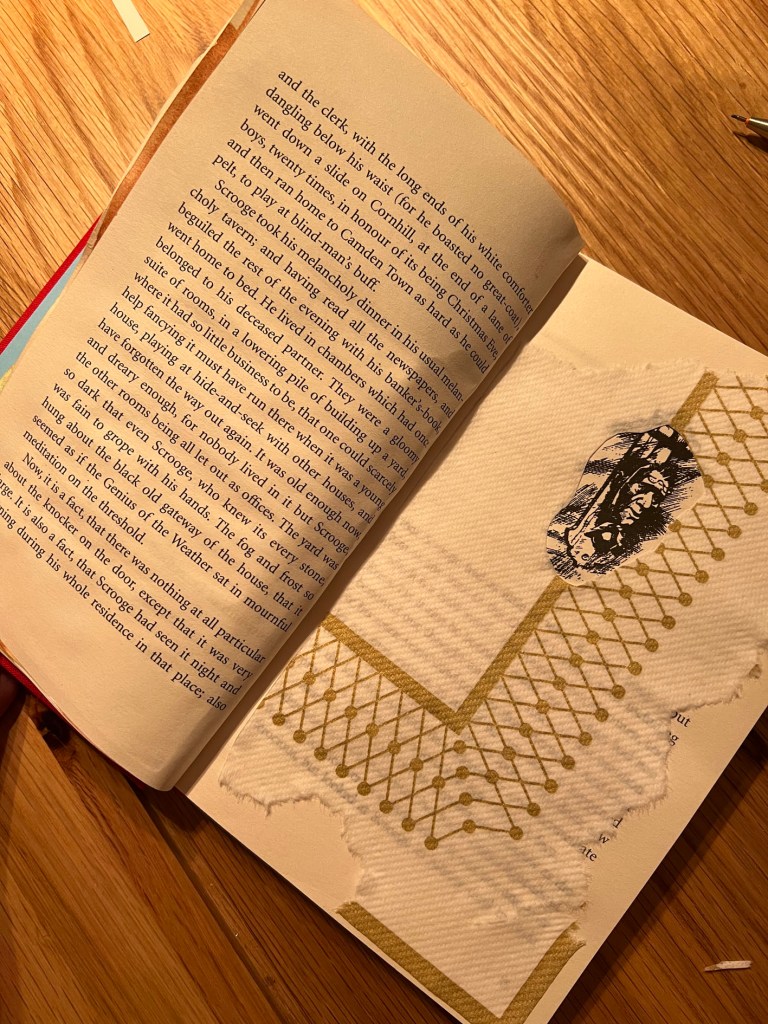
I prepared all materials I was going to work with, a set of knives and blades, which were not sharp enough to be fair, so I had to cut those pages in stages, a big set of Saint-Petersburg watercolours and some Kolinsky paintbrushes. I cut an image of Marley’s ghost and stuck it inside of the window. That image looked spooky, was curious to see how that closed eyes face looked through the window cut. For the colour palette, I was going to use green colour with some brown shades, as I was going to implement some images of trees, forests and leaves around it.
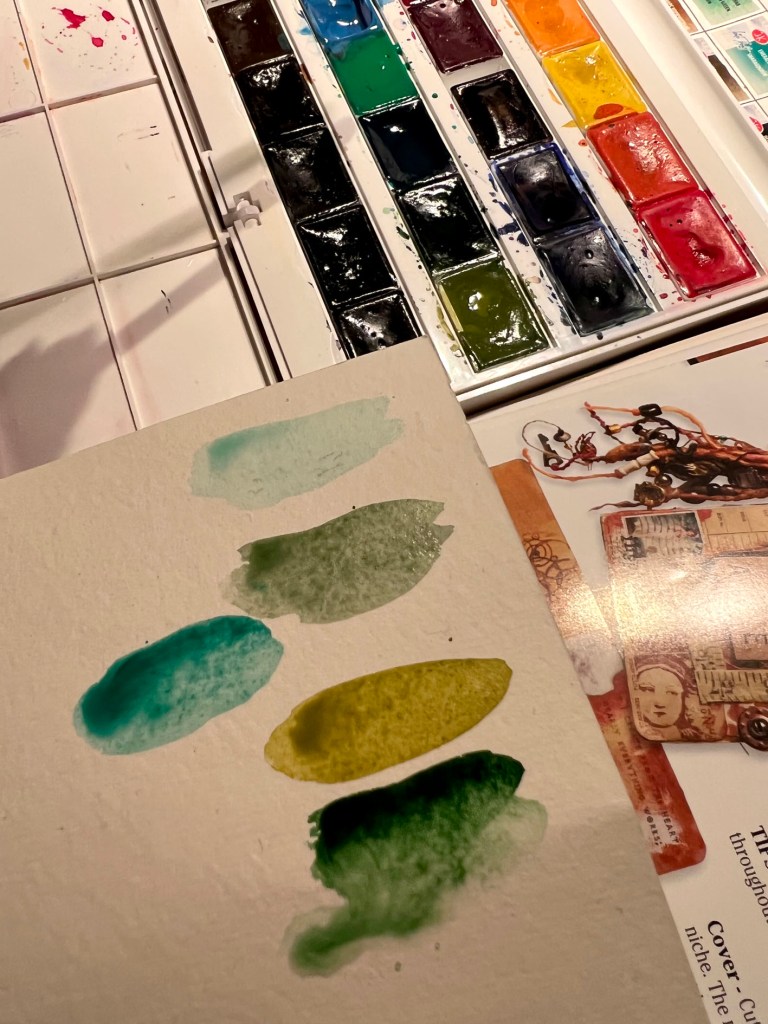
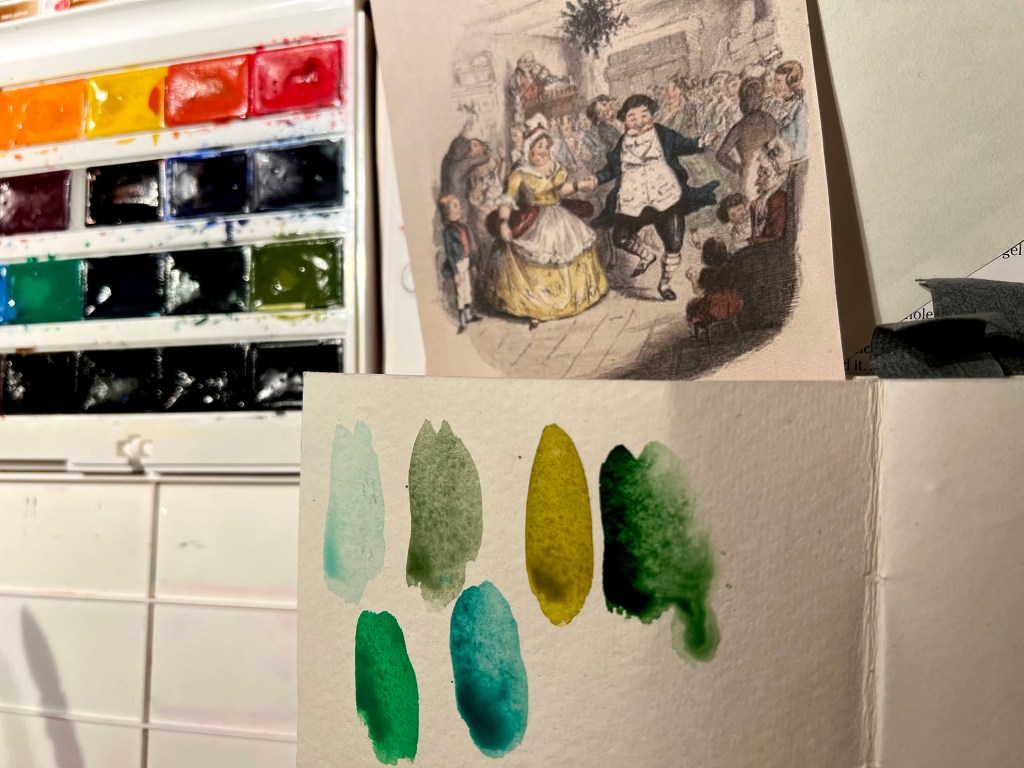
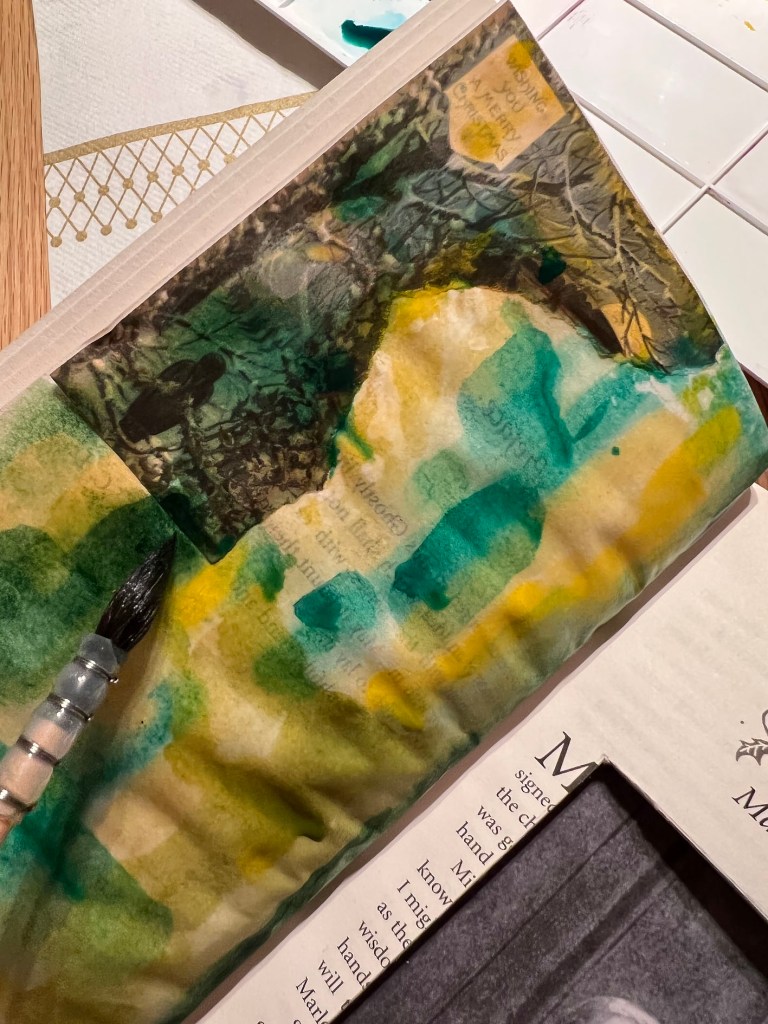
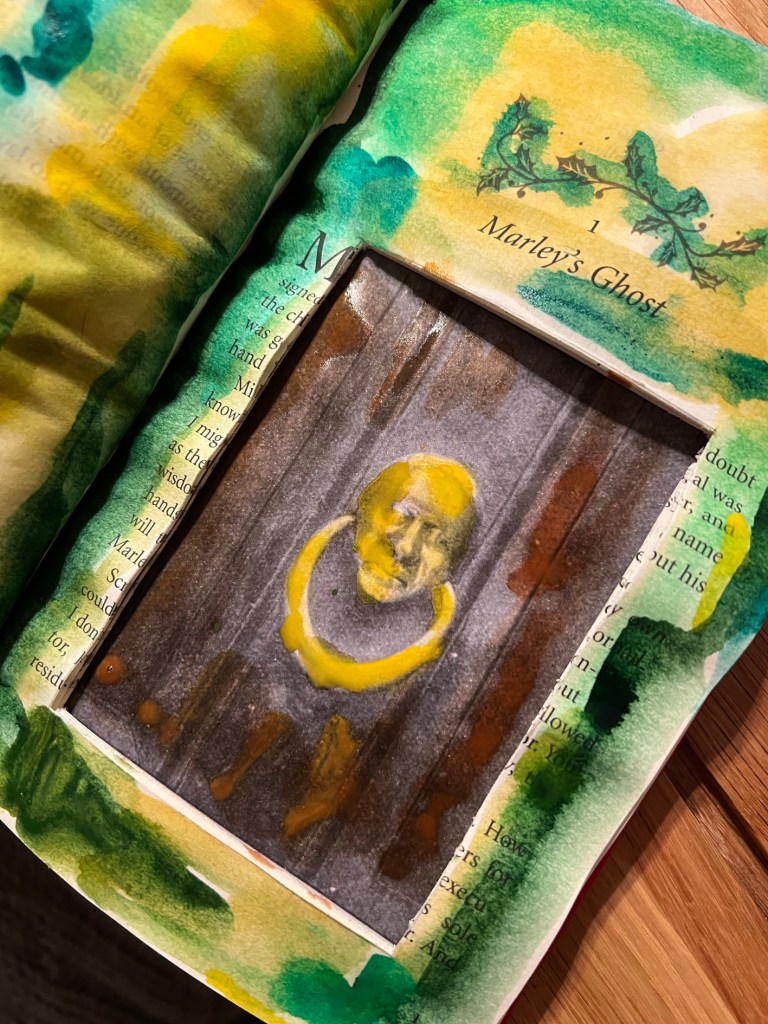
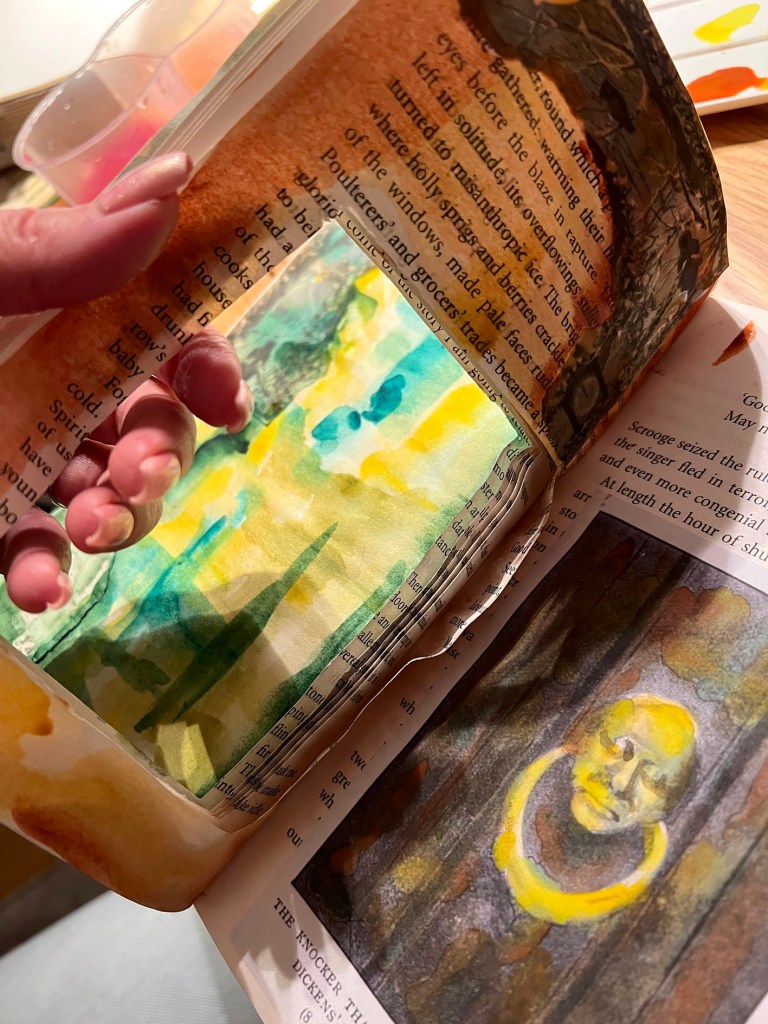
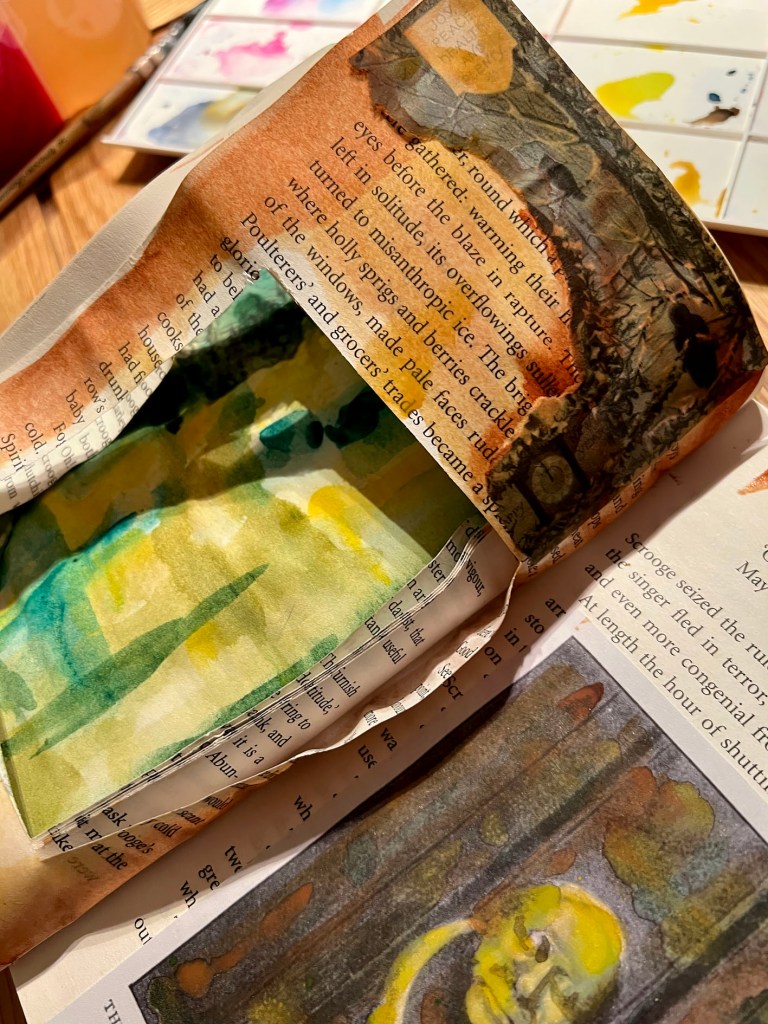
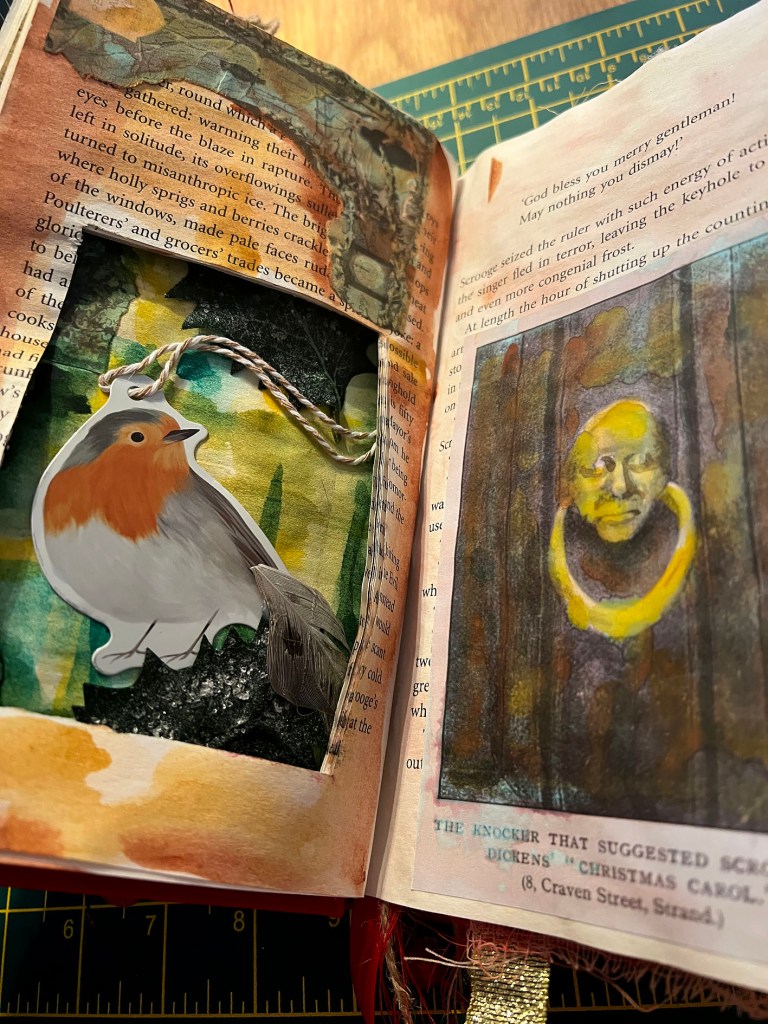
The idea was to glue for the pages torn edges prints and go with some watercolour over the top of it, I liked the texture it was giving to the page. That was a good starting point for the book, it helped me to have a feel for the rest of the design. I could see that some more work needed to be done for it, but I was hoping that pages can go progressively better with some more experiments.
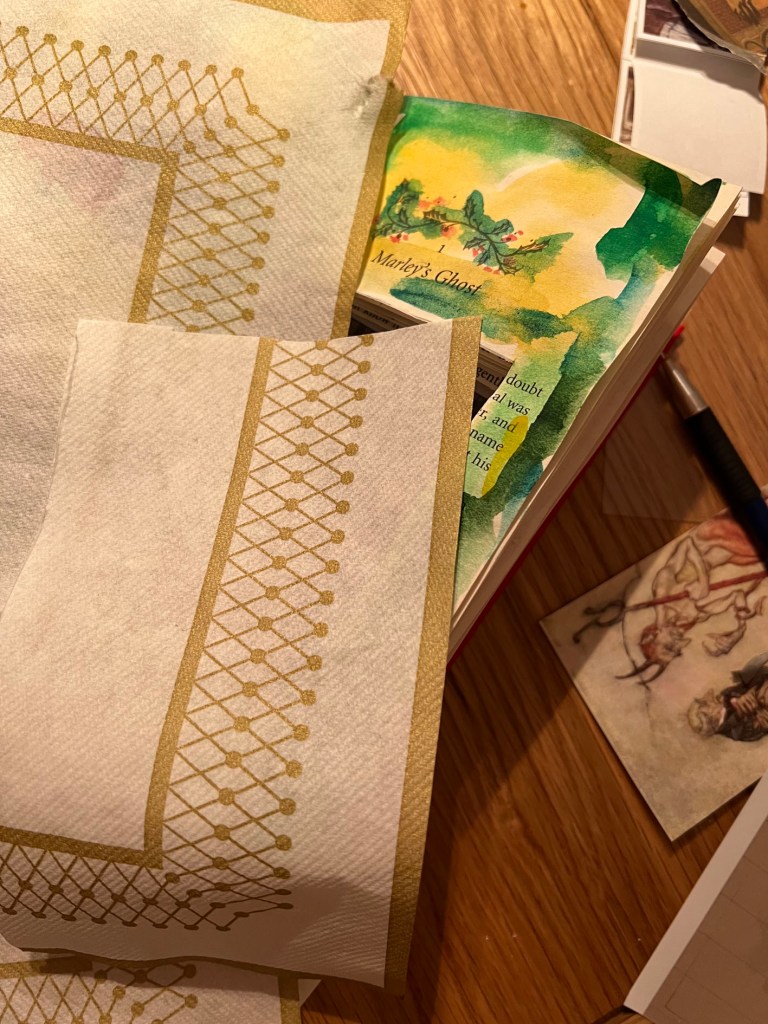
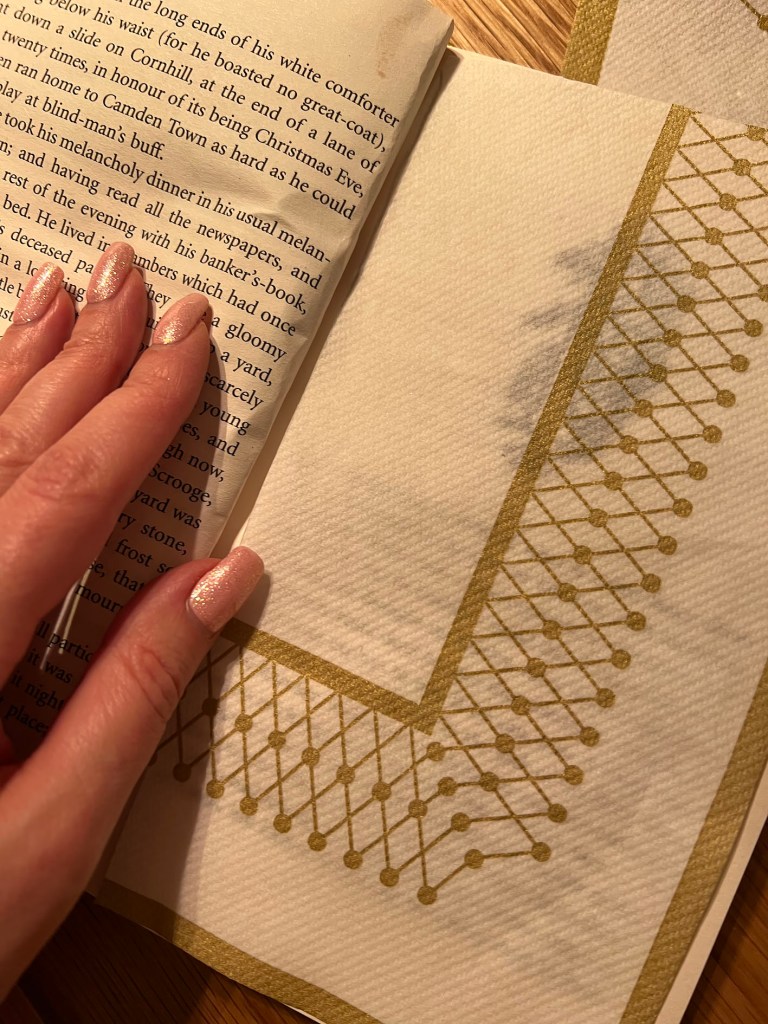
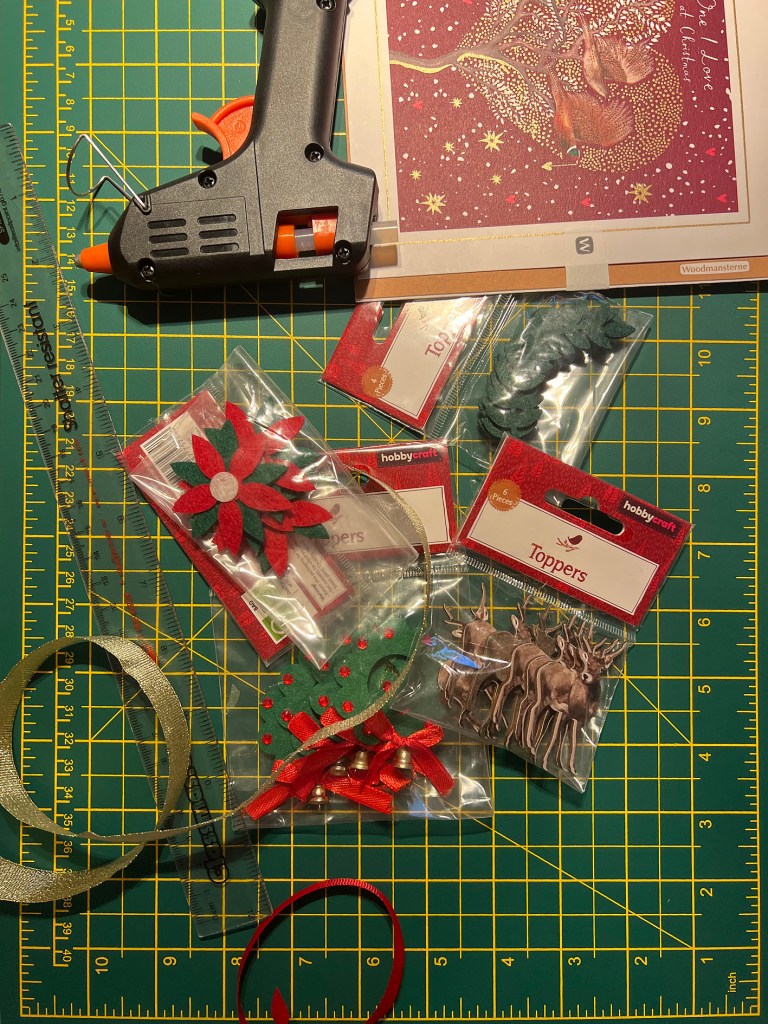
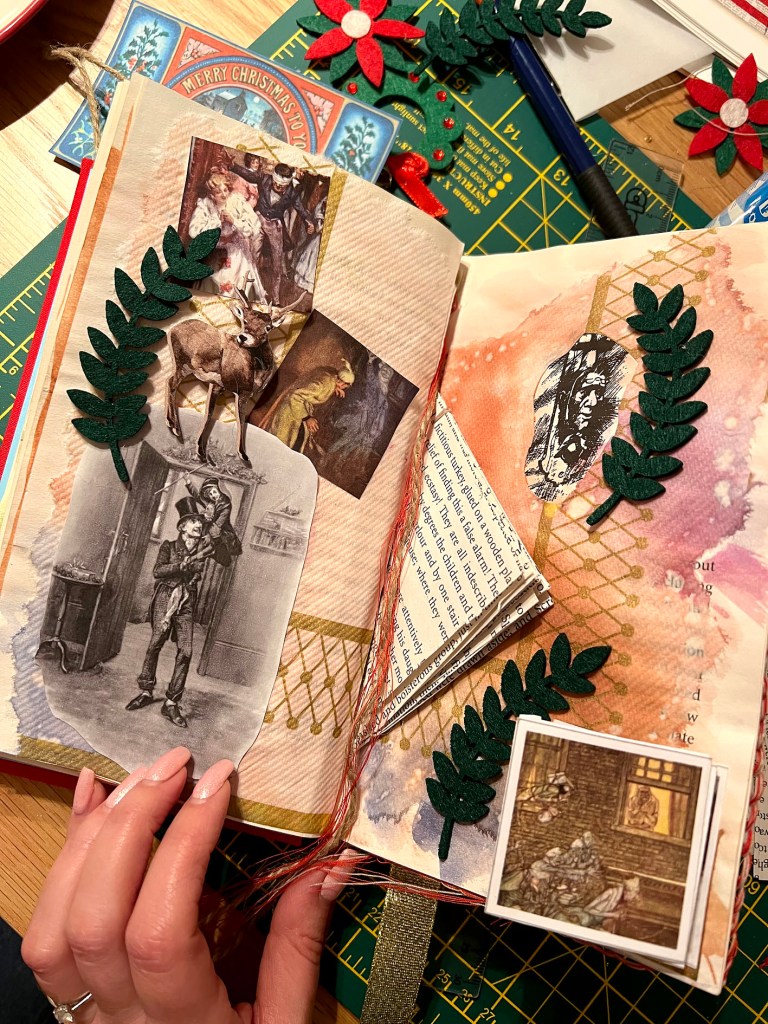
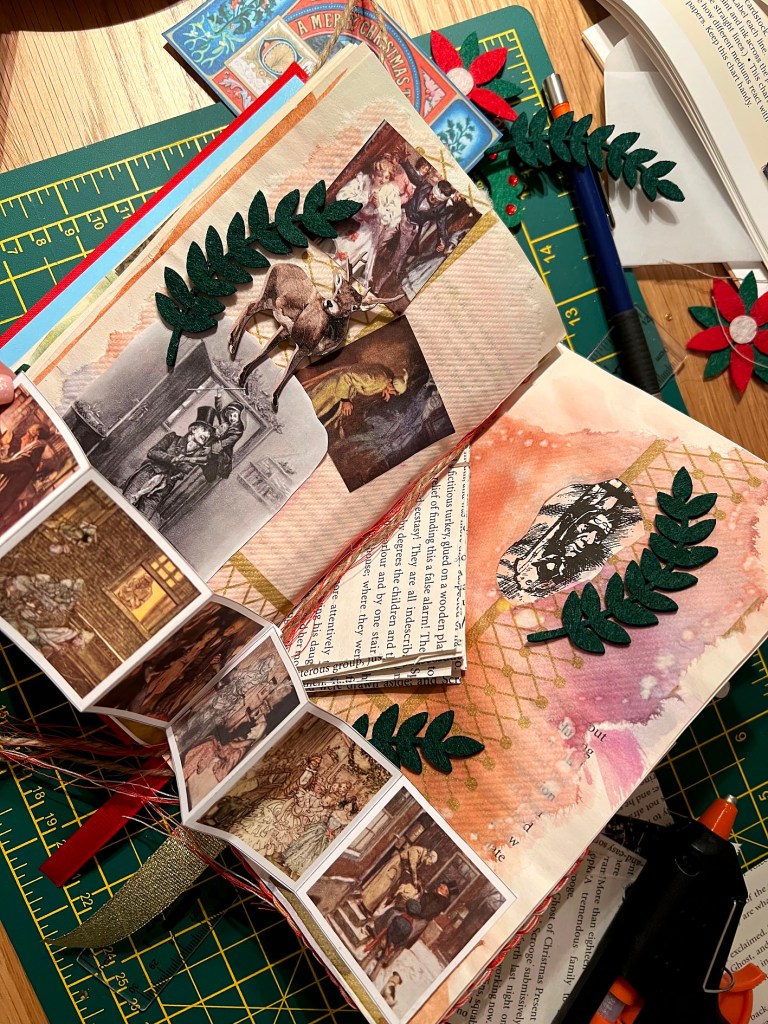
For the second spread, I wanted to use a table napkin to experiment with the watercolour. I quite liked the pattern it had on the sides, so I thought I will keep that as a little frame to go around the page, and apply torn edges as well. In the middle of the process, I got distracted so I forgot to take a picture of just a watercoloured napkin, it was very wet as well, and the poor little book was getting soaking wet, so I assumed I would need to decrease the amount of water that was being used on the book. The next day I ordered a hot glue gun to stick some Christmas elements from a craft shop, so I could glue heavier objects inside. I created a sequence of the images from the Christmas story, stuck a reindeer and a pack of pages I cut from inside of the book. I loved that feeling of the bulkiness of the page, with some pieces that the reader can interact with.
This spread I designed straight after the front pastedown. Collage type design, with red watercolour and a little cut in the corner, that to feel it with tags. I think that red spread looked a bit like blood, something was creepy about it, so I thought some cute stickers will equal the mood. Not sure how it worked, but the main point is that I still have the same mood in the book, as the story itself filled with mystery, spirits and another reality.
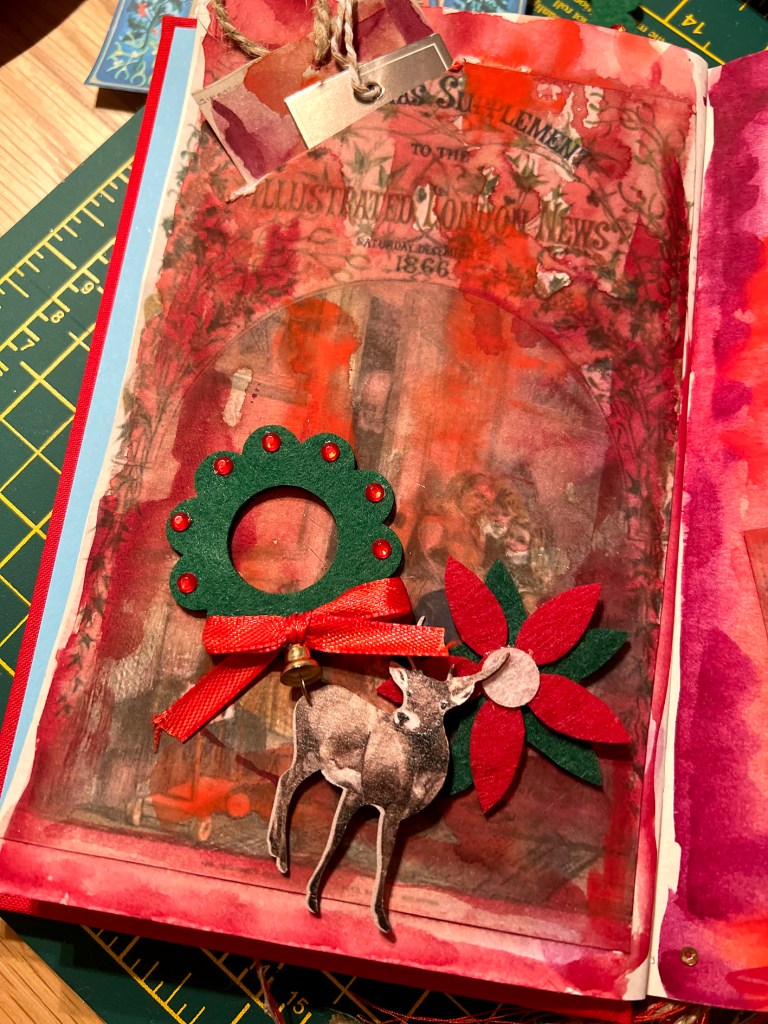
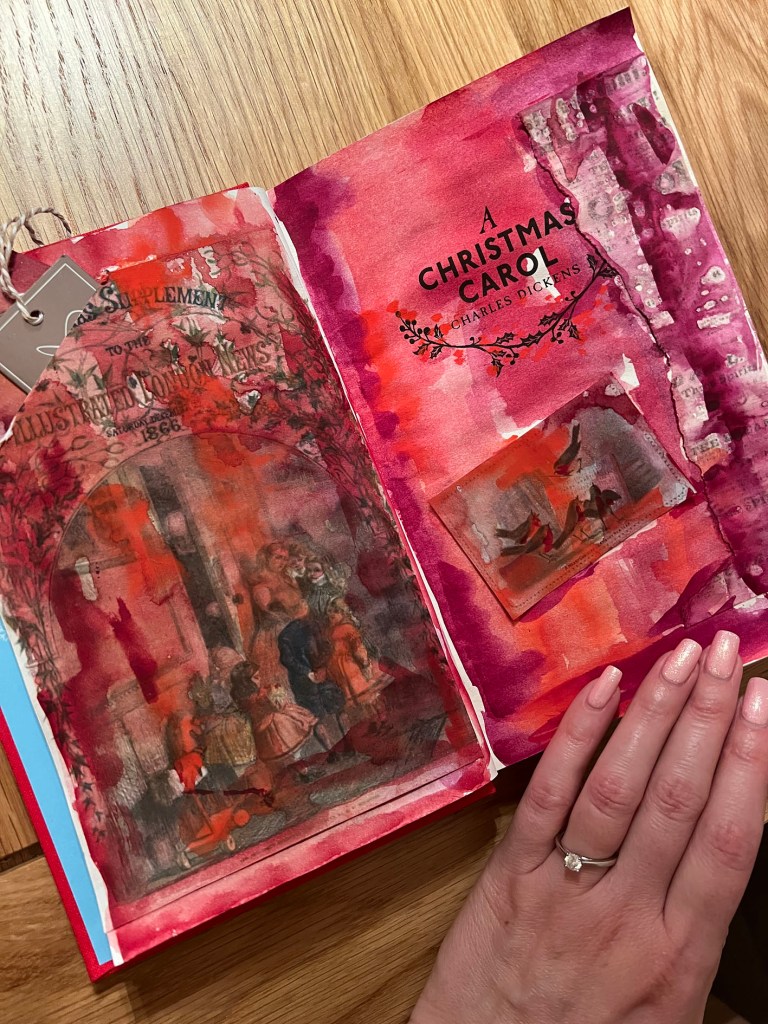
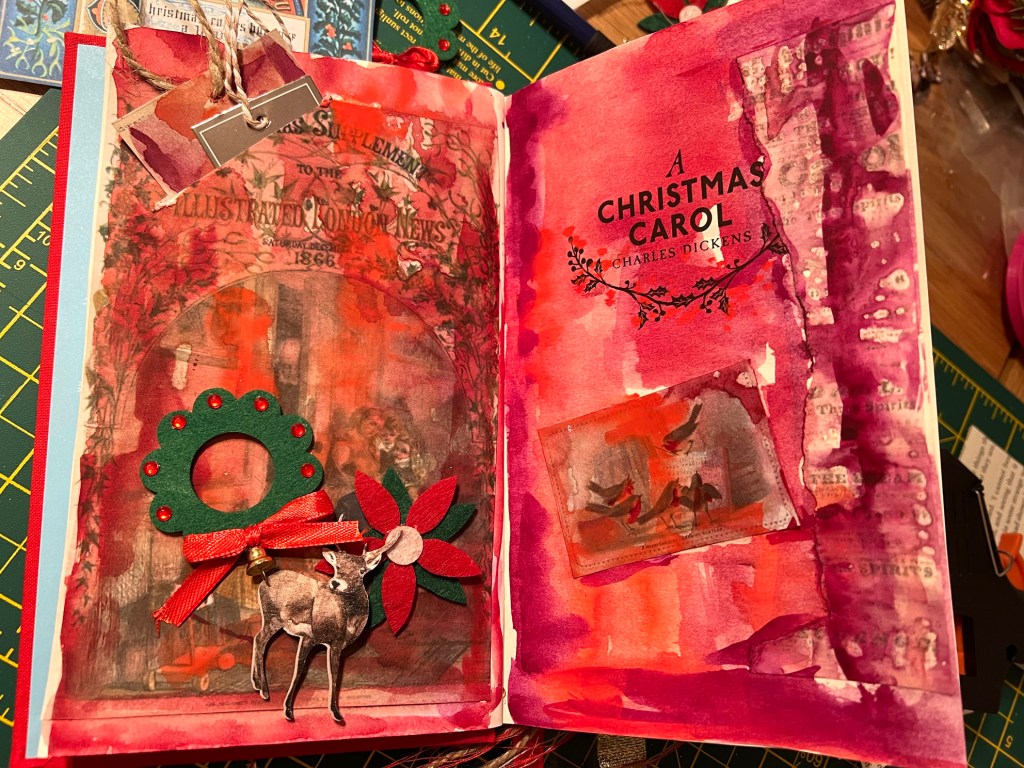
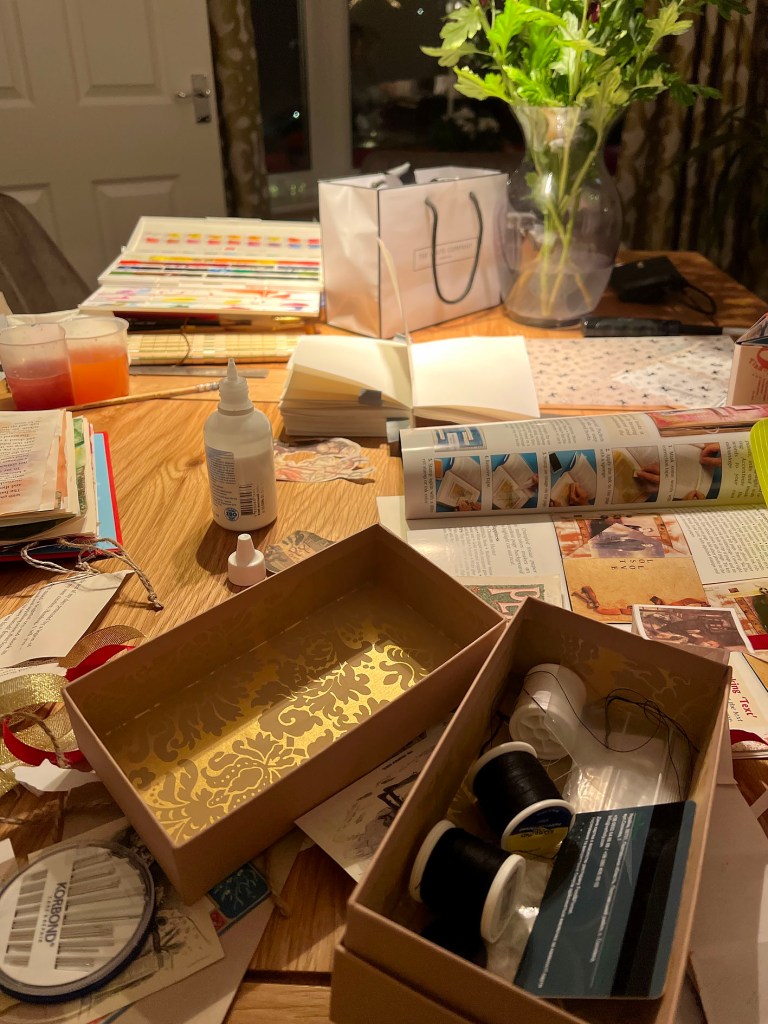
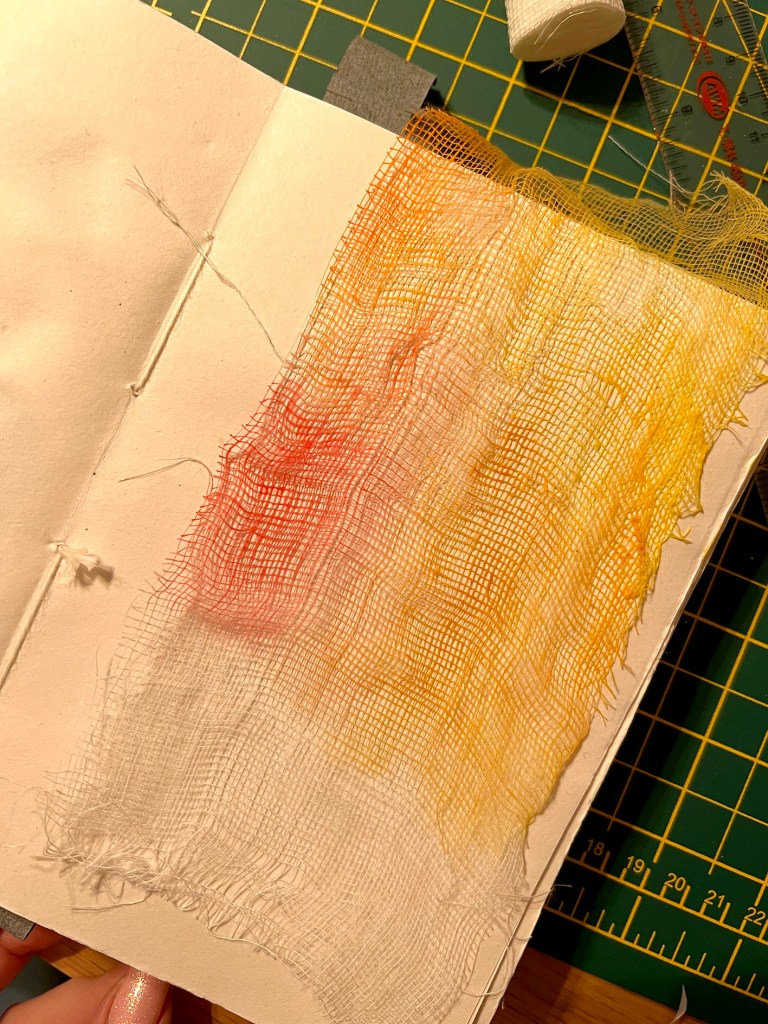
At some point, my table looked like a complete mess, but it was not a reason to tidy, I thought that means that I’m into something creative. I brought some red and cream coloured threads to stitch some pages, obviously, I have torn them before, as I quite liked that effect I was getting. Also, I had a pack of thin gauze that I was going to paint and glue on the top of the pages. In the corner of torn edges I stuck Scrooge and the Ghost of Christmas Yet to Come, and the image was matching to the red watercolour around it.
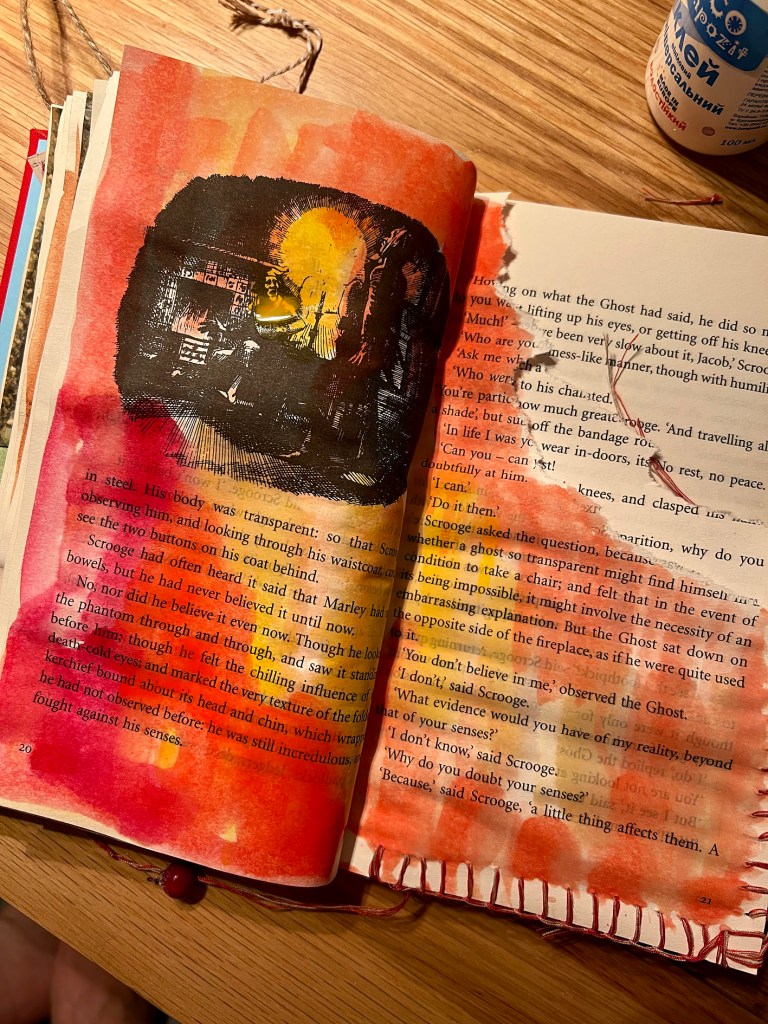
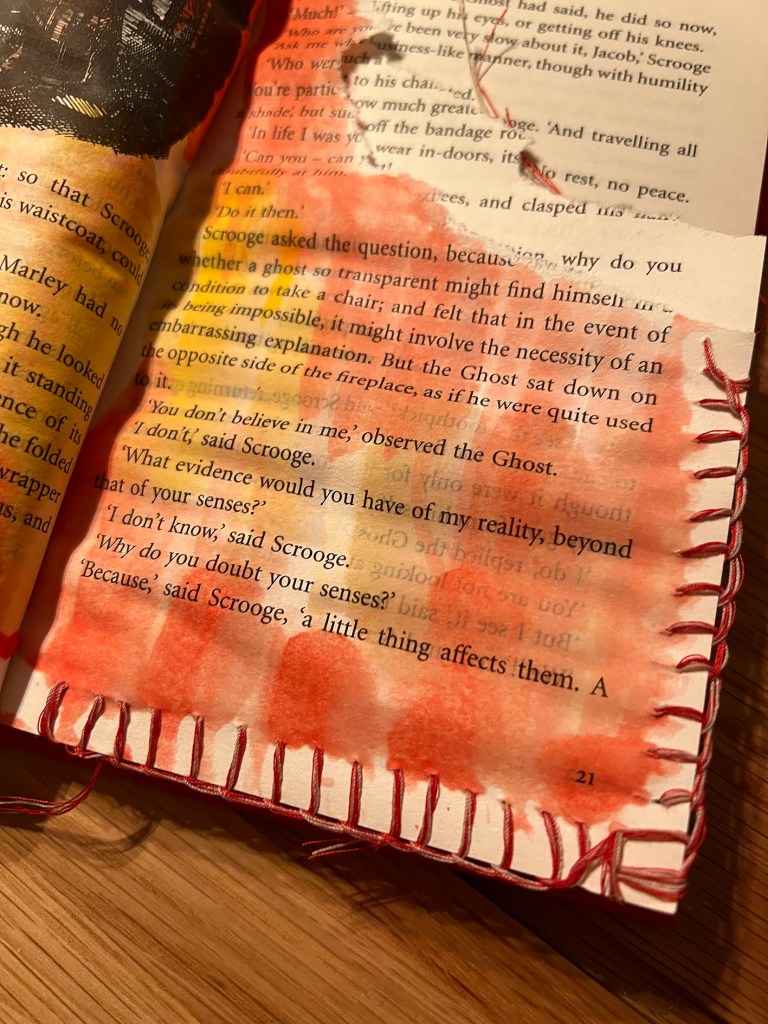
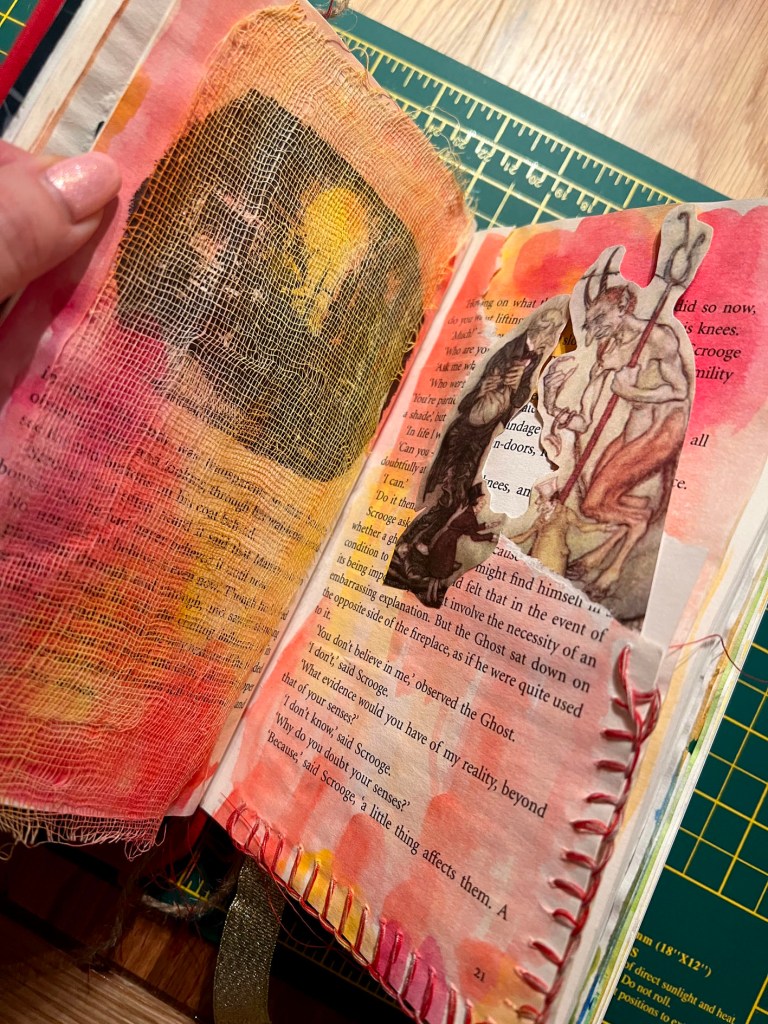
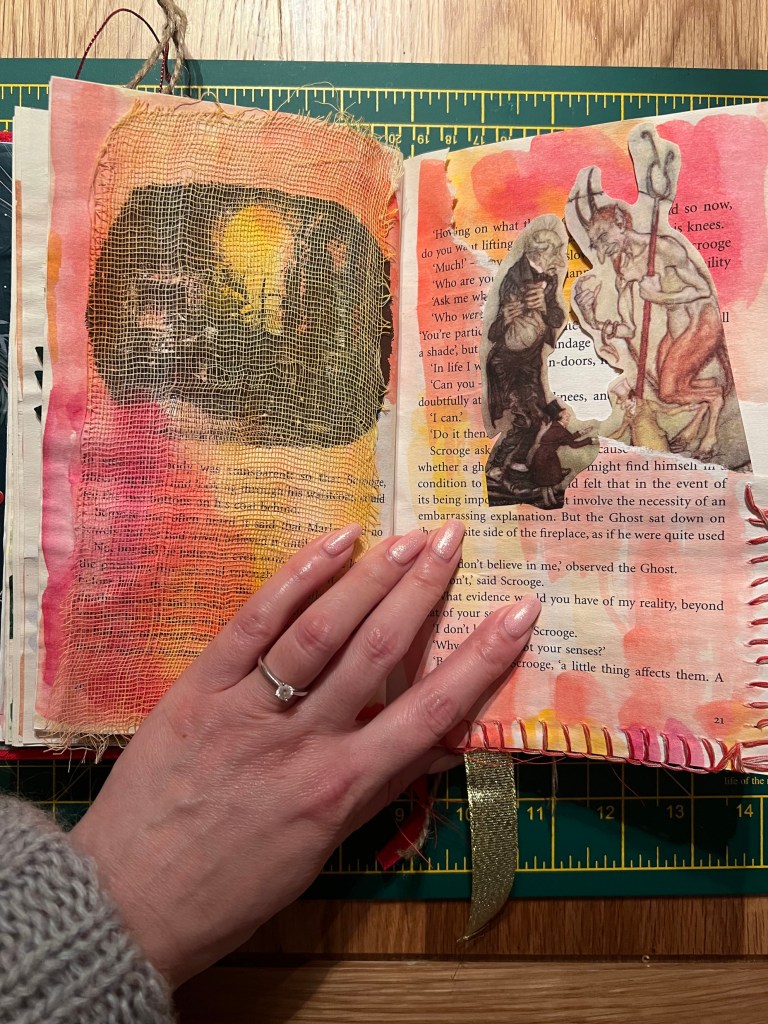
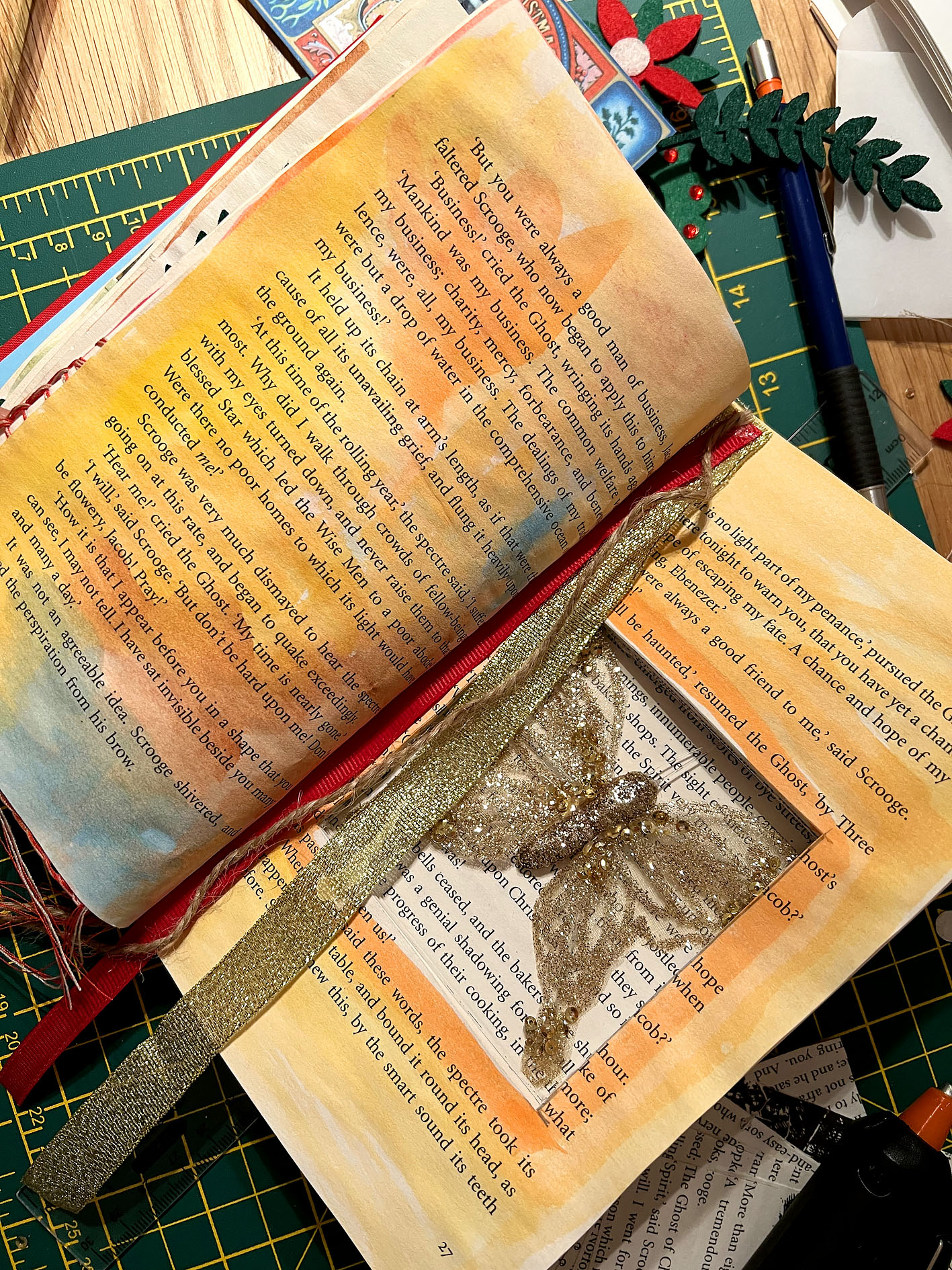
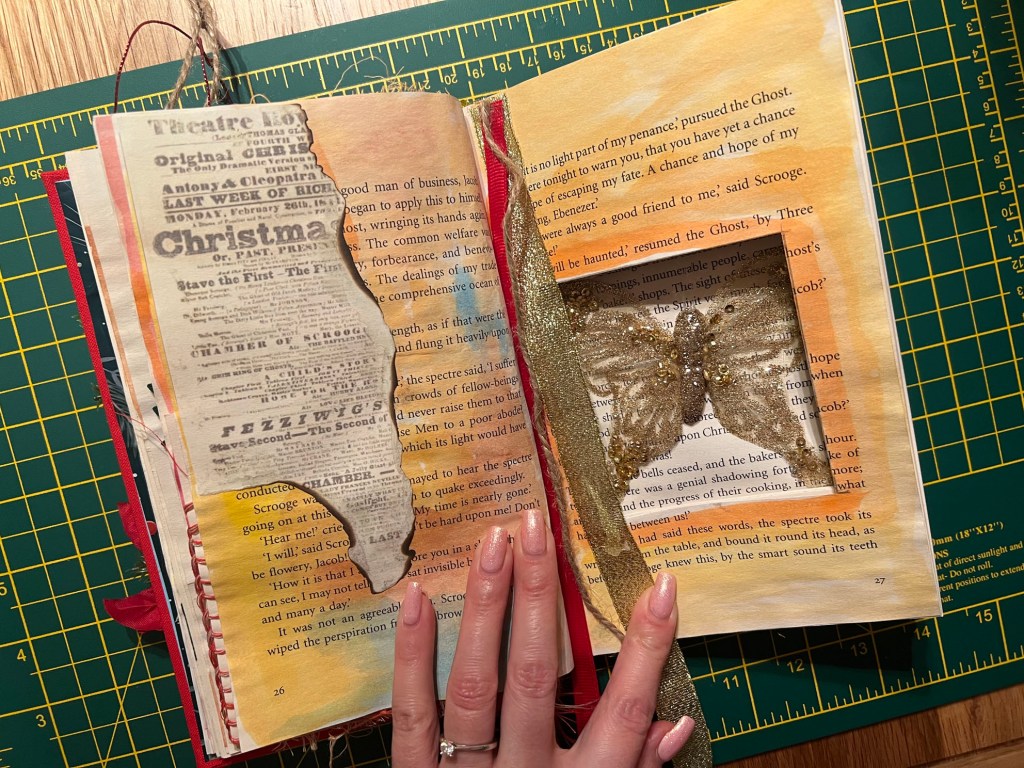
I think that was a moment when I started to be a bit clear with the designs and the direction I was going. At the end of the day, the number of objects I was using didn’t serve the purpose I was aiming for, and clearly, that more minimalistic design with a beautiful golden butterfly looked quite fresh and clean. I added burned ages piece of paper in the corner, and a couple of ribbons and felt like the design was completed.

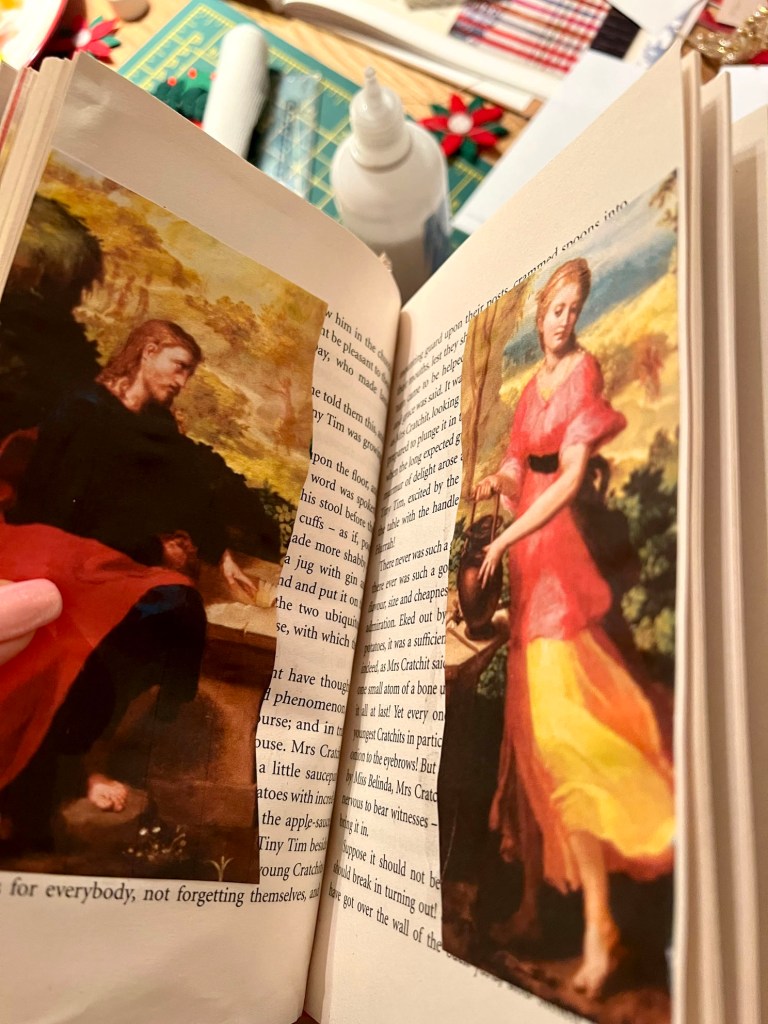
I thought as the Christmas Carol holds a religious theme, I could use some prints of the old paintings, like Michelangelo Anselmi. Christ and the Woman of Samaria. I had that image from my visits to Burghley House. Just matching watercolours around did a great theme as well.
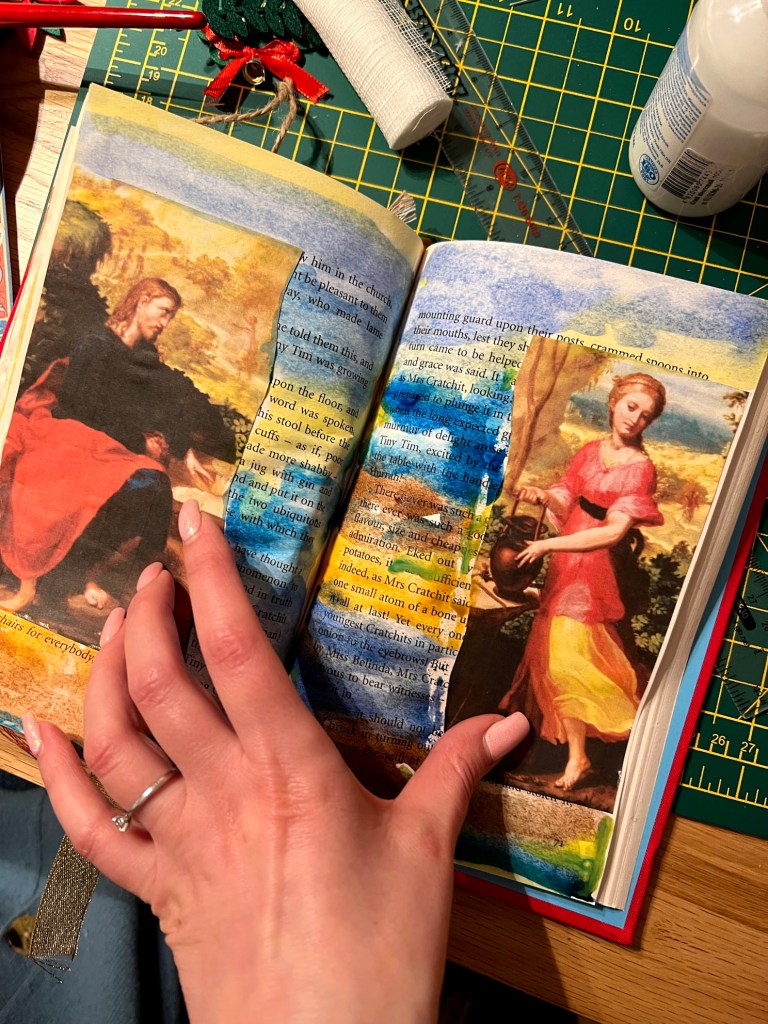
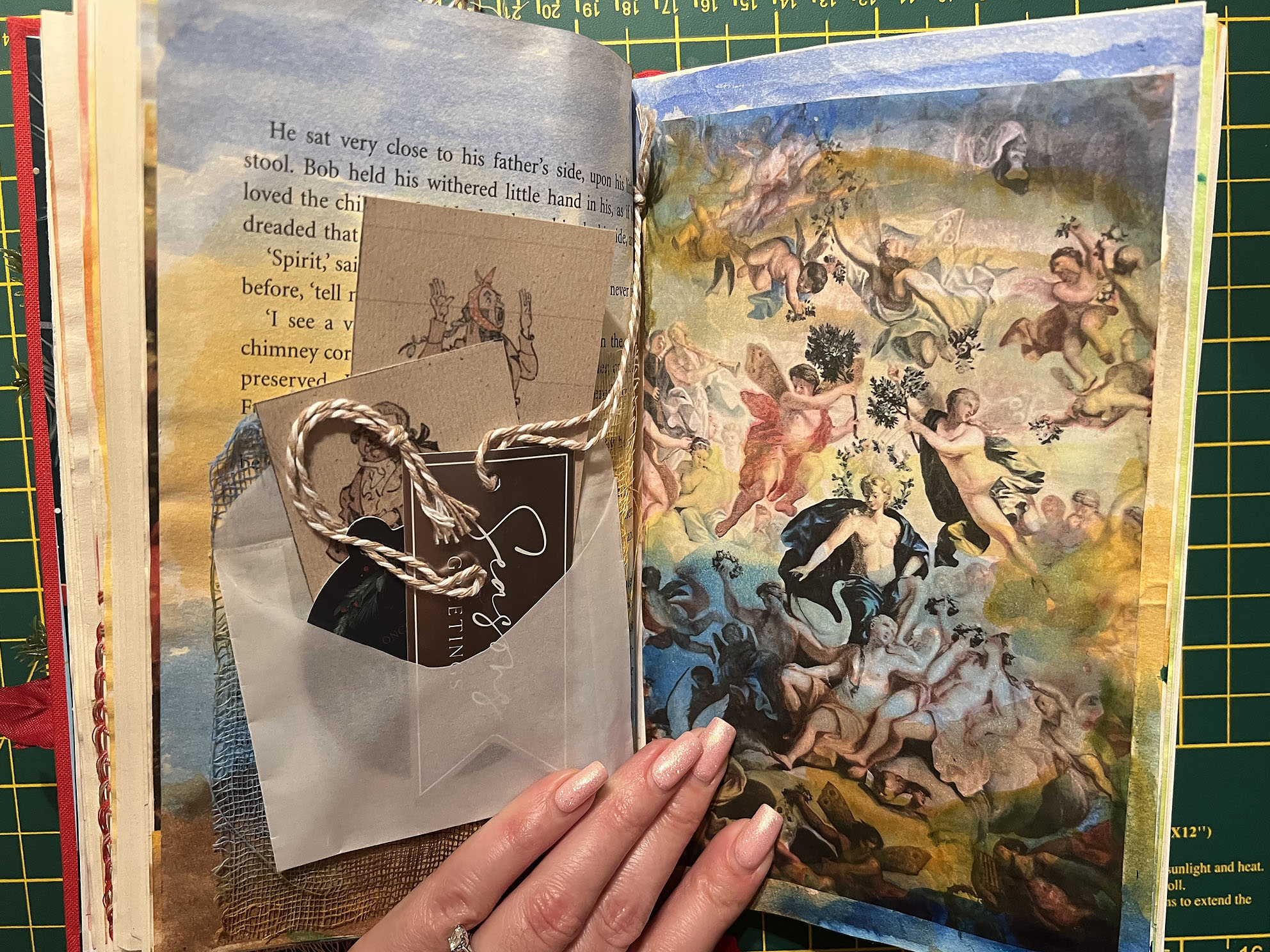
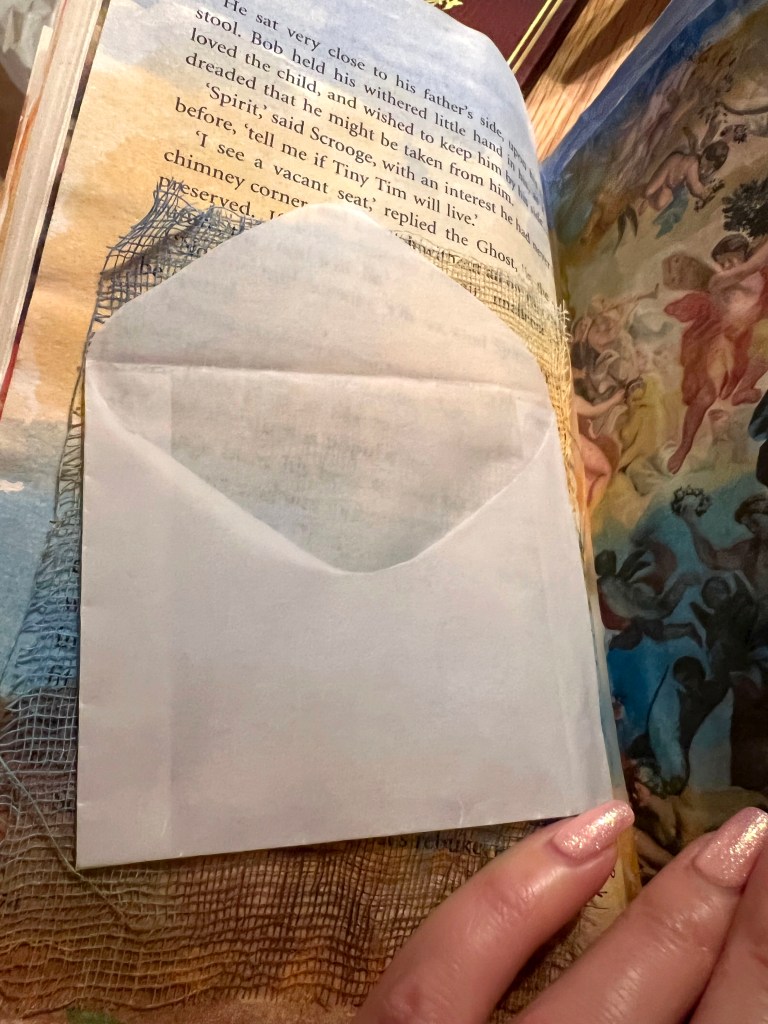
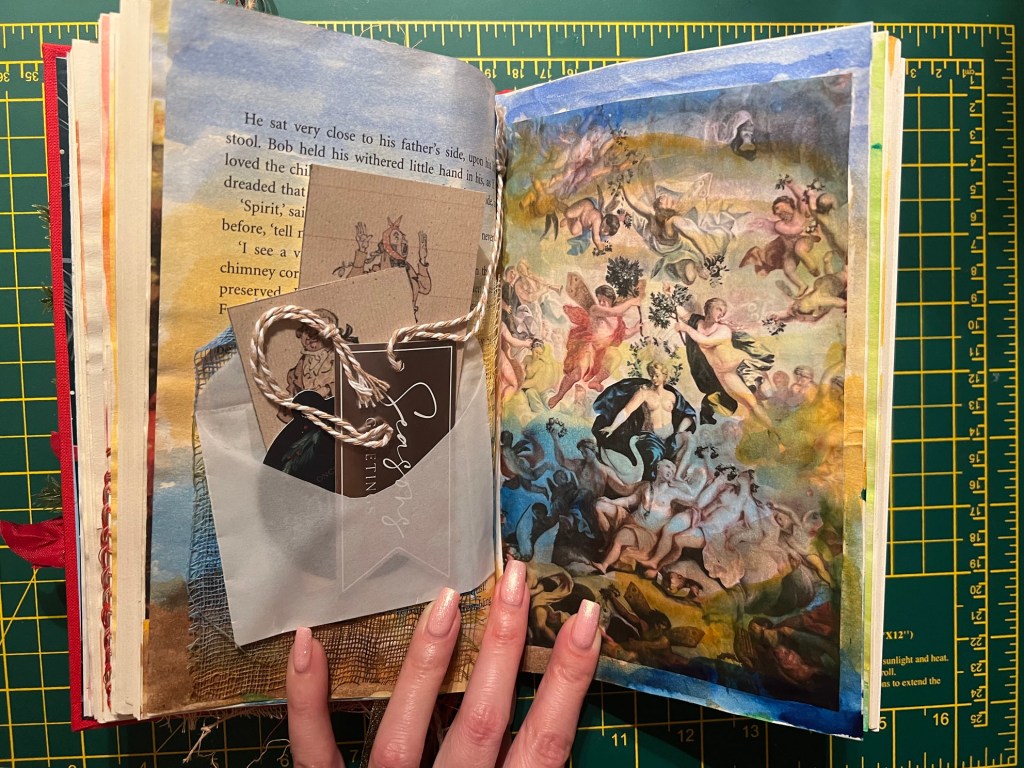
For this spread, I went for a similar path, that to support the previous theme with the painting of Heaven, as well, the Burghley House collection. I stuck it to the page with some watercolours around it, made a little envelope out of tracing paper, made colour shades on the gauze, and filled the page with some tags and images from the A Christmas Carol book. I could see how the experiment with different textures started to show the result, it’s interesting, unusual and creative, and that is a quite nice tactile experience, to have so many different textures at one spread.
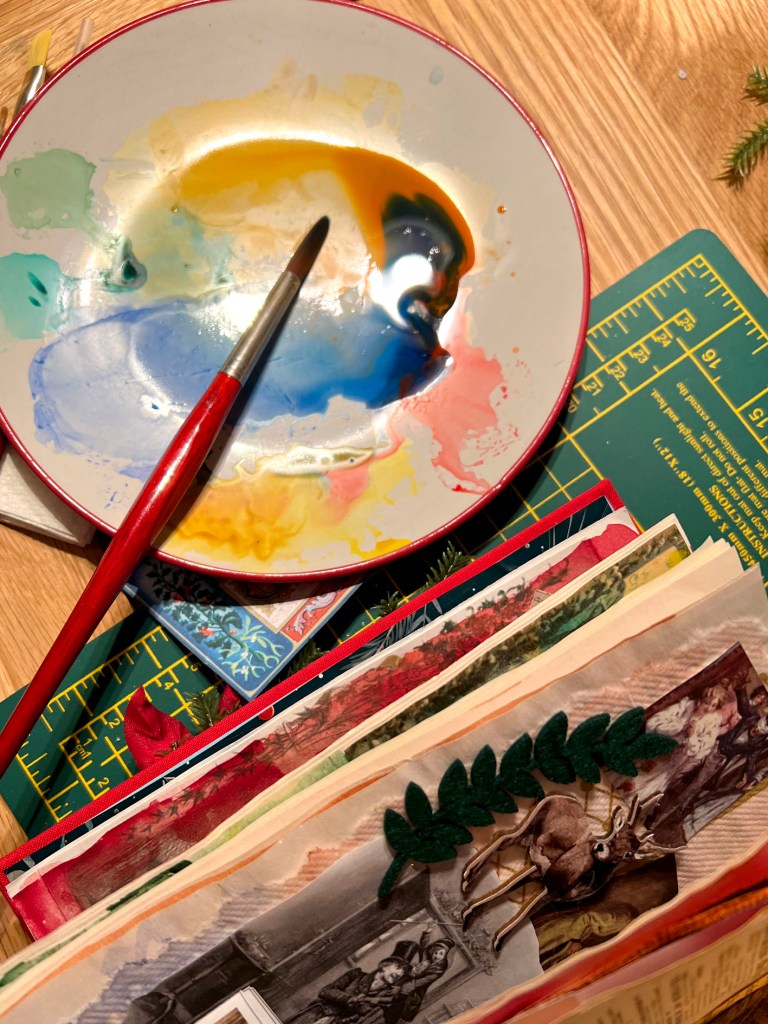
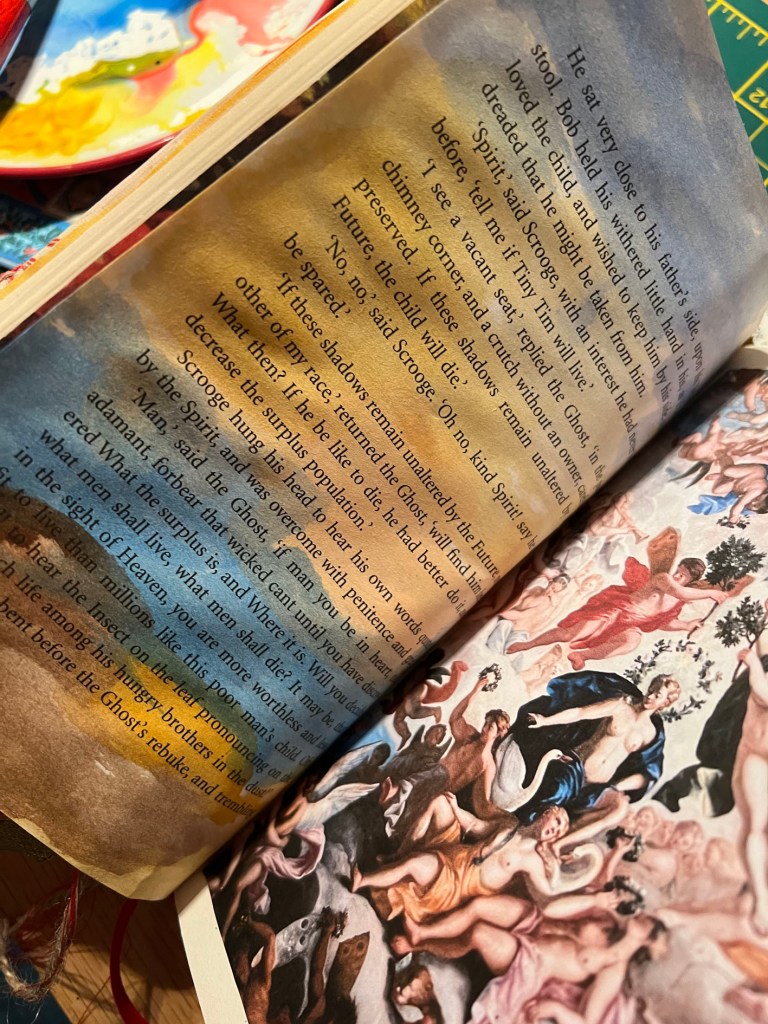
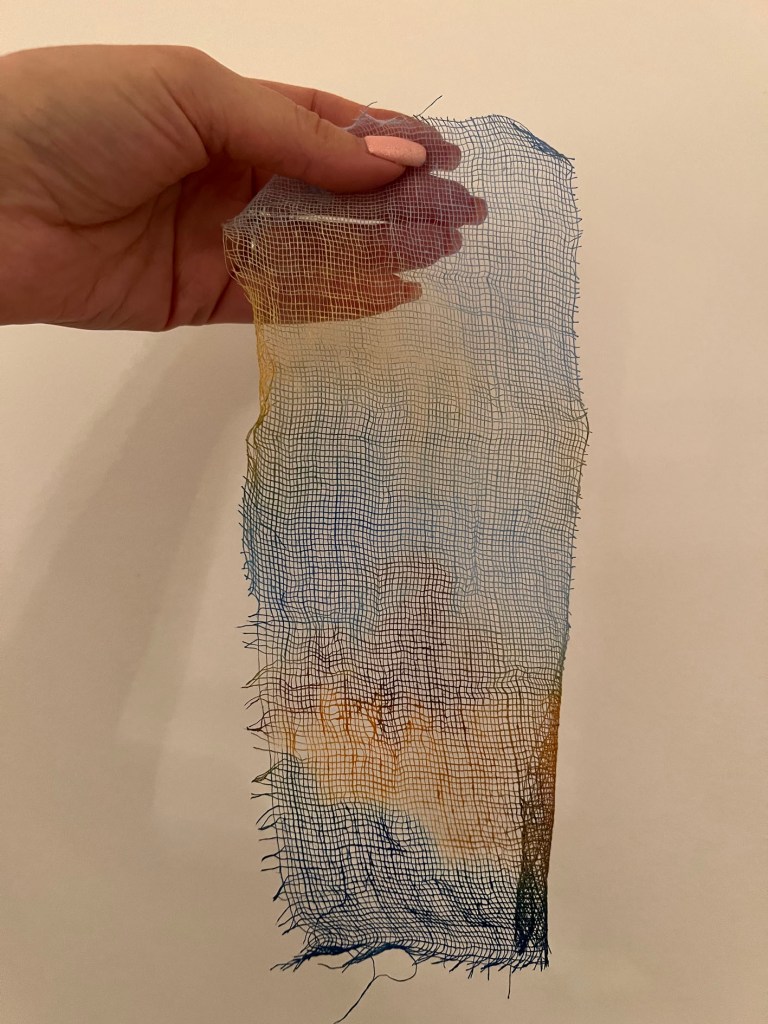
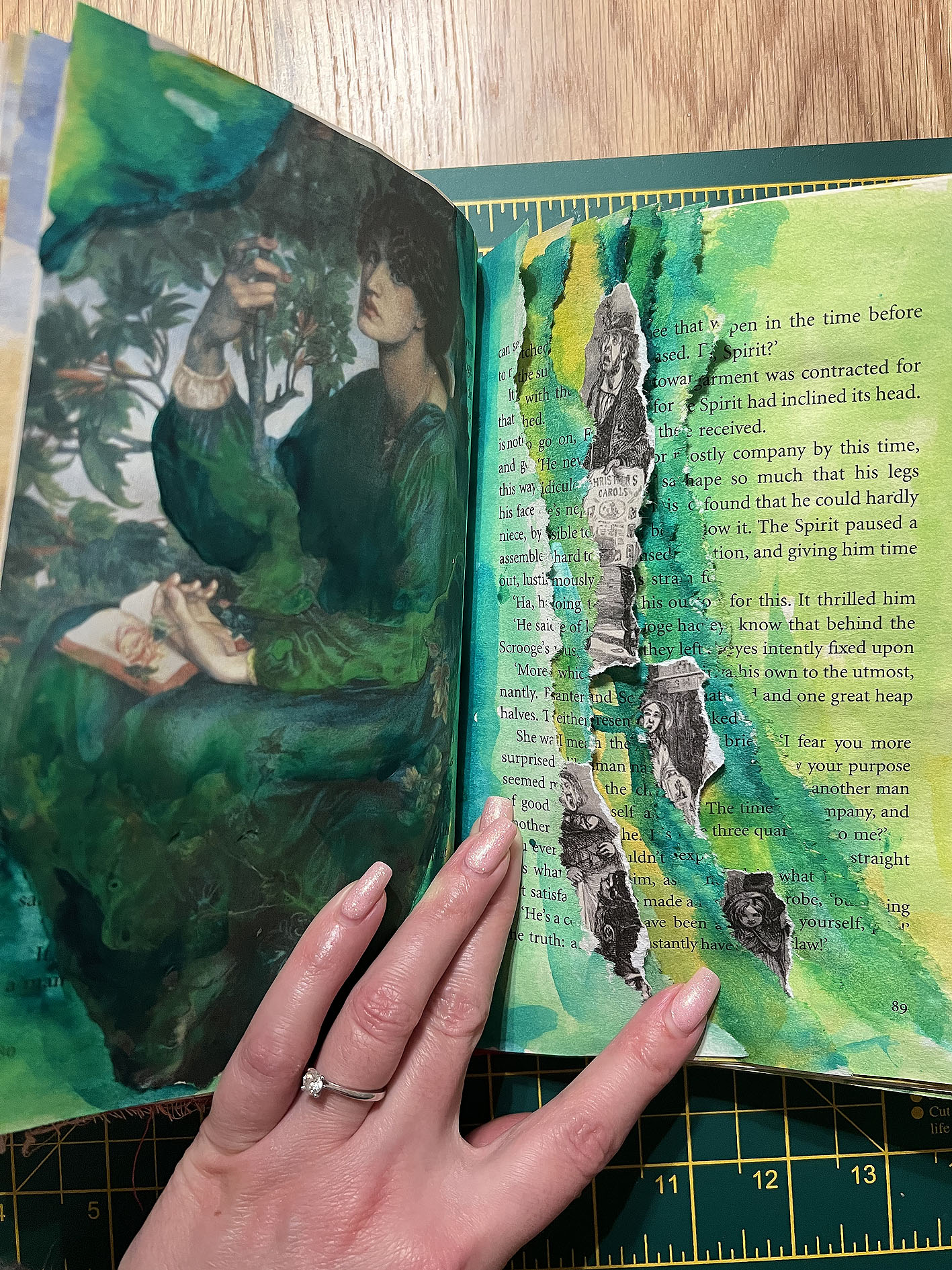
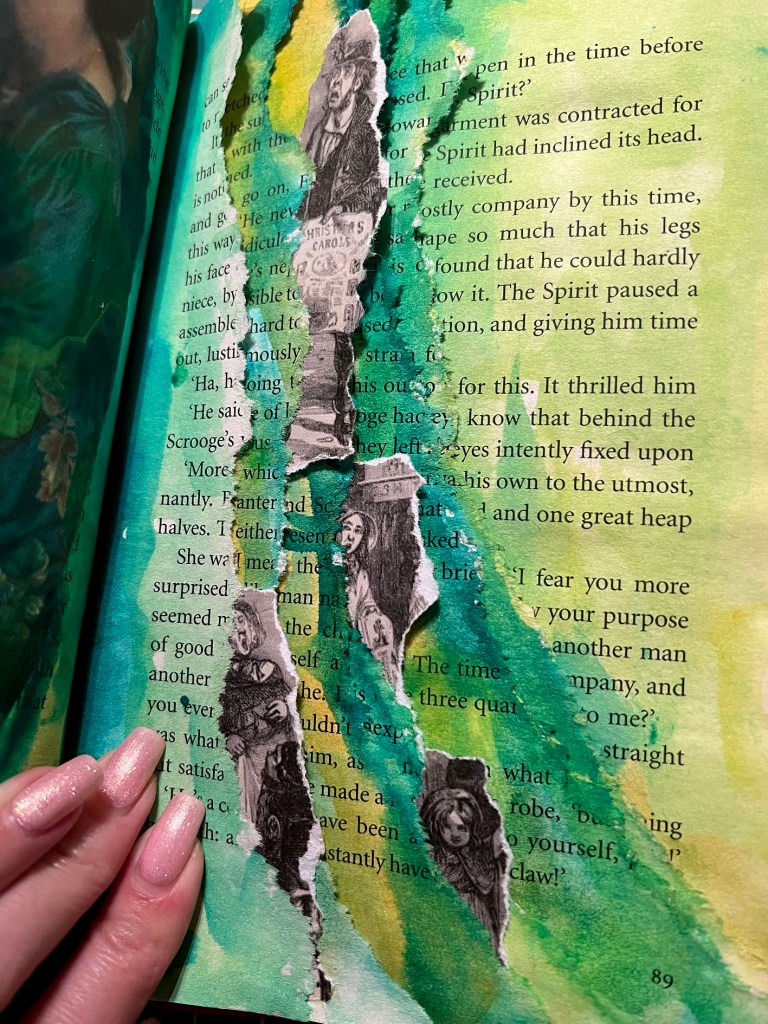
I was so excited about how the book looked in combination with the art, so I decided to go with the last image I had in my head, from Rossetti’s painting. I chose The Day Dream art in the green tone, one of my last paintings I wanted to finish with the green colour, as they are traditional colour shades, of red and green, torn edges of the page and hide inside sketch from The Christmas Carol (engraving) illustration. That created juxtaposition I was looking for and supported the theme of the book. I realised that the whole book was made in that approach, I found something that was visually appealing, it was closer to the end of my research, and I wouldn’t be the mind of creating more of those textures throughout the whole book perhaps, I needed to go through all that experiments to discover something special.

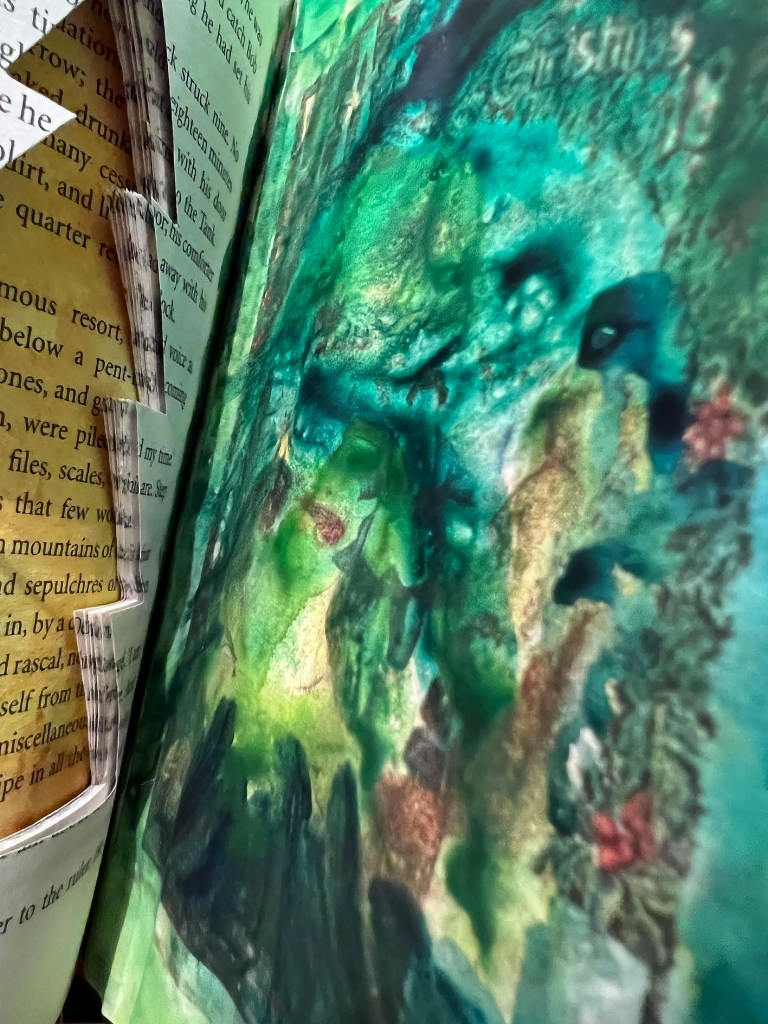
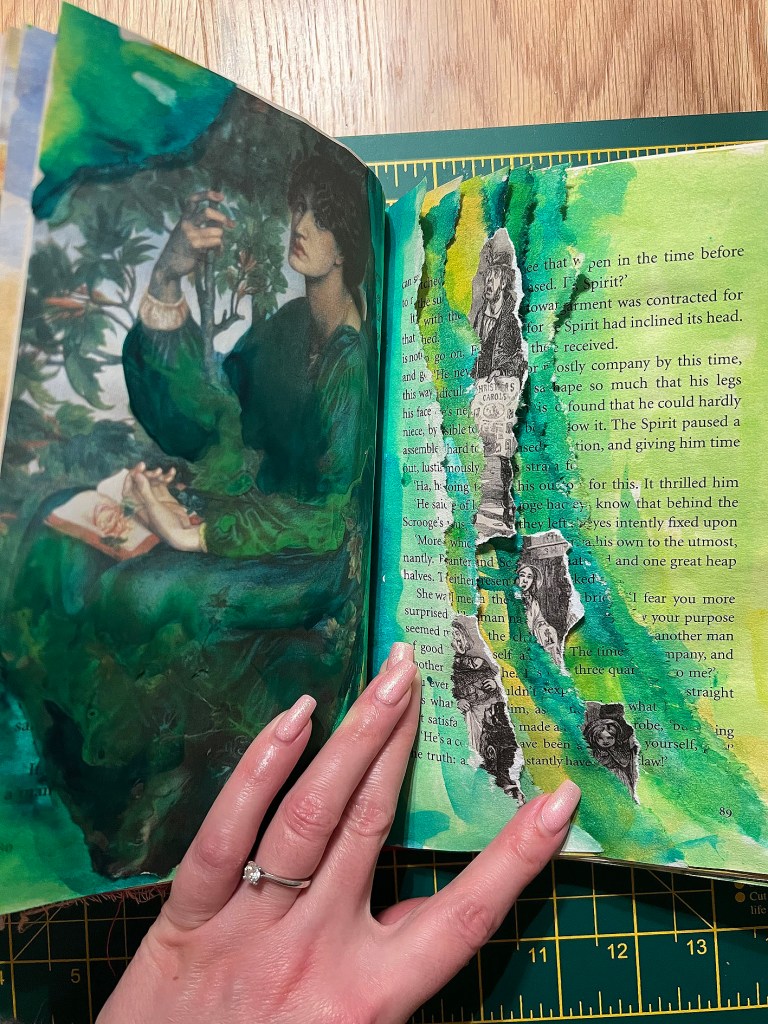
I would probably finish my designs on the previous image, however, I had so many pages left, that probably happened because I didn’t divide pages evenly, so I thought would be a shame not to use a big bunch of last pages, so I decided to go for the last idea I had, with a Christmas tree, with some watercolours and illustration by John Leech (1892). I still had a few pages left, so I just glued them together, and that was me done.
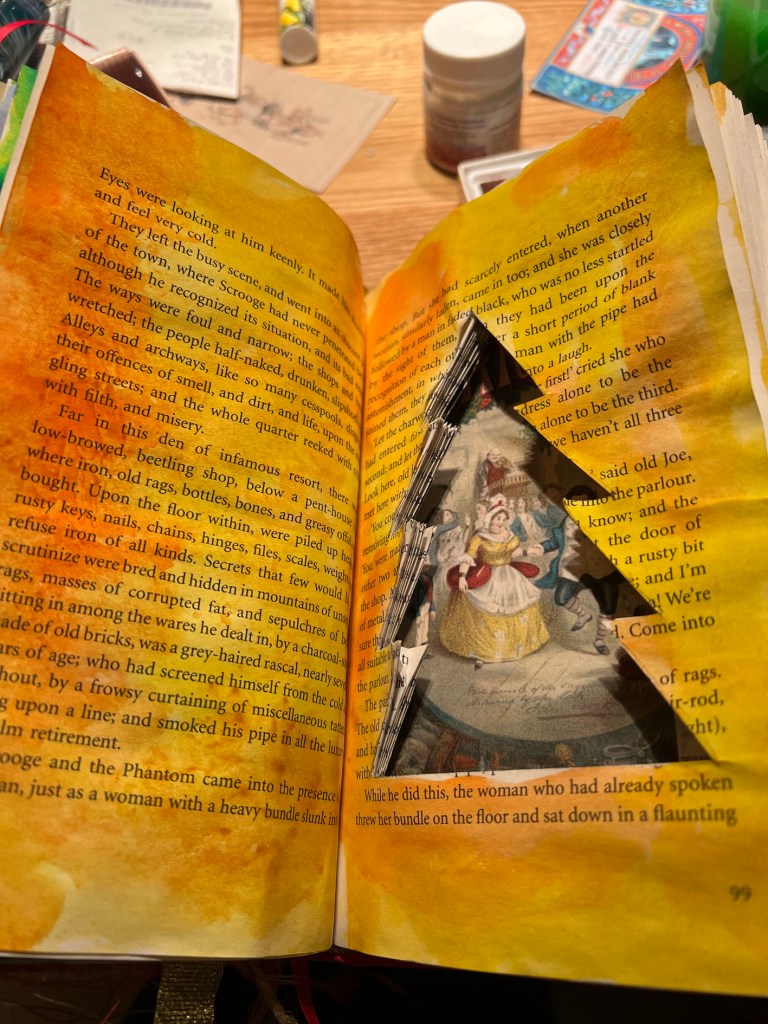
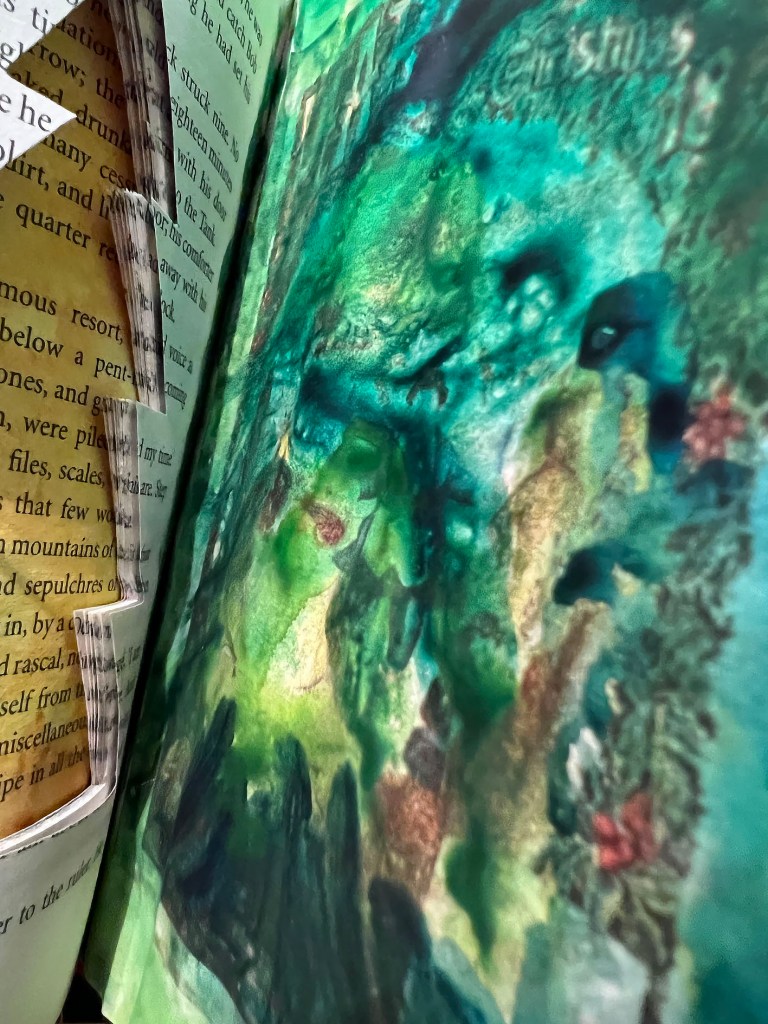
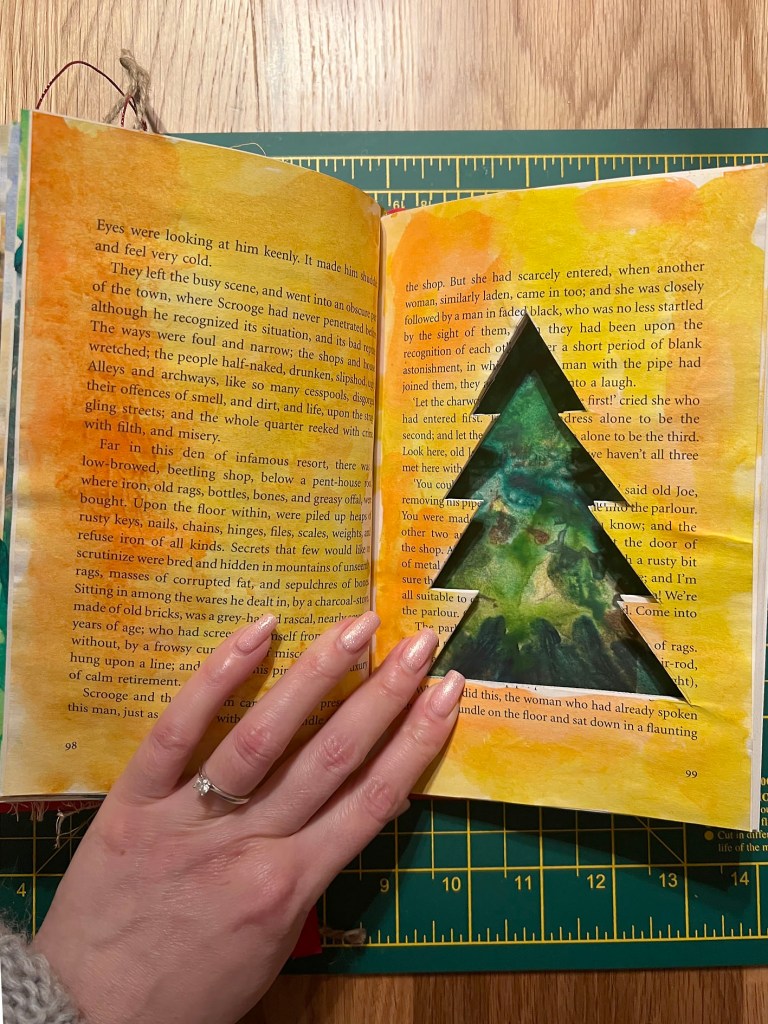
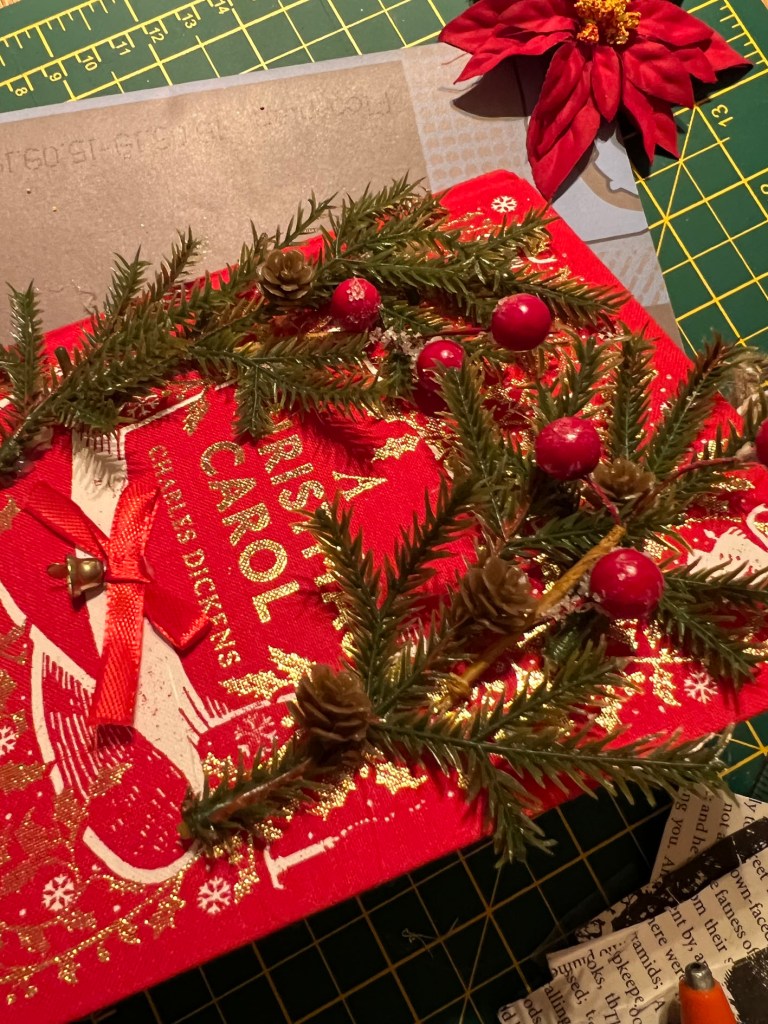
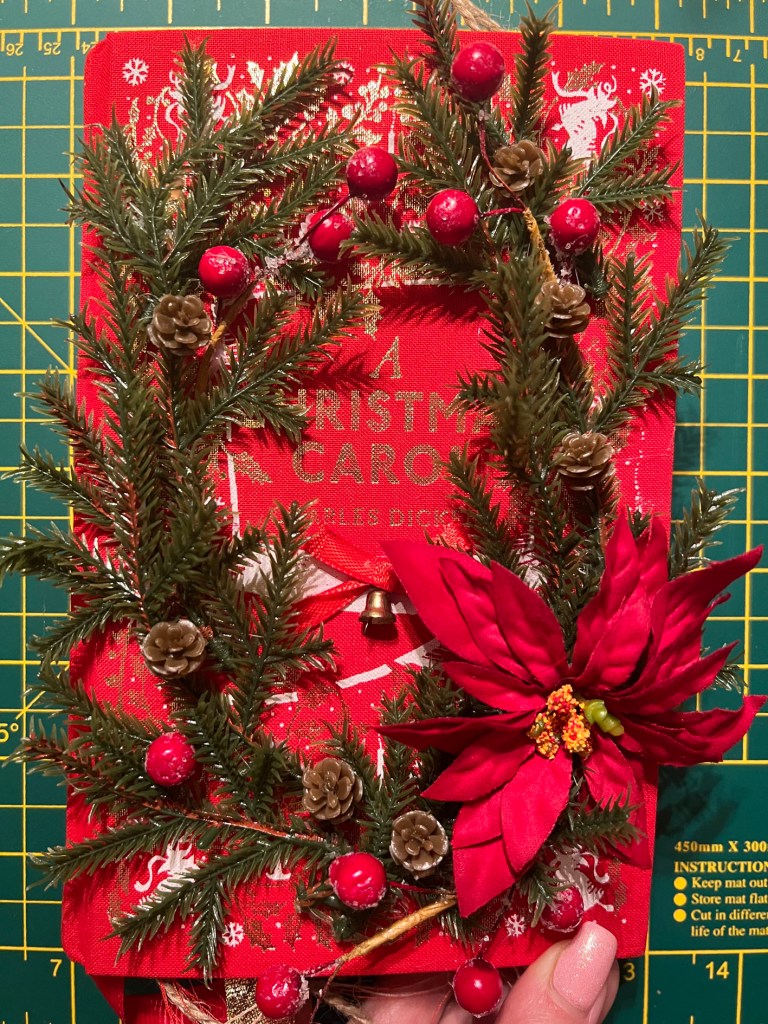
For the front and back pastedown, I used wrapping paper with a red and green Christmas theme, and for the cover, I keep something special, which was artificial pieces of pine tree and red berries. I decided to keep the cover in red, as it was the perfect colour choice for the story, I just made it look like a door Christmas wreath in traditional colours.

Reflection
I think I can call this assignment one of my favourites in regards of work with handmade materials. It was the first time when I went from the begging to the end strictly by working with handmade objects. That was a discovery for me that handy work can bring so much joy and satisfaction. Before that task, I was quite confident that I’m a digital kind of designer, and software is the best way to express my creativity, however, this assignment helped me to discover something new, helped me to open some fresh skills, and showed that I’m I can push even more. I could see that this assignment was a collective task from our earliest exercises like Alternative Publications, Your Zine, Artists’ Books, etc., and I’m pleased to see how the experience can be transformed into discoveries. I believe I could meet the brief, as I did my hardest with the number of materials and media I was working on. I have to admit I didn’t go far from the A Christmas Carol theme, probably slightly moved it closer to the middle of the book, first pages were a start, and I relied pretty much on the story, but closer to the end I could figure out the religious theme in it, and the use of art for this story. I hope I could meet the standards with this work, and I am ready to enrol for the upcoming assessment.
 Eleonora's Art Blog