
Find two artists’ books that you feel demonstrate an interesting relationship between their form and content through the materials that the artist has chosen to use. Reflect on these books in your learning log.
Researches
For the first time, I’ve got familiar with artists’ books through the first part of the Creative Book Design Unit. There I explored some unusual books on Smithsonian Libraries Artist’s Book and Fanzines. I’ve learnt that book has a wider meaning than just an object to read and find out the information from. I discovered that artists’ book has a completely different interpretation, this is a piece to explore intuitionally, and have a feel of the book through personal emotions.
As I can’t have access to the libraries at the moment, due to my location, I had to go to browse them online. Not ideal, but still a great experience to go through some online collections at V&A National Art Library, Tate gallery, and, of course, Smithsonian Libraries.
In this research task, I wanted to find out the meaning of the term of artists’ books. Artists’ books are books made or conceived by artists. Some fine artists make books and book artists who produce work exclusively in that medium, as well as illustrators, typographers, writers, poets, bookbinders, printers and many others who work collaboratively or alone to produce artists’ books. Here I can see that the creative field for the artists’ books is quite broad, and very often not much context could be put into that books, but mainly such things as visual expression. The purpose of that book is to bring emotion, whether it’s awkward or comfortable feelings. Many artists’ books are self-published or are produced by small presses or by artists’ groups or collectives, usually in limited editions.
I would consider artist’s books as a piece of art, which was organised in the booking form. Artists’ books that maintain the traditional structure of a book are often known as book art or book works, while those that reference the shape of a book are known as book objects. Other types of work produced by artists in book format include concrete poetry, where meaning is derived from the spatial, pictorial and typographic characteristics of the work, as well as from the sense of the words.

https://siris-libraries.si.edu/ipac20/ipac.jsp?term=39088010098317&index=BC
Some of the books remind me a scrapbook. They have old type paper, those books are big and bulky, and look like they would have some historical meaning into them. Below is example of the book made from the wood ‘Mapa ed veneiis’, by Genevieve Seill. The artist describes her intention as a
“Mixture of word magic, a strange mind geometry and a secret formal and esoteric architecture holding it all together”.
Another example of artist’s massive book with heavy objects inside – unique, multi-part book object, the title of which translates as ‘Daniil Kharms: love and death’, focuses on the life and writings of Daniil Kharms, an avant-garde poet, dramatist and children’s author born in St. Petersburg in 1905. This is a very peculiar reflection of love, despite that, the main purpose was to make sure that the reader has emotions, and I think the author achieved that.
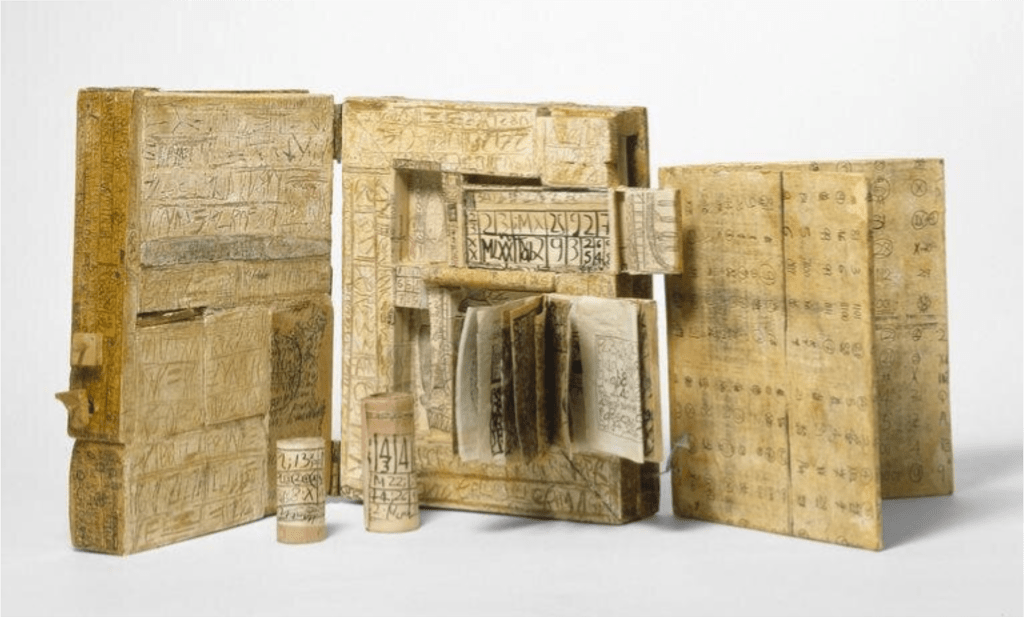
Artist’s book, ‘Mapa ed veneiis’, by Genevieve Seille, Burton-on-Trent, 1990
https://collections.vam.ac.uk/item/O1281786/mapa-ed-veneiis-artists-book-seille-genevieve/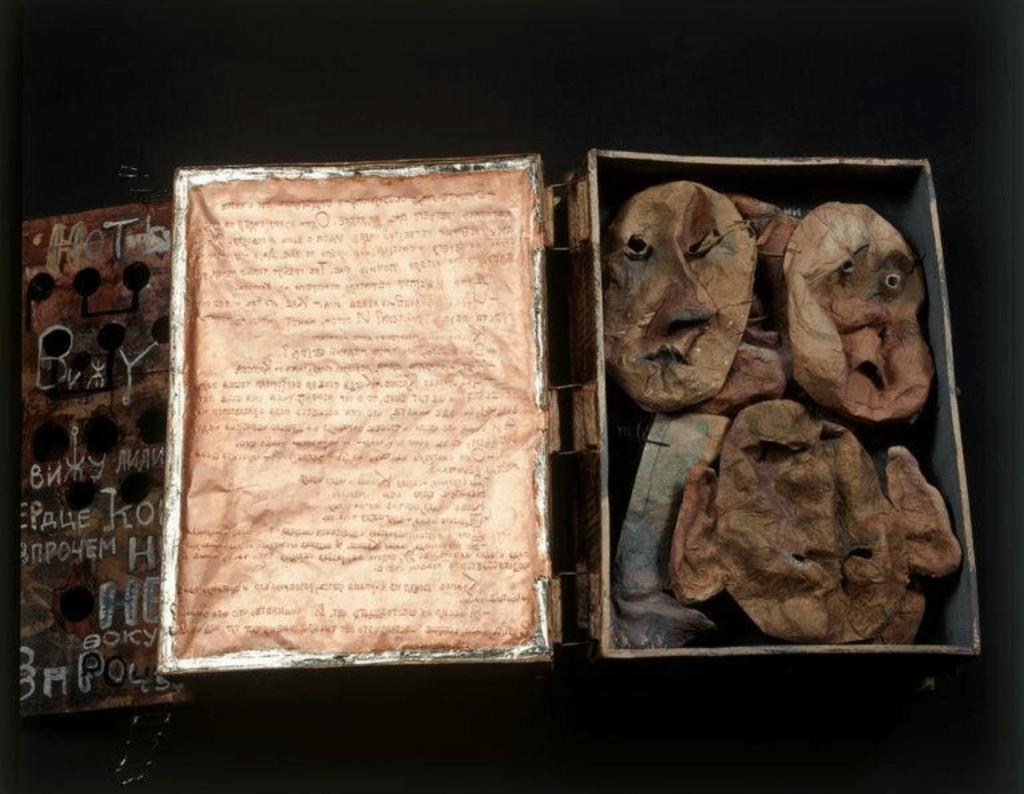
Daniil Kharms: liubovs i smerts. Artist’s Book 1992 (published)
https://collections.vam.ac.uk/item/O1280188/daniil-kharms-liubovs-i-smerts-artists-book-yakunin-sergei/
Some of those artists books bring a special meaning, like the example below is symbolising reminder to conserve and respect the earth. Large enough to be cradled in both hands, The Mollusk has wispy pages in bright red, blue and purple that make up the animal’s filtering gills. In the centre, there is a small white letterpress book, like a pearl, bound with string, that reads a small poem. According to the artist, the piece is
“Intended to be held and read as a celebration of nature and a humble reminder of our own fragile connection with one another.”
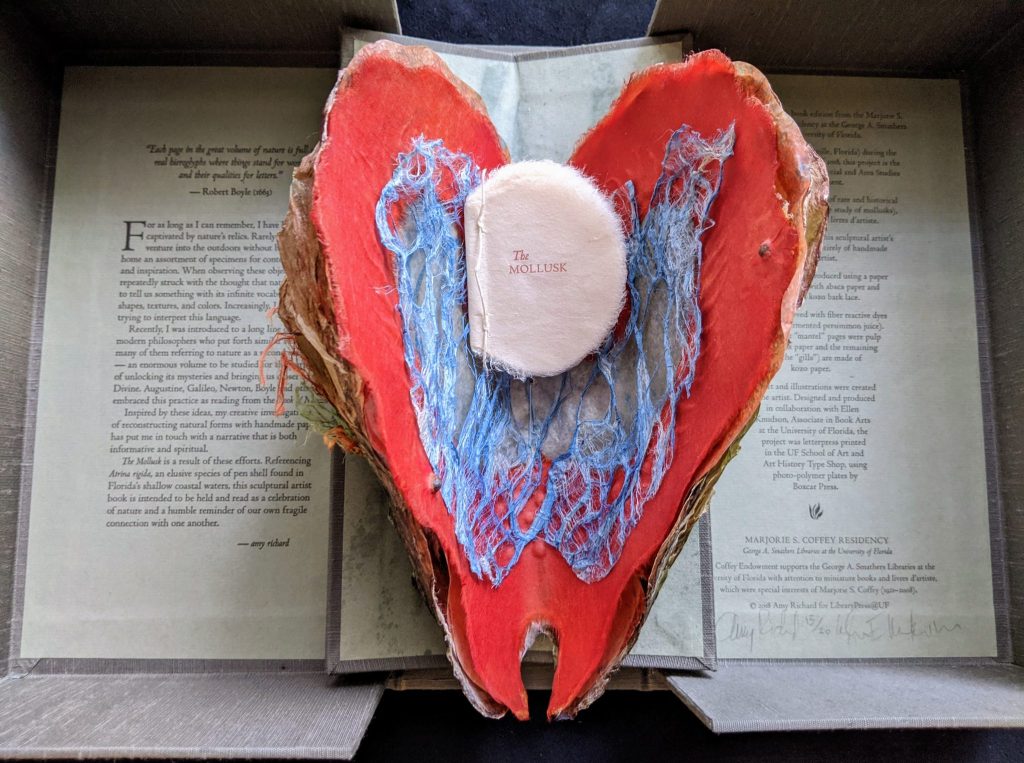
https://blog.library.si.edu/blog/2020/04/22/artists-books-earth-optimism/?_ga=2.245886724.1008561065.1631713330-543218274.1631713330#.YUIBi577Ttw
These are more ordinary formats books, but they are based mainly on vintage images, such as a pistol pointed at a rocking horse, are juxtaposed to develop a feeling of oddness and discomfort throughout the book.
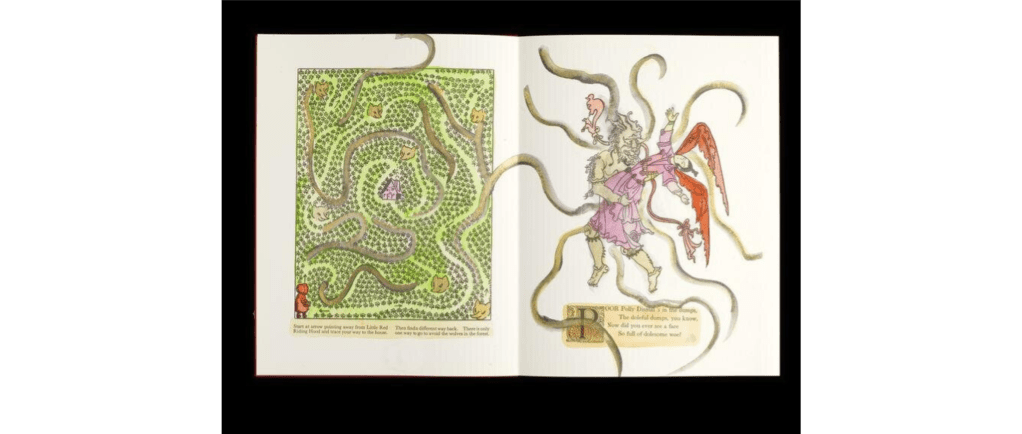
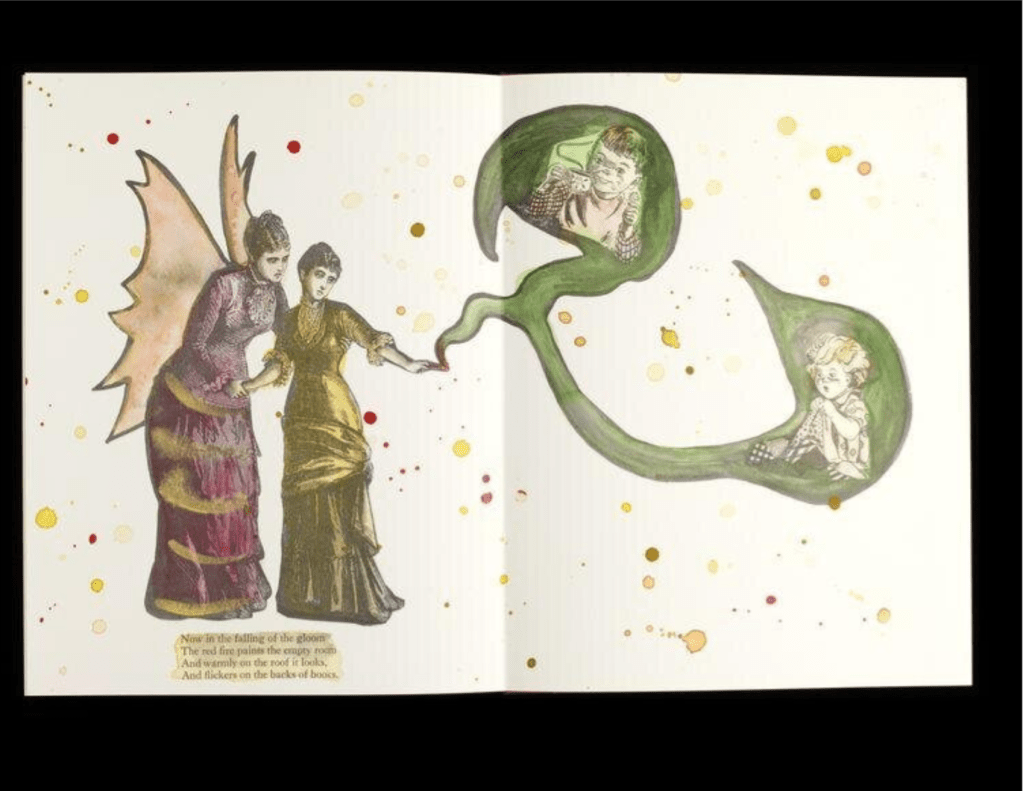

https://collections.vam.ac.uk/item/O1275241/talespin-artists-book-bee-susan/
This book attracted me because of the beautiful cut pages inside in the shape of the butterflies. Half of the book looks pretty regular, but another part has quite a tender and creative style in it. Malone cuts away the blank parts of the pages, leaving the illustrations to really stand out. The drawings are exposed, and the book takes on a sort of flipbook quality.
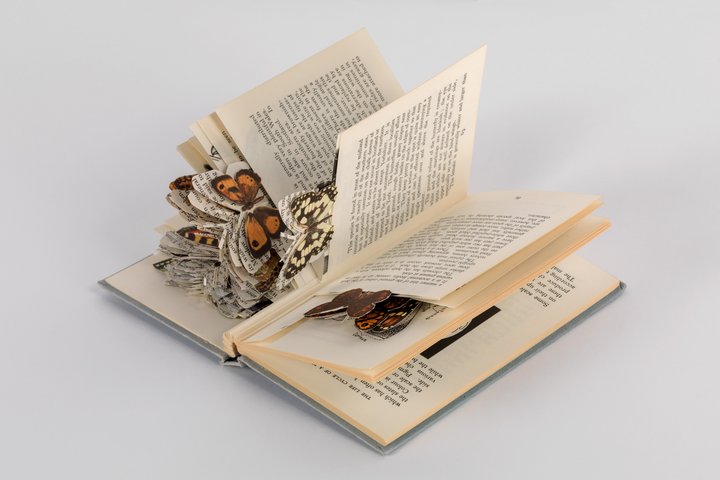
Photo: Matt Greenwood
https://www.tate.org.uk/visit/tate-britain/library-archive-reading-rooms/library
This book reminds me the travel books I remember from the childhood, when you open books like a little accordion book, and make your journey through the pages. The photographs are an apparently random mix of colour and black and white images, something that increases the book’s sense of fragmentation and dislocated story-telling.

https://collections.vam.ac.uk/item/O1281724/unhinged-artists-book-taylor-wood-sam/
From that wide range of artists, I couldn’t stop only on two particular designers, went extra wild on the number of artists I researched. I would probably say that 3D books, with extra layers on them, that we could consider as creative objects are more attractive to me, than just a flat book with illustrations on them. Don’t know how these books were made, but as I remember as a basis for them could be used the layout for promotional boxes, and make sure that the right cut is made for all elements to stick around. Would be curious to try something like that me, and experiment with the shape.
 Eleonora's Art Blog