
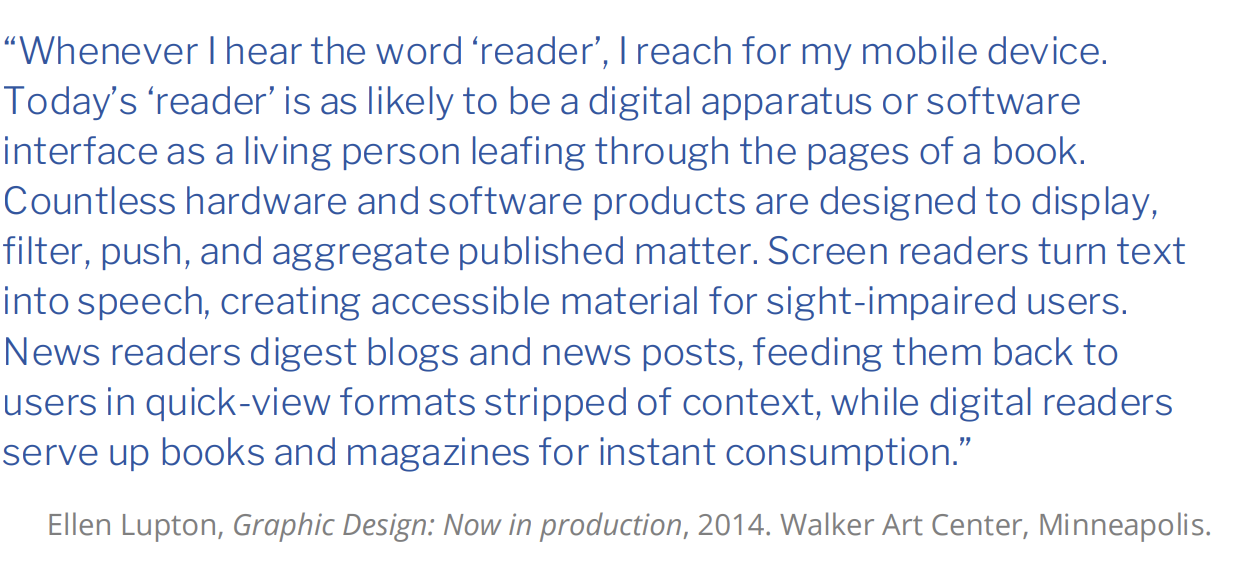
Given the current development of the book from printed to digital technologies,
what do you see as the future of the book, for readers, and book designers?
Where do you see the book heading? Show and tell. Try and summarise your
thinking into a series of short statements, quotations, images (collage) or ideas.
Be creative in how you approach this. Use your learning log to reflect on the
essay and your own thoughts and visual ideas about the future of book design.
This research will feed into part of your first assignment.
Researches
This task turned out to be quite complex in my understanding, as the requirement was to get familiarise on the article first, create my own views on the described topic, and later express my visions on the collage or design. To get started, I decided to reviewing Chapter 7: The Future of the Book from David Finkelstein and Alistair McCleery’s An Introduction to Book History (2005). This book contained from a lot of arguments, facts, figures and assumptions. First of all I decided to put some assumptions into my sketchbook, which helped me to highlight the main statements from this article. In the result I was able to summarise what requires attention in this article, what are the positions of publishing companies in the modern world, what changes have been taking place over the years and how the popularity of the printing business has changed. My mind map entries are presented below.
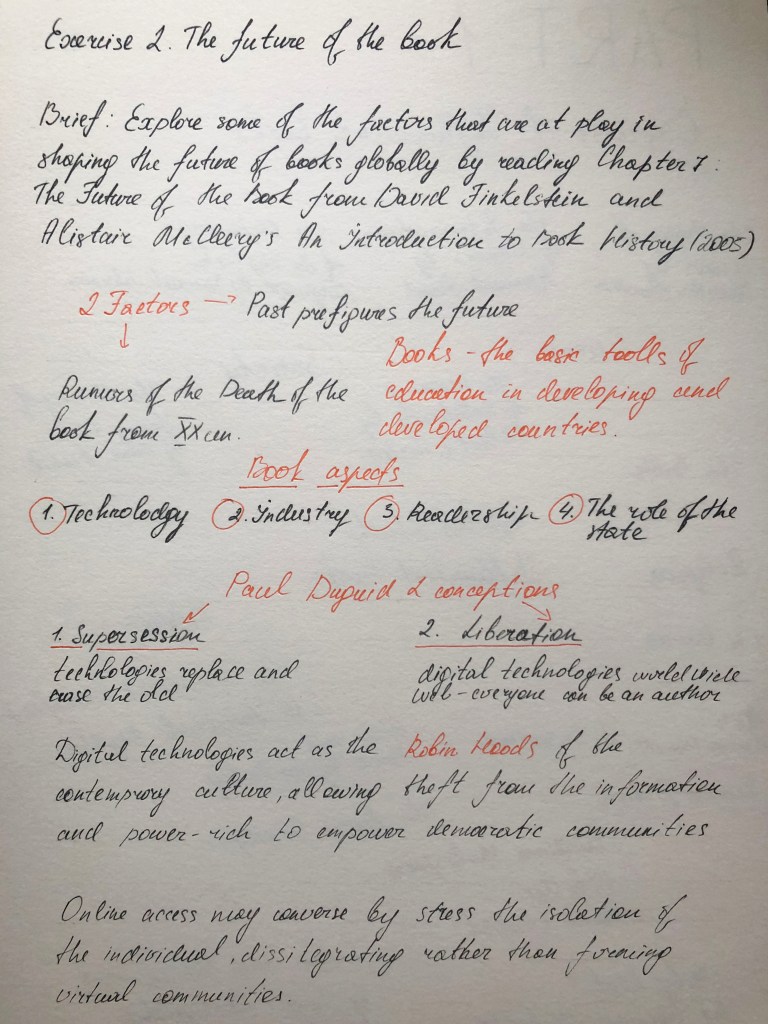
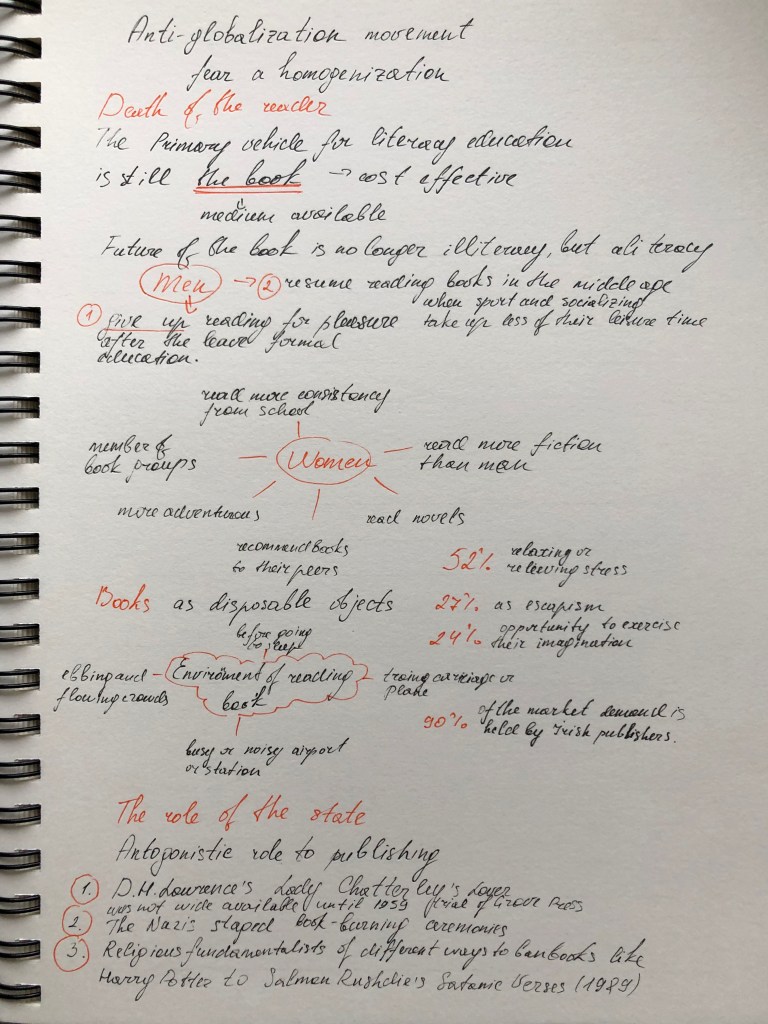
This article did not study the specific future that awaits books printing, but to some extent the factors influencing the formation of this future. The author believes that books will coexist with modern technologies, and will also play a role in storing information in the future. For the sake of fairness, it is worth noting the conclusion that, books are heading to the position of reading for leisure, because now there is no such need to go to the library to get this or that scientific information, electronic libraries have come to replace them. And these consumers of printed information are becoming less and less popular, this is what is called the term globalization. If we turn to the craft of writing books, then we can understand that all history, and the data that are available to us about the past of mankind, have been preserved on the pages of ancient books, papyrus and clay tablets. Now, when there are protests for deforestation, environmental problems, the paper industry, more and more people are leaning towards electronic devices.
From papyrus to pixels
From the article I read there was a clear statement that the web has transformed the publishing and delivery of knowledge and ideas and a book is now much more than papyrus or paper.
Books now come in many digital and analog formats.
- eBooks
- PDF Books
- Kindle books
- Hardcover books
- Paperback books
- Interactive books
- iPad books
- iPhone books
- Tablet books
- Nook books
I love the convenience of the Kindle but I find it inconvenient to not know exactly where I am up to or how far it is to the end of the book. I also miss the the texture of the paper that a Kindle cannot provide me. But at the same time if I want to read something at the present moment, I can have it ‘now’ and I don’t have to wait for the delivery or look for this book in the bookstores, I just can download it within a minutes online, and enjoy reading straight away.
I do not argue that there are aesthetes or book lovers, but mostly if I see some kind of reviews about books, or if my friends recommend reading this or that novel, these are people whose profession is associated with copywriting.
First storages of information
In my researches, I would like to review related to the development of the writing in the book Sapiens. A Brief History of Humankind. Noah Harari, particularly on the ancient storaging system of information. My goal is to create a parallel between the ancient system of keeping records, their practicality compared to the modern book.
Signature: Kushim
A clay tablet with a business record from the city of Uruk. The word “Kushim” can mean both the position of the official who accepts this tax and a personal name. If this is his name, then Kushim is the first person whose name has survived in history! It is characteristic that the first recorded name in history did not belong to a prophet, poet or conqueror, but an accountant.
Here the author mentioned a data processing system invented by an unknown Sumerian called “writing”. It took scientists a long time to understand the essence of this message. At this early stage, the writing was limited to numbers and facts. The great Sumerian novel, if it was ever composed, never made it to the clay tablets. The writing process itself was time-consuming, the readership was extremely small, so no one saw any point in wasting efforts on any other writing other than the much-needed bookkeeping. Perhaps our modern books in a few thousand years will seem just as impractical a way of storing information, something that will be perceived only as a valuable relic of the author’s communication with society.

© The Schøyen Collection, Oslo and London, MS 1717. http://www.schoyencollection.com
Excerpt From: Sapiens. A Brief History of Humankind. Noah Harari. Apple Books. (Accessed 01/12/2020).
Another example is the Andean writing, which differs in many respects from the Sumerian – so much so that not everyone dares to call it writing. First of all, these were not the signs usually used on clay tablets or other material: the Indians saved information using the kipu, a nodular writing system. A kipu is a bundle of coloured laces spun from wool or cotton. On each lace, knots were made in certain places, and one kipu, thus, could contain hundreds of laces and thousands of knots. The almost inexhaustible variety of combinations of types of knots, distances between them and the colour of laces made it possible to store large amounts of numerical data concerning, for example, taxes or property. After a long Spanish occupation, very little kipu survived, and now they can no longer be deciphered – the ancient art of reading kipu has been lost. Another example of the development of civilisation, probably when first Indinans invented these kipu system they didn’t know that that is not convinient or practival enough to be wildly used in the future.

© The Schøyen Collection, Oslo and London, MS 718. http://www.schoyencollection.com
Excerpt From: Sapiens. A Brief History of Humankind. Noah Harari. Apple Books. (Accessed 01/12/2020).
Researches Conclusion
I would like to sum up that he fact that the inventions of mankind, which were popular and in demand for thousands of years, eventually became impractical and lost their former significance. I know that it could probably be quite extreme comparison, as I still have to analyse what is the future of the book, I need to ask myself a question, how far that future is. If we speak about hundred years ahead, I don’t think there will be completely vanishment of book publicity, but if we speak about more distant future, I believe that books could be more a part of museum property, something that people used to have hundreds of years ago, and instead of paper books society will have only electronic or hologram version for reading the information.
In conclusion of my researches I would like to say that if compare a classic book edition with supposing an electronic version of a book in the distant future, books will be just a part of the humans history. For example book could be displayed in the form of a hologram in front of the readers eyes, or be just a flat electronic version with its own access to the global libraries and storages. I am leading to the fact that what seems convenient and indispensable now, in thousands of years, may seem just a heritage of the past because every invention needs progress. I would like to note that, in my opinion, books hold a strong position as an invention of mankind, but recently we see about the transformation of the book into an electronic version that takes up less space, is cheaper and more practical, so I think it won’t stop the developing and transforming.
Books themselves, however, likely won’t disappear entirely, at least not anytime soon. And there still will be some work for designers and publishing companies to do. For example, publishers looking for the new topics all the time to attract the readers. So the psychology book, or book how to respect yourself and become successful in 21 century will be more popular than book written by classical novel writer in the past century. Books meant not to be read but to be looked at – art catalogues or coffee table collections – will likely remain in print form for longer as well. I think, that print will exist, but it will be in a different realm and will appeal to a very limited audience, like poetry does today.
Design
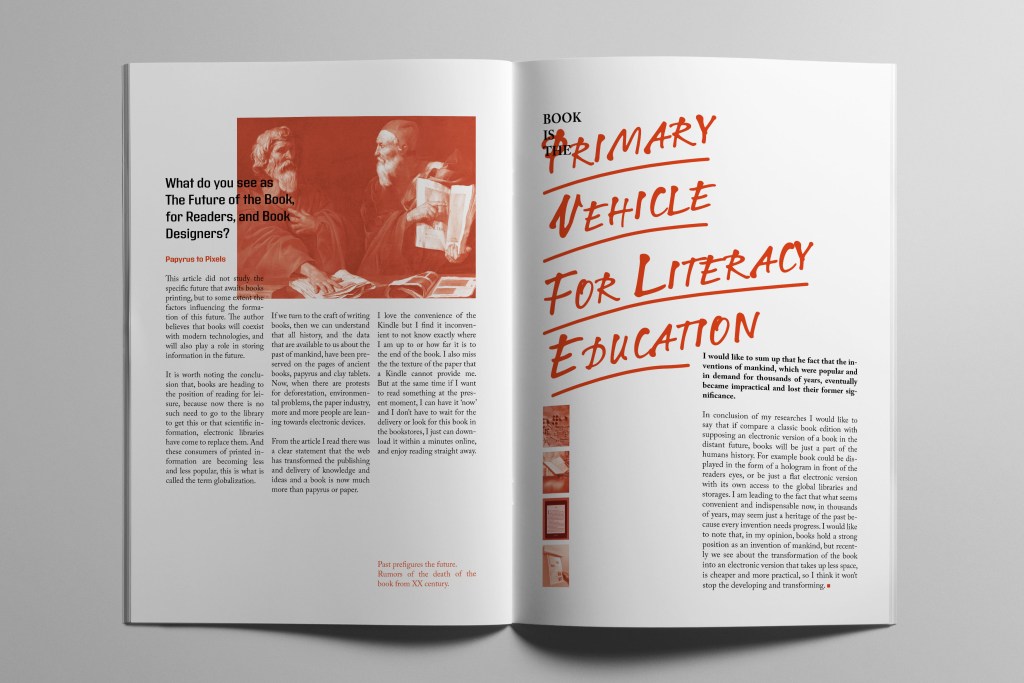
After I analysed the possible options for the future of the book and printed publications, I moved on to the design of the article. To begin with, I created a document in the Adobe Indesign program in A4 format and a spread. I wanted to create a collage of an article with my essay. I placed information around like for a magazine layout. The first option using yellow did not make much progress for me, so I decided to try a new option using large slogans around it, with a red colour palette. I divided the pages of the document on the left side into three columns, and the right side into 2. I wanted to create more air in this article, so I placed the text itself not on the entire page, but leaving a lot of free space at the bottom.
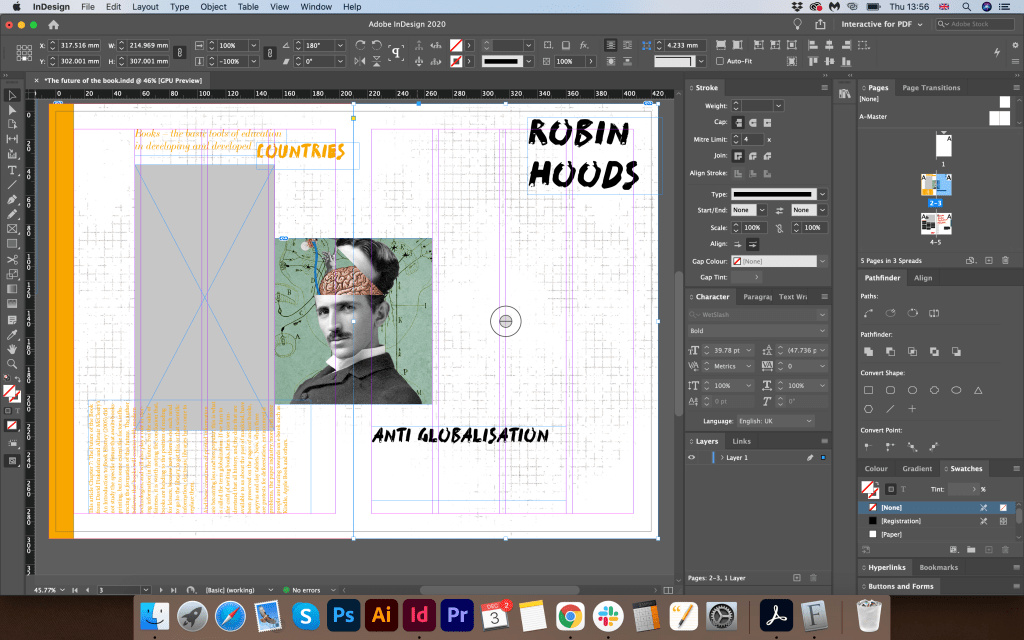
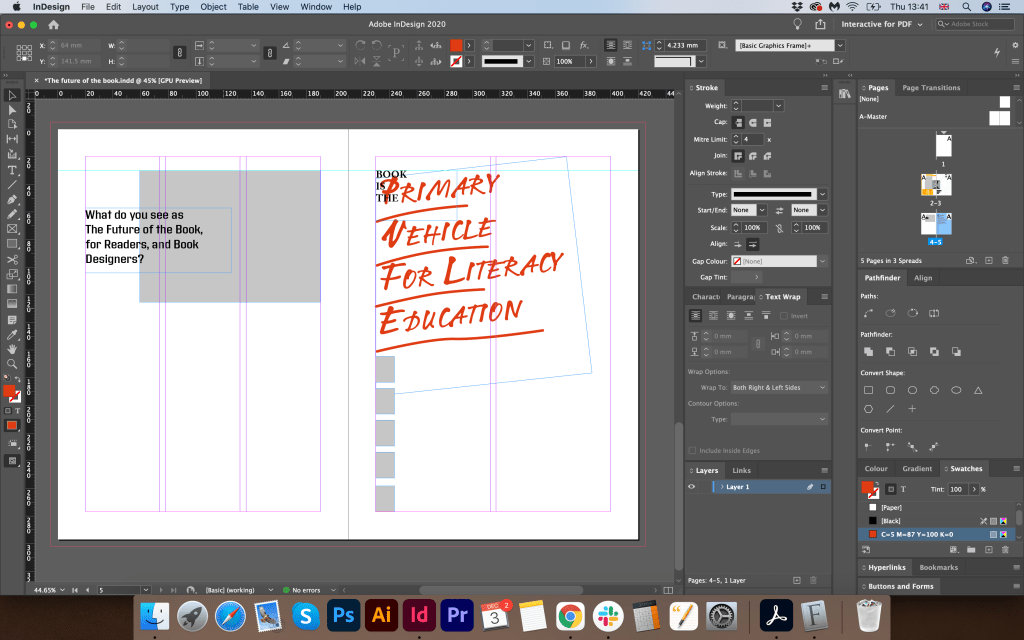
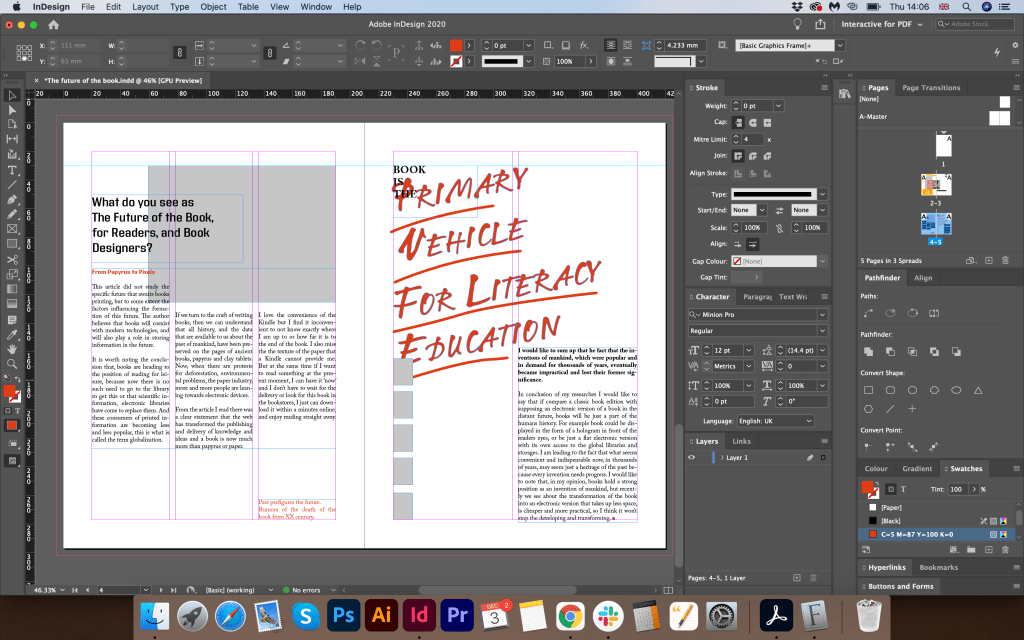
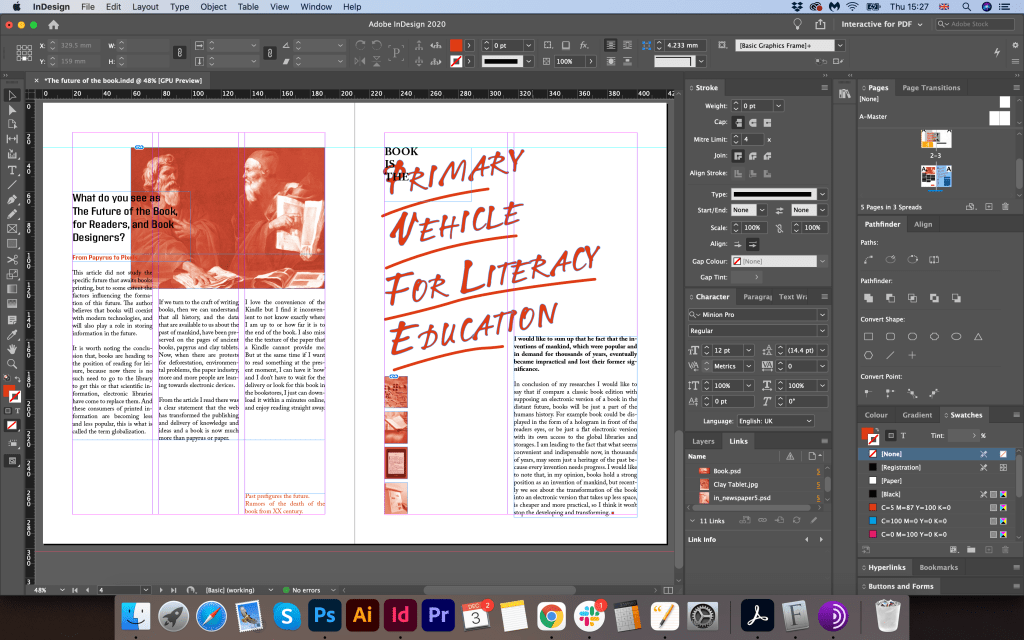
For the main image, I chose The Philosophers painting by Master of the Judgment of Solomon (fl. 1620-25). I put a red filter on top of all the images. In the result, I got a harmonious combination with the big slogan that I placed on the right side of the layout. For the slogan, I chose the phrase Book is the primary vehicle for literacy education from Chapter 7: The Future of the Book. I chose the typeface similar to handwritten LTNotec as if in a hurry, combined with the serif font Adobe Caslon Pro. I wanted to show an example of a modern layout, with the stages of development of mankind and books. So I created a grid of rectangles with a red filter on top, and inside I have images of a clay tablet, a book, an e-book, and an example of a print edition in the future.
In this collage, I wanted to capture the phased development of the book, as a source of information conservation, where it all began and how we came to the electronic book, today the most modern representation of storing printed information. Nevertheless, printed editions are still preserved in our time. Of course, there are significantly fewer of them, but they are still in demand among lovers of literature.
Conclusion
As a result, I would like to say that I enjoyed this exercise, in it, I was able to carry out my arguments and thoughts in combination with scientific publications about the theory of book development, and what the future holds for it. I think that in my article design I was able to summarise my researches. Also, the article colour scheme and composition identifies the modern view of book publishing. I liked the look at book publishing on a global scale, as a source of information, and which contains everything that happened in civilisation, various historical thoughts collected in the world library. I believe that the book will coexist with modern technologies for many years and will be in demand as one of the most important inventions of mankind.
Sources:
https://www.bbc.com/future/article/20160124-are-paper-books-really-disappearing
http://freakfonts.com/fonts/linotype-notec.html
https://www.economist.com/essay/2014/10/11/from-papyrus-to-pixels
https://ao.com/product/b07747fr44-amazon-kindle-tablet-black-68065-252.aspx
http://technologyfox.blogspot.com/2012/10/newspaper-of-future-2017.html
 Eleonora's Art Blog